Do the British (still) care about phone hacking?

The Leveson Inquiry into the “culture, practice, and ethics of the press” and motivated by the phone-hacking scandal that has rocked the UK media world in general and News International in particular is now well under way.

A large number of important people in and around the UK media industry clearly, and rightly, care deeply about the phone hacking scandal, what it tells us about (parts of) the news media, and what the fall-out will be/what the ramifications and consequences should be.

But does the British public care about the whole thing? Yes and no.

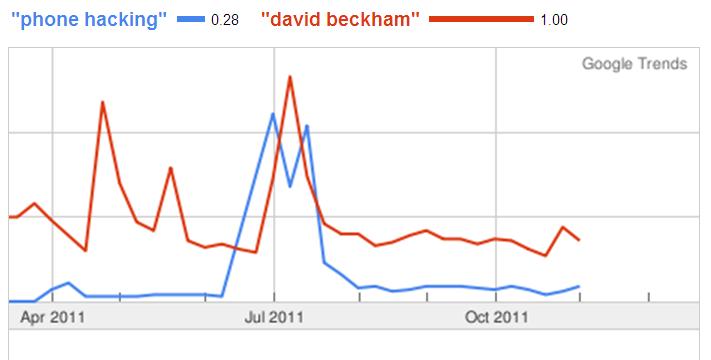
First the “no”—back in July, I used Google Trends to map searches for “phone hacking” versus “David Beckham” (my random choice of baseline celebrity). The data suggested a relatively high level of interest peaking in July around the Guardian’s revelation that News of the World had hacked the missing and murdered girl Milly Dowler’s voice mail. Now, in November, despite the riveting and ongoing unraveling of ever more instances of questionable, often immoral, and sometimes illegal, behavior, the same crude metric suggests interest in phone hacking has faded–as shown below.

Does this mean the whole thing will go away? That we will be back to business as usual in no time? Hopefully not—many people are working hard to make sure that this opportunity to improve the standards of the British media is seized.

Doing so should not be about politicians getting back at the press, hemming it in with needless regulation, or about prudish disdain for the tabloid press. It should be about strengthening the press itself. It should be about establishing a framework that will help British journalism regain the confidence of the British people.

Addressing this crisis of confidence is in the interest of those in the media themselves—and it leads me to the “yes” to the question of whether the British public cares about the phone hacking scandal. Most people do not seem to follow the twists and turns of the case, online or on other media. But many seem to have reacted in a more basic way to the revelations—which more and more evidence suggests has had direct consequences for people’s trust in the media. For a long time, people in the UK have had comparatively low levels of trust in the press, relative to other European countries (see for example Eurobarometer survey evidence–see page 83 of this rather large PDF file). This has only grown worse this year, according to YouGov.

Overtly cumbersome, intrusive, or cumbersome regulation of the media is one threat to the freedom of the press and its ability to serve democracy. But a precondition for this same press to make much of a contribution to the rambunctious running of popular government is that the population has at least some confidence in journalists and their work.

That confidence is low in the UK, the phone hacking scandal has further undermined it, and journalists and media people need win it back—or they will risk commercial ruin and democratic irrelevance. Some form of credible regulation (self or otherwise) and enforceable codes of professional conduct may be a necessary part of that. Oh, and then it also helps to abstain from flaunting the laws of the land in the pursuit of private profit…

The best media in the world?

Together with my near-namesake, Rasmus Helles, I’ve written an op-ed in Berlingske on media trends and media policy in Denmark, arguing we need to support not only content production and diverse provision, but also broad reach in the population if we are to continue to have some of the best media in the world.

Uanset om du læser denne kronik i avisen, på nettet, eller fordi nogen har delt den med dig via Facebook, så tilhører du sandsynligvis den mest overforkælede mediemålgruppe i verdenshistorien. Selv om avisoplagene falder, TV- og radiokanalerne presses af konkurrencen om vores opmærksomhed, redaktionelle satsninger på internettet har svært ved at løbe rundt, og internationale giganter som Google sluger store dele af annoncemarkedet, så har de veluddannede, velhavende byboere over 30 stadig flere medieprodukter at vælge imellem. Men medierne producerer ikke kun indhold til os som individuelle forbrugere. De spiller også en bred demokratisk rolle, der vedrører os alle som medborgere – og selv om Danmark stadig har nogle af verdens bedste medier, er den rolle i dag truet.

The whole thing is here.

The Absence of Americanization?

When Europeans concerned with developments in the media talk about “Americanization”–as Lord Puttnam in this old story from the Guardian–they are usually lamenting some development or other.

Tomorrow, I’ll be presenting a paper at the Future of Journalism conference in Cardiff arguing that, when it comes to market structures and media regulation (rather than, say, professional norms or forms and formats of content), these fears are overblown, and that we have, in fact, not seen convergence on an American-style media model over the last ten years.This is not to suggest that there is nothing to worry about, only that the notion (or rhetorical trope) of “Americanization” is of little use in terms of understanding our predicament.

The abstract is below–comments and feedback welcome, this is work in progress.

The Absence of Americanisation—media systems development in six developed democracies, 2000-2009

By Rasmus Kleis Nielsen (University of Oxford)

“Americanisation” is one of the most frequently used and mis-used terms in discussions of international media developments, a supposed trend much feared by Europeans who are (sometimes justifiably) proud of the distinct qualities of their media systems. In this paper, I present a comparative institutional analysis drawing on media and communications studies (Hallin/Mancini 2004), political science (Hall/Soskice 2001) and sociology (Campbell/Pedersen 2001) and based on data on developments in media markets, media use, and media regulation in six developed democracies (the US, the UK, France, Italy, Germany, and Finland) from 2000 to 2009. I argue that, despite frequent predictions of progressive “system convergence” (Humphreys 1996; Hallin/Mancini 2004; Hardy 2008), the last decade has been characterized by an “absence of Americanisation” of the news institutions in the five European countries considered. National institutional differences have remained persistent in a time of otherwise profound change. This finding is of considerable importance for understanding journalism and its role in democracy, since a growing body of research suggests that “liberal” (market-dominated) media systems like the American one increase the information gap between the advantaged and the disadvantaged, have lower electoral turnout, and may lead large parts of the population to tune out of public life. The finding also has theoretical implications, since the supposed drivers of system convergence—commercialisation and technological innovation—have played a very prominent role during the period studied, suggesting we need to rethink the role of economic and technological factors (and their interplay with other variables) in media system developments.

Internet and politics research, what next?

Just back from the European Consortium for Political Research conference in Reykjavik, where the internet and politics standing group, through the good offices of Anastasia Kavada and Andrea Calderaro, offered a string of interesting papers and generated good discussions. The incredibly industrious Axel Bruns live-blogged many of the presentations here.

Looking at the good quality of work on theorizing “connective action”, new forms of political communication mixing “old” and “new” media, and ten-year attempts to map out closely the changing (and variable) impact of new media use on various forms of political participation, it is clear we’ve come a long way in our understanding of the connections between internet and politics.

Some areas that I, on the basis of what I saw at this conference and what I’ve seen at others over the summer (IAMCR, ICA), think would merit more attention from researchers in the future are then—

  • The use of new ICTs by political actors beyond electoral parties and social movements—a bit of work has been done on various forms of interest groups, but this is a wide open field, and one that deserves much more scrutiny than it has received so far (my friend Dave Karpf has a book forthcoming on this, focused on the U.S., comparative work would make a great supplement to it).
  • The implications that new ICTs have for political practice and participation outside of electoral campaigns and social movement mobilization—we have a growing body of solid, cross-country work on campaigns etc, but less work has been done on how candidates, citizens, and organizes use internet tools in “peacetime”, so to speak.
  •  The ICTs themselves—there is a bit of a tendency to (and my own paper, co-authored with Cristian Vaccari, is an example of this) to focus on publicly manifest tools like campaign websites, social media, and perhaps email communications. This is important. But there is a whole other side to be examined, which is the story of the adoption of tools, of development, innovation, of trials and errors as political actors try to leverage the potential of tools that have to be mastered in practice and aren’t necessarily “just there” but have to be furnished first. (As it happens, another friend, Daniel Kreiss, has a book forthcoming on this—again, comparative work would be a great complement to his work on the Democratic Party in the U.S.)

Supporting the past, ignoring the future? Public sector support for the media

Though Western media systems are going through a rapid and often painful transformation today with the rise of the internet and mobile platforms, the decline of paid print newspaper circulation, and the erosion of the largest free-to-air broadcast audiences, the ways in which governments provide direct and indirect support for the media have remained largely unchanged for decades.

The bulk of the often quite considerable direct and indirect subsidies provided continue to go to industry incumbents coming out of broadcast and print, while innovative efforts and new entrants primarily based on new media receive little or no support. In central ways, public support for the media remains stuck in the twentieth century, and some parts of these support systems are in need of real reform to be brought into the twenty-first we live in.

That is the thrust of a report called ‘Public Support for the Media’ that I’ve written with help from Geert Linnebank, former Editor-in-Chief of Reuters. In it, we review the various forms of subsidy in place in Finland, France, Germany, Italy, the United Kingdom, and the United States.

In all these countries, the main forms of support relevant today have been put in place in the 1970s and in many cases long before. None of these countries have carried out major reforms of their subsidy systems to take into account the changes the media industry has undergone over the last twenty years. The bulk of the public support provided continues to go—

  • First, especially in Europe, directly to public service broadcasters with varying commitments to the online and mobile services people increasingly desire, and
  • Secondly, in all the countries covered including the United States, indirectly through various forms of tax relief to paid printed newspapers that remain of central importance in terms of generating original general interest news content on a regular basis, but are suffering from declining readership and stagnant revenues.

It is well-known that most European countries remain committed to public service broadcasting, but it is less well known that private sector print publishers in most countries benefit from very substantial forms of indirect support. The British press, for example, benefits from VAT relief worth an estimated £594 million (€748 million) every year.

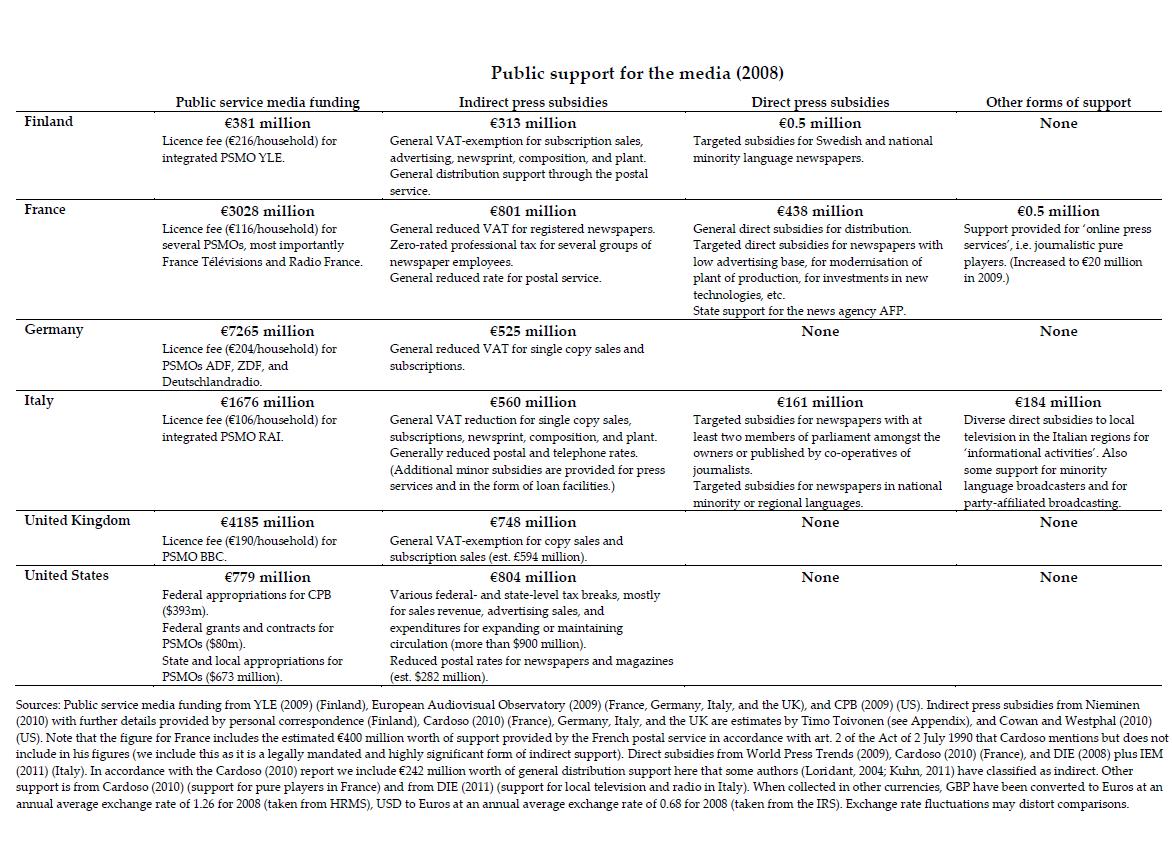
The large table below (click to enlarge) provides an overview over the main forms of support in place in the six countries, and their estimated total value. As is clear, the sums involved are considerable, even if they pale by comparison to how much revenue some parts of the industry has lost in recent years (US newspapers have seen their total revenue decline by more than $20 billion since 2000).
A lot of money thus goes to supporting broadcast and print media in various ways, media that continue to be important for how people keep informed about public affairs, but also media that are increasingly being supplemented by online and mobile media of various sorts. Despite the well known and rapid spread of internet access and increasingly smart mobile phones, today, of all the six countries covered in the report, only France offers any meaningful support aimed directly at online media—and that to the tune of about €20 million a year after reforms in 2009, less than 0.5% of all the support provided. (The ‘Other support’ available in Italy goes to private sector broadcasting.)

Our aim with the report has been to collect in one place information on various forms of public sector intervention meant to encourage and foster vibrant and diverse media systems. Rather than discuss each kind of policy—broadcast, press, online, etc—separately and on its own terms, we have wanted to provide a more general overview over forms of intervention in increasingly convergent media markets and help shed some light on an otherwise all too opaque policy area attracting increased interest as some commercial media companies continue to struggle and newsrooms in many countries are cut. In several countries, detailed reports on the national support systems have been published in recent years (see for example this one from the US, this one from France, or this one from Finland), but we are not aware of any comparative overviews bringing together different forms of media support the way we have done.

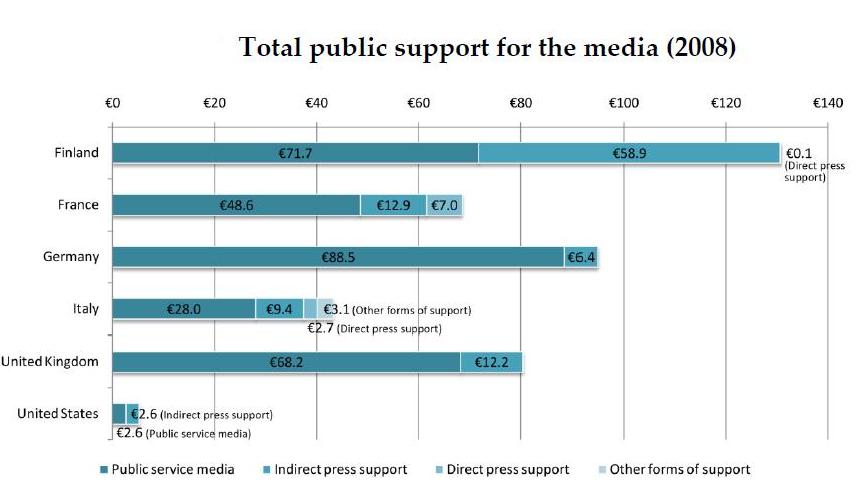
This kind of cross-country comparison can help identify overlaps—like the absence of change and the bias in favor of legacy media common to all the countries considered here—but also map out differences. Different developed democracies support the media to different degrees and in different ways—of the countries we looked at, Finland, Germany, and the United Kingdom offer the most support in per capita terms, based on robust public service funding and VAT relief for historically strong newspaper industries. France and Italy has more extensive support systems in place, but their total value is actually lower in per capita terms partially because of their lower license fees, partially because tax relief is worth less for their much smaller press. The US is the clear outlier amongst developed democraces, with minimal public support, mainly for public service broadcasting (through federal and state appropriations) and for print publishers (through various forms of tax relief).

The figure below breaks down the absolute sums in terms of support per capita to make them more directly comparable than absolute figures (listing 5.5m population Finland and 300+m population US side-by-side may invite misunderstandings).
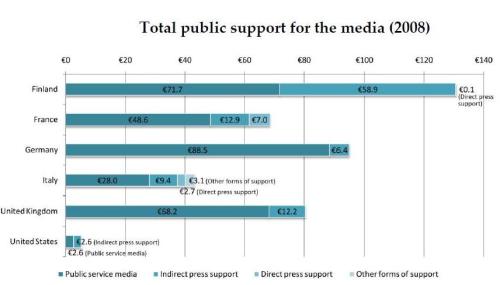
As is clear, there are important variations in how these six different countries support the media. But in all of them, direct and indirect subsidies runs to billions of Euros per year and overwhelmingly go to legacy media organizations coming out of broadcasting and print, while new media initiatives—whether pursued by these or by new entrants and entrepreneurs—get basically no support.

As our media systems change and people’s media use switches towards new media platforms, the effectiveness of the inherited forms of intervention will decline. Especially indirect support for the press—support still considered “essential” by industry associations—is and has been far more significant than most people realise. But support systems built around legacy platforms of relatively diminishing importance will lose their effectiveness as current trends in the advertising business and in people’s media habit continues. As newspaper circulation and revenues from print sales and advertising thus decline, the value of the indirect subsidies meant to help the industry thrive will diminish—and they do nothing to help it address the more fundamental challenge of structural adjustment that it faces.

Those who favour a renewed commitment to public support for the media will therefore have to rethink the role of public policy, of public service media organizations, and reconsider how governments can support those private sector media companies that provide public goods like the kinds of accessible accountability journalism and diverse public debate that democracies benefit from. Media scholars have long called for such reform, and yet little has been done to bring our twentieth century media policies into the twenty-first century. The basis for indirect support for the press in the United Kingdom, for example, continues to be the definition of a newspaper as publications that “consist of several large sheets folded rather than bound together, and contain information about current events of local, national or international interest.”

Whether one wants public support for the media or not is a political question (and one all developed democracies have answered in the affirmative in the twentieth century), but as people’s media habits and the economics of the industry change, effective intervention probably ought to be built around the “information” part of the sentence quoted above rather than the “several large sheets” part (just as “public service broadcasters” have in many countries sought to redefine themselves as “public service media organizations” to emphasize their cross-platform ambitions).

It will not be easy to develop new forms of public support for the media. New policies intervening in a sensitive area crucial for the functioning of our democracies will have to command wide political support, navigate industry and professional concerns, and at the same time try to meet the multiple ideals of being platform neutral (not biased in favour of any one distribution system), of being viewpoint neutral (not affording politicians or others too many opportunities to meddle), of being targeted enough to make a difference (one can’t support everything), of being governable and transparent (so that recipients can be held accountable in the public interest), of not distorting competition unnecessarily, and of being able to pass muster under various anti state-aid provisions in for example the European Union.

Developing new policies in this area is not a question of simply shouting “out with the old, in with the new” and switching support wholesale to new media—most news, for examples, is still accessed via linear broadcast and print newspapers, even though other platforms are of growing importance. Reform is a more difficult issue of deciding what it is one wants to support—what kind of public interests public support should serve, what kinds of public goods one wants delivered—and developing forms of direct and indirect support that effectively encourage that without too many malign side effects.

Developing such policies will be hard, difficult work, and call for renewed intellectual and political leadership—but it is also much needed work. Reform is necessary if we want to move beyond supporting our media past while ignoring the future.

Note: We decided to look at these six countries because they represent distinct approaches to media policy and have different media market structures. (For more on this, see for example the chapters on each (bar Italy) in the book I edited with David Levy last year). I should add that our review is not completely comprehensive in that we leave out public notice laws, regulatory relief in competition and labour law, and many other potentially important but smaller forms of support for certain media, and that it is not absolutely up to data as the last year on which the necessary information was available on all six countries was 2008. We have focused on support for the main kinds of content-producing media companies with at least a partial interest in news journalism, and thus left out both telecommunications and support for, for example, movie production and various kinds of art and culture.

Cross-posted on politicsinspires

Impressions of Indian Newspaper Journalism

I’m no expert on Indian newspaper journalism, but for the last two weeks, I’ve been an avid reader of the country’s English language press and have thoroughly enjoyed my fleeting encounters with the Times of India, the Hindu, the Deccan Chronicle, the New Indian Express and several other titles.

There are plenty of things to worry about when it comes to the status of newspaper journalism in India, even as the industry in contrast to its peers in many Western countries is enjoying rapid growth in circulation and revenues—problems include the proliferation of paid coverage not only of commercial ventures and in reviews, but also in politics (“no money, no news”), various fights between the editorial and the commercial side, plus the frequent harassment of journalists by local authorities, political activists, criminals, and sometimes the military or the police.

But boy can they write, and can they write about politics in particular—riveting accounts means that even now, after my return from travels in South India, I find myself frequenting their websites—trawling for news about Prime Minister Singh’s possible involvement in the 2G scam, following the twists and turns of the fall of Chief Minister B. S. Yeddyurappa in Karnataka after a judicial inquiry connected him directly with widespread illegal mining in the state, reading about how Ms. Jayalalithaa’s newly elected AIADMK government in Tamil Nadu is cracking down on their defeated DKM predecessors on numerous charges of land grabs, corruption, and the like.

All this is so interesting partially because the substance matter is so serious, so clearly worth ones’ time. (On my return I found by contrast that the London Times had seen fit to write an editorial about Prime Minister Cameron’s decision to, while on holiday, wear black shoes without socks. The Times editorial writer thought one should always wear socks when wearing shoes, though conceded that one could be forgiven for wearing flips flops or even loafers without socks. Riveting stuff, really.) The 2G scam, for example, is estimated is estimated by some to have cost the Indian state almost $40 billion in lost revenue.

This kind of stuff matters, and even without independent investigative work, simply reporting the work of judicial investigators, non-profits and others looking into this, and how elected officials talk about it is important and commands attention. Even as a complete outsider, on many days, I’d find as much of interest in the daily edition of a 24-page newspaper sold for 3 or 4 Rupees (about 5 pence) as I usually do in the UK in daily newspapers often approaching a hundred pages all included and sold for a pound.

The journalists and editors who write all this surely face many challenges as their industry and profession develops alongside so many other changes in India—let me just say I enjoyed my brief brush with their work and wish them and all their colleagues working in broadcasting, online, as well as in Hindi and numerous other vernacular languages well.

How much do the Brits care about the phone hacking scandal?

How much do the Brits care about the phone hacking scandal? Not the Brits at the Guardian, or the Brits at the BBC, or for that matter the various Brits who are quoted in news media all over the world by journalists enthralled by the biggest media scandal in years.

No—how much does the broader British population care about the phone hacking scandal?

At the moment, they seem to care rather a lot—if you go by Google Trends’ mapping of search terms; they care about “phone hacking” as much as they do about “David Beckham”, my random choice of a baseline celebrity.

That popular interest lends extra importance and extra impetus to the current debate over the whole News of the World/News International/News Corporation phone hacking scandal. Right now, it is not simply the chattering classes, the Westminster crowd, and people in London newsrooms who care about this—it is a much wider audience, an audience of people who will (because they have lives to live) rarely pause for as much as a moment to consider journalistic ethics, media reform, or the relations between politicians and the press.

As long as that audience is there—and I’m not sure that will last long—the scandal may represent not only enormous damage done to the image of the Murdoch family, their closest associates and the corporate empire they have built, the British politicians who have too often seemed subservient to them, and the police officers who have turned out to be paid by them.

It also represents a real opportunity to reform media regulation and professional practice in the United Kingdom on the basis of something more than the usual suspects arguing things out amongst themselves and thus perhaps begin to address the real crisis of confidence that exist between the British population and institutions ranging from parties to the press.

As long as the audience interest is there, it is not simply the case that a majority of those who pollsters can induce into opining think News Corporation has handled the situation badly, that Prime Minister David Cameron has handled the situation badly, and that the police has handled the situation badly—but in fact very large numbers of people who would normally not have much of an opinion at all on such matters. And as long as they are paying attention, there is thus, perhaps, a slim chance of doing things right and regaining some of their trust.

Good read – 07 18 11

Everything everywhere seems to be about News Corporation and its assorted scandals-important, though I find myself wondering if audiences outside of Britain care nearly as much about this as editors, journalists, and media commentators around the world do.

This good read is in a different realm and one I just wanted to highlight as all the attention is elsewhere–It’s Alan D. Mutter again, who puts it straight in this great blog post (see especially his figure at the end, the rapid contraction of the print classified market represents about $15 billion out of the $21 billion newspaper revenues have declined by in the US from 2000 to 2010)–Newspapers remain, first and foremost, well, papers.

“Fifteen years after the commercial debut of the Internet, publishers on average still depend on print advertising and circulation for 90% of their revenues. Stop the presses and newspaper companies are out of business. It’s just that simple.”

Arianna Huffington opens “Huffington Post of X”

One constant theme of contemporary conversations around journalistic online start-ups is the oft-expressed desire to start something that will be “a bit like the Huffington Post of X”—X here being some other country than the US. Apparently, Arianna Huffington and/or her AOL bosses share this ambition, as they have announced launches in Brazil, France, and the United Kingdom (in addition to the Canadian version launched in May).

Just looking quickly at the UK media market, the one of the three I am most familiar with, I’d second many of Kevin Anderson’s observations, and suggest Huffington/AOL faces several challenges as they try to expand—

  1. They are entering a smaller and more competitive market (Kate Burns aside) than the one they entered in the US in 2005, with a more diverse media system, including ideologically diverse nationally-read newspapers with a strong online presence and of course the giant that is the BBC.
  2. They do not have the early mover advantage that they had in the US. It is, to put it bluntly, not 2005 anymore, and many sites have moved a long way since in terms of harnessing people’s desire to participate and express themselves (either because of the intrinsic rewards or because they are spokespeople of various sorts) and to be engaged.
  3. They are no longer the Huffington Post of 2005, the exciting start-up, the cool new thing everyone (might) want to be part of. They are part of AOL, and the same issues over compensation or lack thereof that are dogging the site in the US will follow the model as it is transposed to other countries (especially since some of them have, you know, unions and stuff).

Does the UK need a HuffPo site? Personally I’m not sure it adds much that is critically undersupplied here, but it is an open party, and a free-for-all when it comes to competing for audience attention and advertising revenues. If Huffington makes any substantial contributions to the media systems she is about to launch in, it may be indirectly, by pushing legacy media online to compete with her in terms of participation and engagement, where there is surely still much room for improvement.

Coming with a well-known brand and much know-how accumulated over the years, the new HuffPo subsidiaries need not necessarily grow to the same size as the original to be successful—if aggregation, remix, and commentary fuelled by those who make a living professing views and those who like to profess their views (plus a bit of original content) can be assembled at a low enough cost and a large enough audience gathered by using the methods that have worked so well in the US, they could wriggle their way in here and there.

But I suppose that this is the central difference between the old (US) HuffPo and the new (national) HuffPos—the 2005 original very successfully created a niche by identifying and serving an underserved demand in the US. It looks like the 2011 franchises around the world will have to carve out their niches in a rather more crowded space.

What We Don’t Know About the Business of Digital Journalism

“The Story So Far”, an interesting new report by Bill Grueskin, Ava Seave, and Lucas Graves published by the Tow Center for Digital Journalism at the Columbia Journalism School, presents a great tour d’horizon of the business of online news in the U.S. I’d warmly recommend reading it, it is well-written and wide-ranging, and deals with a whole host of important question facing the commercial media organizations that are such important parts of most national media systems and, despite their decline in recent years, continue to fund most accountability journalism around the world.

The report’s treatment of the increasingly explicit link between the cost of reporting, the traffic it attracts, and the revenue it generates will be rather chilling reading for many journalists and editors (see chapter nine). A concrete example: I spent a couple of hours reading the report, and a couple more writing this–even if we place the result in the lowest-ranking category used by AOL for “revenue managment”, this post would still have to generate 7,000 page views to be worth commissioning for $25. Let’s just say it is a good thing I have other incentives.

The subtitle of the report is “What We Know About the Business of Digital Journalism”, with the proviso inserted in the introduction, that the study is restricted “mostly to the U.S. market.” “Entirely” would be more precise here, and that is a problem, not only for the international reader, but also for people who want to understand the situation in the U.S.

The thing is that we know an awful lot more about developments in the business of journalism, digital and analogue, in the U.S. than anywhere else, and that much of the conversation around the future of journalism remains focused on what takes place in the states—in the U.S. because this is understandably the main concern and because most of those taking part in the conversation do not seem to know much about how things are done elsewhere, in other countries, because comparative conversations are all too often limited to “us vs. the U.S.” and rarely expanded into more meaningful cross-national discussions of countries with similar size markets, market structures, and historical legacies.

This is not Grueskin, Seave, and Graves’ fault, and it takes nothing away from the valuable work they have done in researching and writing this report. But the dearth of comparative analysis is constraining both intellectual attempts to understand what is going on, and arguably also the ability of industry people and policymakers to make informed decisions about how to react to current changes in the industry. As the great comparativist Seymore Martin Lipset wrote in his book American Exceptionalism, “to know only one country is to know no country”–a point I’ve reiterated elsewhere.

In many ways, the American experience is exceptional, and one should be careful in understanding developments elsewhere through this lens. Let me give just three examples of factors rightly highlighted by Grueskin, Seave, and Graves as important in understanding the development of digital journalism in the U.S., and illustrate how things look different in much of Western Europe.

1. Sales versus advertising income

“Even before the Internet, subscription revenue didn’t amount to much for most news organizations,” the authors write. This is true in the U.S., but certainly not in much of Northern Europe, where home-delivered subscriptions have been an important, often dominant, form of newspaper use, and where the revenues generated have been very considerable. Consider the national differences illustrated by the following figure, taken from The Changing Business of Journalism and its Implications for Democracy, a book I co-edited with David Levy.

While American newspapers generated less than 20% of their revenues from sales in 2008, many European newspapers generated closer to 50%, much of this from subscriptions (in particular in Germany and the Nordic countries).

Many European newspaper readers have had a different relationship with their newspaper than their American counterparts, a relationship built on (often quite expensive) subscriptions and long-term loyalty.

More comparative research might help us understand whether this historical legacy can help them build different models as they move to online and mobile platforms, and whether it means people perceive the issue of online payments differently.

2. Newspaper competition

Grueskin, Seave, and Graves also explain why American newspaper came to be so dependent on advertisements: “The monopoly or oligopoly that most metropolitan news organizations enjoyed by the last quarter of the 20th Century meant they could charge high rates to advertisers, even if their audiences had shrunk.”

From the 1970s onwards, fewer and fewer American newspapers faced direct competition in their local markets, and national distribution was quite limited. Again, this is very different in much of Europe where national distribution is often more developed.

I live in Oxford in the United Kingdom, which is in most respects far from an ordinary place, but can serve as an illustration here: this town of about 150,000 people is served not only by the local Oxford Mail (6 days a week) and Oxford Times (weekly), plus various local advertising freesheets, but also by the whole range of nationally distributed British papers—The Sun, the Daily Mail, the Daily Mirror, The Daily Telegraph, The Daily Express, The Times, the Financial Times, the Guardian, the Independent, and the newly-launched compact title simply called the i. And no doubt several titles more that I’ve forgotten here. Most of these offer subscriptions for Oxford residents. All of them are available at newsstands.

The upshot of this is that many European media markets have historically been more competitive than their American counterparts at the national level, and the news organizations that operate in them have been more used to dealing with competition than their American counterparts. The Oxford Eagle published in Oxford, Mississippi (U.S.) does not need to worry all that much about print competition. The Oxford Mail published in Oxford, Oxfordshire (UK), has had to content with numerous other print titles for decades.

Again, more comparative research is needed to help us understand if this legacy makes any difference in how news organizations compete for audience attention and advertising revenues and how they try to stay relevant to their readers.

3. Charging for online content

I suspect the report’s chapter on paywalls will be read with particular interest, for the obvious reason that everyone in the news industry wants to know if it is indeed feasible to charge for general interest news online and on mobile platforms.

As the authors rightly point out, the track record in the U.S. (and elsewhere) is less than inspiring so far. While the Wall Street Journal and the Financial Times remain well-known exceptions, few newspapers have built significant revenue streams from online sales. The decision to make content available for free online (to market the print product and in the hope that audiences and advertising revenues would eventually grow to cover costs) is now widely seen as the “original sin” of the business of digital journalism.

While the free model certainly does seem to be dominant not only in the U.S., but also around the Western world and beyond, here too more comparative research might help us understand developments in the business of digital journalism.

To take just one example from my native region, Scandinavia—the Swedish tabloid Aftonbladet, which has the highest print circulation in the country (over 300,000 copies), has for years operated a system by which most basic breaking news is free, but where people need to sign up for a special online premium subscription to get access to long-form and unique content on the website. In 2010, the newspaper reported that 115,000 people paid about $4.5 a month for this (several more specialized and more expensive subscriptions are also offered for people interested in particular topics)–see more in English here.

If the self-reported figures are reliable, this should generate north of $6 million a year in sales revenues—not a fortune, but not trivial either. Has this drastically undermined the total audience of Aftonbladet.se, and thus its ability to be “part of the conversation” and generate online advertising revenues?

Not if one compares daily unique visitors to the second and third-most circulated Swedish newspapers, the broadsheet Dagens Nyheter (dn.se) and the tabloid Expressen (ds.se) or to the public service television broadcaster Sverige Television (svt.se), as can be seen from the above Google Trends graph—Aftonbladet is, despite having charged for premium content for years, by far the most popular news website in Sweden, a country that has a quite competitive national media market with several newspaper titles, a well-funded public service broadcaster, and several commercial television channels.

According to a press release from Schibsted (the Norwegian media conglomerate that owns 91% of Aftonbladet), the newspaper generated almost 20% of its revenues from online operations in 2010. This is in itself an impressive figure, and even more promising because a growing part of this comes from online sales.

How does Aftonbladet, which is neither particularly specialized nor particularly localized, get away with this model (which is increasingly being replicated by others, like the Danish broadsheet Berlingske)? Nobody knows for sure, but again, more comparative research beyond the exceptional case of the U.S. should help us understand what is going on.

* * *

None of this—the international variations in the historical importance of sales and subscription revenues, in how competitive newspaper markets in particular have been, and in how news organizations have tried to monetize content online—take anything away from the value of the Grueskin, Seave, and Graves report.

But it all underlines that “The Story So Far” is an American story, and that there is a lot we still don’t know about the business of digital journalism, including how the spread of new digital information and communication technologies impacts commercial news organizations with different historically inherited business models, operating in different contexts, and who have pursued different online strategies.

These are important questions, not only for the journalists and others directly impacted by the upheaval of the news industry, but for all citizens in the democracies that have developed hand-in-hand with the mass media for the better parts of a century, and thus also for social scientists who have an obligation to understand what is an ongoing and potentially profound transformation in how we govern ourselves.

Full disclosure: I graduated from the Columbia Journalism School, and Lucas Graves is a good friend.