Category Archives: digital politics

Politicians are increasingly intense use of genAI, even as the public is very pessimistic about politicians’ use of genAI

Politicians and political parties are increasingly intense users of generative AI, even as much of the public is very pessimistic about the implications for society.

To avoid further damaging already often low trust in political actors and the political process, it seems important to get to grips with this.

The growing use by political actors is on full display during the U.S. midterm elections.

This includes both disclosed and undisclosed AI-generated content, various AI-powered tools to help campaigners monitor the conversations happening in different corners of the internet to refine their media and messaging approaches, experimental tools for AI-powered voter contacts, as well as internal tools for data access, research, and organizing voter contact. Back in April, 83 percent of political professionals surveyed by the AAPC said they use AI tools, and by mid-October, the Wesleyan Media Project reported that more than $137 million had been spent on airing campaign ads using AI-generated content during the midterms. (As they note, that is almost certainly an undercount given how difficult it is to detect uses of AI.) And use is, of course, not limited to campaigning. In several countries, the Economist reports, “AI-written speeches are taking over politics”. I am sure there are already major political parties (in Europe and elsewhere too) working with ChatGPT Enterprise, Claude’s enterprise plans, or similar back-end tools. Little of this is about sophisticated deepfakes or game-changing supposedly super-powerful persuasion. Most of it looks like what is happening in many other white-collar professions too. (Last year, 40% of respondents across six countries said they thought politicians and political parties were using generative AI always or often, about the average for the 12 sectors included in the question.)

But the public does not see the use of generative AI by politicians and political parties the way they see the use of these technologies by other professions and sectors. People are much more pessimistic about use in politics.

In a recent survey, Felix M. Simon, Richard Fletcher, and I asked respondents how much better or worse they think different actors’ use of generative AI will make society. Across nine countries covered, between half and two-thirds of respondents have a view on whether generative AI use in a given sector will impact society, either for the better or for the worse. Another quarter to one-third say neither better nor worse, and the rest say they do not know. The chart below shows the net balance between the optimists – respondents who say they expect the use of generative AI will make something better – and the pessimists – those who fear it will make it worse – as a way of comparing public expectations across various sectors. (We ask a similar question about what it will mean for people’s personal life – the results are very similar.)
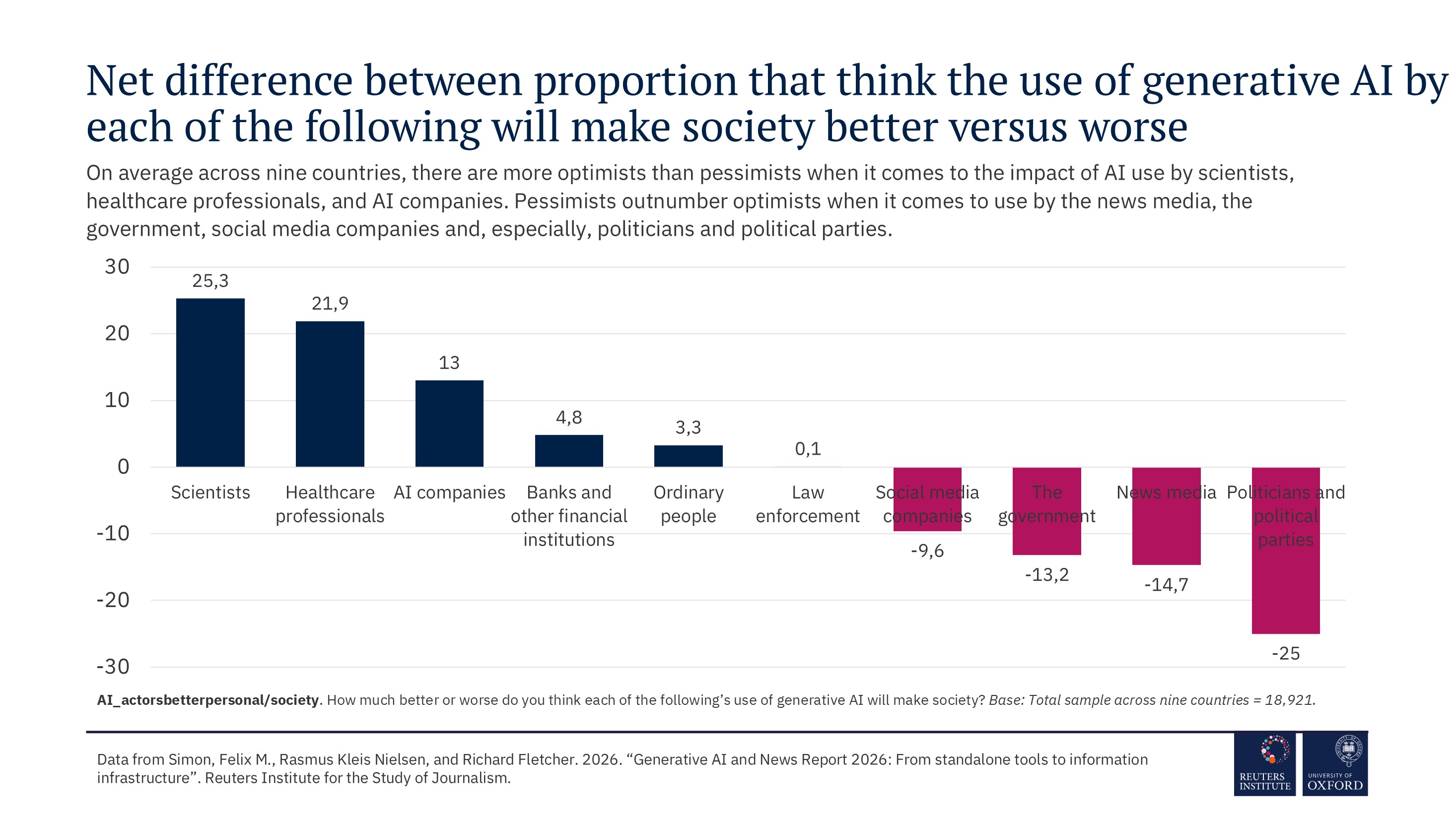
The findings clearly document that much of the public have little, if any, confidence in politicians and political parties’ use of generative AI. There are 25 percentage points more pessimists than optimists. There is pessimism around social media, the government, and news media too, yes, but no other sector comes close to political actors. At the other end of the chart, we have white collar professions including science and health care, where there are many more optimists, but it is noteworthy that the AI companies themselves and established private enterprise, here banks and other financial institutions, also face more optimism than pessimism from the public.

This is not blanket pessimism. It is pessimism about specific sectors – politicians and political parties more than any other.

One campaign professional quoted by in a field report from the Ash Center at Harvard describes the current situation when it comes to AI use in politics as ““the wild west” with few rules or norms to work off of”. That is often the case when campaigns adopt disruptive innovations, whether coming from inside politics or, as in this case, from outside.

What is striking is how pessimistic the public is about what this means for our societies, in a context where many more of them are willing to give other sectors (the AI companies included) the benefit of the doubt, and a context where trust in politicians and political parties is often already low in many countries.

To avoid already brittle (if not absent) public trust in the political process, it seems urgent for politicians and political parties to get ahead of this and explain to the public how they use generative AI (if they do), and why we should accept their use as serving not only the partisan interest of the politicians in question, but also the public interest.
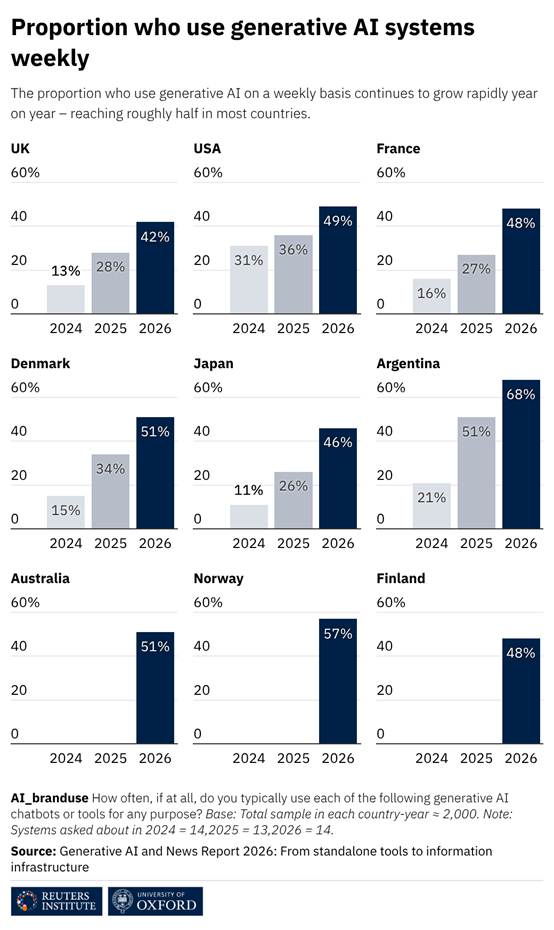
4 key charts from a new report on generative AI use

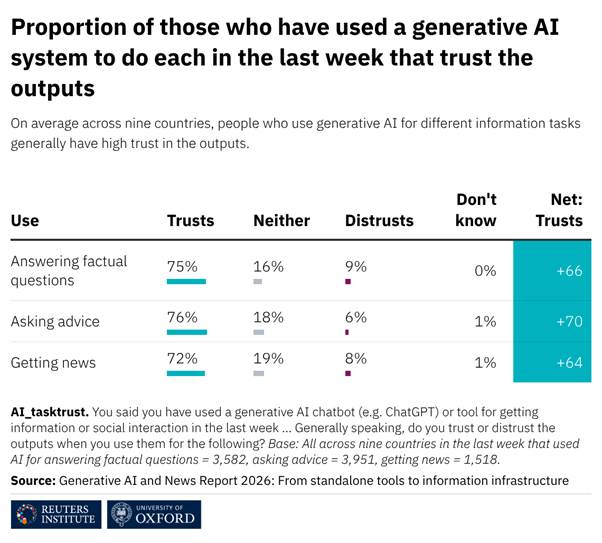
Public use of generative AI continues to grow rapidly, and while much of the public is undecided or distrusting, those who use AI systems tend to trust the tools they use and the information they provide. Despite growing use, familiarity, and considerable optimism among users, public attitudes towards the use of generative AI in news (and by politicians) are much more negative – and seem relatively settled despite much else changing.

First, weekly use continues to grow rapidly. Intentional use where people actively use generative AI systems (e.g. ChatGPT, Gemini, Copilot) has reached half the population in these high-income countries in less than four years, much faster than internet use, faster than smartphone use, and about as fast as social media use (at least going by US track record).

Second – in a context of wider public skepticism – those who use generative AI systems for informational purposes (answering factual questions, asking advice, getting news) generally say they trust the outputs.

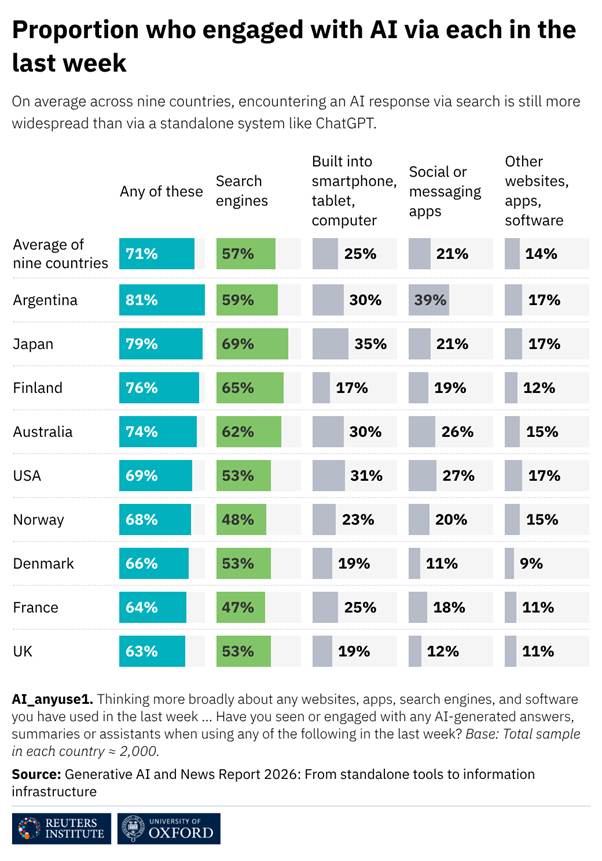
Third, in parallel with intentional use, incidental generative AI exposure is even more widespread, as people, without necessarily wanting to, encountering AI-generated content in increasingly AI-infused legacy platforms and services, especially search engines, but also social media, as a feature on their devices, and on various other web sites (including news).

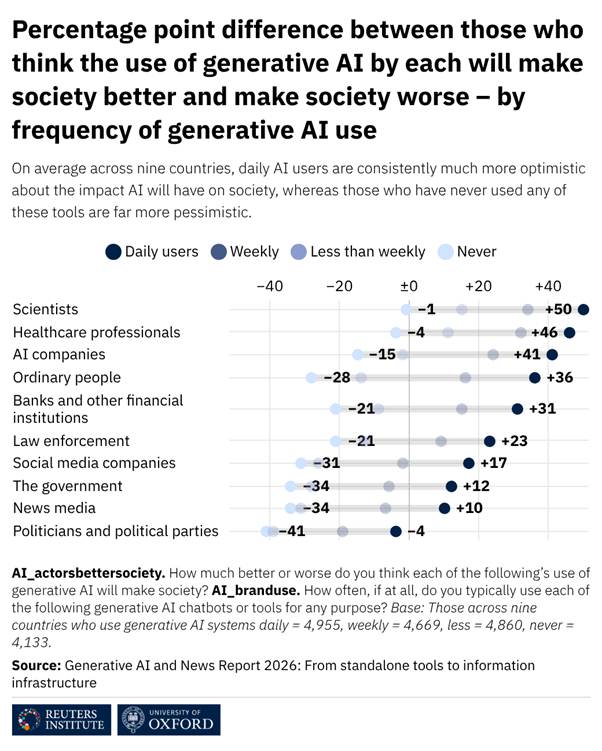
Fourth, even as there is a lot of change with intentional use growing and incidental exposure increasing, some public attitudes seem to be settling into a rather polarized pattern with the (growing number of) users far more optimistic than those who do not use (and in some cases fundamentally may not /want/ to use) generative AI systems.

These are some of the key findings from a new report by Felix Simon, myself, and Richard Fletcher and published by the Reuters Institute, based on surveys conducted in nine countries (Argentina, Australia, Denmark, Finland, France, Japan, Norway, the UK, and the USA) to explore how people use generative AI in their everyday lives, what they think its impact will be on different sectors of society, and what they think about its use in news and journalism specifically. The study builds on similar studies we did in 2024 and 2025.

Generative AI news discovery looks much more concentrated than other forms of access

Generative AI could in principle feature a great diversity of sources in output responding to news-related queries.

But do various generative AI products actually do this?

In early 2026, Roa Powell and Carsten Jung published a piece of research for the Institute for Public Policy suggesting maybe not – based on analysis of responses to a sample of 100 hypothetical UK news queries submitted to four different AI tools (ChatGPT, Perplexity, Gemini, and Google AI overview), they found that these tools draw “on a narrow range of prominent news brands”.

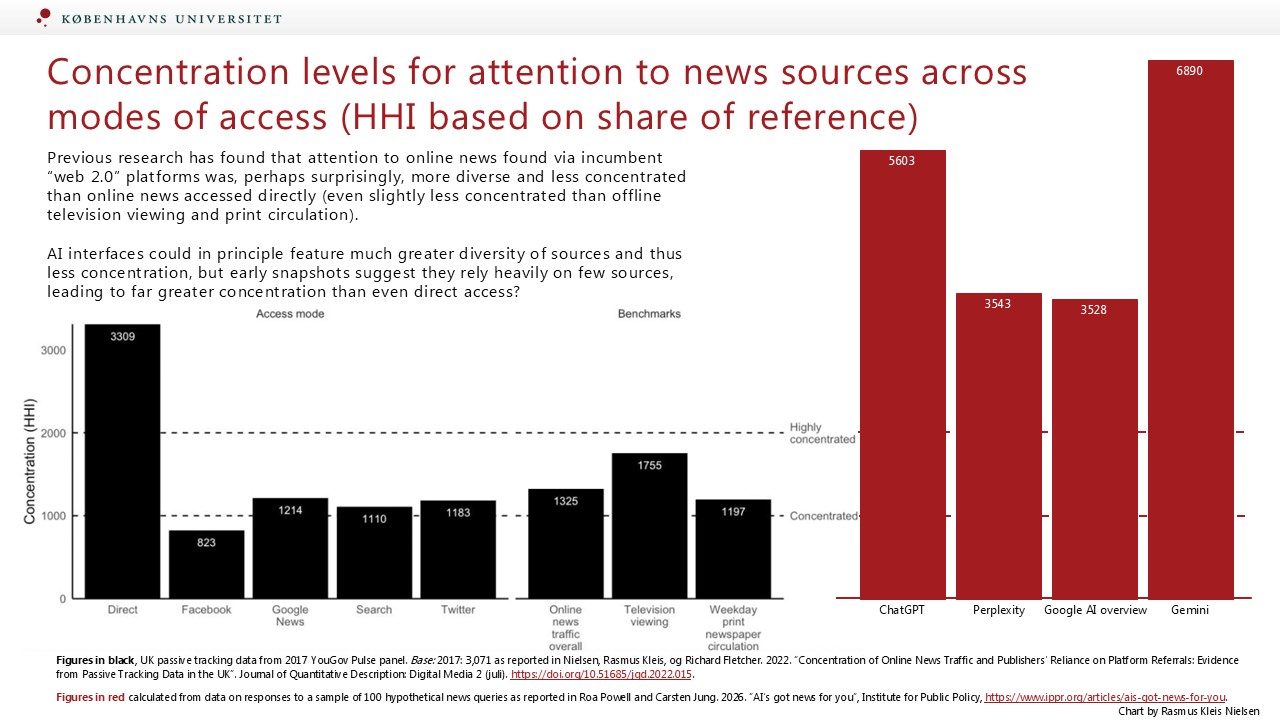
As a benchmark for interpreting their results, I have created the slide below.

The figures in red are my calculations of the Herfindahl–Hirschman Index (HHI) (a common measure of market concentration) for each of the four AI tools based on the share of reference that goes to each of the top ten news brands (as reported by Powell and Jung).

The figures in black are taken from this piece of work I did with Richard Fletcher included for comparison, namely similar HHI calculations based on historic data from the UK from 2017 for online news accessed directly, via search, news aggregators, or various kinds of social media, as well as, for further comparison, HHI figures for television viewing and weekly print newspaper circulation at the time.

The concentration of attention, with a few brands accounting for a very large share of reference, is far greater for the AI tools than any other form of access.

While the underlying data is not like-for-like comparison (the bulk of the 2017 data is based on passive tracking of actual UK users, the 2026 AI tool data is generated by prompting), I think the figures are still interesting and thought-provoking. (And not necessarily unique to the UK – Nikos Smyrnaios and Olivier Koch has published a piece of work, based on a somewhat different methodology, suggesting results for France that are also about the 2,000 bar for a highly concentrated market.)

It’s not just that Powell and Jung are right to stress that a narrow range of prominent news brands (some of whom have commercial deals with the AI companies) loom very large in AI output.

It is also that the concentration in question, measured here in terms of share of reference, is far, far greater than any of the different kinds of access we analyzed based on the 2017 data – even more concentrated than direct access, which itself was significantly more concentrated than any other kind of access at the time.

We already know that AI tools generate far fewer referrals than established platforms do – worrying enough for a multitude of publishers competing to connect with the public.

It also seems the (comparatively fewer) referrals they do drive are highly concentrated amongst a select few publishers, much more so than has been the case for search, social, or news aggregators.

(Underneath the topline, there is some diversity from tool to tool (just as we found different outlets doing well via different platforms), as Powell and Jung writes, their findings suggest “each AI tool prioritizing news brands in different ways, in each case foregrounding a distinct selection of news outlets compared with those that are currently most popular across the UK” – go read their report for more details.)

Dealing with digital intermediaries – article out

In a new article, “Dealing with digital intermediaries”, Sarah Anne Ganter and I examine relations between publishers and platform companies.

The article presents an in-depth case study and show that publishers’ relationships to platforms are characterized by a tension between (1) short-term, operational, often editorially led pursuit of the opportunities offered by both search and social to reach people and (2) more long-term strategic worries about whether publishers will become too dependent on platform companies, including worries over whether they will lose control over their editorial identity, access to user data, and central parts of their revenue models.

On the basis of interviews with senior editorial staff, people from management, and technologists, we show that the way the case organization handles its relationship with different platforms is shaped by a fear of missing out, by the difficulties of evaluating the risk/reward ratio of engaging with different initiatives developed by platform companies, and by a sense of a profound asymmetry as a large news media organization finds itself dealing with far larger platforms.

Ultimately, our analysis suggests that publishers are becoming simultaneously increasingly empowered by and dependent upon a small number of centrally placed and powerful digital platforms largely beyond their control.

The article is published in New Media & Society and available as open access here and here as PDF.

The work behind the piece was supported by the Tietgen Award that I received in 2014 from the DSEB.

Fake news – an optimistic take

tv

Nobody likes fake news, whether produced for profit or for political purposes, and irrespective of how it has been disseminated.

It clearly exists, whether propaganda or churned out by the now infamous Macedonian teenagers.

But how much of an issue is fake news, narrowly understood as news that is factually wrong and/or fictitious while masquerading as news and is knowingly produced as such?

The first rule of writing about fake news is to admit that we do not really know what is going on: how much is there, produced by whom, who uses it, why, and how much does it influence them?

That said, here is an optimistic take on the fake news discussion–based on three points.

  1. Are there in fact likely to be significant effects of being exposed to fake news? Before jumping to the conclusion that people are in fact influenced by fake news, consider the following possible objections. First, most people are exposed to many different messages, pieces of information, and news stories every day, and research suggests that the effect of any one of these messages (like a fake news story) is likely to be very limited and short-lived, unless exposure is consistent, sustained, and very one-sided. Second, when people navigate news online, they rely in part on what their own browsing behaviour and various algorithmic filters lead them to, but also on source affiliation and social endorsements for cues on what to believe. Third, when they do in fact engage with news (some of which may be fake), they may do so in a whole lot of ways and for a whole lot of reasons that are more ritual and do not involve them actually believing that the information contained is necessarily true—think of this by analogy as being amused by a tabloid or gossip site, sharing something on Twitter or commenting on Facebook without actually having read it, etc.
  2. Everybody seems to think other people are fooled by fake news, few seem to think that they themselves have been fooled. The discussion around fake news seems to reflect at least in part what media researchers call “third-person effect”, the fact that people generally see media and communication “as having a greater effect on others than on himself or herself”. Often, these “others” happen to people who are (a) poor and have low levels of education and (b) with whom those worried about the effect disagree politically, adding a bit of classism and partisan polarization to the discussion. (BuzzFeed and Ipsos did one of the most interesting and important empirical studies of fake news in the US back in December, and found that 33% of survey respondents—a clear minority—recalled seeing fake news headlines during the election (57% recalled real news headlines). Of those who did recall fake news headlines, a majority (especially amongst Republicans and Trump supporters), rated those headlines as “very accurate” or “somewhat accurate”—though keep in mind as is clear from the topline data, in most cases, most respondents answered “somewhat accurate”).
  3. Of course, fake news is likely to be important for some. Selective exposure to partisan fake news (we tend to seek out information that reinforces our pre-existing views while avoiding information that contradicts it) and motivated reasoning (we tend to process information so that it fits with our existing beliefs) means that for a minority of very highly partisan people, fake news probably shore up and even further polarize their political views. But here fake news is arguably (unless empirical work can find that there is a lot of it and people pay a lot of attention to it) a small part of a larger story of partisan polarization in some countries (including notably the US) and of a media industry that has moved from providing mostly middle-of-the-road, he-said/she-said news committed to some version of attempted objectivity to a situation where more and more media are clearly partisan or perhaps deliberately and for largely commercial reasons peddle moral outrage. Fake news may intensify this development, but if so clearly builds on a much broader and long-standing development.

There are no doubt a group of people who are fooled by fake news and who in fact are influenced by it.

And it seems clear that fake news is not only cheaper to produce (and monetize) today, but also easier to disseminate online than ever before.

But until someone provide evidence to the contrary, I suspect most people are exposed to relatively little fake news (and a lot of other stuff) and are not very much influenced by it.

Point one and two above, building on decades of empirical media research, suggest that, until there is evidence to the contrary, we should expect only a minority of people to be both (a) exposed to fake news, (b) fooled by it, and (c) in fact influenced by it. Point three of course suggests that there is another minority who may rely in part on fake news as they maintain partisan identities, but, as said, this is arguably a broader point about political (partisan polarization) and media (move from mass to niche, including partisan niche).

None of this means that we should not take fake news seriously or that there aren’t reasons to be concerned when people produce fake news, either for profit or for political purposes. Nor does it mean that we should not be concerned about the question of whether technology platforms including Google and Facebook enable the production and dissemination of fake news (though they also enable a whole lot more, and any call for change, intervention, and/or regulation needs to keep this in mind, and to think about whether the cure is sometimes worse than the disease).

But what this optimistic take on fake news does mean is that we should not let the passionate and heated (and sometimes largely evidence-free and polemical) discussion distract us from a set of arguably more fundamental challenges concerning news and the role of news in contemporary politics and public life.

These include—

  • Do non-fake news in fact serve society well in terms of how they have dealt with issues including Brexit and Donald Trump? The loud discussion around fake news risks obscuring a critical discussion of (real) news and how well different (real) news organizations handle their public role. Some news organizations did a valiant and principled job. Others did not. Research on rumours both offline and online suggest people turn to “improvised news” (often inaccurate, sometimes outright falsehood) especially in times of crisis when conventional news may be scarce or do not answer the questions people have.
  • Why is it that so many people (in the US almost 40%) do not trust (real) news and in some cases don’t accept that (real) news is much different from fake news, or much more trustworthy than fake news? As a media researcher and as someone who personally believes in the public value of much of journalism, warts and all, I am concerned that the focus on one easy target of moral approbation—fake news—distracts from the fact that many people think of much of news, sometimes justifiably so, as less than trustworthy, and often out of touch with their problems, values, and concerns.
  • Are the political outcomes of political processes like the UK referendum on the European Union and the US Presidential Election perhaps first and foremost political in nature? Blaming Macedonian teenagers making things up for a living, Russian propaganda, and the opaque algorithms of powerful and profitable technology companies for an election result draws attention away from whether in fact these outcomes were primarily driven by more fundamental political, social, and economic processes (and that these in turn vary by country).

An optimistic take on fake news may thus (perhaps pessimistically) suggest that the most important questions we face around media and democracy today concern real news, and how real news—often on an eroding resource base—can cover highly partisan politics, reach more people, and connect societies that in some cases seem more and more polarized in terms of both social values and relative affluence.

(Many thanks to David Levy and Richard Fletcher for comments on this piece. I wrote this in part because Gina Neff effecitvely told me to.)

APSA 2016 Political Communication Preconference Agenda

Very happy to have been involved in organizing the American Political Science Association 2016 Political Communication Preconference this year. Programme below.

***

APSA POLITICAL COMMUNICATION PRECONFERENCE

AGENDA


DATE:                       Wednesday August 31st

LOCATION:             Temple University’s Center City campus at 1515 Market Street, Philadelphia PA, 19102.

SCHEDULE:

  • 8:AM to 8:45AM:             BREAKFAST & REGISTRATION (Rm. 222)


  • 8:45AM to 9:00AM:             WELCOMES (Rm. 222)


  • 9:00AM to 10:15AM: PANELS


  • Gender, Class & Age (Chair: Diana Owen, Georgetown University) (Rm. 420)
    • Computer Silence: Gender Differences in Online Comment Sections. Natalie Jomini Stroud (The University of Texas at Austin), Emily Van Duyn (The University of Texas at Austin) and Cynthia Peacock (The University of Texas at Austin).
    • Visual Communication and Candidate Evaluation: Testing the Influence of Images on Support for Male and Female Candidates. Nichole Bauer (University of Alabama) and Colleen Carpinella (Disney Research).
    • Class Opinion Alignment: The Influence of Poverty Discourse on the Political Attitudes of Low-income Citizens. Lori Young (Annenberg School for Communication, University of Pennsylvania).
    • The Gender Gap and Online Political Activity in Canadian Politics. Tamara A. Small (University of Guelph), Harold Jansen (University of Lethbridge), Frédérick Bastien (Université de Montréal), Thierry Giasson (Université Laval) and Royce Koop (University of Manitoba).
    • Political Information Usage and Sources for Young Citizens: Comparison of Electoral and Non-Electoral Periods. Andrius Suminas (Vilnius University).


  • Media and Political Engagement I (Chair: Rasmus Kleis Nielsen, Oxford University) (Rm. 421)
    • WhatApp..ening to Political Discussion in Europe? Instant Messaging Services and Political Engagement in Italy, United Kingdom and Germany. Augusto Valeriani (University of Bologna) and Cristian Vaccari (Royal Holloway, University of London and University of Bologna).
    • Fly My Pretties: John Oliver, Net Neutrality, and Comedy as an Agent of Political Activation. Leticia Bode (Georgetown University) and Amy Becker (Loyola University Maryland).
    • Digital Politics and the Political Community. Michael J. Jensen (Institute for Governance and Policy Analysis, University of Canberra).
    • The Instagram Election: The Role of Visual Social Media in the 2016 Presidential Campaign. Terri Towner (Oakland University).


  • Partisan Media (Chair: Bruce Hardy, Temple University) (Rm. 422)
    • Media Issue Ownership: Reconciling Partisan News and Issue Ownership. McGregor, Shannon C. (University of Texas – Austin).
    • Media Choice and Moderation: Evidence from an Experiment With Digital Trace Data. Andrew Guess (New York University).
    • The Impact of Partisan News Exposure on Perceptions of the Opposing Party and Public Confidence in the Electoral System. Hye-Yon Lee (Annenberg School for Communication, University of Pennsylvania).
    • Self and Contextually Activated Networks: An Expanded Approach to Selective Exposure. Benjamin Lyons (University of Pennsylvania)


  • 10:15AM to 10:30AM:    BREAK
  • 10:30AM to 11:45AM:    PANELS


  • Campaigns & Elections (Chair: Michael X. Delli Carpini, University of Pennsylvania) (Rm. 420)
    • Online Interaction: Do Candidates Still Avoid It? Jennifer Stromer-Galley (Syracuse University), Patricia Rossini (University of Minas Gerais, Brazil), Lauren Bryant (University at Albany, SUNY), Bryan Semaan (Syracuse University), Jeff Hemsley (Syracuse University), Kate Kenski (University of Arizona) and Feifei Zhang (Syracuse University).
    • The Promise of Social Media Intelligence: Leveraging Consumer Analytical Tools to Understand Voters Online in 2016. Sarah Oates (University of Maryland College Park) and Wendy Moe (University of Maryland College Park).
    • Oh Snap: Chat Videostyle in the 2016 U.S. Presidential Campaign. Eisa Al Nashmi (Kuwait University) and David Painter (Rollins College).
    • Tipping the Balance of Power in Elections? Voters’ Engagement in the Digital Campaign. Diana Owen (Georgetown University).
    • Relational Labor in Candidates’ Social Media Presence. Shannon C McGregor (University of Texas – Austin) and Nancy Baym (Microsoft Research).


  • Disagreement, Negativity & Incivility (Chair: Dannagal Young, University of Delaware) (Rm. 421)
    • Liberal and Conservative Political Incivility. Ashley Muddiman (University of Kansas).
    • How Personality Traits Affect Voters’ Campaign Tone Perceptions and Responses. Annemarie Walter (School of Politics and International Relations, University of Nottingham), Travis Ridout (School of Politics and International Relations, Washington State University) and Cees Van der Eijk (School of Politics and International Relations, University of Nottingham).
    • How Political Disagreements Lead to Participation: Comparing Less and More Experienced Voters in the Case of the U.S. 2014 Midterm Elections. Hailey Hyun-kyung Oh (George Mason University).
    • Deliberative Signals: The Importance of Incivility in Highlighting Anti-Democratic Rhetoric. Emily Sydnor (Southwestern University) and Grace Atkins (Southwestern University).


  • Protest, Revolution and Media (Chair: Abby Jones, Visiting Scholar, Annenberg School for Communication, University of Pennsylvania) (Rm. 422)
    • Revolutionary Narratives and the Future of Revolution. Guobin Yang (Annenberg School for Communication, University of Pennsylvania).
    • The Contagion Effects of Protest Movements – Pegida and Party Politics in Germany. Sebastian Stier (GESIS – Leibniz Institute for the Social Sciences, Cologne), Arnim Bleier (GESIS – Leibniz Institute for the Social Sciences, Cologne), Christoph Kling (GESIS – Leibniz Institute for the Social Sciences, Cologne) and Lisa Posch (GESIS – Leibniz Institute for the Social Sciences, Cologne).
    • Democracy, New Media and Social Actors in Contemporary Spanish Politics. Leocadia Díaz Romero (Murcia State University).
    • From Connective Action to Connective People: An Empirical Evidence from Egypt. Mostafa Shehata (Roskilde University).


  • 11:45AM to 12:30PM:     LUNCH (Rm. 222)


  • 12:30PM to 1:30PM:       KEYNOTE & DISCUSSION ON THE 2016 U.S.

PRESIDENTIAL ELECTION (Rm. 222)


  • Facilitator: Michael Hagen (Temple University)
  • David Nickerson (Temple University)


  • 1:30PM to 2:30PM:         THEORY AND THEORY-BUILDING ROUNDTABLE

(Rm. 222)


  • CHAIR: Regina Lawrence (School of Journalism and Communication, University of Oregon)
  • PANELISTS
    • Geoffrey Baym (Temple University)
    • Andrew Chadwick (Royal Holloway, University of London)
    • Daniel Kreiss (University of North Carolina, Chapel Hill)
    • Dannagal Young (University of Delaware)


  • 2:30PM to 2:45PM:         BREAK


  • 2:45PM to 4:00PM:       PANELS


  • Journalism, News, and Politics (Chair: Geoffrey Baym, Temple University) (Rm. 420)
    • Platformed Publishing? The Rise of Digital Intermediaries, the Transformation of Online Journalism, and Implications for Mediated Politics. Rasmus Kleis Nielson (Oxford University) and Sarah Anne Ganter (Oxford University).
    • Analyzing PolitiFact.com: Assessments of Key Partisan Claims Regarding President Obama. Stephen J. Farnsworth (University of Mary Washington) and Robert S. Lichter (George Mason University).
    • Objective and Subjective Political Knowledge in the New Media Environment. Kylee Britzman (University of Illinois at Urbana-Champaign).
    • Last Week Tonight with John Oliver: Combining Journalistic Ideals and Political Satire. John Remensperger (Annenberg School for Communication, University of Pennsylvania).


  • Issue Coverage in Comparative Perspective (Chair: Jennifer Stromer-Galley, Syracuse University) (Rm. 421)
    • Threatening or Sympathetic? The Cross-National Framing of the Syrian Mass Exodus. Abby Jones (Visiting Scholar, Annenberg School for Communication, University of Pennsylvania).
    • Communist Party’s Soft Power in Cross-national Persuasion Videos: Shaping China’s Image among Overseas Audiences. Kecheng Fang (Annenberg School for Communication, University of Pennsylvania) and Diana C. Mutz (Annenberg School for Communication, University of Pennsylvania).
    • Ownership, Differential Framing and Attitudes to Labor Unions: Evidence from Two Experiments. Liam Kneafsey (Trinity College, Dublin).
    • Social Media Use and Fear Levels after the Paris 2015 Attacks. A Comparative Study. Shana Kushner Gadarian (Syracuse University),
      Kari Steen-Johnsen (Institute for Social Research, Oslo) and Bernard Enjolras (Institute for Social Research, Oslo).


  • Media and Political Engagement II (Chair: Lance Holbert, Temple University) (Rm. 422)
    • Ask Me Anything: How Elites Trigger Political Participation on Reddit. Galen Stocking (Pew Research Center), Michael Barthel (Pew Research Center), Jeff Gottfried (Pew Research Center), and Katerina Matsa (Pew Research Center).
    • Getting to the Grassroots: How Corporate Sponsored Activist Groups Are Covered in the News. Tim Wood (New York University).
    • Explaining Constituent Calls and Online Comments: The Role of Organized Interests in Grassroots Lobbying. Kelsey Shoub (University of North Carolina, Chapel Hill) and John Cluverius (University of Massachusetts, Lowell).
    • Skipping Politics: Measuring Avoidance of Political Content in Social Media. Leticia Bode (Georgetown University), Emily Vraga (George Mason University), and Sonya Troller-Renfree (University of Maryland).
    • Internet Campaigning in Japan and Taiwan: A Comparative Institutional Approach. Shoko Kiyohara (Meiji University) and Chen Boyu (University of Niigata Prefecture).


  • 4:00PM to 5:00PM: “BIRDS OF A FEATHER” SESSIONS (Facilitated Open

Discussions among Interested Scholars)


  • #WomenAlsoKnowStuff (Room 420)
    • Facilitators
      • Amber Boydstun (University of California, Davis)
      • Samara Klar (University of Arizona)
      • Yanna Krupnikov (Stony Brook University)
      • Kathleen Searles (Louisiana State University)


  • Comparative Political Communication (Rm 421)
    • Facilitators
      • Kari Steen-Johnsen (Institute for Social Research, Oslo Norway)
      • Cristian Vaccari (University of London)


  • Digital Trace Data (Rm. 422)
    • Facilitators
      • Deen Freelon (American University)
      • Andrew Guess (New York University)
      • Andreas Jungherr (University of Konstanz)


  • 5:00PM to 5:30PM:        TRAVEL TO TEMPLE’S MAIN CAMPUS


  • 5:30PM to 6:45PM:        RECEPTION AT TEMPLE’S MAIN CAMPUS

(Location TBD)

No, this won’t be the “Meerkat Election”. Or the “Periscope Election”. It’s digital politics as usual.

No, this won’t be the “Meerkat Election”. Or the “Periscope Election”. And as exciting as these new live streaming social media apps are, they certainly not “taking over” Washington, the Presidential Primary, or the 2016 elections (or any other political scene).

It’s the same old story, and we will hear it again and again over the next year and a half.

Much of the hype emanates from the run-up to the US presidential primaries and general elections and wild extrapolation from a few high profile incidents or particularlly succesful outliers.

  • 2004 was called the “Meetup Election” after Howard Dean’s spectacular primary campaign used the platform as part of its effort to mobilize volunteers and raise money.
  • 2008 was called the “Facebook Election” and the “YouTube Election” as these tools grew in importance and particularly the Obama campaign used them.
  • 2012, of course, was called the “Twitter Election” (by amongst others, a purely disinterested source like the CEO of, well, Twitter) as that was the new tools of the season.
  • And 2016 in addition to having already been dubbed the Meerkat Election will probably also be called the Snapchat election and the Whatsapp election and surely more too.

Much of all this hype is driven by a combination of tech journalists and political reporters with an endless need for new content and always looking for the new thing and self-interested sources like political operatives and tech professionals who have a story to tell. (It turns out that the Smith for President social media director thinks social media may decide the election, and that social media consultant Johnson and social media CEO Williams agree.)

One is tempted to say that much of it is bullshit (in the technical sense of the term as communication designed to impress), as no one seems to care whether it is actually true in any meaningful sense of that word. Thought-provoking that even very self-consicously “serious” news outlets lend their name to this stuff.

It’s all predictable but slightly annoying, as is the tendency of some journalists in other countries to pick up on coverage of US election campaigns and assume that whatever happens (or could/will/may happen there) will eventually also decide the upcoming election in country X.

What is missing from this is the simply but important point made by everyone from serious political professionals like David Plouffe (as he has written, “balanced communications across all mediums is critical in any messaging effort today”) over scholars of political communication and media like Andrew Chadwick to historians of technology like David Edgerton: the interplay between old and new media is not either/or scenario where a succession of new media arrive, displace old media like television and inherited campaign practices like going door-to-door, and proceed to decide the election in a blaze of dazzling technology-driven power. It is an additive process where new forms of campaign communication are gradually added on to existing, well-known ones in the pursuit of victory.

So what we have today is digital politics, yes, because these tools—all these tools, including seemingly old and unsexy “mundane tools” like email, spreadsheets, databases, etc—are increasingly integral to much of what many of us do, especially in high income democracies, and hence also important parts of the political process.

But it is digital politics as usual, as old media and campaign practices remain stubbornly important and central, and elections are still won as much on the basis of policy, personality, performance, and at the mercy of events and conjecture like changes in the economy.

I know saying we have a “complicated” election ahead of us that will be decided by a combination of many different factors and where those involved will rely on a wide range of different forms of communication, most of them fairly well-known and older ones, is not very exciting. But it is the honest-to-God truth of the matter. Calling it the “app-of-the-year election” is not.

Now that is off my chest at least I will have this blog post to point to for the rest of the 2015-2016 election season and probably for the rest of my life.

New article out “Political communication research: New media, new challenges, and new opportunities”

A new special issue of MedieKultur has just been published.  It includes an article by my based on a keynote lecture I gave in November 2012 at the Danish Association of Media Researchers’ Annual Meeting.

The talk and the article deals with how the field of political communication research might benefit from embracing the theoretical and methodological diversity that characterize the broader field of media and communications research, including intellectually adjacent and overlapping “sibling” fields like journalism studies and audience research.

It builds on the same line of thinking I’ve developed with David Karpf and Daniel Kreiss elsewhere (including our chapter in this book, based on our paper from ICA 2013) and that was part of the motivation for the preconference on the role of qualitative methods in political communication research that we organized with Matthew Powers for ICA in 2014.

As always, I’m grateful for our ongoing conversations.

Abstract below–full text (PDF) here.

Political communication research: New media, new challenges, and new opportunities

Rasmus Kleis Nielsen

Abstract

The rise of new media and the broader set of social changes they are part of present political communication research with new challenges and new opportunities at a time when many think the field is at an intellectual impasse (e.g., Bennett & Iyengar, 2008). In this article, I argue that parts of the field’s problems are rooted in the way in which political communication research has developed since the 1960s. In this period, the field has moved from being interdisciplinary and mixed-methods to being more homogenous and narrowly focused, based primarily on ideas developed in social psychology, certain strands of political science, and the effects-tradition of mass communication research. This dominant paradigm has contributed much to our understanding of some aspects of political communication. But it is struggling to make sense of many others, including questions concerning people’s experience of political communication processes and questions concerning the symbolic, institutional, and technological nature of these processes—especially during a time of often rapid change. To overcome this problem, I argue that the field of political communication research should re-engage with the rest of media and communication studies and embrace a broader and more diverse agenda. I discuss audience research and journalism studies as examples of adjacent fields that use a more diverse range of theoretical and methodological tools that might help political communication research engage with new media and the new challenges and new opportunities for research that they represent.

Keywords:political communication, new media, digital politics, theory, method

Most people still ignore most politicians online…

The great open access journal International Journal of Communication just published a paper I’ve written with Cristian Vaccari called “Do People “Like” Politicians on Facebook? Not Really. Large-Scale Direct Candidate-to-Voter Online Communication as an Outlier Phenomenon”.

In the paper, we analyze the presence of 224 major-party candidates for the House of Representatives across the 112 most competitive districts in the 2010 U.S. Congressional Elections across Facebook, Twitter, YouTube, and their campaign websites and find that attention is highly concentrated with just a few candidates attracting vastly more supporters, followers, video views, and website visitors than everyone else.

Though a few politicians stand out, the median candidates count their followers etc in the hundreds or at best the low thousands. It is a hit economy out there, and most politicians are not a hit with the wider population, at least in the U.S. (I’ve blogged about this data before, and TechPresident wrote a bit about it back in 2010—the article had a tortured review process, so it has taken a bit of time to get this simple but I think pretty important argument out there in its final form.)

Are our findings still relevant three years after the data was gathered, three years in which the spread of smartphones and tablets and the growing popularity of new social media have changed the web?

I very much thing so—the four basic patterns we identify seems stable. They are:

(1) limited reach in terms of the number of people who follow most campaigns on various platforms; (2) high levels of concentration of attention across all platforms, with a few politicians drawing many people, and most drawing few; (3) considerable correlations between visibility on each platform, where candidates who do well on one also tend to do well on the others; and (4) noticeable growth in the total number of people following candidates in the course of the campaign period without any change in the overall pattern of highly skewed distributions.

Data from our follow-up work on 2012 confirm all four basic patterns (here for a first cut of that data), and several of them are familiar from earlier work by Matt Hindman and others on “web 1.0” online politics.

As we write in the paper,

The few candidates with significant online audiences are not as much ahead of the curve as they are on top of the curve. If the limited number of politicians in our sample who attracted a lot of attention were distinguished by being early adopters of particular platforms, perhaps others could do likewise and achieve similar results. But with adoption rates of the four platforms considered here ranging between 91% and 100% among candidates [in 2010], and large parts of the adult population already using them regularly [again, in 2010], the highly uneven distributions are clearly not the outcome of uneven levels of use.

Ultimately, the online environment, partially discounting online marketing, is a pull environment in which people opt in and self-select. And at least in the U.S., interest in politics is limited and unevenly distributed, trust and confidence in politicians is limited, and while many people talk about politics online, most people do not connect with most politicians online.

It is an open question how relevant these findings are in countries where more people are more interested in politics (many countries have far higher turnout than the U.S.) and have more faith in politicians and the political process (as in some Northern European countries, for example). (On the other hand, they may be even more true in countries with lower levels of engagement and trust, or in supra-national political systems like the E.U., where very few European-level politicians have build significant popular followings online.)

But at least in the U.S., what we wrote in conclusion about our 2010 data still seems accurate to me–

As long as competition for attention is so fierce and levels of interest so low and uneven, only a few politicians will attract large online audiences that allow them to communicate directly to the electorate to any significant degree via various social networking sites. The rest will have to find other ways, including both traditional means, such as direct mail, field operations, and television advertising, as well as new forms of push marketing online. The topology we have mapped here is one dominated by a few exceptional outliers who attract tens of thousands of supporters and viewers, but where the great majority of candidates—even in well-funded, competitive, high-stakes contests—labor in relative obscurity online.

American Political Science Association 2013 annual meeting round-up

I’m not going to try to summarize everything I went to at American Political Science Association 2013 annual meeting, nor go into details with all the great papers given by colleagues, friends, and complete strangers, but just highlight a few key take-aways for me.

Lots of laurels—

1)      At the political communication pre-conference, I was very happy to see some great work done on local news, local-level political campaigns, and the interaction between the two. I’m looking forward to seeing what comes out of Frankie Clogston and Joshua Darr’s doctoral work, both gave very interesting presentations. We know much about local politics from political science, but less than we ought about local news and local political communication.

2)      I found the comparative work presented by James Stanyer and others on “intimate politics”, the ways in which politicians, often initially deliberate and for strategic reasons, but in the longer run with unintended and uncontrolled consequences, seek out soft news coverage of what might conventionally be considered their “private life”.

3)      And then I was reminded how deeply engaged a subset of political communication researchers are with psychology. I’m far from fluent in this area of research, but I went to some interesting presentations based on affective intelligence theory, elaboration likelihood theory, and theories of motivated reasoning working to advance our understanding of how people process political communication, form attitudes, and ultimately act (or not) politically.

But also some darts—

1)      The study of information technology and politics is gradually infiltrating other areas of political science, as it should, as digital technologies increasingly become ubiquitous, domesticated, integrated into everyday life (mundane media rather than “new media”). This is a good thing. Digital media are far from everything, but they are increasingly everywhere. Now it would be nice if the latecomers to the party would read up on the research done by those, political scientists and others, who arrived early. A lot of people even today build their arguments against strawmen-type arguments from early digital utopians like Nicholas Negroponte or cite papers from the late 1990s and early 2000s as if the internet is still the same thing. (See Dave Karpf’s great piece on the problems of research in internet time.)

2)      Political communication scholars based on political science departments rarely read the work of media and communications scholars. (Sigh.) They should, even though they’ll find some of the theoretical and methodological vocabulary foreign, there is much to be gained from a better understanding of how media systems are changing, how audiences engage with new media, how journalism is evolving, and how digital media rarely constitute a separate dimension but are parts of cross-media use, cross-media news coverage, and cross-media strategic communication. It is called political communication for a reason.

3)      Tons of people study Twitter rather than Facebook, often because it is easier to access the data. Twitter is important, but it’s hugely problematic if we let data availability guide our overall understanding of social media in politics. It is a parallel to the tendency in journalism studies to study print media/textual news rather than broadcasting/audio-visual news, in part because it is easier. Just as we need more studies of broadcast news (also in a changing media environment where TV is increasingly intertwined with other media, but still the single most important source of news for most citizens in many countries), we need more studies of Facebook and YouTube, far more widely used than Twitter by ordinary people.