I gave the closing keynote at the 2025 Nordic AI in Media Summit April 24 under the title “What could ‘European alternatives’ mean? Three possible platform models in search of your support”.
Photo credit: Philip Jørgensen
As a scientist, I prefer to deal in reliably, empirical knowledge, but I was grateful to be invited to think aloud in terms of possible responses to the current moment in geopolitics and tech.
If you are interested in my three possible models, each of which represent an approach trying to solve for a different definition of the problem ( (1) reliance on American tech? Airbus-for-the-internet as national/European champions!, (2) reliance on for-profit tech companies? BDC/public service platforms! (3) reliance on big technology companies? Mastodon as a decentralized, open-source alternative!).
In each case, for every alternative, at every level of the stack, at least three questions need clear answers – what, exactly, is the alternative meant to do, who will fund it, and how is it going to be governed.
It all strikes me as a wicked problem akin to climate, defense, and the future of strained welfare systems – and of a comparable scale and scope, and seriousness that requires serious responses. I hope the models I outline and the questions I offer can help structure how we discuss possible responses and move beyond the declarations and rhetoric that suffice for headlines and a bit of publicity, but don’t actually change anything.
I am very grateful that the Danish National Science Foundation has awarded me a DNRF Chair grant to support my new project “Power over Platforms?”.
Power over platforms?
The aim of this 3-year project is to understand how power is exercised over platform companies such as Google, Meta, and their competitors by actors who have neither raw economic nor formal regulatory or legislative means.
The focus is on how civil society groups, interest groups, professional associations, and companies from other sectors sometimes actively try to shape how platform companies operate. The starting hypotheses are that these actors (a) do this because they believe they are able to exercise at least some influence and (b) this is sometimes the case.
Systematically analyzing the actors involved in trying to influence key decisions made by different platforms on key issues—content moderation, privacy, and the use of generative AI for political information and speech—across different jurisdictions (the US and UK as major markets outside the EU, key markets inside the EU), and across different platforms (primarily consumer-facing content platforms including Google, Meta, and their smaller competitors TikTok, X, Snapchat, and Reddit) the project sets out to identify who seeks to influence platform governance, how, and what the outcomes are across countries and across companies.
The project builds on and goes beyond previous work on the “Power of Platforms” I did with Sarah Anne Ganter, and seeks to expand our scientific understanding of platform governance by analyzing a wide range of actors involved, some of whom have received limited attention from researchers. It aims to provide insights which can in turn help inform public and policy discussions about how to respond to the role that platform companies play in a range of important areas including free speech (through content moderation), privacy (data protection and encryption), and, with rapid development and deployment of generative artificial intelligence, new ways for people to exercise their fundamental right to receive and impart information and ideas.
This is an important area to research because platform companies increasingly develop and enforce principles, policies, and practices that go above and beyond what is legally required in defining what they consider acceptable behavior and content. But who, in turn, seeks to and sometimes manages to influence how the companies do this? When do they succeed? These questions are at the heart of the project.
I will be working with two postdoctoral researchers on the project (interested in these posts? Details here – apply by December 13) and various international collaborators.
I’m going to tell you a story about what’s happening to journalism and news media across the world. There are a lot of variations, differences between countries and organizations and communities being served. But I still think there are some big themes that we can recognize that are worth going out to recognize where we come from, where we are, and where we might go in the future.
Where we come from
So if we start with where we come from, journalism has a lot to be proud of. At its best, it’s an occupation that is committed to seeking truth and reporting. it. It provides a way of telling people stories that can make them understand other people’s experiences, but also sometimes their own experiences in a new light. It can portray the contending forces in the world so that people can relate to some of the titanic forces at play beyond our own immediate circles.
And at its best, it both aims and sometimes is in fact able to help people understand the world beyond personal experience and make the invisible world visible in a way that is profoundly empowering.
One of the reasons I do what I do is that I’ve seen so powerfully in my own family of people who in the past had little access to formal education and few of the structural privileges that we associate with bourgeois citizenship, how profoundly important journalism was in enabling them to connect with the world beyond personal experience and be active participants and shape and reshape that society in line with their own ideals and their own interests.
And there is something special about journalism that’s not unique in trying to help individuals be citizens, but often would aspire to do so in a way that is independent of the powers who actively try to reshape society in particular directions.
Whether you think of that independence in terms of an ambition to be impartial, or whether you think of that independence as being upfront and clear about your point of view or your editorial line, what those different conceptions have in common, I think, is at least a commitment to not do it on behalf of some other organized interest or force in society. This is how journalism can retain its autonomy of the many other forces at play.
This wild and varied set of aspirations gives us a way of thinking about what many journalists would like to achieve. It also gives us yardsticks by which we might judge ourselves when we fall short. Nothing is perfect, and the history of journalism is certainly not perfect either.
I think it’s also important to recognize that these are things that much of the public would like to have from journalism.
This is one of the most powerful themes in years of research that we have done at the Reuters Institute on people’s relationship with the news – much of the public has what might come across as surprisingly conventional, or in a nicer term, classical, expectations of what they would like to have from journalism.
They would like journalism to provide a way to stay up to date with what’s going on in society. They would like journalism to help them understand things that they are not themselves familiar with. They would like journalism to convey the range of different perspectives on some of the issues that we face as societies. These are aspirations that journalists have, and they are things that much of the public would like to have from journalism.
And over the years, of course, professional practice and the occupation of journalism grew up in part in pursuit of these aspirations, and in part grew up inside of media organizations and businesses that made money off of investing in this professional practice. At the dawn of the century in Berlin alone, there were well over a hundred different newspapers.
This is a very different world from the one we live in today. If we move from the profession to the business that employed these journalists, and that many of these journalists were themselves active in – we have to remember that many of the pioneers of journalism, the great reporters and editors of the 19th century and early 20th century were entrepreneurs. They were interested, yes, in the editorial side. But they were also interested in the business side that enabled editorial autonomy from the state, from political parties, from organized interests, and from other businesses.
The environment in which they thrived was an environment that, from the point of view of people such as my family – members of the public – was one where citizens had a low choice media environment, not that many ways in which they could access information about the world beyond personal experience.
As a consequence of that, those who controlled the printing presses had high market power, high market power over the public and high market power over advertisers. And this in turn produced a, in many countries, very lucrative business. Profit margins in the double digits and a sort of a veneer of stability and success that we associated with newspaper companies in particular, till relatively recently.
It is also, I think, obvious to everyone in the room that this is not the world we live in anymore. And it hasn’t been for quite a long time. But I think it’s important to start with that world because it’s so profoundly still shaped the profession of journalism and the media organizations that employ journalists. Many of them are still at least in part oriented towards the world of yesterday even as they have to navigate the world of today and tomorrow.
Where we are
So what is the world in which we live today? I mean in the simplest sense you might start with the relationship between the public and journalism and just recognize that if the world of my grandparents and parents was a world of low choice for the public, high market power for publishers, the world of today is a world of high choice for the public and low market power for publishers.
This means that the business of news is far less lucrative than it was in the past and it means that the unearned confidence that journalism had in a world in which, essentially, journalists wrote and people like my family read, has been blown out of the water because now everyone can raise their voice and many of them do that – including very critically and in ways that contend and sometimes outright attack or harass journalists.
We need to be very, very clear about where journalism sits in this fundamentally transformed media environment.
Because it is not the case that people have turned their back on the ways in which media can help you imagine a richer and more varied life than what you live yourself. In fact, people spend more time and in many cases more money on media than they did in the past.
What is the case is that the role of journalism in this more varied and from the point of view of much of the public, frankly richer and better media environment has shrunk.
We really need to be clear-eyed that every day the public is voting with its attention and with its wallet, and they are not voting for conventional forms of journalism.
The shift from the old world to the new world is not about people not having access to printed newspapers or linear scheduled broadcast channels or linear scheduled radio channels.
It is about them not choosing them when they have found things they find more satisfying and rewarding and valuable to them.
This shift has been incredibly disruptive for the business of news that journalists were employed by, even as a profession sort of drifted away from seeking to assume responsibility for the business that made journalism possible.
And the shift is actually even more challenging than just the financial crisis. Because there’s also a loss of cultural prominence in our societies that we can see in so many ways in audience research.
Every day the public is telling us things and it is up to us what we make of them and whether we want to convince them to see the world differently or whether we want to respond to what they’re telling us.
What are they telling us even as the old business of news is busy dying? Well, we see expressed levels of interest in news is in decline in much of the world. That trust in news is in decline in much of the world. That levels of active news avoidance is on the rise in many parts of the world.
And essentially, if I want to be really pointed about it, a significant and even growing part of the public, particularly younger people, people with lower levels of income, lower levels of formal education, historically poorly served minorities, in many cases women as well, are expressing in our more qualitative research – interviews, focus groups and the like – that they find that journalism irrelevant, depressing, and incomprehensible.
The public is essentially telling us every day and in growing numbers that even though they often want what journalism aspires to provide, they’re not feeling that we’re delivering it in a way that makes it worth their while to engage with us.
Think about what this means – there is a lot of concern in the industry about how can we convince people to pay for news. As a sort of a way of overcoming some of the business challenges that are consequences of these great structural transformations that I have very briefly outlined.
But in a sense, the problem is much more fundamental than convincing people to pay. The problem is that publishers are struggling to convince people to pay attention to news. And that, I would say, logically is a precondition of them before they would want to pay.
This is very clearly a crisis. It’s a crisis for the organizations that employ journalists, yes, that is a concern for their shareholders and owners. But it is also a concern for the profession of journalism, people being laid off, and many companies are really struggling to find better ways forward than just managing decline.
And it is a very real crisis for the profession, as I said, in a more profound cultural sense, of this fraying sense of public connection.
The idea that much of the public does not see journalism as providing the public value that journalism would say it is premised on providing. We may disagree with that judgment. Then there is a persuasion challenge. We may also feel that sometimes people have a sense of what they want, what they need. In those cases, I think we have a product problem.
Because we need to recognize, again, that it is a crisis for journalism and a crisis for the news industry but it’s not at all obvious that it is a crisis from the point of view of the public.
This year in the annual Reuters Institute Digital News Report when we surveyed people in 47 markets across the world, amongst the many questions we ask people was how well they felt that their different information needs were being met. You might think in a world in which many of those of us who care about journalism and the news industry increasingly are talking about news deserts and crisis of provision of factual information and the like – all of which are very real phenomena and very concerning phenomena – that the public at large would think about these challenges in similar terms.
But this is not at all the case.
The vast majority of our respondents would say on everything we asked them about that all or most of the information they needed was available to them, irrespectively of whether they paid for news or not. To them, irrespective of whether they paid for news or not. So we don’t know what we don’t know, and sometimes we have needs that we are not aware of, or informational things we would benefit from if they were available to us, even though they are not. But I think we really need to be very clear-eyed, that from the point of view of much of the public, what is happening to journals and the news is not a crisis for them – it is a crisis for us.
Where we might go in the future
That recognition is also where the work to address the crisis needs to begin, and this is where I think we need to turn from the past and the present towards the future and where I think it’s so important to recognize just the enormity of the forces that the people who will join me on the panel have found ways to navigate.
To be slightly reductionist about it, we can stylistically suggest that there are two main ways in which the industry has reacted to this structural transformation. There is what i think of as a rearguard reaction which is essentially is the view that things worked great and the problem is that the world has changed. Then there is a different view which is more of a sort of vanguard approach, which is that essentially the view that whatever things were like in the past, the problem now is that things have changed and we haven’t.
I’m not going to dwell here on whether things really were great in the past, other than just say, that even in what in sometimes in retrospect is seen as the high point of high modern journalism, a period that may look like a golden age from the point of view of those who worked in it and those who owned and ran the companies that dominated it, I think we need to be very clear that many people were very poorly served by that kind of journalism. And that the biggest difference perhaps was that they lived in a world in which most people couldn’t really find alternative sources or raise their voices in public, and now they can. But of course, it also had incredible value, and something very real is being lost as those institutions and those professional practices unravel.
So where do we go from there? I mean, if you think of these two stylized responses, I want to be clear that this is not meant to in some absolute sense judge this. Rearguard action works for some people and some communities and there is real value in the kinds of journalism that are being done and there are still declining but real business built around providing it. So it is sensible from the point of view of those people who do that work those businesses serve those audiences and those shrinking aging and ultimately dying audiences to continue with defending what, crudely put, works for me and older versions of me, what works for the highly educated, affluent, urban, engaged, willing to pay, middle-aged or older, and often in many societies, white men.
But it doesn’t work for everybody and it doesn’t work for them in the future.
With exception of a few winners in a winner-takes-most market consolidation, this form of journalism, this business, is in inexorable one-way decline. And it doesn’t work for many of the parts of the public that are most poorly served by this existing professional practice and business.
It doesn’t work for younger audiences. It doesn’t work for precisely the kinds of people that, as I said, I’ve seen in my own family history, have benefited so much from journalism in the past. People with low levels of formal education, lower levels of income and life, for whom journalism made, in a sense, the biggest difference at its best. It doesn’t work for those parts of the public, and it doesn’t work for historically underserved communities.
What these parts of the public say they want is not something that is not journalism.
As I’ve said at the outset, our research documents again and again that much of what people say they want from journalism is very well aligned with very timeless professional aspirations to seek truth and report it to provide analysis and understanding and arrange different perspectives. The problem is not that people are not interested in these things. It is that a large part of the public does not feel that we are providing it.
So what does one do then in response? I think what some of the most impressive pioneers have done whether they work in legacy titles or in startups is that they have returned to some of the thinking of the origin of the profession, but flipped it around.
So instead of thinking about what we did then, they’ve been thinking about who we did it for. They have put the public at the center of how they think about journalism and the business of news as a form of value creation.
They recognize very clearly that journalism exists in the context of its audience, that the political importance, the social significance, but also the economic sustainability of journalism as a professional practice is premised on the relationship with the public that it serves. If we lose sight of that and ignore what people are telling us, or only super serve the ones we are currently serving really well, then it is not surprising that we are losing touch with much of the public and struggling to make our businesses work. And I think that really is where we are seeing some of the most impressive and innovative work again across sometimes legacy titles and also new startups.
I want to be slightly rude here, if i may, and say that, with the greatest respect to my U.S American friends and that great citizen republic across the ocean – I don’t think the most interesting things right now are happening in the United States of America, because I think the rearguard action there takes the form of a few super successful companies over-serving people like me and then managed decline of asset-stripped companies in much of the rest of the industry. And then really, really interesting non-profit support and initiatives, yes – but initiatives that are so closely intertwined with the unique foundation and philanthropic funding environment of the United States that really does not exist anywhere else in the world. So I really think that people elsewhere should cheer on the US Americans for what they’re doing, but not always look there for inspiration.
I think far more promising and interesting things are happening across Europe, in really difficult markets – Dennik N in Slovakia, 444 in Hungary – as well as in more privileged markets. Lea is here from Zetland in Denmark, we have colleagues from Republic in Switzerland, and we see others like MediaPart in France or El Diario in Spain.
We’re seeing really impressive things. And I think there are some commonalities, and this is where we should really hear from the people who are doing the hard work, not those of us who are sort of admiring them at a distance as we analyze what’s going on.
But I think that some of the things that are happening are really about putting the public at the center of what journalism is and what the business of news is.
It’s about connecting with people. It’s about meeting them where they are in terms of their preferences for platforms, but also culturally. It’s about centering their needs and interests rather than this rather imperial “we-publish-your-read” attitude, this “we will tell people what they need to know” attitude that I think was quite widespread in the past and I think that that is where we will find the foundations from which we can build the journalism of tomorrow, a journalism that is better than the journalism that we had yesterday.
What will that look like? I don’t know!
I don’t think anyone know.
This is where Publix and you all fit into this.
I think the only way in which we can find out all the ways in which that could look is if we try looking for it, and if we wrest ourselves away from this picture that has held us captive of what journalism was and start thinking about what it might be. And I think that’s the invitation of Publix as a house and i think that is where the people who join me on stage now provide ideas, examples, inspirations that may not work for everyone or every community, but work for them and are different from what come before.
So with that, I look forward to the panellists joining me and to the conversation we can all have.
Thank you very much.
(Lightly edited transcript of my talk at the Publix opening conference September 12 2024 in Berlin, with links added to some of the underlying research. Picture by the organizers, with fellow panellists Maria Exner (Publix), Simon Jacoby (tsüri.ch), Lea Korsgaard (Zetland) and Katharina Binder (Media Forward Fund).)
In a new Reuters Institute report, Richard Fletcher and I present an analysis of survey data from six countries.
Many of our respondents are optimistic that generative AI will make their personal lives better, views on whether it will make society better varies more, and when we look across different sectors, while people generally believe generative AI will have a large impact on almost every sector, many distrust that news media and (especially) social media companies will use generative AI responsibly.
This and more in the full report, which you can read here.
I wrote a piece for the Financial Times about why I think we need to focus squarely on this as we head into a big election year.
My (naively unworkable) working title when I submitted it was “It’s the elite, stupid: stop gaslighting the public about where consequential misinformation comes from”.
A few links below to evidence that has informed my view.
Third, to state the obvious, some politicians sometimes weaponize false and misleading information for their own purposes. It’s easy to pin this on “populists” – there may be something to this – but it can come from establishment types too – Blair, Bush, Kennedy, Reagan, etc.
Fifth, we don’t need to “forget” technology, as the FT headline suggests, but look at root causes – how political elites make use of tech, and how tech companies react to this use, sometimes treating them differently as a matter of policy, sometimes perhaps for pragmatic reasons.
In summary – misinformation often comes from the top, elite cues are more consequential than more misinformation added to what is already a vast ocean of content, populists may be particularly likely to use this for political purposes but they are not alone, and some politicians want to be allowed to act as they please. There is a lot of research on misinformation – if you are interested in more, great and warmly recommended resources include the “Critical Disinformation Studies” syllabus from CITAP, Brendan Nyhan’s “Political Misinformation” syllabus as well as (both of these are pretty US-focused) for example the edited volume “Disinformation in the Global South” for a wider view.
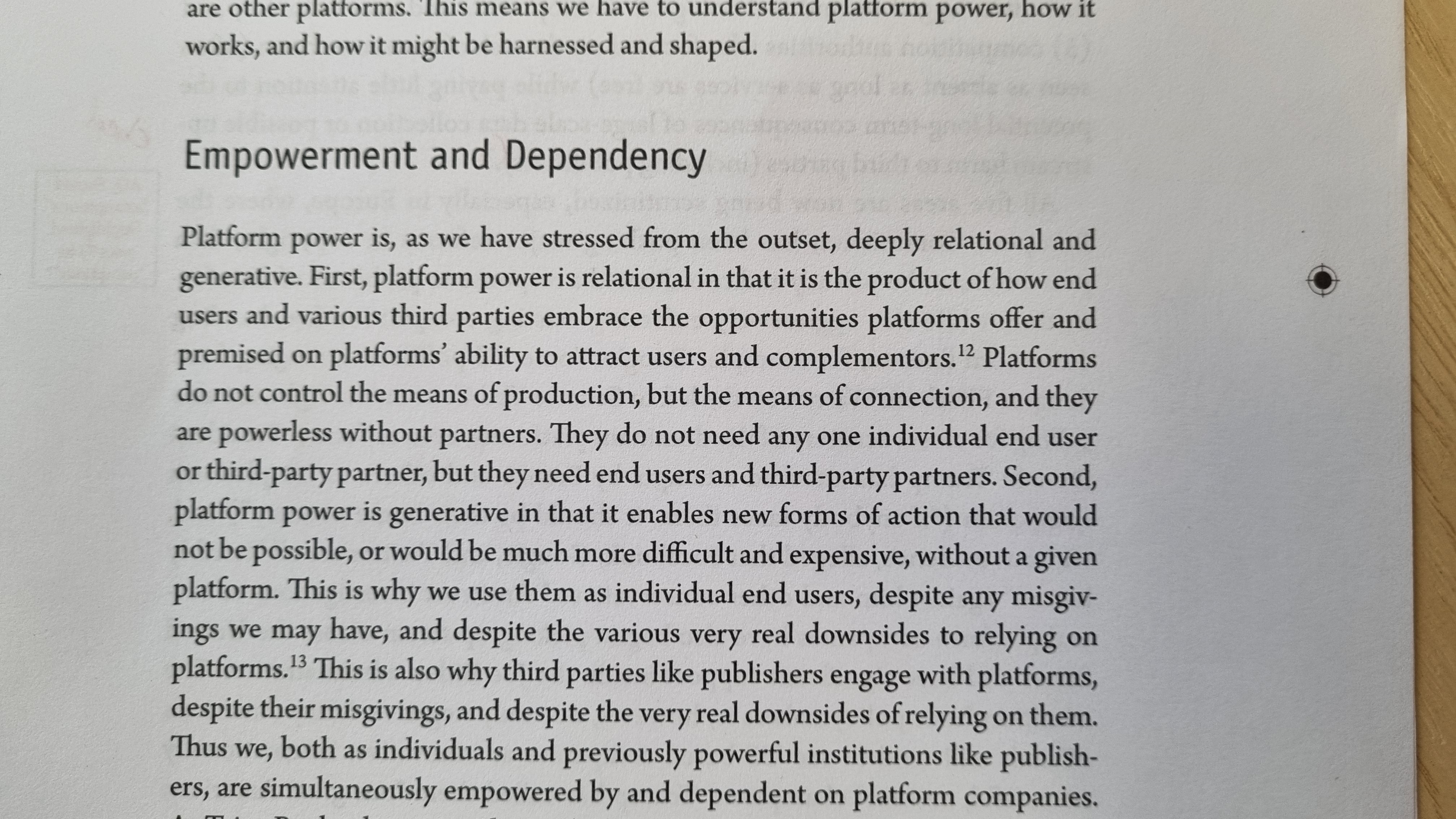
Our core argument is that the power of platforms is deeply relational and based on ability to attract end users and partners like publishers.
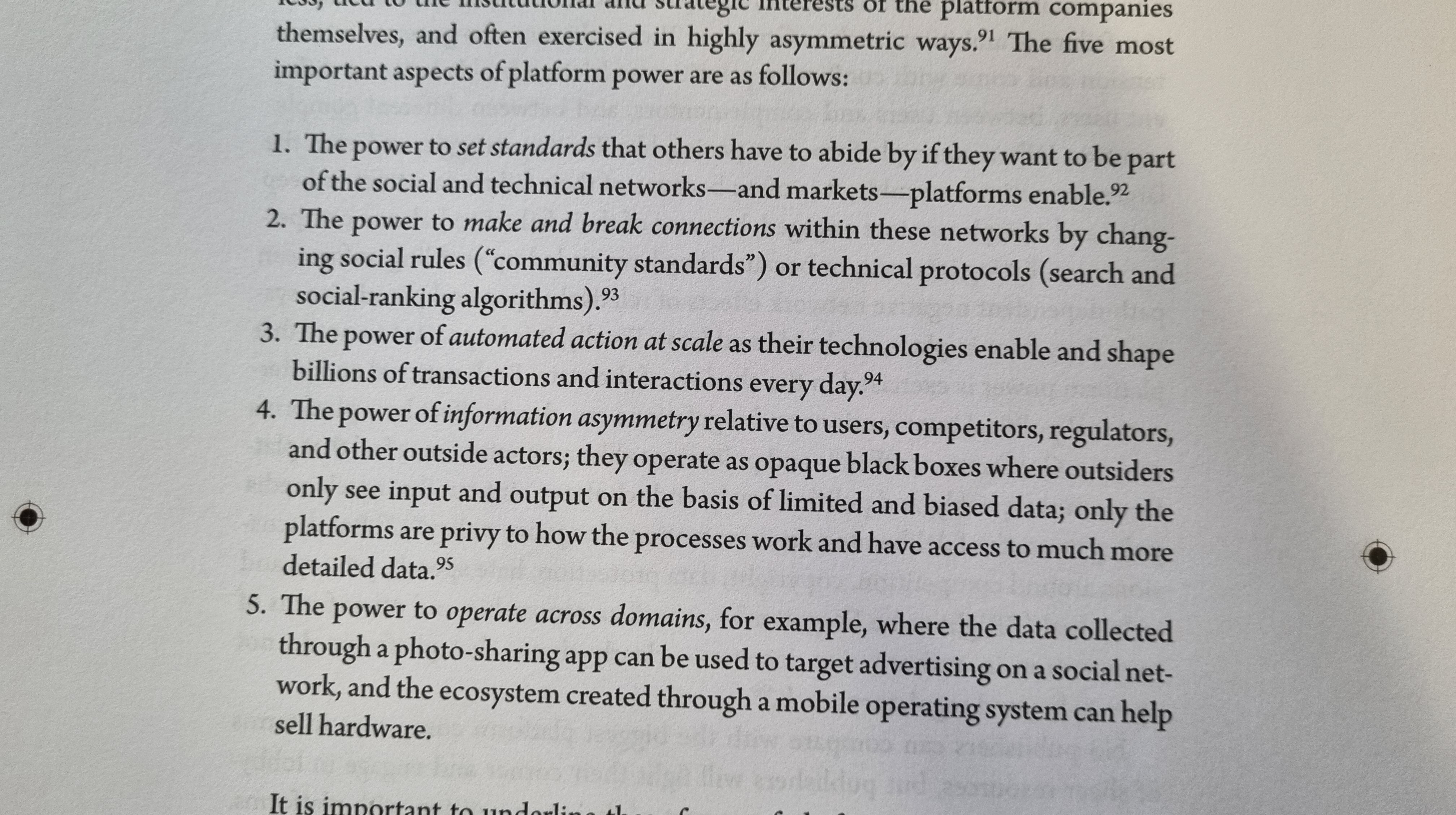
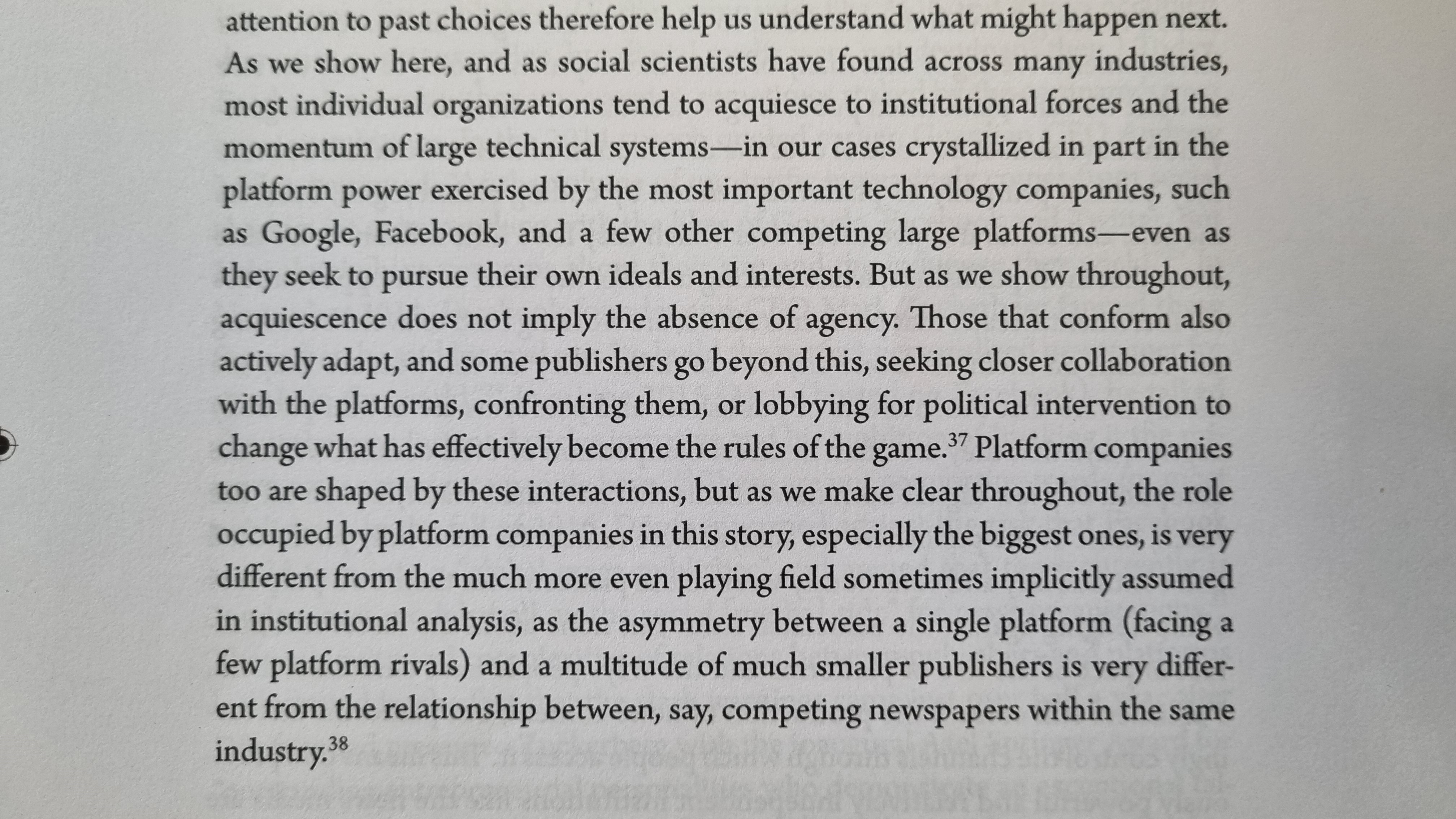
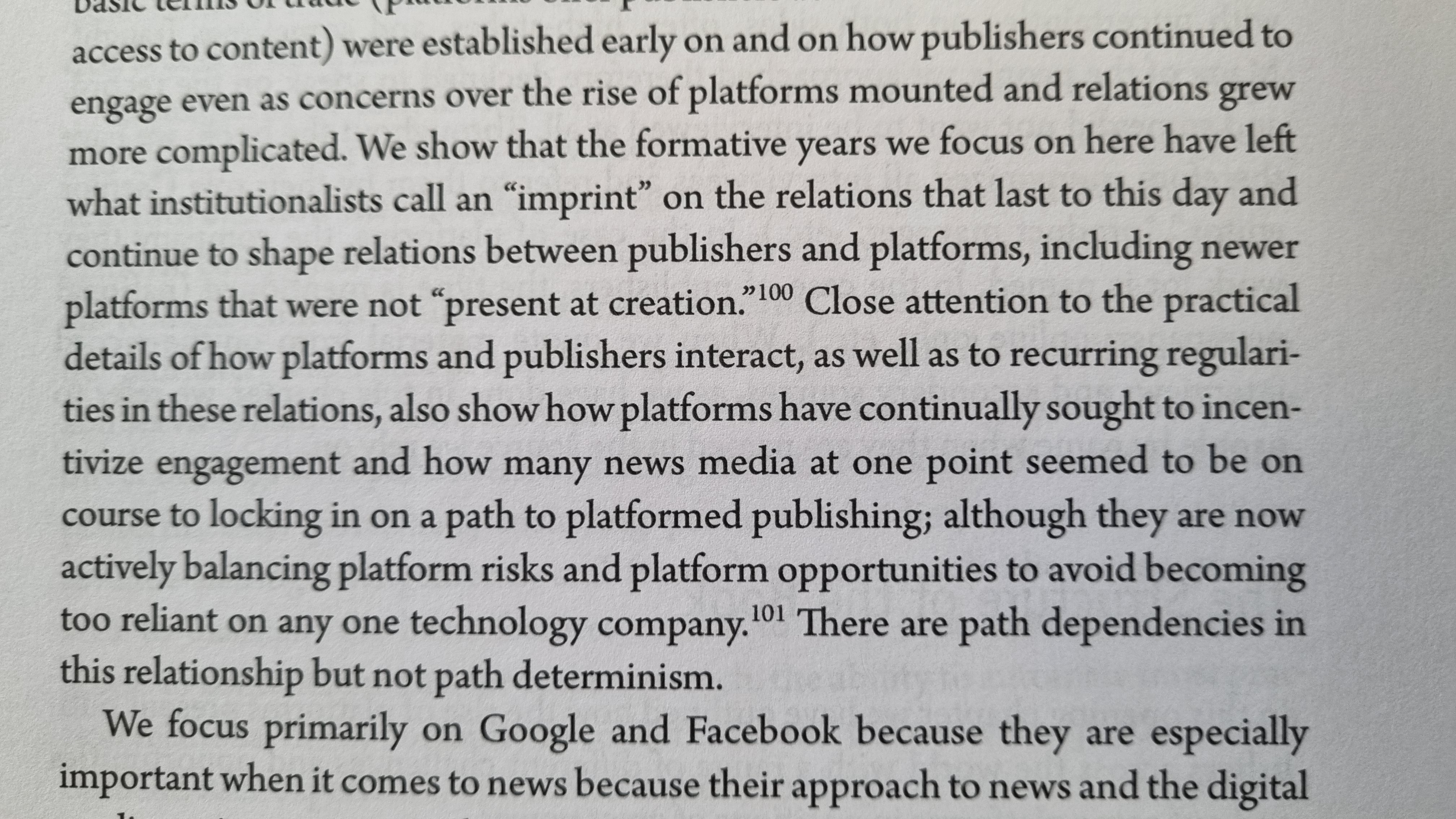
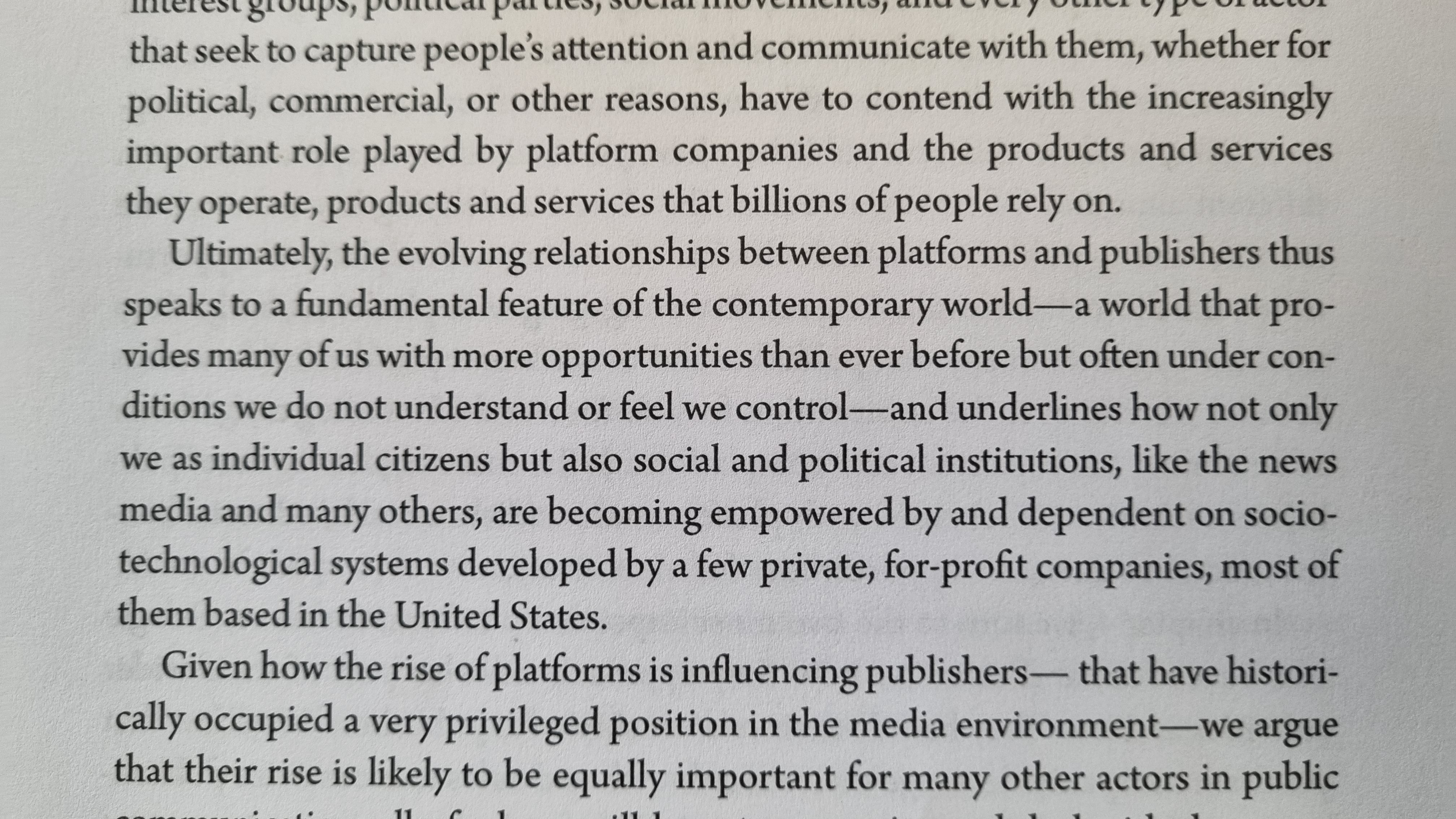
It’s always hard to summarize extensive empirical work briefly, but here a few key points from my short Twitter thread on the book, with a few pics of some central passages in the book.
Platforms do not control the means of production, but the means of connection, and they are powerless without partners. To understand their power we need to understand both reservations partners have and why they often embrace platforms nonetheless, continue to work with them.
Platform power is an enabling, transformative, and productive form of power—and power nonetheless, tied to institutional and strategic interests of platform companies, often exercised in highly asymmetric ways.
It goes beyond hard and soft power. We identify five main aspects.
In the short run, actors make choices, in the long run, these choices become structures. Both platforms and partners have agency here, but there is a huge asymmetry between the biggest platforms (facing a few big platform rivals) and a multitude of much smaller publishers.
We approach platform power through an institutionalist lens, and focus on how it is exercised in relational ways through socio-technical systems that develop path-dependency and momentum over time and retain an imprint of their founding logics that shape ongoing interactions.
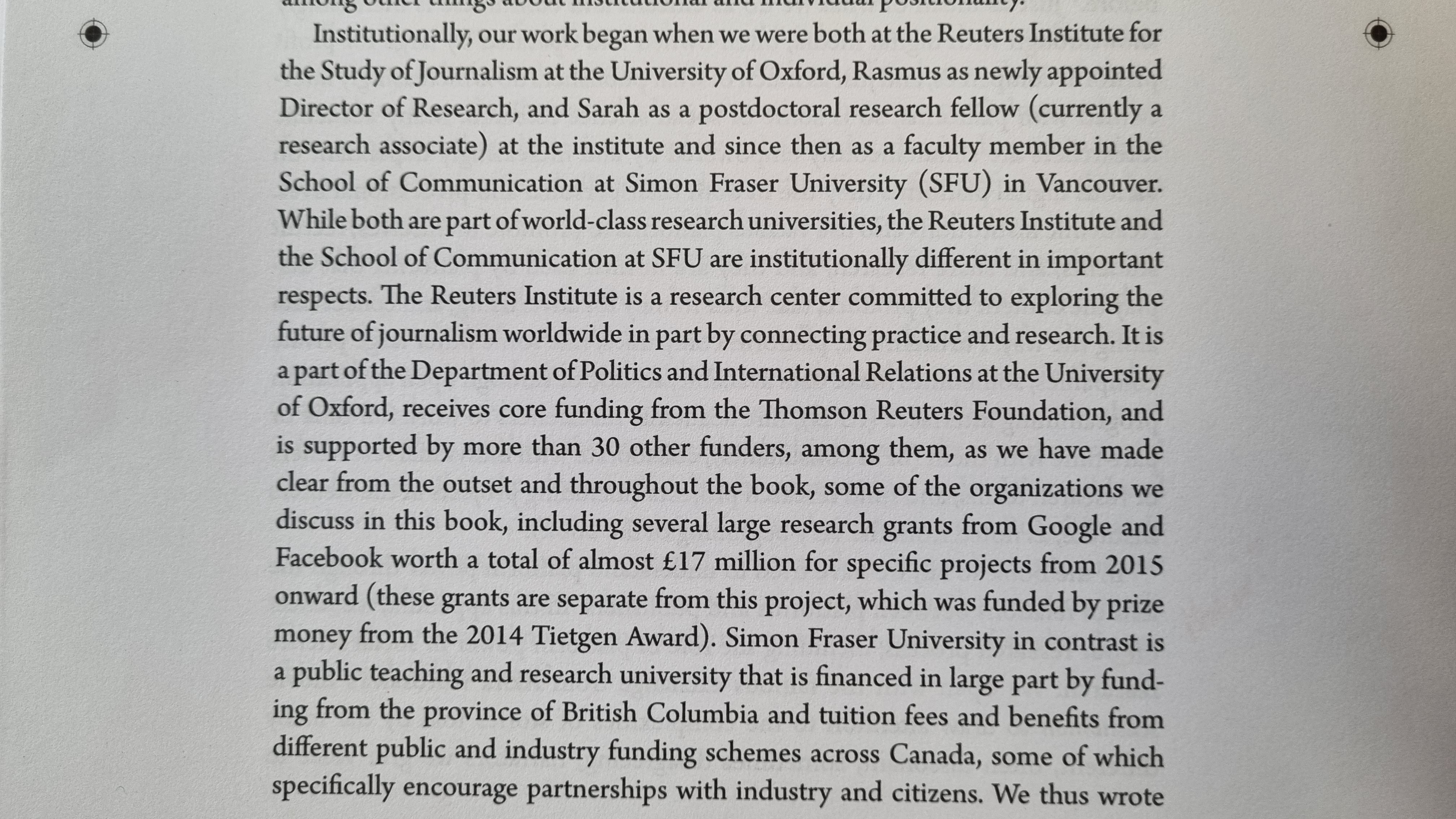
Our analysis is based on interviews across several countries, observation, background conversations, as well as on-the-record sources and more. In the methods appendix we reflect on individual and institutional positionality, including differences between the Reuters Institute for the Study of Journalism where I work and much of the research was done, and Simon Fraser University where Sarah now works.
The evolving relationships between platforms and publishers speaks to fundamental feature of the contemporary world – that not only individual citizens, but also social and political institutions, are becoming empowered by and dependent on a few private, for-profit companies
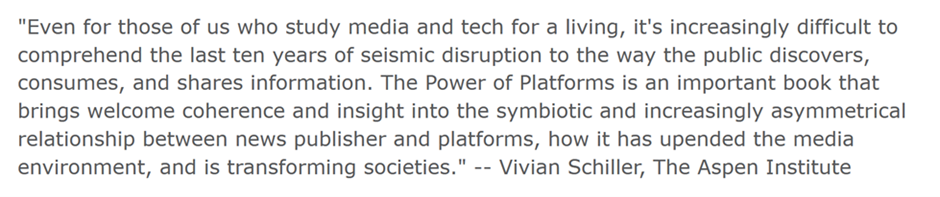
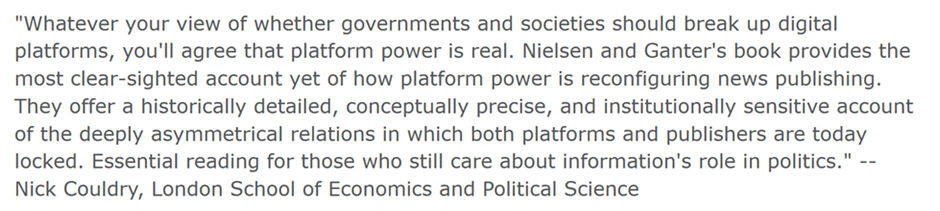
Very proud of the advance praise from colleagues with experiencing working in publishing companies, for platforms, as well as some leading academics researching digital media, including from Vivian Schiller, Nick Couldry, and José van Dijck. It means a lot to me personally to read what they kindly had to say about the book in advance of publication!
The research for this book was made possible by the prize money from the 2014 Tietgen Award, which funded Sarah’s position as a postdoctoral research fellow at the Reuters Institute for the Study of Journalism and the associated research costs.
We would like to thank first of all our interviewees and everybody else who has talked to us, joined off-the-record discussions we hosted, invited us to events, and let us sit in on meetings. The book would not have been possible without them sharing their perspectives, and whether they agree with our analysis or not, we hope they recognize the processes they are part of in what we write about here.
In addition, many different colleagues and friends have provided generous (and often challenging!) feedback as we worked on this, including David Levy, the former Director of the Reuters Institute for the Study of Journalism, and our many good colleagues there. Special thanks go to Chris Anderson, Gina Neff, Joy Jenkins, and Lucas Graves, who went through an entire draft manuscript with us and provided invaluable input. Daniel Kreiss and the anonymous reviewer helped further sharpen our thinking, and the series editor Andrew Chadwick went above and beyond in helping us develop our ideas. Fay Clarke, Felix Simon, and Gemma Walsh all did an outstanding job as research assistants at various stages of the project. Angela Chnapko at Oxford University Press masterfully guided us through the publication process.
I’m in the process of writing up a report that presents the main findings from the research project on the changing business of journalism and its implications for democracy that I’ve been involved in over the last two years.
In the project, we try to identify the key “big trends” in the media in a range of different democracies (Brazil, Finland, France, Germany, India, Italy, the United Kingdom, and the United States) over the first decade of the twenty-first century.
Given such a spread of countries, widely different in too many ways to mention, there is obviously not one thing, or even a few things, that have happened to media and democracy in all of them.
Nonetheless, I’m trying to summarize the main points—below is a condensed passage from the concluding part of the draft report. Any and all comments on its most welcome, here or by email.
Most fundamentally, the last decade has involved a continued expansion of the number of options available to audiences and advertisers. This expansion originates in political, economic, and technological developments that gathered pace in the 1980s and 1990s with deregulation of the media sector in many countries, the growth of multi-channel television, the launch of an increasing number of free newspapers in many countries, and the spread of first-generation internet access via dial-up modems. It has been vastly accelerated by the spread of digital television and broadband internet in the 2000s.
The expansion of options has lead to an erosion of the everyday audience of most individual media outlets across most platforms, pressuring sales and advertising revenues for commercial providers, especially in mature markets with limited growth—in some cases to an extent that has jeopardized sustainability or forced severe cost-cutting. Few significant newspapers or broadcasters have actually closed, but most are under pressure. One the one hand, media companies have responded by adding more and more outlets to their expanding portfolios—at the very least adding a website and mobile services to whatever print title or broadcast channel they have historically been based around. On the other hand, this move towards more and more integrated and convergent media companies has been accompanied by layoffs, demands for increased productivity, and internal restructurings. (The booming Indian media market, where industry revenues are growing at double-digit rates annually, has seen much more of the former than the latter, though a recession will almost certainly result in retrenchment and consolidation.)
While a handful of infrastructural intermediaries in the telecommunications, pay television, search engine, and social media sectors have built positions that allow them to exercise market power and generate considerable profits, most content-based media companies face increased competition. In their attempts to remain distinct and relevant to audiences they are under external pressure from a growing number of alternatives appealing to the same users and under internal pressure in cases where cost-cutting threatens investments in quality content.
National newspapers that in the 1990s primarily competed with each other today face competition from both freesheets, broadcasters, and online services. The terrestrial television channels that ruled the airwaves twenty years ago are now up against a growing number of digitally transmitted free-to-air channels as well as premium pay channels and audiovisual services streamed over the internet. Legacy media websites and internet portals that dominated online news provision ten years ago are under increasing pressure from a growing number of aggregators and other new alternatives. As when radio disrupted the media sector in the 1920s and 1930s and television did the same in the 1950s and 1960s, the introduction and spread of a new media platform and the emergence of a multitude of new entrants all catering to the same finite number of audiences and advertisers have had knock-on consequences for legacy media, forcing incumbents to adjust their existing operations and take a stance on how to position themselves vis-à-vis the new medium.
This fundamental strategic challenge is the same across the world, but differences in conditions on the ground means that the tactics and outcomes vary in significant ways.
…
Amongst affluent democracies, the development is most dramatic in the United States, where all major news providers, with the partial exception of local television stations and a few cable channels, have lost revenues, seen their profit margin shrink or disappear, and have cut their investment in journalism. In much of Europe, public service providers face strategic challenges associated with the expansion of choice and the intensified competition for audiences, but their revenue models remain fundamentally solid. In Northern Europe, including Finland and Germany, commercial legacy media companies coming out of both print and broadcasting have so far managed to hold their own despite the spread of multi-channel digital television and high levels of broadband penetration. In Southern Europe, broadcasters have also held their own while many newspaper companies are struggling as challenges associated with the rise of the internet threaten their already weak commercial foundations, forcing some to rely on cross-subsidies from non-media businesses or financial support from their owners. In Brazil and India, large parts of the media sector are booming, but the revenues are not necessarily invested in quality content.
In the absence of dramatic change in media use, media markets, or media policy, and assuming no new game-changing technologies are waiting in the wings, media systems in affluent democracies are likely to see (a) a continued erosion of most media audiences and an increasing number of only partially overlapping niche audiences, (b) the continued decline of a newspaper industry that has in some cases enjoyed a few decades of monopoly-powered profitability but has been on the retreat overall in many countries for longer (as newspapers, for all their trouble, has been the main underwriters of professionally produced news journalism this has direct consequences for the number of reporters employed), (c) a continually growing gulf, driven in part by people’s preferences, in part by niche-oriented marketing logics, and in part by competition between outlets keen to differentiate their products from the competition, between the few who will in all likelihood be more informed than ever before, and the many who will receive, seek out, and find less and less news produced for them, especially if they belong to groups not considered attractive by advertisers. We are still at the beginning of the shake-out that will follow.
The full report will be published in October–stay peeled.
Together with my near-namesake, Rasmus Helles, I’ve written an op-ed in Berlingske on media trends and media policy in Denmark, arguing we need to support not only content production and diverse provision, but also broad reach in the population if we are to continue to have some of the best media in the world.
Uanset om du læser denne kronik i avisen, på nettet, eller fordi nogen har delt den med dig via Facebook, så tilhører du sandsynligvis den mest overforkælede mediemålgruppe i verdenshistorien. Selv om avisoplagene falder, TV- og radiokanalerne presses af konkurrencen om vores opmærksomhed, redaktionelle satsninger på internettet har svært ved at løbe rundt, og internationale giganter som Google sluger store dele af annoncemarkedet, så har de veluddannede, velhavende byboere over 30 stadig flere medieprodukter at vælge imellem. Men medierne producerer ikke kun indhold til os som individuelle forbrugere. De spiller også en bred demokratisk rolle, der vedrører os alle som medborgere – og selv om Danmark stadig har nogle af verdens bedste medier, er den rolle i dag truet.
When Europeans concerned with developments in the media talk about “Americanization”–as Lord Puttnam in this old story from the Guardian–they are usually lamenting some development or other.
Tomorrow, I’ll be presenting a paper at the Future of Journalism conference in Cardiff arguing that, when it comes to market structures and media regulation (rather than, say, professional norms or forms and formats of content), these fears are overblown, and that we have, in fact, not seen convergence on an American-style media model over the last ten years.This is not to suggest that there is nothing to worry about, only that the notion (or rhetorical trope) of “Americanization” is of little use in terms of understanding our predicament.
The abstract is below–comments and feedback welcome, this is work in progress.
The Absence of Americanisation—media systems development in six developed democracies, 2000-2009
By Rasmus Kleis Nielsen (University of Oxford)
“Americanisation” is one of the most frequently used and mis-used terms in discussions of international media developments, a supposed trend much feared by Europeans who are (sometimes justifiably) proud of the distinct qualities of their media systems. In this paper, I present a comparative institutional analysis drawing on media and communications studies (Hallin/Mancini 2004), political science (Hall/Soskice 2001) and sociology (Campbell/Pedersen 2001) and based on data on developments in media markets, media use, and media regulation in six developed democracies (the US, the UK, France, Italy, Germany, and Finland) from 2000 to 2009. I argue that, despite frequent predictions of progressive “system convergence” (Humphreys 1996; Hallin/Mancini 2004; Hardy 2008), the last decade has been characterized by an “absence of Americanisation” of the news institutions in the five European countries considered. National institutional differences have remained persistent in a time of otherwise profound change. This finding is of considerable importance for understanding journalism and its role in democracy, since a growing body of research suggests that “liberal” (market-dominated) media systems like the American one increase the information gap between the advantaged and the disadvantaged, have lower electoral turnout, and may lead large parts of the population to tune out of public life. The finding also has theoretical implications, since the supposed drivers of system convergence—commercialisation and technological innovation—have played a very prominent role during the period studied, suggesting we need to rethink the role of economic and technological factors (and their interplay with other variables) in media system developments.
Though Western media systems are going through a rapid and often painful transformation today with the rise of the internet and mobile platforms, the decline of paid print newspaper circulation, and the erosion of the largest free-to-air broadcast audiences, the ways in which governments provide direct and indirect support for the media have remained largely unchanged for decades.
The bulk of the often quite considerable direct and indirect subsidies provided continue to go to industry incumbents coming out of broadcast and print, while innovative efforts and new entrants primarily based on new media receive little or no support. In central ways, public support for the media remains stuck in the twentieth century, and some parts of these support systems are in need of real reform to be brought into the twenty-first we live in.
That is the thrust of a report called ‘Public Support for the Media’ that I’ve written with help from Geert Linnebank, former Editor-in-Chief of Reuters. In it, we review the various forms of subsidy in place in Finland, France, Germany, Italy, the United Kingdom, and the United States.
In all these countries, the main forms of support relevant today have been put in place in the 1970s and in many cases long before. None of these countries have carried out major reforms of their subsidy systems to take into account the changes the media industry has undergone over the last twenty years. The bulk of the public support provided continues to go—
First, especially in Europe, directly to public service broadcasters with varying commitments to the online and mobile services people increasingly desire, and
Secondly, in all the countries covered including the United States, indirectly through various forms of tax relief to paid printed newspapers that remain of central importance in terms of generating original general interest news content on a regular basis, but are suffering from declining readership and stagnant revenues.
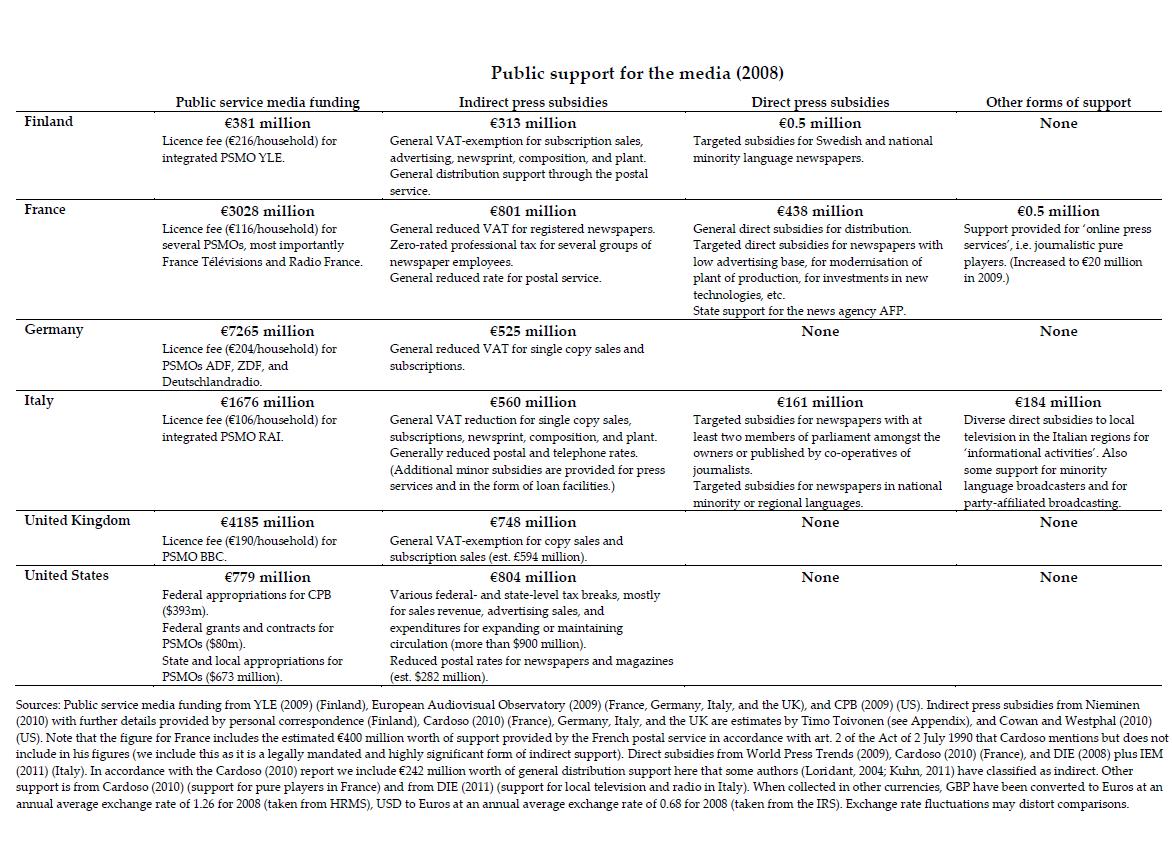
It is well-known that most European countries remain committed to public service broadcasting, but it is less well known that private sector print publishers in most countries benefit from very substantial forms of indirect support. The British press, for example, benefits from VAT relief worth an estimated £594 million (€748 million) every year.
The large table below (click to enlarge) provides an overview over the main forms of support in place in the six countries, and their estimated total value. As is clear, the sums involved are considerable, even if they pale by comparison to how much revenue some parts of the industry has lost in recent years (US newspapers have seen their total revenue decline by more than $20 billion since 2000).
A lot of money thus goes to supporting broadcast and print media in various ways, media that continue to be important for how people keep informed about public affairs, but also media that are increasingly being supplemented by online and mobile media of various sorts. Despite the well known and rapid spread of internet access and increasingly smart mobile phones, today, of all the six countries covered in the report, only France offers any meaningful support aimed directly at online media—and that to the tune of about €20 million a year after reforms in 2009, less than 0.5% of all the support provided. (The ‘Other support’ available in Italy goes to private sector broadcasting.)
Our aim with the report has been to collect in one place information on various forms of public sector intervention meant to encourage and foster vibrant and diverse media systems. Rather than discuss each kind of policy—broadcast, press, online, etc—separately and on its own terms, we have wanted to provide a more general overview over forms of intervention in increasingly convergent media markets and help shed some light on an otherwise all too opaque policy area attracting increased interest as some commercial media companies continue to struggle and newsrooms in many countries are cut. In several countries, detailed reports on the national support systems have been published in recent years (see for example this one from the US, this one from France, or this one from Finland), but we are not aware of any comparative overviews bringing together different forms of media support the way we have done.
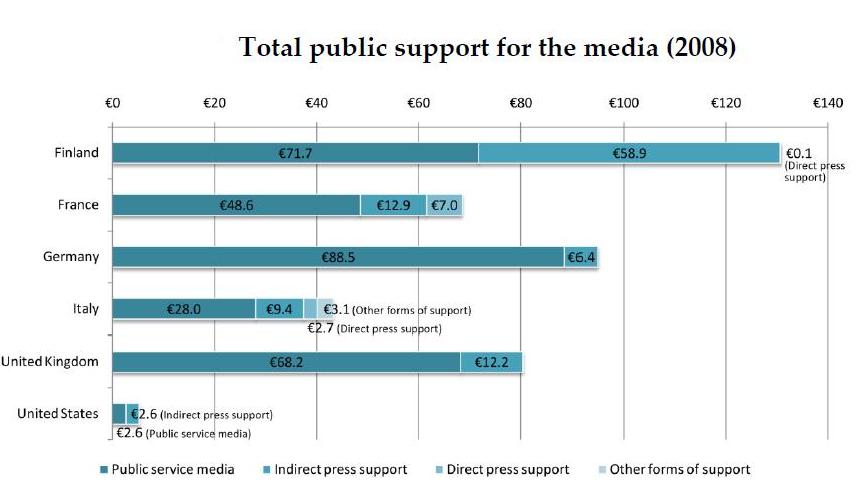
This kind of cross-country comparison can help identify overlaps—like the absence of change and the bias in favor of legacy media common to all the countries considered here—but also map out differences. Different developed democracies support the media to different degrees and in different ways—of the countries we looked at, Finland, Germany, and the United Kingdom offer the most support in per capita terms, based on robust public service funding and VAT relief for historically strong newspaper industries. France and Italy has more extensive support systems in place, but their total value is actually lower in per capita terms partially because of their lower license fees, partially because tax relief is worth less for their much smaller press. The US is the clear outlier amongst developed democraces, with minimal public support, mainly for public service broadcasting (through federal and state appropriations) and for print publishers (through various forms of tax relief).
The figure below breaks down the absolute sums in terms of support per capita to make them more directly comparable than absolute figures (listing 5.5m population Finland and 300+m population US side-by-side may invite misunderstandings).
As is clear, there are important variations in how these six different countries support the media. But in all of them, direct and indirect subsidies runs to billions of Euros per year and overwhelmingly go to legacy media organizations coming out of broadcasting and print, while new media initiatives—whether pursued by these or by new entrants and entrepreneurs—get basically no support.
As our media systems change and people’s media use switches towards new media platforms, the effectiveness of the inherited forms of intervention will decline. Especially indirect support for the press—support still considered “essential” by industry associations—is and has been far more significant than most people realise. But support systems built around legacy platforms of relatively diminishing importance will lose their effectiveness as current trends in the advertising business and in people’s media habit continues. As newspaper circulation and revenues from print sales and advertising thus decline, the value of the indirect subsidies meant to help the industry thrive will diminish—and they do nothing to help it address the more fundamental challenge of structural adjustment that it faces.
Whether one wants public support for the media or not is a political question (and one all developed democracies have answered in the affirmative in the twentieth century), but as people’s media habits and the economics of the industry change, effective intervention probably ought to be built around the “information” part of the sentence quoted above rather than the “several large sheets” part (just as “public service broadcasters” have in many countries sought to redefine themselves as “public service media organizations” to emphasize their cross-platform ambitions).
It will not be easy to develop new forms of public support for the media. New policies intervening in a sensitive area crucial for the functioning of our democracies will have to command wide political support, navigate industry and professional concerns, and at the same time try to meet the multiple ideals of being platform neutral (not biased in favour of any one distribution system), of being viewpoint neutral (not affording politicians or others too many opportunities to meddle), of being targeted enough to make a difference (one can’t support everything), of being governable and transparent (so that recipients can be held accountable in the public interest), of not distorting competition unnecessarily, and of being able to pass muster under various anti state-aid provisions in for example the European Union.
Developing new policies in this area is not a question of simply shouting “out with the old, in with the new” and switching support wholesale to new media—most news, for examples, is still accessed via linear broadcast and print newspapers, even though other platforms are of growing importance. Reform is a more difficult issue of deciding what it is one wants to support—what kind of public interests public support should serve, what kinds of public goods one wants delivered—and developing forms of direct and indirect support that effectively encourage that without too many malign side effects.
Developing such policies will be hard, difficult work, and call for renewed intellectual and political leadership—but it is also much needed work. Reform is necessary if we want to move beyond supporting our media past while ignoring the future.
Note: We decided to look at these six countries because they represent distinct approaches to media policy and have different media market structures. (For more on this, see for example the chapters on each (bar Italy) in the book I edited with David Levy last year). I should add that our review is not completely comprehensive in that we leave out public notice laws, regulatory relief in competition and labour law, and many other potentially important but smaller forms of support for certain media, and that it is not absolutely up to data as the last year on which the necessary information was available on all six countries was 2008. We have focused on support for the main kinds of content-producing media companies with at least a partial interest in news journalism, and thus left out both telecommunications and support for, for example, movie production and various kinds of art and culture.