How quickly does the structure of digital media use change, and how well have incumbents been able to defend their position and remain competitive through waves of technological innovation and changes in user behavior?
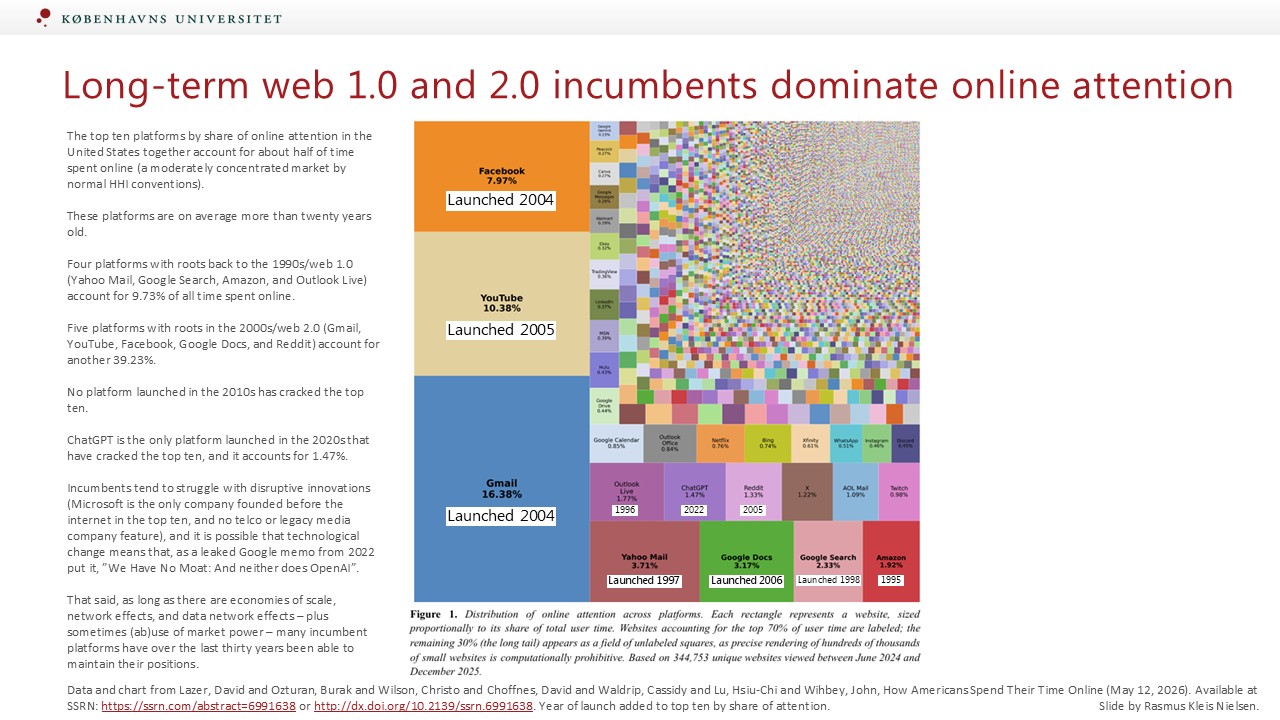
After an interesting workshop discussion yesterday I had a look at this question using data on share of time spent online in the United States as the metric. The slide below provides an overview.
The top ten platforms by share of online attention together account for about half of time spent online (a “moderately concentrated” market by normal HHI conventions).
These platforms are on average more than twenty years old.
Four platforms with roots back to the 1990s/web 1.0 (Yahoo Mail, Google Search, Amazon, and Outlook Live) account for 9.73% of all time spent online.
Five platforms with roots in the 2000s/web 2.0 (Gmail, YouTube, Facebook, Google Docs, and Reddit) account for another 39.23%.
No platform launched in the 2010s has cracked the top ten.
ChatGPT is the only platform launched in the 2020s that have cracked the top ten, and it accounts for 1.47%.
Incumbents tend to struggle with disruptive innovations (Microsoft is the only company founded before the internet with a platform in the top ten, and no telco or legacy media company feature), and it is possible that technological change means that, as a leaked Google memo from 2022 put it, ”We Have No Moat: And neither does OpenAI”.
That said, as long as there are economies of scale, network effects, and data network effects – plus sometimes (ab)use of market power – many incumbent platforms have over the last thirty years been able to maintain their positions. (This has been an argument Matthew Hindman in particular has made in academic research in this area, e.g. here.)
The last thirty years thus simultaneously demonstrate (a) that real, structural change does sometimes happen, and can happen fast (as in the 1990s and then again the 2000s), but also that (b) while some end up much diminished when overtaken by the pace of change, many incumbents are able, by hook or by crook, to maintain their position.
(Added: I should have made explicit above that the above data is on desktop browsing, so there is a significant issue with capturing mobile, app-first 2010s social platforms and games, skewing the picture. I still think/hope it is useful.)
The incentive structure around grounding AI outputs on real-time related issues looks busted, and PR and other forms of strategic communication may increasingly drown out news content if the incentives for news publishers remain unclear.
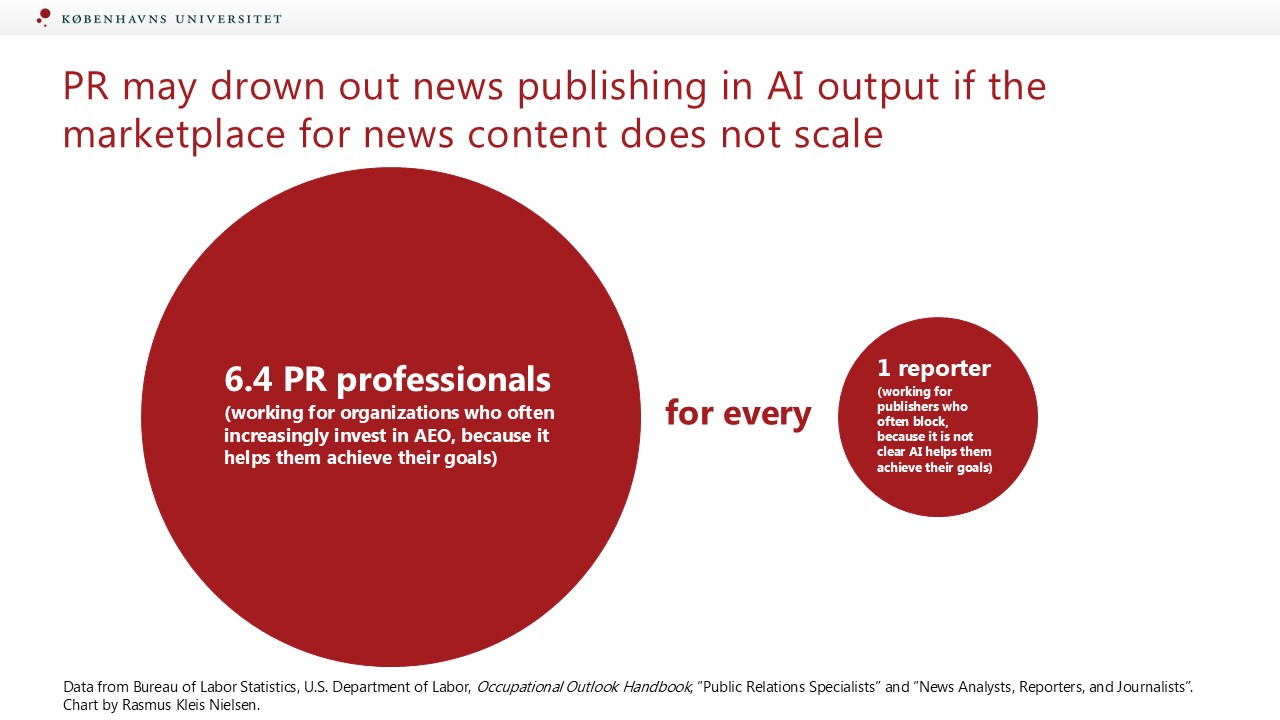
As with so many other topics around AI, the underlying issue isn’t new, exactly. PR professionals already outnumber reporters by a ratio of 6.4-to-1 in e.g. the United States.
The AI angle on that ratio is this: Every kind of strategic communication from advertising to marketing to public relations seems to be increasingly investing in “Answer Engine Optimization” (AEO) to increase their chances of featuring in and influencing output (remember, it’s only called “LLM grooming” when others do it). Meanwhile, publishers are often blocking AI crawlers in frustration over what many of them experience as increasingly rapacious extraction of their intellectual property that delivers very little of the referral traffic that underpinned the de facto content-for-reach terms of trade they acquiesced to around search engines and social media for decades, and no other clear incentives either.
Strategic communications is supply-driven, and has incentives to lean in to AI
Strategic communications broadly speaking is supply-driven and underwritten by those who have money to spend on getting their message “through the right channel, to the right person, at the right time” (as the mantra goes). AEO professionals are increasingly helping their clients do that by recommending e.g. making content that is relevant to target audiences’ likely information needs and questions, building topical authority, making the content crawlable and presented as structured data so it is easy for AI crawlers to access and extract, etc.
So strategic communicators want in to AI output, because it helps them achieve their goals. (Elsewhere, I have written about this broad and heterogenous category as “promoters”.)
Publishing is demand-driven, and the incentives are unclear
Publishing, in contrast, is demand-driven and underwritten by paying users and advertisers who want to pay to reach users. Right now, crudely put, publishers invest in content, but often don’t see any real return on that investment from AI, because AI for most of them deliver tiny amounts of referrals (the traffic from search and social that could, in the past, help sell subscriptions and generate advertising revenue), and because the vast majority of them are not paid anything by any AI company.
Referrals first. Late last year, Google delivered about 6 billion referrals to the 2,576 sites in the Chartbeat network, and Facebook about 1 billion. (Numbers from data shared with the Reuters Institute.) Of course publishers would love to be paid as well. But even in the absence of payment, most will want the referrals. By comparison, in the same period in the same population of publishers, ChatGPT delivered 4.6 million referrals, and Perplexity 449,422. That’s more than three orders of magnitude between ChatGPT and Google. Referrals from by far the most popular consumer-facing AI chatbot are only little more than 1/10 of referrals from X, themselves a rounding error of overall traffic and of limited commercial value to most publishers.
Licencing deals next. Depending on what you consider a deal there are, according to Cloudflare, about 50 or so publisher-AI agreements. That’s not nothing, and some of the individual publishers are privately or publicly happy with the deals they have. But there are thousands of major and medium-size publishers globally (WAN-IFRA alone organizes more than 3,000 news publishing companies), and tens of thousands smaller ones. Considering only the major and medium-size publishers, that means less than 2% of them have any kind of deal. Meanwhile, AI companies and the various third parties who crawl content for them are making an aggressive bet premised on the claim that all or most of this is fair use and/or transformative and/or covered by text-and-data-mining exemptions etc. etc. etc., and whether that is so or not will probably take years and millions in legal fees to establish.
Given this lack of clear incentives, it is not surprising that, according to Buzzstream, 79% of top news sites block AI training bots and 71% also block AI retrieval bots.
So many news publishers do not want to go in to AI output, because it is not clear it helps them achieve their goals, and may in fact undermine them.
What does strategic communications leaning in, and many publishers blocking, entail?
I am not suggesting all strategic communications, or other content that those behind it actively invest in and make freely accessible for AI use (as they do for many other uses) is necessarily always bad for grounding, or that publisher content is always intrinsically good for every purpose or all users, or necessarily better than alternatives from other sources. The European Union, the US National Institute of Health, NASA, the US National Oceanic and Atmospheric Administration, and the World Bank are among the top 500 registered domains of the last main/monthly crawl from Common Crawl.
These are different kinds of public institutions that invest in content and make it available, also for AI. Many top universities also feature. Some are private, some are public, again, they invest in content that is made available, also for AI. Numerous private companies that aren’t publishers also figure on the list, all the way down to Deloitte at number 500. That’s good for AI companies, and arguably good for users.
At the same time, when it comes to news, the overall incentive structure looks kind of busted to me, at least for real-time output. It may only be a small part of overall use, and not the most important. But it is arguably still important, at least in a public sense. PR and other forms of strategic communication are accustomed to spend money, sometimes a lot of money, to get their content, their narrative, their version in front of people. Publishers, most of whom are for-profit, and others of whom are non-profits with bills to pay, try to make money from the content they offer to people. The first group can live with the current terms of trade around AI. The second group? Unclear. Over time, this does not point to a great equilibrium.
What are some possible medium-term scenarios for news?
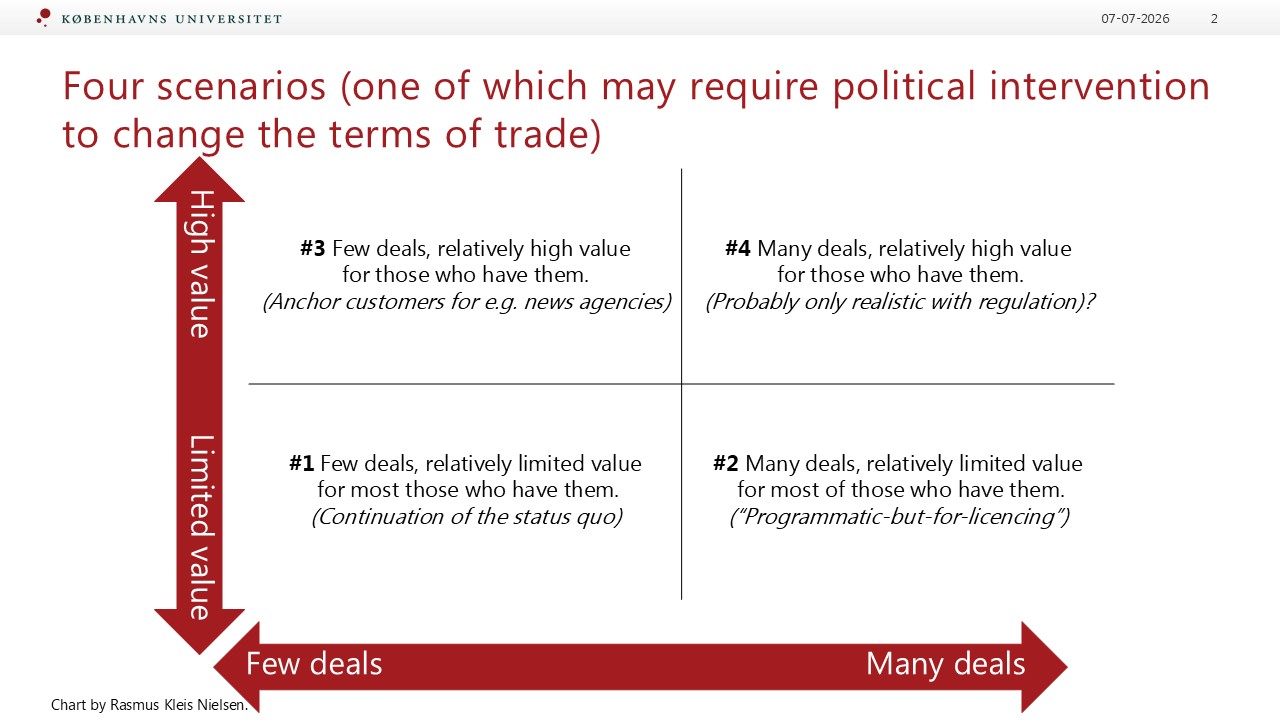
Leaving strategic communications/PR aside and focusing on news, in terms of supply (publishers) and demand (AI companies willing to strike deals), abstractly, we can map the possibilities along two axis – few deals versus many deals, and limited value deals versus high value deals.
(“Value” here could potentially be referrals, the traditional currency of content-for-reach, but across both AI, social, video, and more platforms we seem to be moving away from referrals so unless other incentives are provided, value here would mean some kind of payment.)
That gives us four scenarios. They are not mutually exclusive, but provide a stylized sense of different landing zones. Given current dynamics, one of them (many deals/high value) seems to me to only be realistic if AI companies are basically forced to pay in some way.
So here we go –
Scenario 1 – Continuation of the status quo (few deals, of relatively limited value for most those who have them)
This is a scenario where the dominant trends are the current ones. So more PR, perhaps a growing market for content farms willing to enter on terms many other publishers find unattractive, few deals and in most cases of relatively limited value to participating publishers. (We fundamentally don’t really know what the current deals are worth, but in the cases where do, whatever other value they may hold they seem to represent incremental revenue.)
In this scenario, AI output at least around real-time issues is increasingly grounded in content that mostly comes from those willing to actively invest in making information accessible to AI companies, new AI-directed content farms driving “market for lemons” dynamics, and only subsidiarily a limited number of AI-darling publishers with deals. This is, by and large, a market that treats news as an information commodity, and, as was pointed out almost thirty years ago, information commodity markets don’t work.
Scenario 2 – “Programmatic-but-for-licencing” (Many deals, relatively limited value for most of those who have them)
Here we would see more licensing, mostly at very low rates. This would be a world where the marketplace begins to scale beyond a few dozens of often bespoke deals to include a much, much larger number of publishers. Cloudflare, one of the companies trying to build the infrastructure for such transactions, argues that a “licensing economy is emerging”, Microsoft is offering its “Publisher Content Marketplace”, Amazon has reportedly been planning one.
All of these (and several start-ups) come out of the technology industry. Meanwhile, the SPUR coalition of publishers – perhaps informed in part by publishers’ mixed experience with programmatic advertising infrastructures developed by tech companies – is, among other things, intending to “evaluate existing industry infrastructure and assess where new technologies or approaches are needed”, suggesting the possibility of a marketplace infrastructure developed from a publisher/supply side perspective rather than from a technology industry/demand side perspective.
In this scenario, licencing could work akin to programmatic advertising, something many publishers have as part of their revenue mix, even though the money involved can be limited.
Scenario 3 – AI companies as anchor customers for e.g. news agencies and a few others (Few deals, relatively high value for those who have them)
We might also see few, but much bigger deals. Here, deals continue to be the exception, but those who do get deals scale up what they offer to AI companies, and how they offer it.
It is noteworthy that news agencies – long accustomed to B2B wholesale deals with the requisite B2B technical infrastructure – feature prominently among those who have already struck deals. The three biggest ones, AFP, Associated Press, and Reuters all have one or more deals. EFE is also part of a deal. AFP and Associated Press both publish more than 300,000 text stories every year, and Reuters over 2 million, and the content is essentially all news reported to very high professional standards. (By comparison, a big general interest news title might publish something like 50,000 units, and much of this will not be news but entertainment, lifestyle, opinion, recipes, travel, etc.)
News agencies are also not unaccustomed to having a few key customers/ sources of revenue. The London Stock Exchange Group pays Reuters News $325 million per year, somewhere in the region of half of Reuters’ revenue. The French state provided AFP with €120 million in funding in 2025 as compensation for fulfilling a mission of general interest, about a third of AFP’s revenues.
Compared to AI investments projected by some analysts to exceed $1 trillion in 2026, and packages for some individual AI engineers reportedly running into the hundreds of millions of dollars, if an AI company believed exclusive access to news content would give it a competitive edge vis-à-vis its rivals, surely they would spend as freely on that as they do on talent, data, and energy? (Some primarily B2C news publishers could try to get in on this, as some have in the past operated what was effectively their own news agencies. You could also imagine vertical integration, but I suspect AI companies, conscious of the scrutiny this would draw from politicians and regulators, and the legal liabilities that would surely follow, will hesitate – Google considered this almost twenty years ago but decided against it.)
In this scenario, you might see a lot of content made available by a few respected major publishers.
Scenario 4 – something for everybody? (Many deals, relatively high value for those who have them)
Right now, I just do not see effective demand for this from the AI companies. Big or small, old or new, they do not seem to think they need lots of significant content deals to compete with one another. They do not seem to think they are under any legal or regulatory obligation to strike lots of deals. Unless that changes, that means this scenario seems to presuppose some kind of political intervention.
That’s a matter for citizens and their elected officials. Both the domestic politics (especially if a country has, or wants, AI companies) and the geopolitics (if they want to be on civil terms with the few, big countries that have AI companies) of this are complicated. But many politicians and some governments around the world are clearly signaling that they regard the current trends and status quo as problematic.
If elected officials want to do something, there are any number of possible interventions here, from facilitating collective management organizations to final offer arbitration to cultural levies to hypothecated taxes to statutory licensing regimes. Almost all would require legislation which is slow, uncertain, and relies on elected officials and the government of the day (including their willingness to tangle with, for example, a US government that has, under both for example the Obama administration and more vocally the current Trump administration, regarded much tech regulation in other countries as thinly-disguised protectionism). And as with all public policy, the devil is in the detail, and every intervention will necessarily have winners and losers, in publishing, and in society at large.
Where might each lead?
These four scenarios are not all mutually exclusive, but each foregrounds a different aspect and dynamic.
Under scenario #1, publishing arguably plays a smaller and smaller role in grounding AI output on real-time issues, leaving more and more space for the strategic communicators and PR professionals I started with. That seems to be the current direction. (Surely AI companies are at least aware of the risk this could pose to them over time?)
Under scenario #2 more publishers are paid, and the news they produce serve to ground AI output on real-time related issues, though on terms that may not be what they had hoped for. It could help reduce the relative role of strategic communications and PR, and increase supply of news, but if rates are mostly (very) low, may still be subject to the market for lemons problem.
Under scenario #3, a few publishers really scale up what they offer and how they offer it, paid for – at a completely different scale – by competing AI companies. This could supercharge existing winner-takes-most dynamics in publishing (this report points at related dynamics) and simultaneously provide a generally strong basis for grounding AI outputs on real-time issues in key markets, strengthen a few publishers, while potentially making AI a (even greater) challenge for many other publishers.
Under scenario #4, publishers probably have to rely on politicians to change the terms of trade in ways that are to their benefit – and, if done well, hopefully also serve a wider public. This one is, to an even greater extent than the others, incredibly uncertain, so who knows that that would look like (other than probably necessitating a more direct political intervention in the news media market).
What have I missed? (Other than the data here being limited so a lot of this necessarily speculative, and the majority of these scenarios mostly about the context of high-income democracies I am most familiar with, not representative of the situation and possible paths elsewhere.) Other plausible scenarios for where this goes? It is early days yet, and while there are observable dynamics, the situation remains shifting and contested. Let me know where you think it is heading.
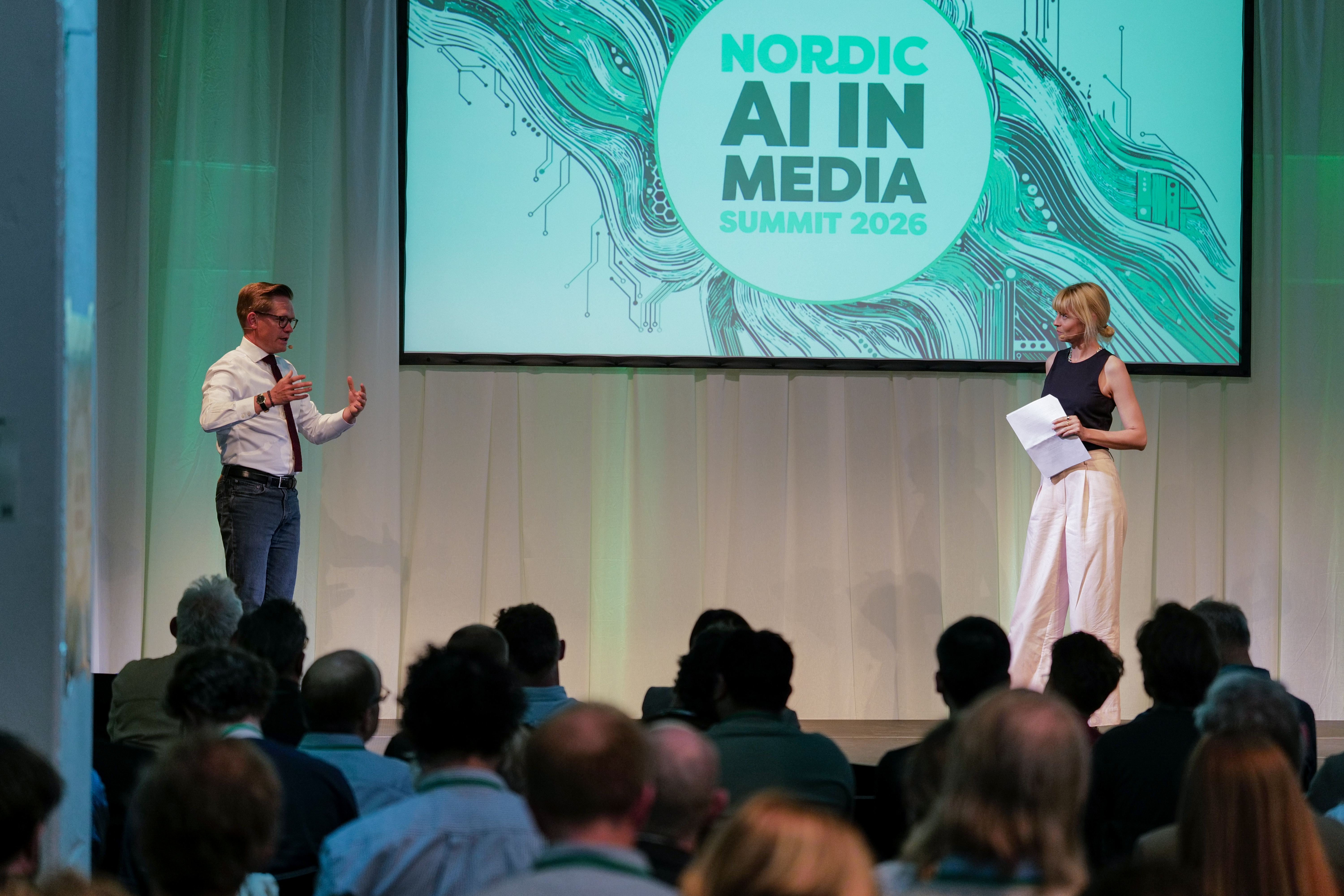
I gave the closing talk at the Nordic AI in Media Summit 2026 May 27 – 28th Copenhagen, Denmark. It is an incredible event, and it was a privilege to be part of it. A video of my talk is here. The audio is a bit uneven, so below a transcript, lightly edited for clarity and with a few links to sources added.
What’s in it for me (as a member of the public)? A ‘public test’ for AI in news
Thank you very much for this opportunity to be here and learn from all of you, and also to speak today. So what I want to do today is to make a very Freudian move: ‘Enough about you, let’s talk about me.’
I want to do that in an assuming role, if you will, as an individual member of the public.
Anything in this presentation that’s good is to the credit of Richard and Felix. And then I will go beyond that research and try to interpret what I think this might mean as we move forward, and anything in that interpretation that you think is shoddy, guesswork, or anything like that, is entirely my responsibility.
Where I want to start, as said, is with a point also made on the panel before. It is the recognition that the value of any kind of news – tech enabled or not, more or less tech enabled – is in large part in the eye of the beholder. It’s a relationship between what you do – the content and service you provide – and then people like me, members of the public.
That point is important for our discussions here today because it means that realizing the full potential of AI in media is only in part about how you all judge it, and at least as much about how all of us as members of the public and what we make of that.
We know that this relation is essential, irreducibly important. How it will evolve in a changing ecosystem, we don’t know, but I will say that my hypothesis is different from the provocation that Felix offered before. I think that trust will grow more important as a differentiator.
So content may be commoditized, but I don’t believe that connections will be commoditized. But this is a hypothesis at this stage.
The way I want to evolve these ideas or offer them up for your considerations to sort of say, okay, we have heard from and now we will turn to us, the public.
Public perception of AI use and AI implications across sectors
So how do we do that? I’ll share some slides here based on survey research I did with Felix and Richard. This is based on representative samples of internet users in a range of countries across the world. I’m happy to share the details. The point here is not the details. I’m happy to discuss methods, but the presentation is not about methods. So bear with me when I go through this quite quickly to set up the interpretation that I hope will be generative for you, in an intellectual sense, as you think about how to do your job when you return to your day job tomorrow morning.
The first thing I think we can say confidently now after two years of doing this kind of survey research is that people tend to think that AI generated news and AI assisted news will be less trustworthy and cheaper for you to make.
So good for your proprietors, not so good for me as a member of the public.
We also know, I think now, after two years of doing this research, that people tend to assume that news media already use AI quite a lot.
So large shares of respondents in the survey when we were in the field last year said that they believe news media use AI often or always in their work. I think third only after search engines and social media companies.
Now in this room, yes, there are lots of video organizations we’ve seen who have really have integrated AI elements in many steps of the workflow and used them continuously.
But we can also step outside of this room and recognize that may not be the case in industry as a whole. Perhaps there is an assumed use of AI that in fact exceeds the actual role of AI in the industry as a whole.
So people seem to assume that the industry uses AI quite a lot.
But when we ask them what they think it will mean for their experience of news, a plurality believe that the use of AI in the news industry will make news worse for them.
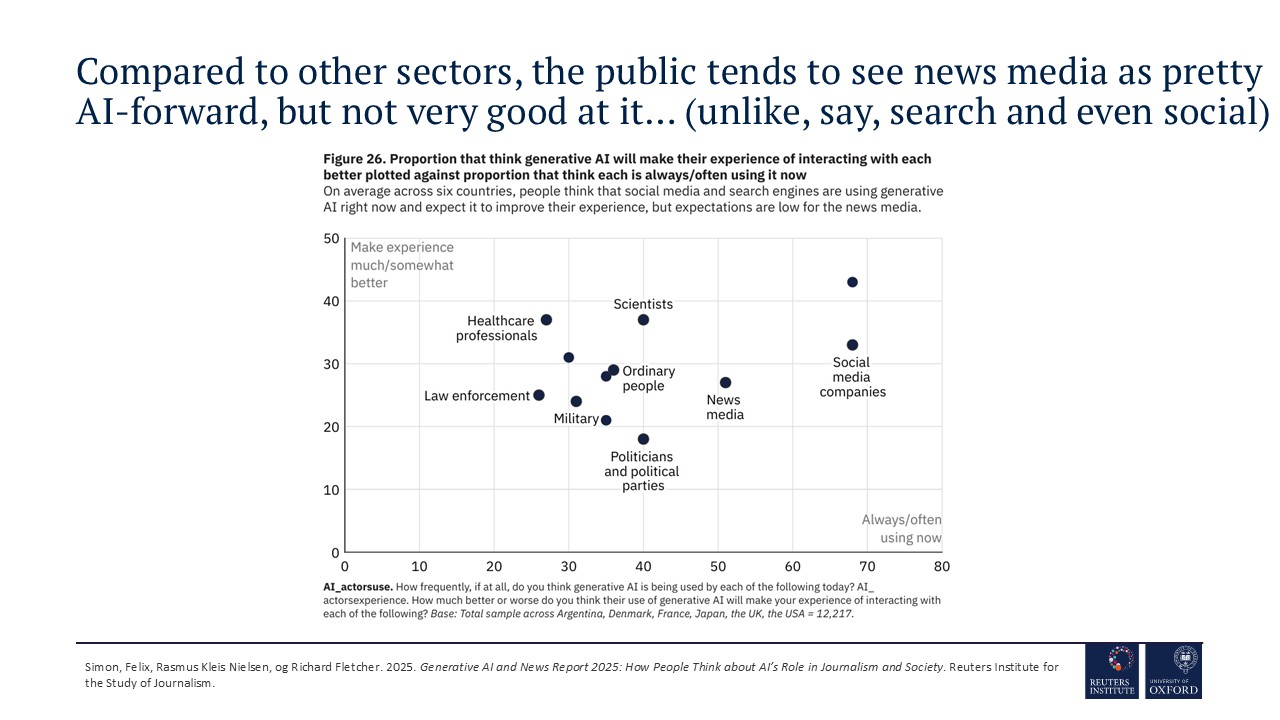
Using these two data points – on assumed use and expectations, what it will mean for each of us individually as members of the public – we can create a chart like this, where we have on one axis, the assumed scale of use of AI in a particular sector of society, and the other one, the share of the public who believe that AI use will make their experience of engaging with the sector better.
Thus there are some sectors, politicians and political parties, for example, where people don’t really think they’re using AI or that much and also have pretty dim expectations about what it might mean to them.
There are sectors like science, where I happen to work myself, where people don’t think science is used to stuff all that much yet, but they have pretty high expectations what it might mean for their engagement with science.
Then you have news media high assumed use, pretty skeptical assumptions about what it would mean for us as members of the public.
And in the top right quadrant social media companies and the unnamed dot up there are search engine companies where people assume – probably rightly – that these tools are used extensively and also are more optimistic about what it means for us as members of the public than they are when it comes to your work as news organizations.
Interpreting public skepticism of AI use in news media
Why? Why do so many have such a skeptical view of your use of AI in the news media?
Often while simultaneously having more trust in and higher expectations for other sectors’ use of AI, including sectors that many of us and many of you, I think, have a sort of grounded skepticism of.
Here I necessarily need to move beyond the data and start to interpret it, but I will offer I think at least one thing that we can consider one potential heuristic or input into people’s interpretation of this, which is as an industry and as a profession, we are pretty good at drawing attention to it when we fuck up.
Just using only examples of organizations I personally respect and who have fessed up and stood up and sort of taken on the chin when there’s been something – so I use these as examples of what I think is a courage in time of uncertainty not to put anyone on the spot – here at Politiken last year the newspaper published a fact box that turned out to be curiously void of facts generated by, according to the paper, essentially a user error in terms of how an internal tool was deployed. There was a taking responsibility for it.
Another upmarket, generally a highly trusted title, also here in Denmark, then a little while later ran a long op-ed piece by a political party’s leadership. It turned out to contain multiple entirely fabricated supposed quotations attributed to rival politicians. This had not been discovered, neither by the political party nor by the publisher. Again, they stood up and took it on the chin and apologized.
We have my dear friend Melissa Bell from Chicago Public Media. The Chicago Sun-Times, published a AI-generated book list that involved imaginary titles. Melissa stood up and took responsibility and tried to explain how to move forward from that.
And also, of course, the New York Times has had a recent brush with this earlier this month, where an article turned out to contain a remark that was attributed to the leader of the opposition in Canada, but turned out it was an AI-generated summary of his views about Canadian politics that had been presented as a quotation to the journalist in question.
Again, I’m not putting people on the spot. I’m just saying, you know, we have these moments that really are not our best selves, and responsible organizations step up and admit it and explain it, and try to move past it.
And if they don’t, we’re lucky that the answer to the old question from Plato of ‘who guards the guardians’ is that the Guardian guards the guardians.
So if you don’t step up, you can be sure the Guardian will be ever vigilant.
So we have plenty of justified, negative, and fairly high profile attention that we draw to our industry and our professions own uses of AI.
Unlike the technology industry which tends to be conspicuously using AI, relentlessly optimistic about what it will mean for me as an end user, and the rest is sort of hidden in the corners or left to the Guardian and a few others to draw attention to.
It’s a very different way for different industries or professions to talk about how they’re rolling this out and what it might mean for me.
The old journalistic adage that we don’t cover the planes that land also seems to apply to our own profession and own industry’s use of AI.
We don’t talk very much about what’s working, we talk an awful lot about both our own failures and our peers’ failures.
And we do this in a context where people assume we’re using these tools and don’t think they’re going to be in their benefit, even though it may make it cheaper to produce content.
Four possible responses to public skepticism to AI use in news media
So how do we move on from here?
That’s your problem, not mine.
But I think research can at least offer an interpretation of different possible responses.
So I’ll do some stylized possible responses to this context that I think you’re operating when it comes to the public’s relationship to you and your use of AI and different tools.
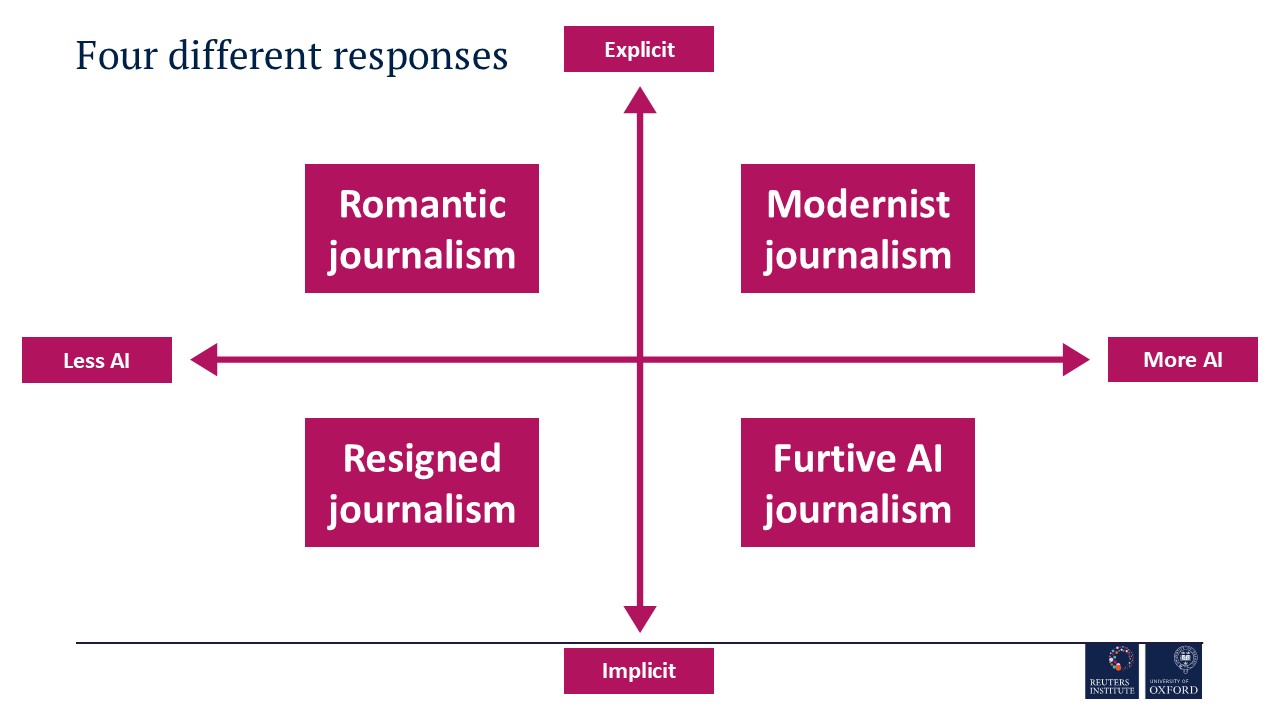
I’ll map them out on two stylized axes. These are ideal types. Of course, nothing would ever be so clean and neat as this, but hopefully still useful to think about it.
One axis is essentially whether you are less of a user or more of a user, whether you plan to increase your use or perhaps in some cases constrain or even reduce your use of AI, which there are some companies who are saying that they will do, including in other sectors.
And the other axis is whether you are explicit about telling a story about how you’re using AI and really leaning into publicizing and communicating that story, or whether you’re using the tools implicitly and accepting that as a consequence, people will interpret that, what this might mean for their relationship with your journalism on the basis of other signals than what you provide them.
So with this, I think we can sort of name them.
One, I have called sort of ‘resigned journalism’, which is, I’m sorry it’s a bit of a negative phrase, but I couldn’t really think of a better way of putting, essentially what is saying, well, we’re going to continue to do what we’ve been doing since essentially the 19th century, if I can be a bit blunt, and we’re just going to hope that it works, and we’re not really going to make a fuss and a hue and a cry about how we do it that way. We’ll just carry on with this as usual and hope that that gets us we’re not going to lean into the tools and we’re not going to tell any exciting stories about this. I don’t think anyone see themselves in this, but i think this is the reality of some organizations, at least from the outside I think we can describe them this way perhaps uncharitable, but nonetheless.
Then we have what we might think of as ‘furtive AI journalism’ where you’re leaning into the tools you’re using them more and more you’re integrating them in particular back end and lots and lots of different things. But you’re not telling anyone about it, other than maybe a little sort of greyed out AI summary little note here and there.
And yes, if you click enough, perhaps you’ll find something somewhere on the website where you have your principles for use of AI, but there’s no explicit proactive effort to communicate how and why you are using AI more and more in your organization.
Then you have what we might think of as ‘romantic journalism’. This of course was the manifesto launched in Perugia, for those of you who were there at the International Journalism Festival by Lea Korsgaard from Zetland here in Denmark and Josh Herman from Mill Media in the UK, which is a nuanced view. So I don’t want to sort of suggest that it’s in any way opposed to technology, but I do think it’s a view that regards AI in journalism as something that needs to be carefully contained and primarily used for back-end things and is extremely explicit about positioning themselves as such. If you write a manifesto, you have an explicit communication strategy, let’s put it like that. And you’re also very conscious of drawing a contrast between you and your competitive set – the other publishers – who may be less romantic than what this perspective or response looks like.
And then we have a fourth one, which is why I think it was about ‘modernist journalism’.
So if the romantics believe that there are timeless things that we are at risk of losing touch with and we need to make a conscious choice to reconnect with those timeless values and see technology primarily as something that underpins those timeless values.
The modernist view would be – as is modernism in some forms of architecture, art, and literature – would be the view that our best selves are in the future and they are enabled by technology.
I think that people who come to an event like this are probably primarily drawn to this.
But I would also put to you that – while we talk about it here, and there are sort of various ‘how do we use AI’, you know, items on websites and Perugia talks and other things – the people who aspire to some sort of modernist vision of AI-enhanced journalism are perhaps not telling the story of it, or at least not cutting through the story of it to the same extent as some of the other voices in the industry and the profession, let alone in public life.
Because this is the forum that it is, without discounting the potential of romantic journalism, or without judging anyone for other responses that may be dictated by circumstances that are less benign or privileged, shall we say, than some of the people in the room here – because of the context that we’re in, I think it’s probably the modernist view that’s most interesting to sort of do a little bit more on before I wrap up.
How might one think about earning trust in AI use in news media?
So if one were to aspire to be a modernist journalist, and if one did believe that our best selves are ahead of us and are enhanced by technology, enabled by technology, but also recognize that trust is going to be central in realizing the full value of this, and connections and credibility are an incredibly important part of managing to connect with people in an ever more competitive media environment.
Then, if you want to use AI, and want to earn, maintain, and perhaps deepen public confidence in how you use that AI as part of your journalism, as part of your editorial operation, as part of your business, your distribution, we can go back to research we already have that speaks to how one builds trust.
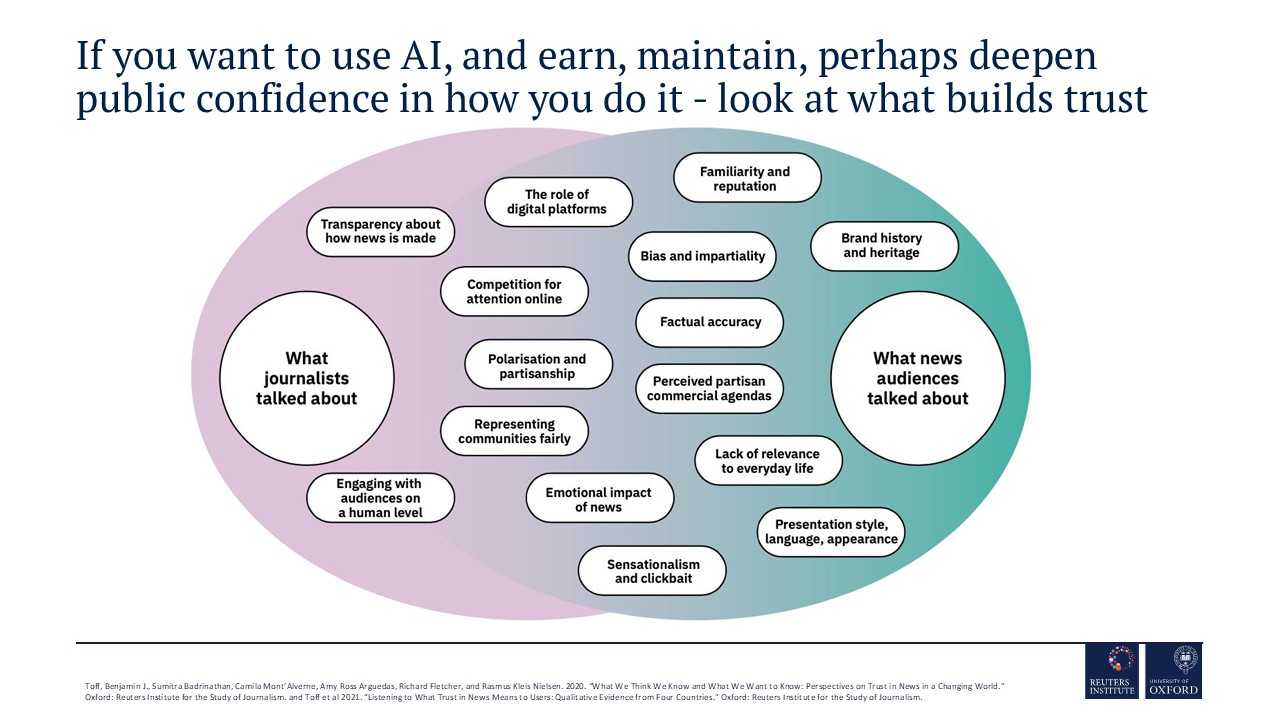
This chart is drawing on earlier research led by Benjamin Toff – that also involved a team of colleagues – it’s just a sort of a slide to remind us when we talked in that research to journalists about what matters for public trust in news and then talk to members of the public in different countries, people in different backgrounds, different communities.
Yes, there is some overlap. It is a Venn diagram sort of thing to come up in both types of conversations. But also significant differences. And if you are particularly interested in the question of public trust in journalism, professional trust in one another is also important, but public trust in journalism, I think it’s really important to recognize that a lot of the things that citizens talk about when they talk about what from their point of view in general, trust in journalism or news, it’s not necessarily the same as the things that are top of mind from the point of view of journalists.
For example, journalists talk a lot about transparency.
Very rarely does that come up in interviews and focus groups, where people talk much more about, am I familiar with this brand? They talk about relevance, is it something that demonstrably help me in my everyday life? They talk about bias and impartiality, which often is community founded, more than ideologically founded, which you remember, most people do not think of politics in left-right terms, they think more of us and them. So it’s more about, is this a title that is aligned with or at least open to me and people like me – my experiences my view of the world do they respect represent and reflect the community that I am part of. That’s very easy for people like me to say ‘yes’ to because people like me have both made the news spin in the news and enjoyed the news for a long time. But a lot of people don’t have that privilege.
These are things that have little if anything to do with technology. But they are things we know from research can help engender trust. So maybe these are also important parts of your journey with AI, if you want to deploy it in a way that is not furtive, but modernist. Explicit about how you think this benefits not only you, but also me and other citizens.
The ‘public test’ for AI news – what’s in it for us?
So I will end simply with this – it is so good that we are all able to be here. As many have said before now, I’ll say it again. We owe a tremendous debt of gratitude to the organizers and instigators of this gathering in addition to all of you giving one another the gift of your time and your expertise and conversations.
It remains really important that a professional community of practice continues to judge one another’s work and set standards for one another. And Kasper has given us one example of that. The ‘pøsevogn-test’, right, whether these tools can sort of capture, reproduce and create cultural specificities of language, of representation, of the like.
I mean, there are many ways of doing this. We have standards in the community, and that’s important. There’s nothing that I want to take away from that.
But equally important, perhaps even more important, I would say, at least for the next stage of the journey, I think, are the rest of us, right? Not just you, but also me and millions more like me.
Because it’s only one leg, the professional judgement of trust, of what value and trust looks like – and probably not the most important one, honestly.
So I would suggest as a compliment to ‘pølsevogns-testen’ the ‘public test’ for AI news.
As you move forward with your work in this, you are all very well positioned and in a community of practice that can help you judge what’s in AI news for you.
But you need to convince me and a multitude of other members of the public of what’s in it for us.
So I don’t have a sticker to give you. But if I had a sticker to give you, it would be this.
And I would encourage you to keep it at hand as you think about how you develop and deploy AI in news, if you want to.
Generative AI could in principle feature a great diversity of sources in output responding to news-related queries.
But do various generative AI products actually do this?
In early 2026, Roa Powell and Carsten Jung published a piece of research for the Institute for Public Policy suggesting maybe not – based on analysis of responses to a sample of 100 hypothetical UK news queries submitted to four different AI tools (ChatGPT, Perplexity, Gemini, and Google AI overview), they found that these tools draw “on a narrow range of prominent news brands”.
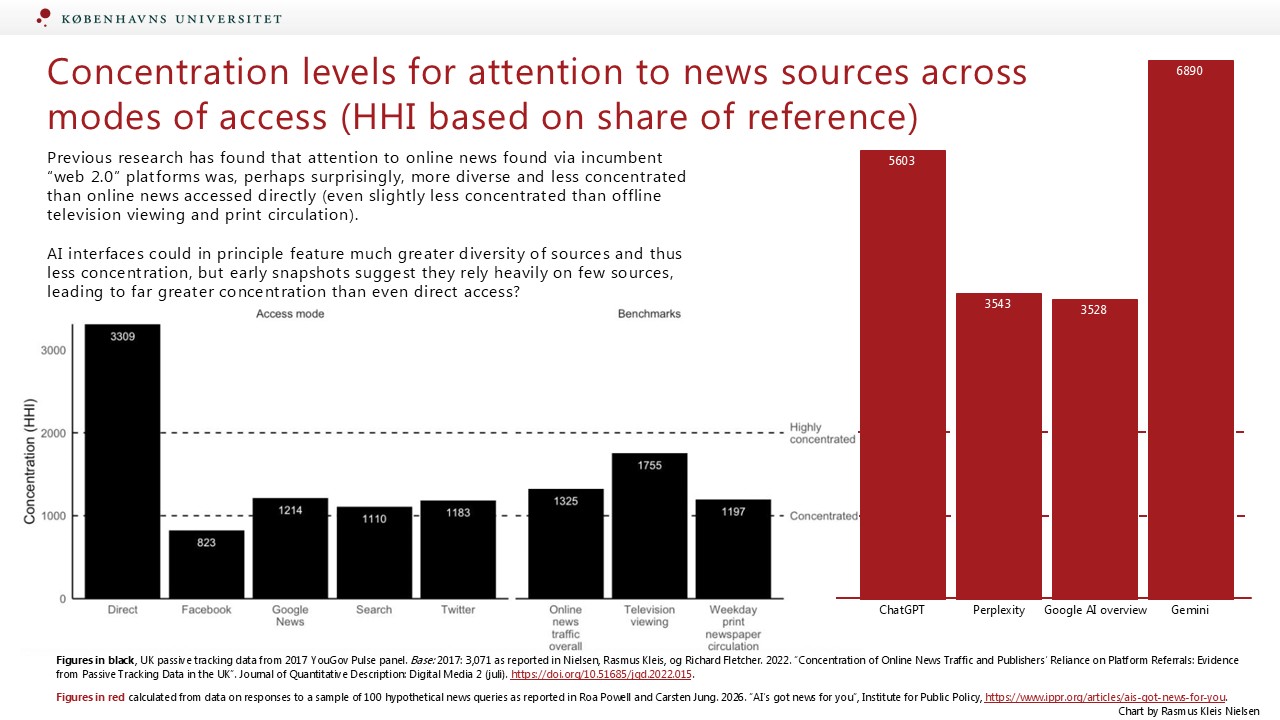
As a benchmark for interpreting their results, I have created the slide below.
The figures in red are my calculations of the Herfindahl–Hirschman Index (HHI) (a common measure of market concentration) for each of the four AI tools based on the share of reference that goes to each of the top ten news brands (as reported by Powell and Jung).
The figures in black are taken from this piece of work I did with Richard Fletcher included for comparison, namely similar HHI calculations based on historic data from the UK from 2017 for online news accessed directly, via search, news aggregators, or various kinds of social media, as well as, for further comparison, HHI figures for television viewing and weekly print newspaper circulation at the time.
The concentration of attention, with a few brands accounting for a very large share of reference, is far greater for the AI tools than any other form of access.
While the underlying data is not like-for-like comparison (the bulk of the 2017 data is based on passive tracking of actual UK users, the 2026 AI tool data is generated by prompting), I think the figures are still interesting and thought-provoking. (And not necessarily unique to the UK – Nikos Smyrnaios and Olivier Koch has published a piece of work, based on a somewhat different methodology, suggesting results for France that are also about the 2,000 bar for a highly concentrated market.)
It’s not just that Powell and Jung are right to stress that a narrow range of prominent news brands (some of whom have commercial deals with the AI companies) loom very large in AI output.
It is also that the concentration in question, measured here in terms of share of reference, is far, far greater than any of the different kinds of access we analyzed based on the 2017 data – even more concentrated than direct access, which itself was significantly more concentrated than any other kind of access at the time.
It also seems the (comparatively fewer) referrals they do drive are highly concentrated amongst a select few publishers, much more so than has been the case for search, social, or news aggregators.
(Underneath the topline, there is some diversity from tool to tool (just as we found different outlets doing well via different platforms), as Powell and Jung writes, their findings suggest “each AI tool prioritizing news brands in different ways, in each case foregrounding a distinct selection of news outlets compared with those that are currently most popular across the UK” – go read their report for more details.)
I wrote a piece for the Financial Times about why I think we need to focus squarely on this as we head into a big election year.
My (naively unworkable) working title when I submitted it was “It’s the elite, stupid: stop gaslighting the public about where consequential misinformation comes from”.
A few links below to evidence that has informed my view.
Third, to state the obvious, some politicians sometimes weaponize false and misleading information for their own purposes. It’s easy to pin this on “populists” – there may be something to this – but it can come from establishment types too – Blair, Bush, Kennedy, Reagan, etc.
Fifth, we don’t need to “forget” technology, as the FT headline suggests, but look at root causes – how political elites make use of tech, and how tech companies react to this use, sometimes treating them differently as a matter of policy, sometimes perhaps for pragmatic reasons.
In summary – misinformation often comes from the top, elite cues are more consequential than more misinformation added to what is already a vast ocean of content, populists may be particularly likely to use this for political purposes but they are not alone, and some politicians want to be allowed to act as they please. There is a lot of research on misinformation – if you are interested in more, great and warmly recommended resources include the “Critical Disinformation Studies” syllabus from CITAP, Brendan Nyhan’s “Political Misinformation” syllabus as well as (both of these are pretty US-focused) for example the edited volume “Disinformation in the Global South” for a wider view.