
Politicians and political parties are increasingly intense users of generative AI, even as much of the public is very pessimistic about the implications for society.
To avoid further damaging already often low trust in political actors and the political process, it seems important to get to grips with this.
The growing use by political actors is on full display during the U.S. midterm elections.
This includes both disclosed and undisclosed AI-generated content, various AI-powered tools to help campaigners monitor the conversations happening in different corners of the internet to refine their media and messaging approaches, experimental tools for AI-powered voter contacts, as well as internal tools for data access, research, and organizing voter contact. Back in April, 83 percent of political professionals surveyed by the AAPC said they use AI tools, and by mid-October, the Wesleyan Media Project reported that more than $137 million had been spent on airing campaign ads using AI-generated content during the midterms. (As they note, that is almost certainly an undercount given how difficult it is to detect uses of AI.) And use is, of course, not limited to campaigning. In several countries, the Economist reports, “AI-written speeches are taking over politics”. I am sure there are already major political parties (in Europe and elsewhere too) working with ChatGPT Enterprise, Claude’s enterprise plans, or similar back-end tools. Little of this is about sophisticated deepfakes or game-changing supposedly super-powerful persuasion. Most of it looks like what is happening in many other white-collar professions too. (Last year, 40% of respondents across six countries said they thought politicians and political parties were using generative AI always or often, about the average for the 12 sectors included in the question.)
But the public does not see the use of generative AI by politicians and political parties the way they see the use of these technologies by other professions and sectors. People are much more pessimistic about use in politics.
In a recent survey, Felix M. Simon, Richard Fletcher, and I asked respondents how much better or worse they think different actors’ use of generative AI will make society. Across nine countries covered, between half and two-thirds of respondents have a view on whether generative AI use in a given sector will impact society, either for the better or for the worse. Another quarter to one-third say neither better nor worse, and the rest say they do not know. The chart below shows the net balance between the optimists – respondents who say they expect the use of generative AI will make something better – and the pessimists – those who fear it will make it worse – as a way of comparing public expectations across various sectors. (We ask a similar question about what it will mean for people’s personal life – the results are very similar.)
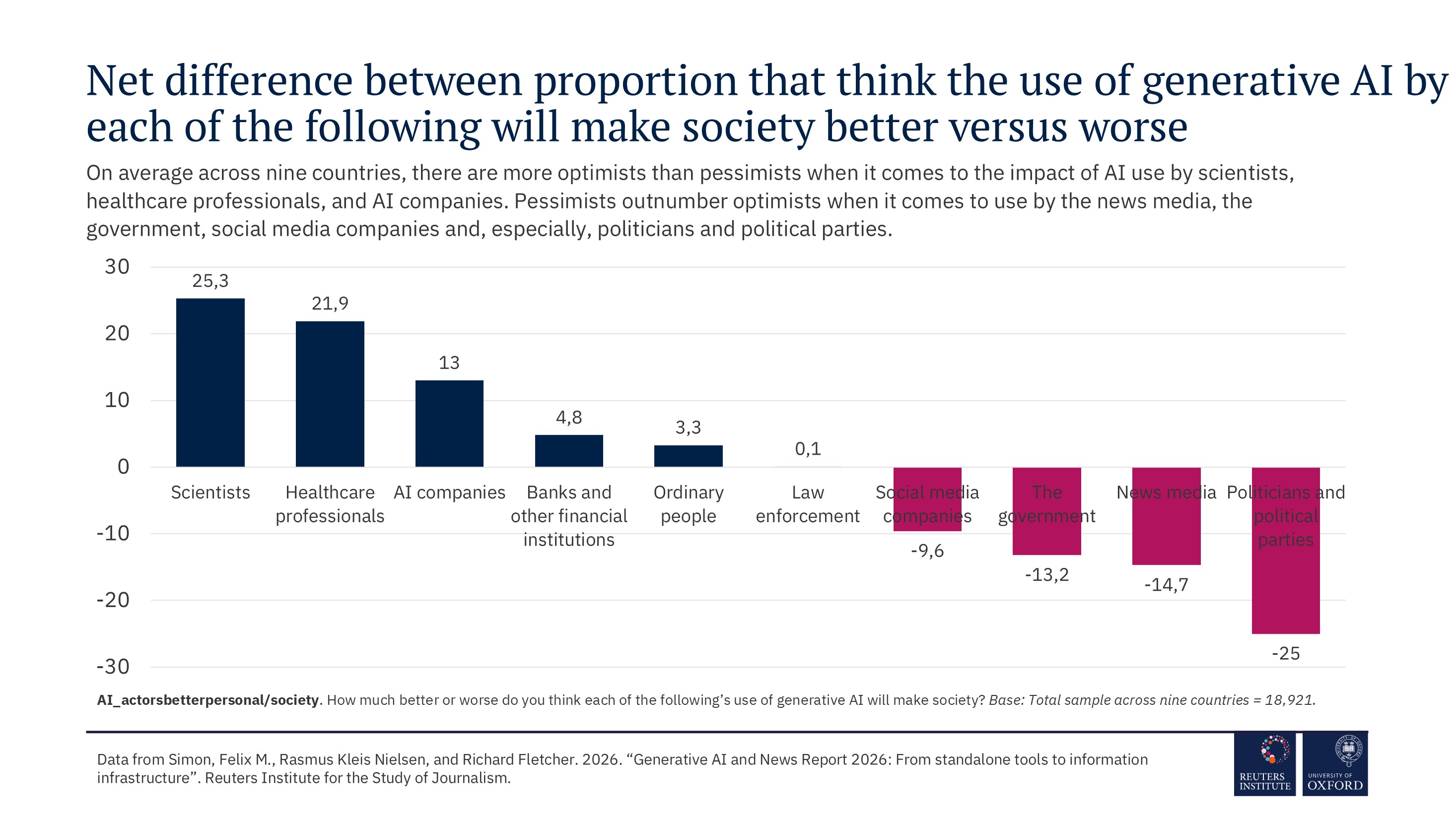
The findings clearly document that much of the public have little, if any, confidence in politicians and political parties’ use of generative AI. There are 25 percentage points more pessimists than optimists. There is pessimism around social media, the government, and news media too, yes, but no other sector comes close to political actors. At the other end of the chart, we have white collar professions including science and health care, where there are many more optimists, but it is noteworthy that the AI companies themselves and established private enterprise, here banks and other financial institutions, also face more optimism than pessimism from the public.
This is not blanket pessimism. It is pessimism about specific sectors – politicians and political parties more than any other.
One campaign professional quoted by in a field report from the Ash Center at Harvard describes the current situation when it comes to AI use in politics as ““the wild west” with few rules or norms to work off of”. That is often the case when campaigns adopt disruptive innovations, whether coming from inside politics or, as in this case, from outside.
What is striking is how pessimistic the public is about what this means for our societies, in a context where many more of them are willing to give other sectors (the AI companies included) the benefit of the doubt, and a context where trust in politicians and political parties is often already low in many countries.
To avoid already brittle (if not absent) public trust in the political process, it seems urgent for politicians and political parties to get ahead of this and explain to the public how they use generative AI (if they do), and why we should accept their use as serving not only the partisan interest of the politicians in question, but also the public interest.

