
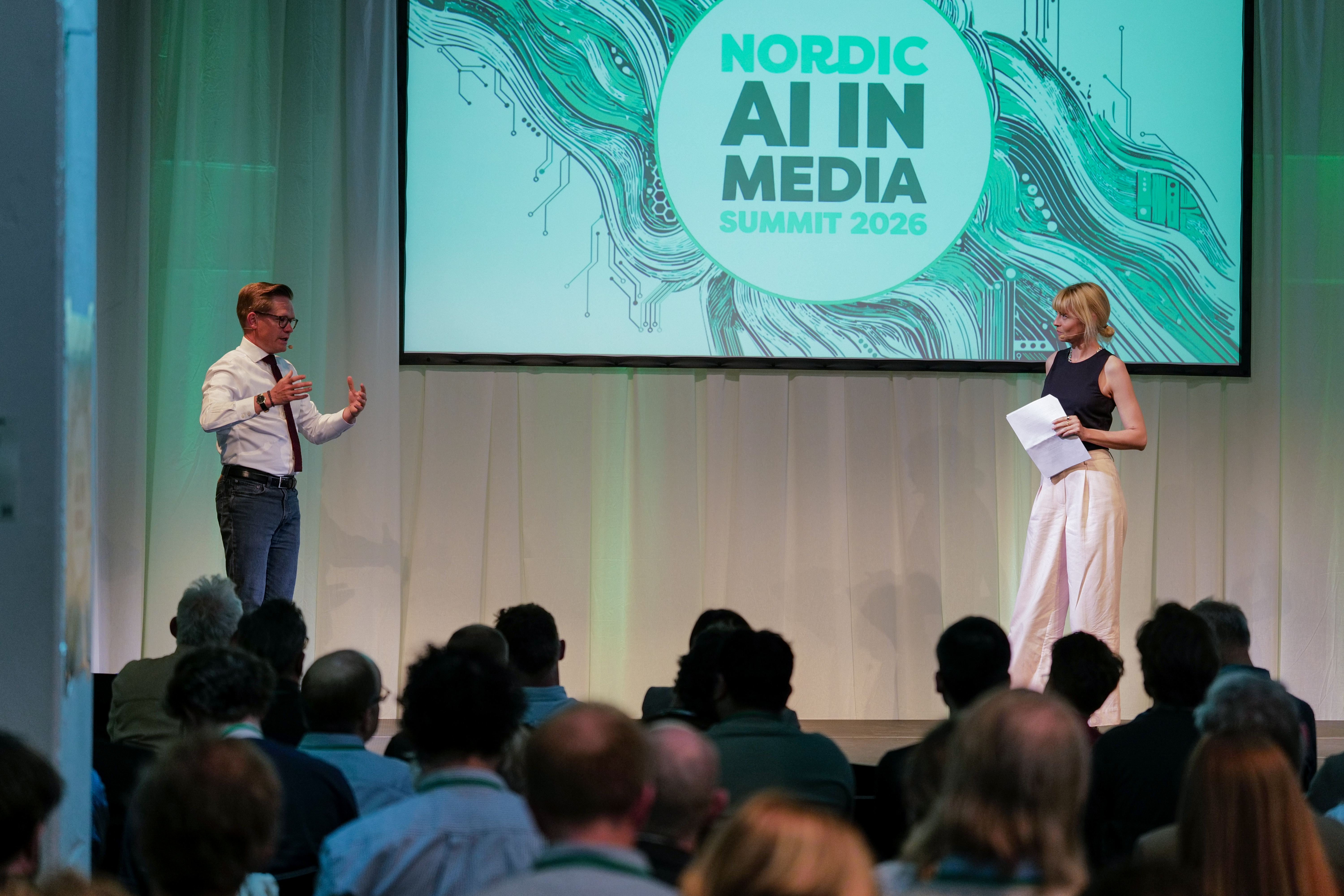
I gave the closing talk at the Nordic AI in Media Summit 2026 May 27 – 28th Copenhagen, Denmark. It is an incredible event, and it was a privilege to be part of it. A video of my talk is here. The audio is a bit uneven, so below a transcript, lightly edited for clarity and with a few links to sources added.
What’s in it for me (as a member of the public)? A ‘public test’ for AI in news
Thank you very much for this opportunity to be here and learn from all of you, and also to speak today. So what I want to do today is to make a very Freudian move: ‘Enough about you, let’s talk about me.’
I want to do that in an assuming role, if you will, as an individual member of the public.
I’ll do it on the basis of research that I’ve had the privilege of doing together with Felix Simon, who you saw on the panel before, and Richard Fletcher from the Reuters Institute at the University of Oxford.
Anything in this presentation that’s good is to the credit of Richard and Felix. And then I will go beyond that research and try to interpret what I think this might mean as we move forward, and anything in that interpretation that you think is shoddy, guesswork, or anything like that, is entirely my responsibility.
Where I want to start, as said, is with a point also made on the panel before. It is the recognition that the value of any kind of news – tech enabled or not, more or less tech enabled – is in large part in the eye of the beholder. It’s a relationship between what you do – the content and service you provide – and then people like me, members of the public.
That point is important for our discussions here today because it means that realizing the full potential of AI in media is only in part about how you all judge it, and at least as much about how all of us as members of the public and what we make of that.
We know that this relation is essential, irreducibly important. How it will evolve in a changing ecosystem, we don’t know, but I will say that my hypothesis is different from the provocation that Felix offered before. I think that trust will grow more important as a differentiator.
So content may be commoditized, but I don’t believe that connections will be commoditized. But this is a hypothesis at this stage.
The way I want to evolve these ideas or offer them up for your considerations to sort of say, okay, we have heard from and now we will turn to us, the public.
Public perception of AI use and AI implications across sectors
So how do we do that? I’ll share some slides here based on survey research I did with Felix and Richard. This is based on representative samples of internet users in a range of countries across the world. I’m happy to share the details. The point here is not the details. I’m happy to discuss methods, but the presentation is not about methods. So bear with me when I go through this quite quickly to set up the interpretation that I hope will be generative for you, in an intellectual sense, as you think about how to do your job when you return to your day job tomorrow morning.
The first thing I think we can say confidently now after two years of doing this kind of survey research is that people tend to think that AI generated news and AI assisted news will be less trustworthy and cheaper for you to make.
So good for your proprietors, not so good for me as a member of the public.
We also know, I think now, after two years of doing this research, that people tend to assume that news media already use AI quite a lot.
So large shares of respondents in the survey when we were in the field last year said that they believe news media use AI often or always in their work. I think third only after search engines and social media companies.
Now in this room, yes, there are lots of video organizations we’ve seen who have really have integrated AI elements in many steps of the workflow and used them continuously.
But we can also step outside of this room and recognize that may not be the case in industry as a whole. Perhaps there is an assumed use of AI that in fact exceeds the actual role of AI in the industry as a whole.
So people seem to assume that the industry uses AI quite a lot.
But when we ask them what they think it will mean for their experience of news, a plurality believe that the use of AI in the news industry will make news worse for them.
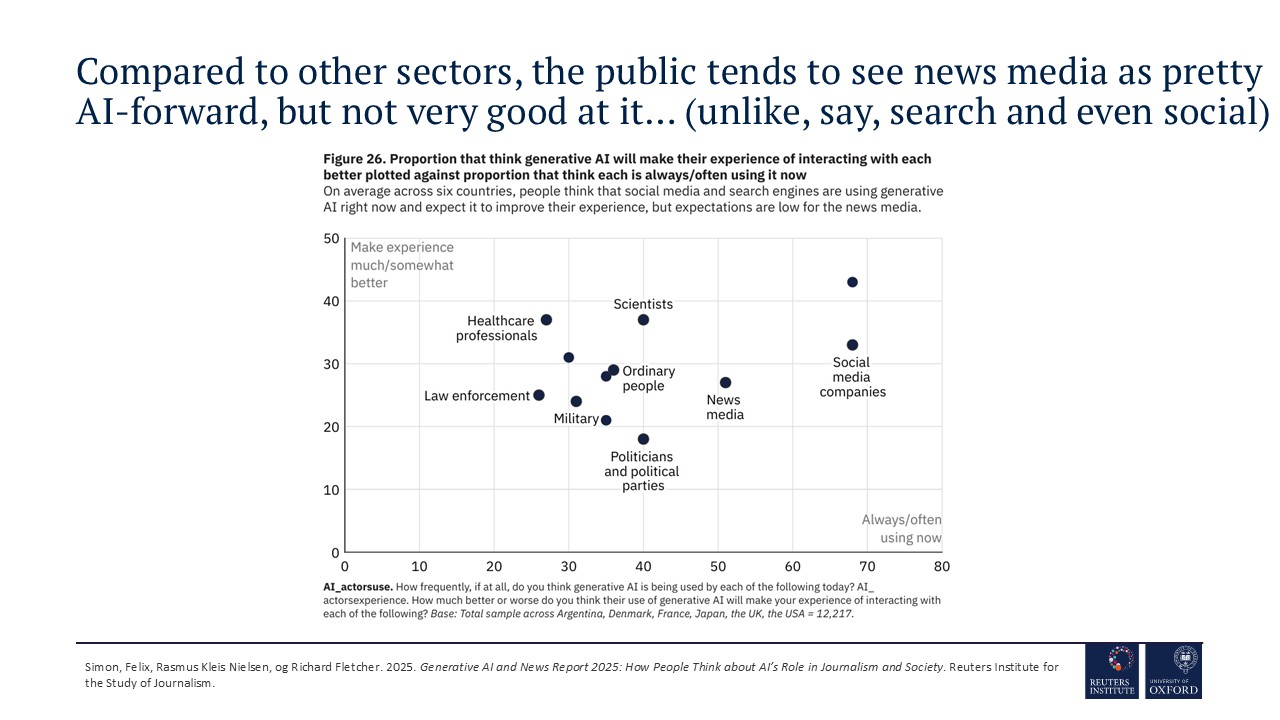
Using these two data points – on assumed use and expectations, what it will mean for each of us individually as members of the public – we can create a chart like this, where we have on one axis, the assumed scale of use of AI in a particular sector of society, and the other one, the share of the public who believe that AI use will make their experience of engaging with the sector better.
Thus there are some sectors, politicians and political parties, for example, where people don’t really think they’re using AI or that much and also have pretty dim expectations about what it might mean to them.
There are sectors like science, where I happen to work myself, where people don’t think science is used to stuff all that much yet, but they have pretty high expectations what it might mean for their engagement with science.
Then you have news media high assumed use, pretty skeptical assumptions about what it would mean for us as members of the public.
And in the top right quadrant social media companies and the unnamed dot up there are search engine companies where people assume – probably rightly – that these tools are used extensively and also are more optimistic about what it means for us as members of the public than they are when it comes to your work as news organizations.
Interpreting public skepticism of AI use in news media
Why? Why do so many have such a skeptical view of your use of AI in the news media?
Often while simultaneously having more trust in and higher expectations for other sectors’ use of AI, including sectors that many of us and many of you, I think, have a sort of grounded skepticism of.
Here I necessarily need to move beyond the data and start to interpret it, but I will offer I think at least one thing that we can consider one potential heuristic or input into people’s interpretation of this, which is as an industry and as a profession, we are pretty good at drawing attention to it when we fuck up.
Just using only examples of organizations I personally respect and who have fessed up and stood up and sort of taken on the chin when there’s been something – so I use these as examples of what I think is a courage in time of uncertainty not to put anyone on the spot – here at Politiken last year the newspaper published a fact box that turned out to be curiously void of facts generated by, according to the paper, essentially a user error in terms of how an internal tool was deployed. There was a taking responsibility for it.
Another upmarket, generally a highly trusted title, also here in Denmark, then a little while later ran a long op-ed piece by a political party’s leadership. It turned out to contain multiple entirely fabricated supposed quotations attributed to rival politicians. This had not been discovered, neither by the political party nor by the publisher. Again, they stood up and took it on the chin and apologized.
We have my dear friend Melissa Bell from Chicago Public Media. The Chicago Sun-Times, published a AI-generated book list that involved imaginary titles. Melissa stood up and took responsibility and tried to explain how to move forward from that.
And also, of course, the New York Times has had a recent brush with this earlier this month, where an article turned out to contain a remark that was attributed to the leader of the opposition in Canada, but turned out it was an AI-generated summary of his views about Canadian politics that had been presented as a quotation to the journalist in question.
Again, I’m not putting people on the spot. I’m just saying, you know, we have these moments that really are not our best selves, and responsible organizations step up and admit it and explain it, and try to move past it.
And if they don’t, we’re lucky that the answer to the old question from Plato of ‘who guards the guardians’ is that the Guardian guards the guardians.
So if you don’t step up, you can be sure the Guardian will be ever vigilant.
So we have plenty of justified, negative, and fairly high profile attention that we draw to our industry and our professions own uses of AI.
Unlike the technology industry which tends to be conspicuously using AI, relentlessly optimistic about what it will mean for me as an end user, and the rest is sort of hidden in the corners or left to the Guardian and a few others to draw attention to.
It’s a very different way for different industries or professions to talk about how they’re rolling this out and what it might mean for me.
The old journalistic adage that we don’t cover the planes that land also seems to apply to our own profession and own industry’s use of AI.
We don’t talk very much about what’s working, we talk an awful lot about both our own failures and our peers’ failures.
And we do this in a context where people assume we’re using these tools and don’t think they’re going to be in their benefit, even though it may make it cheaper to produce content.
Four possible responses to public skepticism to AI use in news media
So how do we move on from here?
That’s your problem, not mine.
But I think research can at least offer an interpretation of different possible responses.
So I’ll do some stylized possible responses to this context that I think you’re operating when it comes to the public’s relationship to you and your use of AI and different tools.
I’ll map them out on two stylized axes. These are ideal types. Of course, nothing would ever be so clean and neat as this, but hopefully still useful to think about it.
One axis is essentially whether you are less of a user or more of a user, whether you plan to increase your use or perhaps in some cases constrain or even reduce your use of AI, which there are some companies who are saying that they will do, including in other sectors.
And the other axis is whether you are explicit about telling a story about how you’re using AI and really leaning into publicizing and communicating that story, or whether you’re using the tools implicitly and accepting that as a consequence, people will interpret that, what this might mean for their relationship with your journalism on the basis of other signals than what you provide them.
So with this, I think we can sort of name them.
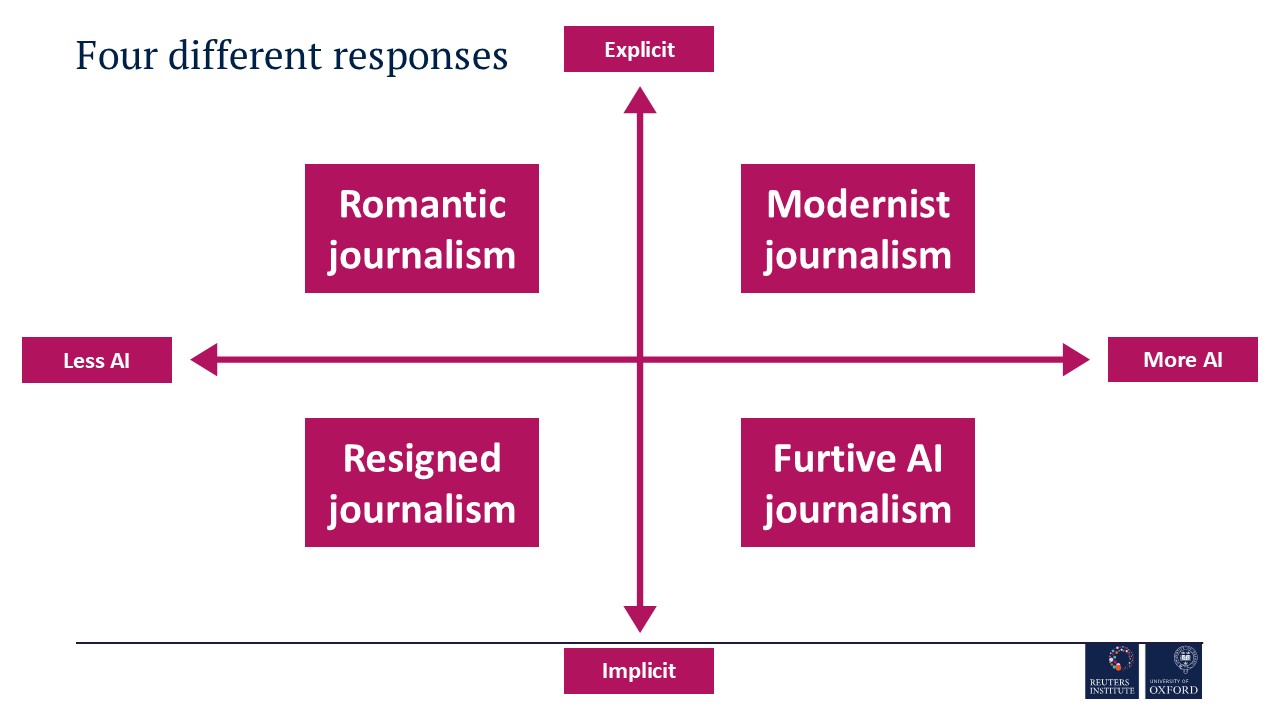
One, I have called sort of ‘resigned journalism’, which is, I’m sorry it’s a bit of a negative phrase, but I couldn’t really think of a better way of putting, essentially what is saying, well, we’re going to continue to do what we’ve been doing since essentially the 19th century, if I can be a bit blunt, and we’re just going to hope that it works, and we’re not really going to make a fuss and a hue and a cry about how we do it that way. We’ll just carry on with this as usual and hope that that gets us we’re not going to lean into the tools and we’re not going to tell any exciting stories about this. I don’t think anyone see themselves in this, but i think this is the reality of some organizations, at least from the outside I think we can describe them this way perhaps uncharitable, but nonetheless.
Then we have what we might think of as ‘furtive AI journalism’ where you’re leaning into the tools you’re using them more and more you’re integrating them in particular back end and lots and lots of different things. But you’re not telling anyone about it, other than maybe a little sort of greyed out AI summary little note here and there.
And yes, if you click enough, perhaps you’ll find something somewhere on the website where you have your principles for use of AI, but there’s no explicit proactive effort to communicate how and why you are using AI more and more in your organization.
Then you have what we might think of as ‘romantic journalism’. This of course was the manifesto launched in Perugia, for those of you who were there at the International Journalism Festival by Lea Korsgaard from Zetland here in Denmark and Josh Herman from Mill Media in the UK, which is a nuanced view. So I don’t want to sort of suggest that it’s in any way opposed to technology, but I do think it’s a view that regards AI in journalism as something that needs to be carefully contained and primarily used for back-end things and is extremely explicit about positioning themselves as such. If you write a manifesto, you have an explicit communication strategy, let’s put it like that. And you’re also very conscious of drawing a contrast between you and your competitive set – the other publishers – who may be less romantic than what this perspective or response looks like.
And then we have a fourth one, which is why I think it was about ‘modernist journalism’.
So if the romantics believe that there are timeless things that we are at risk of losing touch with and we need to make a conscious choice to reconnect with those timeless values and see technology primarily as something that underpins those timeless values.
The modernist view would be – as is modernism in some forms of architecture, art, and literature – would be the view that our best selves are in the future and they are enabled by technology.
I think that people who come to an event like this are probably primarily drawn to this.
But I would also put to you that – while we talk about it here, and there are sort of various ‘how do we use AI’, you know, items on websites and Perugia talks and other things – the people who aspire to some sort of modernist vision of AI-enhanced journalism are perhaps not telling the story of it, or at least not cutting through the story of it to the same extent as some of the other voices in the industry and the profession, let alone in public life.
Because this is the forum that it is, without discounting the potential of romantic journalism, or without judging anyone for other responses that may be dictated by circumstances that are less benign or privileged, shall we say, than some of the people in the room here – because of the context that we’re in, I think it’s probably the modernist view that’s most interesting to sort of do a little bit more on before I wrap up.
How might one think about earning trust in AI use in news media?
So if one were to aspire to be a modernist journalist, and if one did believe that our best selves are ahead of us and are enhanced by technology, enabled by technology, but also recognize that trust is going to be central in realizing the full value of this, and connections and credibility are an incredibly important part of managing to connect with people in an ever more competitive media environment.
Then, if you want to use AI, and want to earn, maintain, and perhaps deepen public confidence in how you use that AI as part of your journalism, as part of your editorial operation, as part of your business, your distribution, we can go back to research we already have that speaks to how one builds trust.
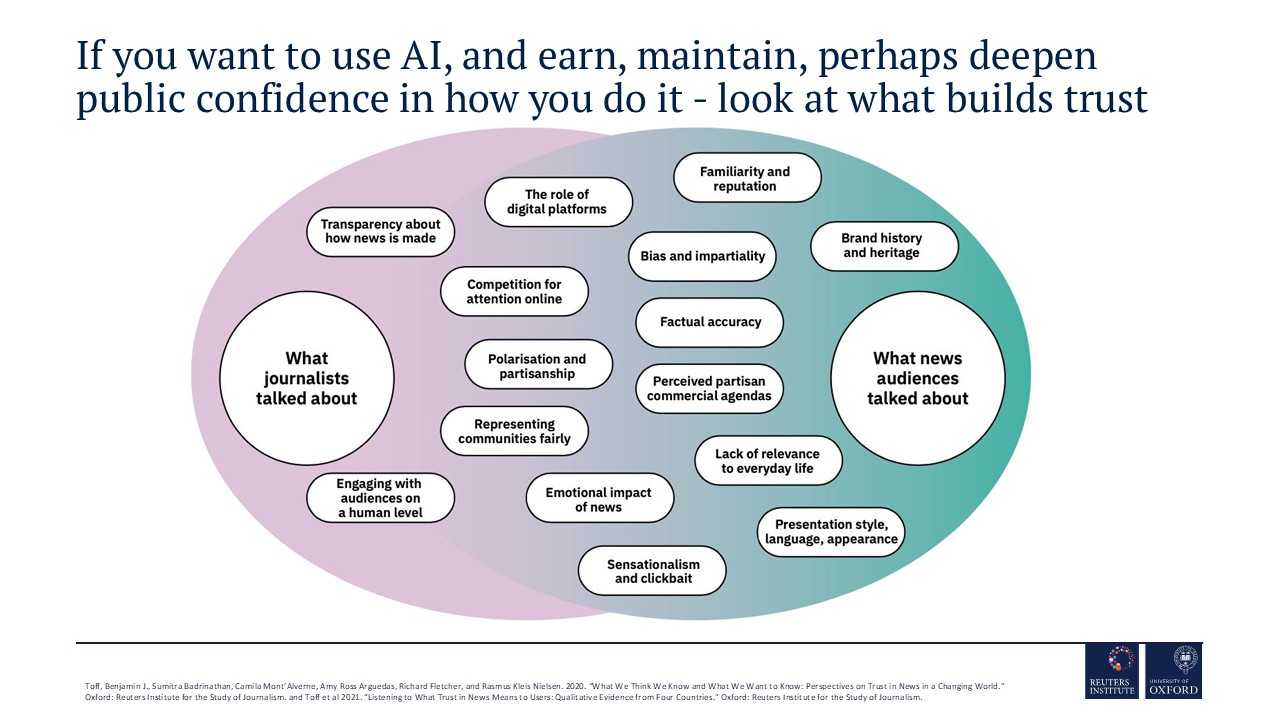
This chart is drawing on earlier research led by Benjamin Toff – that also involved a team of colleagues – it’s just a sort of a slide to remind us when we talked in that research to journalists about what matters for public trust in news and then talk to members of the public in different countries, people in different backgrounds, different communities.
Yes, there is some overlap. It is a Venn diagram sort of thing to come up in both types of conversations. But also significant differences. And if you are particularly interested in the question of public trust in journalism, professional trust in one another is also important, but public trust in journalism, I think it’s really important to recognize that a lot of the things that citizens talk about when they talk about what from their point of view in general, trust in journalism or news, it’s not necessarily the same as the things that are top of mind from the point of view of journalists.
For example, journalists talk a lot about transparency.
Very rarely does that come up in interviews and focus groups, where people talk much more about, am I familiar with this brand? They talk about relevance, is it something that demonstrably help me in my everyday life? They talk about bias and impartiality, which often is community founded, more than ideologically founded, which you remember, most people do not think of politics in left-right terms, they think more of us and them. So it’s more about, is this a title that is aligned with or at least open to me and people like me – my experiences my view of the world do they respect represent and reflect the community that I am part of. That’s very easy for people like me to say ‘yes’ to because people like me have both made the news spin in the news and enjoyed the news for a long time. But a lot of people don’t have that privilege.
These are things that have little if anything to do with technology. But they are things we know from research can help engender trust. So maybe these are also important parts of your journey with AI, if you want to deploy it in a way that is not furtive, but modernist. Explicit about how you think this benefits not only you, but also me and other citizens.
The ‘public test’ for AI news – what’s in it for us?
So I will end simply with this – it is so good that we are all able to be here. As many have said before now, I’ll say it again. We owe a tremendous debt of gratitude to the organizers and instigators of this gathering in addition to all of you giving one another the gift of your time and your expertise and conversations.
It remains really important that a professional community of practice continues to judge one another’s work and set standards for one another. And Kasper has given us one example of that. The ‘pøsevogn-test’, right, whether these tools can sort of capture, reproduce and create cultural specificities of language, of representation, of the like.
I mean, there are many ways of doing this. We have standards in the community, and that’s important. There’s nothing that I want to take away from that.
But equally important, perhaps even more important, I would say, at least for the next stage of the journey, I think, are the rest of us, right? Not just you, but also me and millions more like me.
Because it’s only one leg, the professional judgement of trust, of what value and trust looks like – and probably not the most important one, honestly.
So I would suggest as a compliment to ‘pølsevogns-testen’ the ‘public test’ for AI news.
As you move forward with your work in this, you are all very well positioned and in a community of practice that can help you judge what’s in AI news for you.
But you need to convince me and a multitude of other members of the public of what’s in it for us.
So I don’t have a sticker to give you. But if I had a sticker to give you, it would be this.
And I would encourage you to keep it at hand as you think about how you develop and deploy AI in news, if you want to.
Thank you very much.

