“The Unlovable Press” – Schudson goes to Groningen

Just back from Groningen and “The Unlovable Press”, a two-day event with more than forty scholars presenting work that builds on and engages with the work of Michael Schudson, my PhD advisor at Columbia.

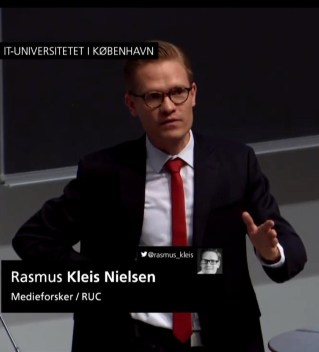
I was a proud part of a panel with three other Schudson-Columbia alumni, C.W. Anderson, Julia Sonnevend, and Lucas Graves (the center of attention on the picture below), moderated by Silvio Waisbord, who worked with Michael at UC San Diego.Schudson

Each of us talked about a piece of Michael’s work that had been particularly important for us, Chris about the Origins of the Ideal of Objectivity in the Professions (parts ofwhich later became Discovering the News), Julia about Watergate and American Memory, Lucas about The Good Citizen, and myself about Why Democracies Need an Unlovable Press.

As so often before, I found it extremely useful to go back and read Michael before taking a stab at staking out a clear position on a big topic—here making the case for a “minimalist approach” to the role of journalism in democracy (outline below).

It was a great event, no doubt slightly uncomfortable for Michael, who never seems entirely at ease when the center of attention, but a real testament to his scholarship, which was also honored by the University of Groningen awarding him an honorary doctorate for his work.

There is a nice video of Michael talking about the “Saving Grace of Journalism” here, made for the occasion. The conference line-up is here.

Our (Anderson/Sonnevend/Graves/Nielsen) panel outline is below.

“Four Approaches to Michael Schudson”

CW Anderson, Lucas Graves, Rasmus Kleis Nielsen & Julia Sonnevend

Panel proposal for “The Unlovable Press: Conversations with Michael Schudson”

PANEL DESCRIPTION

In his introduction to The Good Citizen, Michael Schudson analogizes his approach to political history to that of a child learning the game of baseball for the first time. The point, he explains, is to understand past modes of citizenship not through timeless democratic theory, or even long-­‐standing political institutions, but by “directing attention to the instructions of the game itself”: the values and habits and rules, written and unwritten, that have guided everyday citizens today and in the past. This is a characteristic metaphor from a scholar who wears theory lightly but probes deeply into abiding questions of democratic life and culture. And it suggests a fitting approach to understanding the course of Schudson’s own scholarship, and how it fits into in the world of ideas — by setting aside broad labels to try to read the values and concerns reflected in three decades of writing on the media and the public sphere.

What is the “Schudsonian” approach to doing sociology and history? This panel offers four provisional answers to that question, each an attempt to define and then respond to the wider theoretical framework or political commitments one may read in Schudson’s work. The presenters, all former advisees, will organize the discussion as engagements with four key texts from Schudson’s work on the media and politics: his doctoral dissertation, “Origins of the Ideal of Objectivity in the Professions: Studies in the History of American Journalism and American Law, 1830-­‐1940” (originally 1976); Watergate in American Memory: How We Remember, Forget, and Reconstruct the Past (1993); The Good Citizen: A History of American Civic Life (1998); and the essay “Six or Seven Things News Can Do For Democracy,” in Why Democracies Need an Unlovable Press (2008).

These four texts span more than three decades of thinking about the press, politics, and public culture in the United States and more broadly. As entry points along that span they illuminate the range of methodologies and literatures that have informed Schudson’s scholarship — as a sociologist of public institutions, as a social and cultural historian, and as an observer of political life whose views incorporate classically liberal notions as well as the many critiques liberalism has invited. These texts offer a window onto Schudson’s engagement with questions at the center of intellectual inquiry: How should we as citizens and scholars understand the status of objective truth? What is the relationship between individual events and wider social forces, in a day’s news or a nation’s history? And finally, how should we read the long bend of democratic history, and the possibilities it suggests for meaningful action today by citizens, journalists, and scholars?

PAPER ABSTRACTS

Schudson as a Sociologist of Knowledge: Revisiting the Origins of Objectivity in Journalism (and Law)

CW Anderson

Excavating a doctoral thesis — even a published one — is a dangerous business for both thesis author and archaeological digger. Nevertheless, this paper revisits Schudson’s original doctoral work, “Origins of the Ideal of Objectivity in the Professions: Studies in the History of American Journalism and American Law, 1830-­‐1940,” half of which became Discovering the News. In part drawing on interviews with Schudson, this paper argues that “The Origins of the Ideal of Objectivity” places Schudson more firmly in the sociological tradition and serves as a useful, though occasionally problematic, resource for the current wave of studies on digital expertise.

On the Social Significance of the Statistically Insignificant: Michael Schudson’s Social Theory

Julia Sonnevend

In Watergate in American Memory, Michael Schudson argued that the social sciences avoid history, both the exceptional and the small-­‐but-­‐memorable moments of human existence. In contrast, Schudson’s writings carefully observe and somewhat anxiously admire the power of the singular, the earth-­‐shattering as well as minor events in public life. But is it possible to build a social theory dedicated to the “social significance of the statistically insignificant?” This is the central challenge of his scholarship and the topic I will explore in this paper.

The Monitorial Citizen in the Age of Fact-­Checking

Lucas Graves

In The Good Citizen, Michael Schudson argues that the politics of past eras have to be understood in their own terms — while also painting a picture of broad progress towards a democratic citizenship that is both reasoning and humane. This paper uses Schudson’s “monitorial citizen” to consider recent changes in the media-­‐political world, particularly the rise of professional fact-­‐checking groups. These developments are analyzed in light of two large questions: How does the monitorial citizen fair in a moment of abundant information but little consensus? And, what language does Schudson’s work give us for talking about moments or ways in which things seem to get worse?

The One Thing News Might Just Do for Democracy

Rasmus Kleis Nielsen

In an influential essay in Why Democracies Need an Unlovable Press, Michael Schudson outlines “Six or Seven Things News Can Do for Democracy”. In this paper, I will suggest that Schudson — who is more often attacked by radical democrats and critical theorists for being a timid liberal who demands too little — is in fact far too ambitious. I will argue that journalism, especially in its (in the Western world) increasingly diminished institutional state, can probably do only one truly distinct and important thing for democracy, namely make relatively accurate, accessible, relevant, and timely independently produced diverse information available about public affairs.

2014 Tietgen Award

20140527_235111(1)At a splendid event Tuesday May 27, I was the proud recipient of the 2014 Tietgen Award.

It is awarded annually by DSEB in recognition of a significant contribution to by young researchers in the field of business-oriented humanities and social science. It has been awarded since 1829 and is the oldest prize in the social sciences in Denmark.

The award is accompanied by the splendid Tietgen Gold Medal, funds to support international research work, and was celebrated in style with a very nice dinner in central Copenhagen where HRH Prince Joachim presented me with the award.

2014 Doris Graber Award for “Ground Wars”

“Ground Wars” has just been announced the winner of the 2014 Doris Graber Award, given by the American Political Science Association for the best book published on political communication in the last ten years.

This is what Susan Herbst, chair of the award committee, wrote to me.

“Our committee voted for your book unanimously, finding it to be innovative, engaging and of very high quality relative to the terrific pool of nominee books.”

I’m very proud of this. Previous Doris Graber Award winners include some of the political communication scholars I admire the most, and I’m honored to see my work in this company (especially since so many good books have come out in the last years).

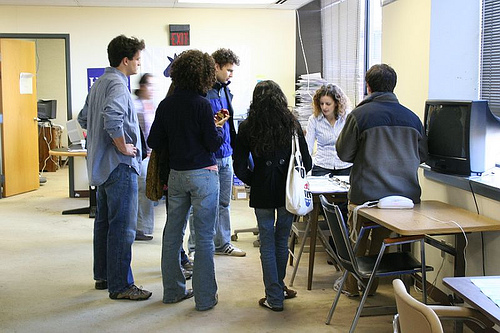
The book is based on hundreds of hours spend in campaign offices (like the one below in Stamford), talking to staffers, being on the phone with volunteers, canvassing with part-timers knocking on doors for $10 an hour, talking to voters all over Connecticut and New Jersey for months on end.

Himes photo 4

As I write in my acknowledgments, “I have learned more from the people involved in campaigns than I can ever hope to teach them, and I thank them all for letting me into their world.”

That’s worth repeating—I’m grateful that people let me in, had the patience and inclination to talk about their work.

For those interested in a taste of the book, the first chapter is available for free here [pdf] on the Princeton University Press website, and the book can be found through Amazon etc.

Danish discussion of surveillance by NSA and others

Spoke yesterday at a debate hosted by the newspaper Information, the Danish Journalists’ Association, and the IT University about the NSA scandal, including its Danish subsidiary (spying during the COP15 negotiations, a story broken by Information working with Laura Poitras on the basis of documents leaked by Snowden and subsequently covered around the world).

I focused on how journalists are not only reliant on brave individual wRKN(1)histle-blowers like Snowden and Manning in covering these kinds of stories, but also enabled and empowered by real political debate and popular interest.
This we have in for example Germany, but is all-too-often often absent when the political elite close ranks or some top news organizations chose not to pursue a story.

It was a great event overall with Ewen MacAskill from the Guardian and a host of Danish journalists and others commenting, coinciding of course with the publication of Glenn Greenwald’s book.

Video of the here (all but Ewen MacAskill in Danish), more on Twitter at #nsadk

Crisis of Journalism Reconsidered—Barcelona workshop

Just arrived for “The Crisis of Journalism Reconsidered: Cultural Power” (May 2- 3), organized by Jeffrey Alexander, Elizabeth Butler Breese, and Maria Luengo at the Social Trends Institute.

The workshop aims to bring more culturally-oriented and sociological perspectives into play to understand contemporary journalism, and move beyond the tendency in some circles to focus mostly on economics and technology.

Not done reading all the papers yet, but a couple of highlights from the program (I’m sure there are other gems)—

  • Daniel Kreiss on journalism as “organized skepticism”. Work in progress, but I’m curious to hear more about this, not sure the profession is particularly skeptical, or even that we should wish it to be primarily skeptical.
  • Nikki Usher on how journalists’ professional preoccupation with scoops may be at least as much to blame for “hamsterization” as new technologies that enable more immediate publication, akin to Rod Tiffen’s work on what he calls journalism’s sometimes “institutionally perverse” competitive ethos.
  • Chris Anderson on how professional journalism in the US, in the 20th century almost aggressively ignorant of its audience, is coming to terms with an ever-growing number of forms of audience metrics, forms of audience engagement, etc that complicates it’s relation to the public it claims to and aims to serve.

My own paper is called “The Many Crises of Western Journalism” and presents a big-picture comparison of economic, professional, and symbolic crises in journalism across six affluent democracies.

The figure below summarize the general thrust of the empirical argument—Northern European countries like Finland and Germany do not yet face the economic and professional crises seen elsewhere, but there too, journalism faces a symbolic crisis as many people have low confidence in news. Mediterranean European countries like France and Italy have both an old and a new economic crisis to contend with (already weak industry hit hard by digital), a profession that has never developed the same kind of occupational autonomy from politics and proprietors seen elsewhere, and low confidence in news. In the US, journalism faces a new economic crisis connected to the rise of digital over the last years, challenges to the status of the profession itself, as well as a decades-old symbolic crisis of confidence as many people have little confidence in news.

In short, different kinds of crisis and different degrees of crises, but a common theme running across these otherwise different Western countries being low public confidence in much journalism (I rely on World Values Survey data for this, see also Jonathan Ladd’s detailed analysis of why American’s don’t trust the news).

I’ve left out of this whether some Western governments behavior towards journalism in itself represent a distinct additional crisis, see for example the report by the Committee to Protect Journalism “The Obama Administration and the Press: Leak investigations and surveillance in post-9/11 America” and the World Association of Newspapers and News Publishers’ Report “UK Press Freedom Report”, also concerned with monitoring and pressure on journalists. Both makes for very worrying reading.

Who should we invite to the Oxford Editor and CEO Forum next year?

Good company...

Good company…

Re-reading summary notes from the Reuters Institute for the Study of Journalism’s Oxford Editor and CEO Forum last week. Chatham House Rules etc, so I will just quote the official RISJ post about the event—

Editors in Chief and CEOs from 10 countries for 24 hours of in-depth and off the record discussions on some of the key opportunities and challenges involved in running a news organisation in the 21st century.

The forum included participants from India (the Hindu), Japan (the Asahi Shimbun) and Latin America (La Nacion from Argentina) but with the majority from Europe (the Irish Times, Le Monde, the Neue Zürcher Zeitung, Berlingske, the Huffington Post Italy, the Guardian and the Financial Times.)

Issues covered included the implications for journalism of the Edward Snowden affair, different approaches to paying for news online, the challenges of innovation in legacy news organisations, to the debate around sponsored content and the rules that should surround that.

I thought it was a very good discussion, but we are always looking for ways of improving.

We plan to arrange another Forum next year, so the question really is, who should we invite?

The focus will remain on private sector news organizations and retain at least a partial emphasis on the business of journalism, but as long as it doesn’t bring together people so far apart it reduce the conversation to conflict, it would be good with more disruptors to add to what legacy media bring to the table.

I’m thinking maybe someone from the advertising world, certainly someone from tech, and more pure players.

Email, DM, etc me with ideas—all welcome.

Preconference on qualitative political communication research

At this year’s International Communication Association conference in Seattle, David Karpf, Daniel KreissMatthew Powers and myself are organizing a preconference on the role of qualitative methods in political communication research.

We believe that qualitative methods like ethnographic field work, interviews, and focus groups that have contributed to many other fields of media and communication research (as well as to other social sciences like sociology) but have played a fairly marginal role in political communication research in recent years have much to contribute to our understanding of political communication processes.

The idea behind the conference originates with a piece Dave, Daniel and I presented at ICA 2013 in London calling for “A New Era of Field Research in Political Communication” (the full conference paper here, a shorter, revised version is coming out in Leah Lievrouw’s edited book Challening Communication Research, which collects the best papers from the 2013 London conference).

For the preconference, the three of us behind the paper teamed up with Matthew Powers, who has done very interesting research on NGOs and their PR strategies (see this piece, for example). All of us have done empirical research based in part or in whole on qualitative methods and all see ourselves as at least in part political communication researchers. Together, we wrote and issued a call for papers for a qualitative political communication preconference at the 2014 ICA, with the support and sponsorship of both the journalism studies section and the political communication section.

We’ve had a great response to the call, and on May 22, we’ll have 32 paper presentations in two parallel tracks as well as roundtable discussions and much more (see the program here), presenting empirical findings, discussing methods, and developing theory for understanding political communication in a changing media and communication environment.

Things are picking up speed as we get closer to our May conference–

On the qualitative political communication blog, we have a series of interviews about methods with some of the presenters.

The political communication report, has just published a feature about the preconference.

We expect to soon to be able to announce a publication venue for a special section consisting of the best papers from the conference.

Stay tuned…

UPDATE: The International Journal of Communication (IJoC) will publish a special section based on the conference. Thrilled, thrilled, thrilled. As the premier open-access communication journal and one with a strong commitment to interdisciplinary work and methodological diversity, it is the ideal forum for this.

Following up on the Oxford Media Convention 2014

The Oxford Media Convention 2014 was great. Interesting keynotes, panels, and discussions, very well organized by Damian Tambini and co. Superb tweeting from Emma Goodman and the LSE Media Policy Project and lots to look at under the #OMC2014 hashtag for those interested.

It also struck me—and many others, judging from conversations had and overheard—that the stuff that was missing was often as important as the stuff that was featured.

As Damien Tambini rightly said in his closing remarks: “we can’t do everything.” And what was done was done well. But many important issues that it would have been useful to take up with this intelligent and diverse group were mostly taken up, if at all, in questions from the audience.

Things not addressed to the same extent included—role of new US-based global digital intermediaries like Google, Facebook, and the like, concerns over copyright in content production, regulation in an increasingly converged media market, impact of NSA revelations on future directions for media policy, balance between national media policy, European Union media policy, and potential transnational/global policy frameworks, (there was a panel which dealt more directly with data/privacy issues, but I missed it).

What was debated was mostly fairly well-known national (UK) media policy issues. Domestic media plurality. The role of the BBC. The possibility of industrial policy when it comes to the creative industries. The role of Ofcom as a regulator.  Many speakers articulated fairly well-known views and defended well-known positions. (Tony Hall from the BBC thinks the BBC is value for money but can always be better, etc.)

This is important, for people to remind each other where they stand, nuance their position, evolve, etc. And all the issues discussed have been and remain very important (and there were other panels I didn’t attend and where I’ve only seen the tweets). But there are larger and perhaps more future-oriented media policy questions that were not discussed in similar detail.

In part this is probably due to the nature of the OMC and the crowd there. It is a conference for discussion, and it is co-sponsored by a think tank, it does draw academics. But it is also a very public event. It is an event where a lot of stakeholders and interests are represented. It is a quite political event. Not the best place for difficult questions with few answers and for blue sky thinking perhaps.

We hope to arrange some seminars for constructive, future-oriented discussions around media policy at the Reuters Institute in the fall. We’ll build on all the discussions coming out of the OMC and then see if we can find a format and a line-up for also taking up some of these bigger issues.

What are the keystone media in our information environment?

Later this month, I’m presenting a paper called “The Increasing Importance of Diminished Newspapers for Local Journalism?” at a conference on local journalism I’m organizing with Robert Picard at the Reuters Institute for the Study of Journalism.

In the paper, I show how despite the fact that it is no longer a “mainstream medium” in terms of audience reach, the local newspaper in the community I study (Næstved, a mid-sized provincial Danish municipality with a population of 81,000) plays an absolutely central role in the wider local political information environment as by far the most important producer of ongoing, original, independently reported news about local affairs.

From the content I have coded, the newspaper accounts for 64% of all coverage of local politics, even in a community also served by two licence-fee funded regional public service broadcasters, several weekly freesheets, a community radio station, and shot through with national and international media as well as global online media like Google and Facebook. Furthermore, much of the (limited) local news content published by other media can be traced back to the newspaper.

I call the newspaper a “keystone medium” in the local political information environment, drawing an analogy to the idea of “keystone species” in conservation biology and zoology. There, the term is meant to capture the critical importance of particular species, who despite being only a small part of a larger interconnected ecology play an outsize role in defining the state and structure of the wider environment. In parallel, I define “keystone media” not in terms of their reach or ubiquity, but in terms of their systemic importance, their importance not for the majority of media users, but for the wider information environment they live in.

I’m thinking the notion of “keystone media” is a useful way of capturing the outsize importance of some entities in a wider environment and that it is an idea that works not only at the local level, but also nationally and internationally (think about news agencies, for example).

I’m not the first to point to the empirical fact that newspapers in many places play a central role in the production of news at the local level. In the US, for example the Project for Excellence in Journalism has done this in a study of Baltimore, Chris Anderson has done this in his great book on Philadelphia, and a series of community information case studies orchestrated by Tom Glaysier when he was still at the New America Foundation has done it.

But what I wanted to do is to make two particular points based on a close study on what sources of information are actually used in my case community and the information that these sources in turn produce and publish.

(1) Though the local newspaper is diminished in terms of reach and resources, it is ironically becoming more important for local information provision as other media pull out and cut their investment and no new providers have emerged. This is not simply a point about volume of production, but also about the environment in which things are produced.

(2) In community case studies done in the US people have generally found a vast ecology of other media outlets reusing and commenting upon news originally produced by local newspapers. That is not the case in the community studied here. Though several of the most widely used media sources of information about local politics in the community (including the regional public service broadcasters) in part base their coverage on stories first covered by the local newspaper, most of what the local newspaper covers does not make it any further in the news “food chain”–it is covered there, and nowhere else. Again, this is not simply a point about the newspaper, but about the environment in which it exists.

The notion of “keystone media” is meant to capture the structural (ecological, if you will) consequences of there being a newspaper in this community rather than there not being one (as in conservation biology).

The true importance of the paper in this community case study lies not in its role as a source of information seen from the users’ point of view (though about a third of the respondents in my survey data read the paper, very few identify the newspaper as their only important source of information about local politics), but as a producer of information that (a) matters because a small minority of it underlies the content produced by other media more widely used in the community but also, importantly, (b) matters because it is there at all, even when it has a limited readership and is not re-used and commented on elsewhere. (And we know from much media research that news coverage of public affairs can affect how politicians and government authorities behave even when the coverage does not routinely reach a large audience–the shadow of publicity is sometimes enough.)

In a time of more and more media, the local newspaper in this case play a structuring role for the entire local political information environment because–though it is only one of many media used as a source of information by citizens, and not a particularly widely used one–it is increasingly the only organization doing ongoing on-the-ground reporting on local public affairs. (Despite Danes having some of the highest levels of internet use and digital device ownership in the world, as well as being avid “joiners” in Robert Putnam’s parlance, active in any number of civic associations, Denmark has not seen the emergence very many significant non-profit or hyperlocal online-only news sources.)

In short, it plays a role as what I am currently thinking of as that of “keystone media” in our political information environments.

The full paper abstract is below. The paper is based on data from a larger research project on local political communication and municipal democracy in a changing media environment that I am pursuing with Nina Blom Andersen and Pernille Almlund from Roskilde University. This is work in progress, so I’d be curious to hear of people working with related ideas or people who think this is nonsense.

The increased importance of diminished newspapers for local journalism? – a case study of sources and producers of information in a digitally connected community

Rasmus Kleis Nielsen

Roskilde University and the University of Oxford

Paper for “Local journalism around the world: professional practices, economic foundations, and political implications”, February 27-28, Reuters Institute for the Study of Journalism, University of Oxford.

ABSTRACT

On the basis of a mixed-method study combining survey data, content analysis, and semi-structured interviews done in a strategically chosen case community in Denmark, this paper shows that the local daily newspaper, despite its diminished audience reach and editorial resources, has become an increasingly important node in the circulation of independent and professionally produced news about local affairs as other news organizations have pulled out of the locality and no new providers have emerged. Citizens in the community studied have access to more and more media, but less and less news, most of it originating with a single news organization—the local daily newspaper. The study suggests that local newspapers—reporting across platforms but still sustained by their eroding print business—despite the well-known challenges they face in a changing and increasingly digital media environment, despite their dwindling editorial resources, and despite their diminished reach, may thus ironically become more important for local journalism as our media environment change, because they increasingly are the only organizations doing ongoing on-the-ground reporting on local public affairs. They are not so much mainstream media—for the majority does not rely directly on them for information, and most of what they produce is disseminated no farther than to their own readers—as keystone media in a local information environment, playing a critical role in the production and circulation of information with ecological consequences well beyond their own audience.

Local journalism around the world: professional practices, economic foundations, and political implications

Below the program for a conference I’m organizing with Professor Robert G. Picard at the Reuters Institute for the Study of Journalism on local journalism, to be held at the end of the month. Tons of interesting stuff being presented, much to be discussed as we tend to focus on developments in international and national journalism though of course much of the profession and industry remains local and regional and journalism plays an important role in many local communities.

Local journalism around the world: professional practices, economic foundations, and political implications

February 26-28, 2014RISJ

Conference hashtag #localjourn


Conference overview

Most journalism is practiced—and most news media organizations are based—at the local level. Yet journalism studies overwhelmingly focus on national and international journalism and most debates over the future of journalism remains oriented towards a limited number of exceptional and often nationally or internationally-oriented news media organizations. This focus limits our ability to understand journalism and its role in society. This conference focuses on local journalism around the world, exploring professional practices, economic foundations, and the social and political implications of local journalism as it is actually practiced today.

The conference is focused in particular on how local journalism is impacted by current technological changes, changes in the media industries, and changed in local communities and local governments. It includes both case studies and comparative analysis, both within-country comparisons between different regions and cross-country comparisons between local journalism in different national contexts.

The conference is focused on empirically-based work that advances our understanding of local journalism both within and across individual countries, and brings together 32 papers presenting research on 16 countries around the world.

The presenters deal with topics including the work conditions and everyday practices of local journalists, relations between local journalists and local business and political elites, the role of local media as part of communities, the journalistic, economic, and democratic track-record of locally-oriented media of various kinds, the role of social networking sites and new mobile media in local news production and use, how existing local and regional news organizations are dealing with current changes in the media business, and with new alternatives to established forms of local journalism (including hyperlocal websites and local non-profits).

Conference organizers

Professor Robert G. Picard, Director of Research, Reuters Institute for the Study of Journalism

Rasmus Kleis Nielsen, Associate Professor of Political Communication, Roskilde University and Research Fellow, Reuters Institute for the Study of Journalism


Program Details

Thursday February 27th (8.30-18.00)

Panel I – Local communicative spaces and media systems (9.15 – 11)

Rethinking local communicative spaces (Julie Firmstone and Stephen Coleman)

Normalization of journalism in local and regional American news systems (David Ryfe)

Increased importance of diminished newspapers for local journalism? (Rasmus Kleis Nielsen)

Local pure players in Southern France between journalistic diversity and economic constraints (Nikos Smyrnaios, Emmanuel Marty & Franck Bousquet)

Panel II – Local media ecosystems (11.15-13.00)

Mapping Local Media Ecosystems: A Comparative, Longitudinal, Cross-National Perspective (C. W. Anderson, Nancy Thumim, and Stephen Coleman)

Adaptation and innovation in metropolitan journalism: A comparative analysis of Toulouse, France and Seattle, Washington (USA) (Matt Powers, Sandra Vera Zambrano and Olivier Baisnee)

Narrating multiculturalism in Brussels (Florence Le Cam and David Domingo)

Ecosystem model applied to local media markets (Piet Bakker)

Panel III – Local journalism and local communities (14.00-15.45)

Are local newspaper chains local media? (Lenka Waschkova Cisarova)

Is it really homegrown? Understanding ‘local’ news in the digital age (Kristy Hess and Lisa Waller)

“Local” and “news” redefined (Bengt Engan)

Value of Hyperlocal Community News (Andy Williams, Dave Hart, Jerome Turner, Glyn Mottershead)

Panel IV – Local journalism opportunities (16.00-18.00)

Local identity in Print and Online News (Helle Sjoevag)

Localism as the new -ism? (Birgit Roe Mathiesen)

Local journalism–how online opportunities change professional practices (Sonja Kretzschmar and Verena Wassink)

I would cover this scandal if only I had the time (Roman Hummel, Susanne Kirchoff and Dimitri Prander)

Exploitation of technological developments from the Greek regional newspapers (Ioannis Angelou, Vasileios Katsaras and Andreas Veglis)

Friday February 28th (8.30-16.30)

Panel V – The business of local journalism (9.00-11.00)

Business approach and motivation of hyperlocals in the Netherlands (Marco van Kerkhoven and Piet Bakker)

Re-Inventing the Business of Community Journalism: New Models for the Digital Era (Penny Abernathy)

Evaluating Strategic Approaches to Competitive Displacement (Dobin Yim)

Local journalism as a business: comparative perspectives on commercial television stations in Serbia (Aleksanra Krstic)

Successful business models in local dailies (Antonis Skamnakis and George Tsouvakas)

Panel VI – Local journalism practices (11.15-13.15)

A print crisis or a local crisis (Ingela Wadbring and Annika Bergsstrom)

Local data journalism for newspapers in Germany (Andre Haller)

Participatory journalism in local newspapers in Germany (Annika Sehl)

Regional networking or not–use of Facebook by Dutch regional news media and their audiences (Sanne Hille and Piet Bakker)

Hyper local online media and influence of local politics in Dubrovnik (Mato Brautovic)

Panel VII – Local journalism in transition (14.00-16.00)

Intent and Practice are Seldom the Same Thing–study of third-sector journalism in UK and Germany (Daniel Mutibwa)

Interpreted Meaning of the Global Journalist (David Bockino)

YourAnonNews and Hashtag Leverage (Jonathan Albright and Amelia Acker)

Local media in a post-democratization context: the case study of local commercial radio in Serbia (Ana Milojevic and Aleksandra Ugrinic)

Role of social networking sites in Australian journalism production (Saba Bebawi and Diana Bossio)