Category Archives: Comparative media research

End of the 2013 media year, beginning of 2014…

I’ve been asked to participate in a couple of “what happened in the media world in 2013” and “what will happen in the media world in 2014”-type exercises in recent weeks.

Here is the piece I wrote for the Nieman Lab at Harvard. As always, Josh Benton and the rest of the crew have done a terrific job and gotten tons of smart people to offer their thoughts. Great stuff, much to read and ponder in the whole series of 2014 predictions.

My own piece focus on three things to watch for 2014, all under the motto “follow the money”. The three things are (1) the coming disruption of television news, (2) the changing interactions between social media and content producers, and (3) the ongoing evolution of pay models for digital news.

Before writing my 2014 piece, I re-read my 2013 predictions, also written for  the Nieman Labs. I mischievously called that piece “a year of more of the same” and argued the underlying trends throughout 2013 would be a continuation of what we have seen for years now, a structural transformation that is eroding legacy business models for news production at a much faster pace than new business models are being developed. (I was tempted to essentially submit the same piece again with the title “It’s the economy, stupid”, but that would be too cheeky.)

I also said we were likely to see at least one major surprise–the Edward Snowden revelations and everything they led to would be my retrospective candidate for that “one major surprise”-award.

I highlight the Snowden revelations in my contribution to Nic Newman‘s annual trends report (here is the 2103 one–hold up well in retrospect, I think, especially on mobile traffic, Twitter, and new social media) where he surveys a range of people to supplement his own many insights into developments in media and journalism.

Nic asked me three questions for his forthcoming 2014 report–

1.     What surprised you most in 2013?
2.     What will surprise people in 2014?
3.     Companies, start ups or technologies to watch

Below is my reply–

What surprised me most in 2013? The extent of NSA surveillance revealed by Snowden and the various media organizations he worked with and who followed up on it. Like everyone else I thought of assumed some of this stuff was going on but frankly I find the extent of it both shocking and somewhat surprising.

What will surprise people in 2014? It will surprise some that there are some people out there who will pay for (digital) news content provided it is (a) relevant, (b) distinct, (c) timely, and (d) convenient. It will surprise some companies trying to charge for news content that their offerings do not qualify under those considerations. It will surprise some journalists that their work does not qualify under those considerations.

Companies to watch? I’m going to be old-school and say Axel Springer. Their pay experiments seem to have gotten off to a good start, they have a strong basis with their legacy operations, they have focused the news and media content parts of the company more clearly through their sales to Funken media group, and the acquisition (provided it is green-lighted by competition authorities) of the TV news channel N24 is really interesting and has the potential to strengthen Welt specifically but also other parts of the company by increasing their video capabilities (for digital as well as for traditional scheduled TV, obviously).

(All of the above is very Western-centric, and very business-oriented. I should hasten to add I continue to try to follow developments in the industry in Brazil and India, and that I, on the content side, look forward (if that is the right word) to following the journalistic coverage of the European Parliamentary elections in 2014, the 2014 U.S. Congressional mid-term elections, and the Indian 2014 general election.)

Frozen media policies during a time of media change—new paper out

This year, we mark the twentieth anniverary after the Mosaic browser and affordable dial-up connections began to make the internet accessible for ordinary people, disrupting almost every aspect of the media business along the way as much of the population in high-income democracies started going online, moved from modems to broadband, from desk tops to lap tops, went from phones to mobile phones to smart phones, and as their TV was digitized and later connected.

And yet, despite all these changes in the media—and close to twenty years of media analysts arguing that they in turn necessitate changes in how media are regulated and underpinned—many areas of media policy remain essentially unchanged, especially when it comes to the forms of direct and indirect public support for media, including news media.

Across otherwise quite different countries including Finland, Germany and the United States, countries with different media systems and political systems, we have generally seen little reform of media policies, in particular those policies more important to democracy than to commerce (broadband policy and transition to digital television has been high on the agenda in many countries). The media industries are in upheaval. Media policies are being tweaked.

In a paper just published in Global Media and Communication (abstract below, full article here), I try to explain why many media policies seem “frozen” during a time of media change, looking at six high income democracies (Finland, France, Germany, Italy, the UK and the US) and drawing on interviews with media managers, media regulators, and media policymakers in each country.

I point to three factors that cut across all six countries and are likely relevant in many other places too.

I call them “the devil that don’t care”, “the devil you know”, and “the devil you don’t know.”

  1. “The devil that don’t care.”—a relative lack of interest in media policy from many leading politicians. The top people have a lot on their plate during a time of economic crisis, war, and all the rest, and changes in the media business has mostly not been put on their agenda.a
  2. “The devil you know.” The role of industry incumbents who are, whether in public service media or in the private sector, (predictably and understandably) keen to protect their existing privileges and who fear that any reform will leave them worse off. In some cases, this is close to “regulatory capture”, but in every case, incumbents can at least oppose reform proposals that hurt their interests.
  3. “The devil you don’t know.” Real, substantial uncertainty about what reform would look like and how it could be made both effective and governable. Anyone who talks to media regulators and serious media policy scholars recognize this. It is a lot easier to call for reform than to specify which reforms are simultaneously politically legitimate, cost-effective (especially during a time of austerity and budget-cuts), and ensure accountability.

The lack of high-level interest, the incumbents protecting their own interests, and the lack of clear blueprints and best practices for what could be done all help explain why media policies remain “frozen” in many respects in many countries.

Of course, the absence of major reform combined with major changes in the media industry means that many media policies are increasingly subject to what political scientists call “policy drift”, a process by which the operations and effectiveness of policies change not because of deliberate reform, but because of changing conditions on the ground.

The changes in our media are not going away. They are in fact likely to accelerate. And while we can understand why our media policies do not always change at the same pace, that does not mean change is not necessary. We need 21st century media policies for 21st century media. (See? I told you it was easier to call for reform that to specify what reform should look like more concretely.)

a) With regards to the first factor: France under Sarkozy was a partial exception to this (and has seen some changes in media support arrangements during his presidency) and Italy, because of Berlusconi, has been an obvious exception to this (though changes there have mostly taken the form of cuts). The period I examine ends before the Leveson Inquiry began in the UK, but keep in mind that despite the best attempts of the Media Reform Coalition and others, that has been more about press regulation than about the framework conditions of media.

Abstract etc below.

Continue reading

Special issue of Press/Politics on changing business of journalism

The October issue of the International Journal of Press/Politics is now available online.

It includes a special section called “comparative perspectives on the changing business of journalism and its implications for democracy” edited by myself, David Levy from the Reuters Institute, and Frank Esser from IPMZ at Zurich.

In addition to the programmatic introduction written by us as editors of the special section, where we note that while comparative journalism research has made great strides in recent years our empirical understanding of the institutional and systemic preconditions of journalism may not have advanced as quickly as either (a) conditions on the ground have changed or (b) other areas of research like those oriented towards news content, media use, or journalistic role-conceptions and practices. We call for more institutionally- and system-oriented comparative, mixed-methods, empirical work.

In the three articles included in the special section, I write about structural changes in Western media systems, Vaclav Stetka and Henrik Ornebring writes about the preconditions for investigative journalism in Central and Eastern Europe, and Edda Humprecht and Florin Buchel writes about similarities and differences in online news reporting in different countries.

We were very happy that Silvio Waisbord (the IJPP editor) entrusted us with his journal and it was a very good experience to work with David and Frank on the issue. I haven’t had time to read the other articles in the issue yet, but I’m looking forward in particular to Rita Figueiras and Nelson Ribeiro’s article on Angolan investments in Portuguese media, a very interesting topic.

It is, however, also clear that while the three articles we ended up publishing are all very interesting, there continues to be a real dearth of actual empirical and genuinely international cross-country comparative research that focus on the institutional and systemic preconditions that journalism operates under. This is, in my view, a major void and one journalism studies need to confront.

Comparing Media Systems and the debate it has sparked over the last decade is a major advance, but much more work, especially actual comparative, original, empirical work–including work that moves beyond content, journalistic role conceptions, and citizens’ media use–needs to be done.

Future of Journalism, Cardiff Conference round-up

I spent the last two days in Cardiff for Bob Franklin’s biannual journalism studies conference hosted by the School of Journalism, Media and Cultural Studies (JOMEC). Lots of good stuff and great to see folks and catch up on interesting work being done around the world. (Full program here, abstracts of all papers here.)

Three take-aways from panels and discussions I attended (more at #FoJ2013 on Twitter for those interested)—

First, local and regional journalism and news information environments–

It was very refreshing to see several very good pieces of empirical research on the particular questions concerning local and regional journalism and news information environments in different contexts. I was particularly impressed with the work being done by Andy Williams and colleagues on local and hyperlocal journalism in the UK, Julie Firmstone and Stephen Coleman’s work-in-progress on the local information environment in Leeds (including studies of the city council, legacy news, and new digital sites), as well as research by Piet Bakker and colleagues from the Netherlands on developments there. Very good stuff. It would be great to see more studies from other countries so we can develop a more comparative understanding of what is going on with local news and information environments in different contexts. (Some work has been done in the US too.)

Second,the ubiquity of the New York Times–

It is clear that the New York Times continues to hold enormous sway over the imagination of both journalists and journalism studies scholars thinking about digital and digital strategy. As Piet Bakker rightly remarked after Robert Picard’s keynote lecture, “everyone talks about the same three examples: the New York Times, financial newspapers like the Wall Street Journal and the Financial Times, and the Guardian.” Of course, all of these are highly unusual cases, from which we can probably learn relatively little about how digital is developing and working out for other news organizations, including top titles in small national markets (that is, much of Western Europe), but also, apropos my point above, local and regional newspapers like the Western Mail in Wales (studied by Williams et al), the Yorkshire Post (studied by Firmstone and Coleman), and their equivalents in other countries. As I’ve argued before—as many others have—even if we have to recognize the empirical fact that the New York Times figures prominently in how lots of people talk and think about digital strategy, the actual news organization and company itself probably can’t even tell us much about how other US newspapers are faring, let alone how newspapers elsewhere are faring. There’s an analogy here to the role for example the Barack Obama campaign plays in discussions of digital politics. (As Oscar Westlund pointed out in one discussion, it’s well known from studies of organizational learning that you often make your biggest mistakes when you learn from the wrong examples.)

Third,lots of good, theoretically and methodologically diverse, work on digital–

Journalism studies continues to catch up on digital, lots of good work on innovation, the integration of new technologies in newsrooms and work practices, how ordinary people engage with news etc through digital, and also some work across platforms that takes digital seriously without giving up on legacy or ignoring legacy media’s enduring importance. The field of journalism studies, from my impression, has done a better job of overcoming sharp analogue/digital distinctions and “old media”/”new media” binaries than many other areas of media and communication studies including, I hate to admit as someone who also has an intellectual home there, parts of political communication research. In part, it is good to see how a conference like this draws not only people who consider themselves journalism studies scholars, but also a sizable contingent of audience researchers (very interesting papers by Regina Marchi from the US and by Tim Groot Kormelink and Irene Costera Meier from the Netherlands on tailor-made news), a few media economists, people studying management, etc. This kind of diversity is surely a necessary part of understanding journalism today.

Prospects for global and national news, what about local?

Developments at leading national newspapers building their (paying) digital audience both in-country and internationally give reason for some cautious optimism concerning the future of global and national news, but it is not clear that we can learn much from the models rolled out at these papers when it comes to the important question of the future of local and regional news.

That’s one of my takeaways from a fabulous 30th Anniversary Weekend celebrating the Reuters Institute’s fellowship program for journalists from around the world. (The program’s 30th anniversary, not mine…)

In addition to a great chance to catch up with fellows and friends from around the world, the weekend provided for several interesting discussions of developments in the business of journalism around the world, with presentations by the new New York Times Company CEO Mark Thompson, Natalie Nougayrede, the editor-in-chief of the French daily newspaper Le Monde, and John Stackhouse, editor-in-chief of the Canadian Globe and Mail.

A few highlights from their presentations—

  • All of them recognized the challenges their organizations have faced and still face in a changing media environment, but all also spoke with confidence and vision about a future in which an expanded range of editorial content across more platform and a greater reliance on reader (viewer/listener/user) payment will continue to provide us with great journalism.
  • All stress their ambition to stand out from the empty calories of breaking news “churnalism” to create value for their users (in Nougayrede’s words: we need to get it first, but also get it right and get it rich). Especially Mark Thompson spoke out very strongly against the idea of “paid advertorials” or “native advertising” blurring the line between editorial and advertising.
  • All predict hybrid print-digital models for the foreseeable future—Mark Thompson said that internal modeling at the NYT suggest that print will be a key part of the company and news organization “for much longer than many people imagine”.
  • All present business models based on print sales and advertising revenues combined with digital advertising plus an increased emphasis on digital sales and an expanding range of ancillary products based on each news organization’s brand and reputation (conferences, seminars, etc).
  • All of them are heading news organizations with lower revenues today than in the 1990s, but all are also painting a picture where the coming years may look better than the dramatic declines of 2007-2012.

It was all very interesting, and many of the journalists in the audience remarked that it was refreshing to hear such confident and relatively upbeat presentations after years of doom and gloom, at least in North America and much of Europe.

Of course, all three speakers are keen to promote their vision for their respective title, and to boost their future prospects, but I thought every one of them remained mostly reality-based on their presentations and I agree that there are reasons for cautious optimism when it comes to the future of titles like especially the New York Times, but also nationally-dominant quality brands with some potential for global reach like the Le Monde (Nougayrede spoke of plans to expand the title’s presence in Francophone Africa, where some countries have a sizable and growing professional class).

But, just sticking to the case of the New York Times and Le Monde, I continue to wonder how much we can really learn from their experience when it comes to the future of other newspapers, especially local and regional newspapers and newspapers in smaller countries.

Mark Thompson quoted Chris Anderson, Emily Bell, and Clay Shirky’s important caveat in their report on “Post-Industrial Journalism” from last year to the effect that every statement in discussions of the future of journalism that begins with the sentence “let’s take the New York Times as an example” ought to be discounted because the NYT’s experience really isn’t representative of anything else. It is in a set of one, and only few other titles, perhaps the Financial Times and the Wall Street Journal, can be compared with it in any meaningful way.

Even the step from being a leading national title (with considerable global potential) in a market of 315 million to being amongst the top titles in markets of 60 million (like France) with less global potential is huge in terms of getting to critical mass both in terms of digital advertising and digital sales. The situation in a country like my native Denmark, with a population of 5.5 million (less than New York City or Paris alone) is of course very different.

For both national papers in smaller countries and regional and local papers in bigger ones, the problem of critical mass—which is central both when it comes to digital advertising revenues and digital sales, where people often speak of aiming for a “conversation rate” of maybe 1 per cent of monthly unique visitors signing up as paying readers—is even more pressing than at titles with potential for global reach. Mark Thompson called the New York Times a relative minnow when it comes to digital advertising (volume is required both to generate revenue and to enable good behavioral targeting of advertising). He is right, of course, when comparing the Times to Google, Facebook, etc, but if the NYT is a minnow, I don’t know what the word would then be for other newspapers.

We can see the problems of reaching critical mass both in small countries like Denmark, where even the top national newspapers are in a situation quite different from that of the New York Times or even Le Monde. The New York Times can support a newsroom with more than 1,000 journalists in a country of 315 million (with an additional about ten percent of its digital subscribers from the rest of the world). Divide that by 60 to get to Danish size, and you would have a newsroom of less than 20. Even after several years of cost-cutting, the newsroom at a title like Berlingske (currently being shopped around by its debt-burdened British owners Mecom) is much, much larger than that, but it remains an open question for how long it can sustain such an investment in quality journalism.

We can also see the problem of critical mass at the hundreds of local and regional daily papers that make up the majority of the US newspaper industry, employ the majority of US journalists, and produce much of the independent coverage of public affairs. The Newark-based Star-Ledger, for example, is critical in terms of covering New Jersey’s notoriously corrupt and incestuous politics (what other Western newspaper has a section simply called “corruption”?). Based across the Hudson River from the New York Times, it is losing money even though it has a daily paid circulation larger than Le Monde or several Danish daily papers combined (over 340,000 on weekdays). And though it is growing its digital subscriber base, it is hard for the Star-Ledger to build a digital business, as many of the readers it caters to already get some local news for free via broadcast and web from local television stations etc and many get much of their national and international coverage from national sources or larger neighboring newspapers like the Philadelphia Inquirer (in South Jersey) and the New York Times (in North Jersey). The recent trouble at AOL’s Patch and Advance Publication’s decision to scrap AnnArbor.com suggest that online-only hyperlocal journalism is even harder to sustain on a commercial basis. The problems of rapidly eroding print revenues and very limited growth in terms of digital revenue also bedevils much of the European local and regional press (though there seems to be some exceptions such as in Finland where the regional press seems to be doing better than the national press).

So, even though the presentations by Mark Thompson and even Natalie Nougayrede from Le Monde provided some reasons for cautious optimism when it comes to the future of global and national news, I’m not sure we can learn all that much from the experience of the New York Times when it comes to newspapers in smaller national markets or when it comes to regional or local newspapers.

This problem—especially the future of local and regional news—is thus intellectually distinct from the problem of the future of national and global news, and of separate importance not only for the business of journalism, but also very much for democracy. Though news tend to focus on national politics and national issues, most of our lives are lived locally, and much of our politics and government play out locally, watched by and reported on by ever fewer journalists. That, I think, is a problem in terms of accountability and in terms of the independent sources of information available to citizens about local public affairs.

2013 RISJ Digital News Report out (including my essay on the uneven digital revolution)

The 2013 Reuters Institute Digital News Report is now out. The report provides a comparative view of news media use in nine countries, Brazil, Denmark, France, Germany, Japan, Italy, Spain, the UK, and the US, based on an online survey conducted by YouGov.

The report, more details, and files with the data itself, is all available on digitalnewsreport.org.

I’ve written a short essay for the report on the uneven digital revolution where I go through some of the many differences that the data document, including pronounced differences in how people in different countries with similarly high levels of internet use, smartphone use, tablet use etc actually use digital media to engage with news and public affairs.

Based on the data behind the report, Kim Schrøder and I have also written a separate report (in Danish) focusing specifically on Denmark. It is available here. A resume of the main findings are (in Danish) below the jump.

Denmark is interesting here, I think, not only to Danes, but also more generally, because it has (a) the highest level of internet use, (b) the highest level of smartphone use, and (c) the highest level of tablet use of all the countries covered in the RISJ Digital News Report, and yet, using digital platforms to (1) get news and (2) engage in participatory forms of news use (commenting, sharing, etc) are as widespread in several of the other countries used.

Germany shares some of these characteristics, with high levels of digital media use generally, but legacy media like broadcast and print remaining very strong in terms of news specifically.

In the future, I hope to connect this data on media use more directly with my ongoing research on institutional variations in the structure of news media systems in different countries.

(Danish summary of the report on news media use in Denmark below the fold.)

Continue reading

Post-industrial journalism across the western world plus predictions for 2013

I’ve written a comment on the Columbia Journalism School/Tow Center for Digital Journalism report on “Post-Industrial Journalism: Adapting to the Present”  for the Nieman Journalism Lab site discussing similarities and differences between the US and Europe, and also contributed a short piece for their series of predictions for what the year 2013 will bring for news/journalism, basically suggesting we’ll see more of the same plus at least one major surprise.

Why Newsweek’s decision to stop printing does not herald the (immediate) end of print

Newsweek just announced it is going all-digital at the end of the year. I’ve been asked by several journalists whether this heralds the end of print. Basically my answer is “no.”

Clearly, the cyclical and structural pressures felt by most of the news industry have played a decisive role in this decision. It is also clear that print is a smaller and smaller (though still significant) part of the overall media environment of affluent democracies, in terms of both audience, sales revenue, and advertising revenue.

But print remains the most important and most profitable part of the news business for most legacy media companies, often accounting for 80%-90% of overall revenues and most of the profit. Digital continues to be at best breaking even or delivering a thin margin, and often continues to make losses even at very prominent news organizations with sizable online/mobile audiences.

Print is shrinking, but it will continue to be a key part of the many, diverse platforms and sources of revenue of many well-run news organizations for years to come. Digital is growing, but still hard to make money off.

Some of the best news magazines around the world, including the Economist operating from the UK, Spiegel in Germany, and to some extent Newsweek’s most direct US competitor, Time Magazine, have managed to build very promising print-digital hybrid models around exactly this basic insight–print and digital typically need to go hand in hand to make things work financially. Born-digital news sites like Politico in the US and The European in Germany and Rue89 in France have all resorted to print products as part of their attempts to build sustainable businesses (and not simply large online audiences drawn by free content). Many of these have so far weathered the ongoing digital transition better than many other legacy media companies. I would be very surprised to see any of the above-mentioned news magazines go digital-only in the near future.

So if Newsweek’s decision to stop printing isn’t the end of print, what is it then?

It is a case to illustrate the point that for legacy print-based media organizations to survive in the vastly more competitive media environment of today, faced with both cyclical and structural challenges, they need—

1)      Operational excellence in terms of running eroding legacy businesses to ensure that they continue to contribute to the bottom line and enable investment in innovation and quality content. It is bad enough to lose money on digital offerings. Many companies do. If you lose money on your legacy offerings too, you are in deep trouble. Newsweek has been losing money for years and its print circulation has declined much faster than for example Time’s.

2)      A reality-based digital strategy that includes a way of generating revenue of expensively produced content. Free as a money-making proposition works only for a very few, very big sites—the volume game has few winners, and most of them are not content-producers but services. (Last year, Zenith Optimedia estimated that Google gobbled up almost 45% of global online advertising spending in 2010. The top five companies together accounted for more than 60%. None of them are content producers.)

3)      A clear value-proposition to one or more clearly defined target audiences and a convincing differentiation between you and your nearest competitors to ensure you can (a) earn people’s attention (and perhaps persuade some to embrace a pay model) and (b) at least ensure you get premium CPM rates for your web traffic.

Newsweek has been a great news magazine and has produced some great journalism. But it had none of the above. In today’s media environment it is increasingly marginalized, an also-ran compared to its main competitors. Second best would have been easily good enough in the most hospitable environment of pre-digital, pre-crisis media. It no longer is.

What’s happening to our media?

I’m in the process of writing up a report that presents the main findings from the research project on the changing business of journalism and its implications for democracy that I’ve been involved in over the last two years.

In the project, we try to identify the key “big trends” in the media in a range of different democracies (Brazil, Finland, France, Germany, India, Italy, the United Kingdom, and the United States) over the first decade of the twenty-first century.

Given such a spread of countries, widely different in too many ways to mention, there is obviously not one thing, or even a few things, that have happened to media and democracy in all of them.

Nonetheless, I’m trying to summarize the main points—below is a condensed passage from the concluding part of the draft report. Any and all comments on its most welcome, here or by email.

Most fundamentally, the last decade has involved a continued expansion of the number of options available to audiences and advertisers. This expansion originates in political, economic, and technological developments that gathered pace in the 1980s and 1990s with deregulation of the media sector in many countries, the growth of multi-channel television, the launch of an increasing number of free newspapers in many countries, and the spread of first-generation internet access via dial-up modems. It has been vastly accelerated by the spread of digital television and broadband internet in the 2000s.

The expansion of options has lead to an erosion of the everyday audience of most individual media outlets across most platforms, pressuring sales and advertising revenues for commercial providers, especially in mature markets with limited growth—in some cases to an extent that has jeopardized sustainability or forced severe cost-cutting. Few significant newspapers or broadcasters have actually closed, but most are under pressure. One the one hand, media companies have responded by adding more and more outlets to their expanding portfolios—at the very least adding a website and mobile services to whatever print title or broadcast channel they have historically been based around. On the other hand, this move towards more and more integrated and convergent media companies has been accompanied by layoffs, demands for increased productivity, and internal restructurings. (The booming Indian media market, where industry revenues are growing at double-digit rates annually, has seen much more of the former than the latter, though a recession will almost certainly result in retrenchment and consolidation.)

While a handful of infrastructural intermediaries in the telecommunications, pay television, search engine, and social media sectors have built positions that allow them to exercise market power and generate considerable profits, most content-based media companies face increased competition. In their attempts to remain distinct and relevant to audiences they are under external pressure from a growing number of alternatives appealing to the same users and under internal pressure in cases where cost-cutting threatens investments in quality content.

National newspapers that in the 1990s primarily competed with each other today face competition from both freesheets, broadcasters, and online services. The terrestrial television channels that ruled the airwaves twenty years ago are now up against a growing number of digitally transmitted free-to-air channels as well as premium pay channels and audiovisual services streamed over the internet. Legacy media websites and internet portals that dominated online news provision ten years ago are under increasing pressure from a growing number of aggregators and other new alternatives. As when radio disrupted the media sector in the 1920s and 1930s and television did the same in the 1950s and 1960s, the introduction and spread of a new media platform and the emergence of a multitude of new entrants all catering to the same finite number of audiences and advertisers have had knock-on consequences for legacy media, forcing incumbents to adjust their existing operations and take a stance on how to position themselves vis-à-vis the new medium.

This fundamental strategic challenge is the same across the world, but differences in conditions on the ground means that the tactics and outcomes vary in significant ways.

Amongst affluent democracies, the development is most dramatic in the United States, where all major news providers, with the partial exception of local television stations and a few cable channels, have lost revenues, seen their profit margin shrink or disappear, and have cut their investment in journalism. In much of Europe, public service providers face strategic challenges associated with the expansion of choice and the intensified competition for audiences, but their revenue models remain fundamentally solid. In Northern Europe, including Finland and Germany, commercial legacy media companies coming out of both print and broadcasting have so far managed to hold their own despite the spread of multi-channel digital television and high levels of broadband penetration. In Southern Europe, broadcasters have also held their own while many newspaper companies are struggling as challenges associated with the rise of the internet threaten their already weak commercial foundations, forcing some to rely on cross-subsidies from non-media businesses or financial support from their owners. In Brazil and India, large parts of the media sector are booming, but the revenues are not necessarily invested in quality content.

In the absence of dramatic change in media use, media markets, or media policy, and assuming no new game-changing technologies are waiting in the wings, media systems in affluent democracies are likely to see (a) a continued erosion of most media audiences and an increasing number of only partially overlapping niche audiences, (b) the continued decline of a newspaper industry that has in some cases enjoyed a few decades of monopoly-powered profitability but has been on the retreat overall in many countries for longer (as newspapers, for all their trouble, has been the main underwriters of professionally produced news journalism this has direct consequences for the number of reporters employed), (c) a continually growing gulf, driven in part by people’s preferences, in part by niche-oriented marketing logics, and in part by competition between outlets keen to differentiate their products from the competition, between the few who will in all likelihood be more informed than ever before, and the many who will receive, seek out, and find less and less news produced for them, especially if they belong to groups not considered attractive by advertisers. We are still at the beginning of the shake-out that will follow.

The full report will be published in October–stay peeled.

UK newspapers account for 65% of investment in news provision, attracts about 25% of advertising

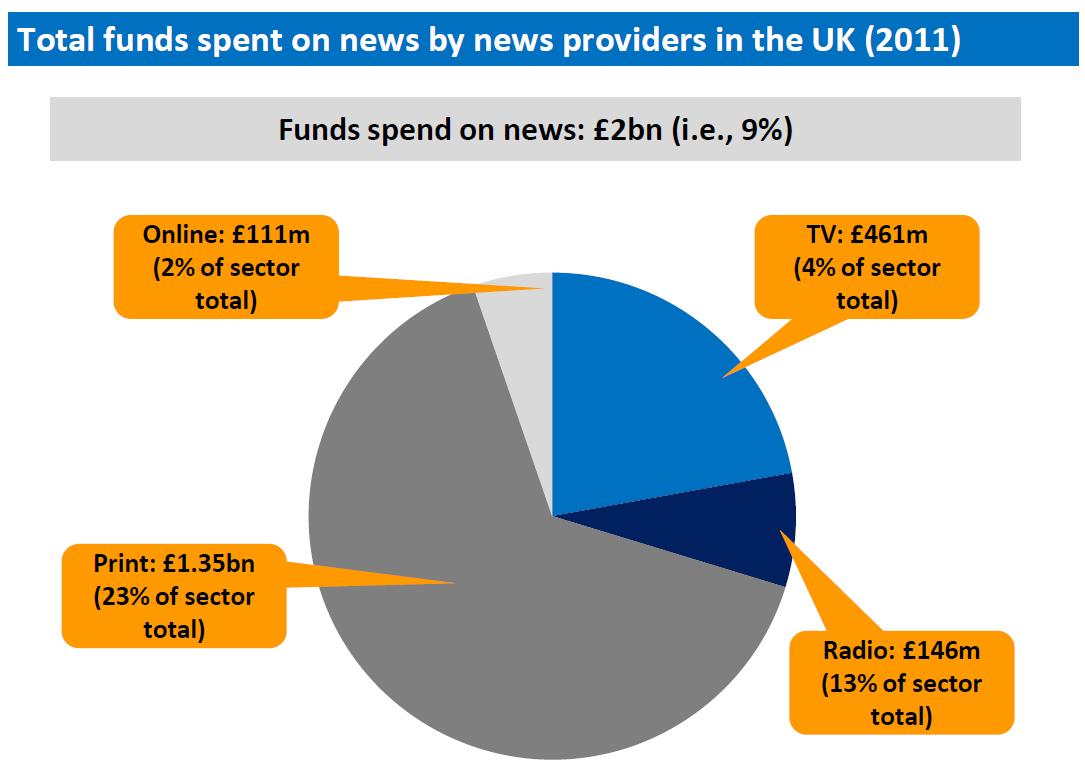
According to recent data from Ofcom and the Advertising Association, newspapers account for 65% of total investment in news provision in the UK, but draw only about 25% of total advertising spend. As audiences and advertisers continue to move from print to other platforms, this will drive a continued erosion of overall news provision in the UK.

The data on news provision comes from a report by Mediatique released by Ofcom June 19. The consulting company has been tasked with quantifying overall investment in news as part of a larger investigation into media plurality. One striking finding is that national and regional newspapers, even after years of declining revenues and often brutal cuts in newsrooms, continue to account for the majority of spending on news.

According to Mediatique’s estimate, the industry as a whole accounts for 65% of total news expenditure in the UK, £1,345 million–this is three times the combined news investment of the BBC, close to three times the combined news investment of all television broadcasters combined (counting BBC TV plus ITV, Channel 4, Channel 5, and Sky). The figure below is from the report and represents the distribution of total news investment in 2011.

Precise accounting is of course hard, and critics would be right to point out that the definition of news may be broader in the case of newspapers, where it includes all editorial content, from investigative reporting to the crosswords, than it is for TV where it focus on news and current affairs. But the overall impression, that newspapers provide the bulk of original news content, is broadly in line with what researchers have found in both the US and in Denmark in recent years.

The figure is striking–and chilling, in light of the newspaper industry’s continued commercial difficulties. Internet revenues are growing, as a mobile ones and a whole slew of side activities ranging from branded merchandise to guided tours, but the bulk of the industry’s income still comes from print sales and print advertising. And though overall advertising spend in the UK increased by 2.7% from 2010 to 2011, the latest data from the Advertising Association suggests that print newspapers drew less than a quarter of overall advertising expenditures in 2011, losing ground both in relative and absolute terms. Every year, this erosion of the commercial underpinnings of newspapers have consequences in the form of cutbacks and layoffs across the industry.

Will digital growth change this? The 25% figure above (still a significant £4 billion) does not include revenues from advertising on newspaper websites–but despite fifteen years of investment and pretty much non-stop growth in terms of traffic and time spent, few of them are making a profit, and none have made the kind of money being lost every year from the ongoing decline of print.

Take as an example the Daily Mail, arguably one of the most successful newspaper companies in the UK–from 2010 to 2011, the DMGT recorded 56% growth in internet advertising from its national newspaper websites (from about £12 million to £19 million). But its Associated Newspapers arm also recorded a five percent decline in print advertising, which fell by about £15 million to £286 million, more than twice what was gained online. A 14 percent growth in the print advertising of the free daily Metro alone accounted for an extra £10 million, more additional revenue than was delivered by the growth of the most popular newspaper website in the world…

As the print parts of the business continue to decline and digital only make up for parts of what’s lost, newspapers will have to continue to cut costs, including investments made in newsrooms. This means fewer journalists, less original news, and as always, we won’t know what we don’t know when things go uncovered.