Review and book salon on Firedoglake

The US-based liberal political blog Firedoglake hosted a lively and interesting book salon discussion of my book this Sunday, moderated by Benjamin Kallos (NYC city council candidate, political consultant, and lawyer) and full of good questions from the FDL community.

Kallos has written a very nice review of my book that kicked off the discussion. Good reviews are of course always a joy to read, but I’m particularly happy that someone like him, with a rare combination of political experience, an activist pedigree, and very impressive academic credentials, likes the book. Here’s how he opens his review–

Ground Wars by Rasmus Kleis Nielsen is an essential new bible for political campaigns locked in the everlasting battle that has become modern American politics.

Look at the discussion too, many interesting points and questions raised, more than we could hope to answer in one evening.

March 2012 book talks

I’m taking Ground Wars on the road in Denmark in March, with three events coming up–

Tuesday March 13, 7pm- at Frit Forum, Reventlowsgade 14, Copenhagen. Frit Forum is a Social Democrat-affiliated student organization. The Social Democrats were one of the party with the most ambitious “ground war”-type operations in the 2011 Danish General Election, so this will hopefully provide an interesting opportunity to hear about people’s experiences with field campaigning in Denmark.

Thursday March 15, 5pm-7pm at Operate (Jesper Brochmands Gade 10, Copenhagen), with Kommunikationsforeningen. This event is organized by the professional association for people working with communications, and also includes Rune Baastrup, who was one of the key people behind the labor union 3F’s work with personalized communication in the run up to the 2011 election and in terms of organizing and community-building. It should make for a great discussion.

Thursday March 29, 2pm-4pm at Copenhagen Business School, Center for the Study of the Americas. (Details to come.) CSA is one of the most interesting research environments in Denmark dealing with American issues, and I’ll be appearing alongside Niels Bjerre Poulsen who is a well-known Danish historian and expert on US politics, so it’s sure to be another interesting event.

Nothing “super” about Super Tuesday

Super Tuesday came and went, and I’m not sure people in the ten states involved felt it was all that “super”.

Despite some Republican party activists asserting this is the most important Presidential Election since George Washington was elected (no, really), voter turnout in several cases was lower than in the 2008 Republican Primary. Many of those who did vote were not enthusiastic about any of the candidates running (according to the Washington Post, “Barely more than four out of 10 voters in Ohio said they were strongly behind their candidate, according to exit polls”). And people aren’t enjoying the spectacle of the campaign itself either—the New York Times quotes a couple from Ohio complaining about the “barrage of ads” and “the phone calls, ugh … We get 15 a day.” (They must be new to the Buckeye State. It will get worse in November.)

At this point it seems clear that, barring some major mistake, damaging revelation, or outside event, Mitt Romney will grind his way to the Republican nomination. It is also clear that it is likely to take months. Rick Santorum in particular has no reason to concede at this point. It is not clear that he has any real chance of winning the nomination. (Josh Putnam at Frontloading HQ has been crunching the numbers and makes a strong case it is highly improbably that Santorum, let alone Gingrich or Paul, can actually win the primary without dramatically improving their performance. The Washington Post has a similar analysis here.) But Santorum’s campaign is kept afloat by the lack of whole-hearted support for Romney in the Republican primary electorate, by media coverage, by outside money, and by the appearance of momentum off the back of a favourable electoral geography/timetable. He will probably do well in Kansas, Alabama, and Mississippi, the next states to vote—all southern, all primed for his folksy style and conservative message—but from late March and onwards, the demography swings in Romney favour as Illinois votes. In April, a raft of North-Eastern states have their primaries, states that Romney will probably win quite clearly on his way to locking up the nomination.

In 2008, the Republican Primary was over after Super Tuesday, the preponderance of winner-takes-all systems for allocating delegates meant that John McCain was comfortably ahead in the delegate count at an early point in time. Out of ten states to vote before February 6, 2008, McCain had won only three (New Hampshire, South Carolina, and Florida) Of the 21 that voted on Super Tuesday that year, he won 9, for a total of 12 out of 31. Mitt Romney, by comparison, had won a total 11 by then—but conceded the next day, accepting that there was no clear path for him to the nomination. In 2012, Romney has won 14 states out of 22 (including Ohio), and Santorum 6, but changes to how delegates are awarded means that Santorum retains a sheen of viability that will only be increased if he racks up more victories in the next couple of states. (It is an interesting question of how one covers this as a journalist—there is a danger to pronouncing people winners before they have actually won. Compare the New York Times coverage, which is very cautious about crowning Romney as the likely nominee, with the Washington Post, which is much less circumspect.)

Why this change to the rules, changes that keep Santorum alive and kicking where he would have been dead and buried under the old rules? After 2008, Republican Party leaders came to the conclusion that the drawn-out Obama-Clinton primary contest was actually an advantage for the Democratic Party, giving their candidates more exposure, battle-testing them, forcing them to built their campaigns across the country. Hence, as Karen Tumulty writes in the Washington Post, in the new system—

“The GOP nomination contest was designed to play out more slowly than in the past. Through the end of this month, states are required to allocate their delegates in proportion to the votes each candidate receives. That means just about everyone comes away from just about every contest with something to show for it — and a rationale for continuing to the next one.”

It is not clear this is working out very well for the Republican Party. As Dan Balz notes in the Washington Post, “Romney is in worse shape at this point in the campaign than virtually all recent previous nominees.” The exposure, the incessant negative campaigning, the party-internal wrangling and the rest of it is not working to the GOP’s advantage. Balz continues—

“Demographically, [Romney’s] image among independent voters, the most critical swing group, is more negative now than it was when the primary battle began. He could be hurt among women. He is in trouble with Latinos, a growing part of the electorate that is tilting even more Democratic than it was four years ago. He is not as strong as he needs to be among working-class white voters, among whom President Obama has been consistently weak.

Geographically, the numbers from several key states have been discouraging for the former Massachusetts governor. Pre-primary polls in Ohio, Virginia and Michigan showed him running behind Obama by low double digits. Ohio is a must-win for the Republican nominee in the fall, and Virginia is a state the GOP is determined to take back from the president. Republicans once thought Michigan would be a possible battleground, but at this point it isn’t.“

Every Republican Party leader, operative, and activist who looks at the trajectory of the primary will have to consider whether the drawn-out contest is undermining the party’s prospects in the fall. Many are clearly pushing hard for the GOP to rally around Romney.

But as long as Santorum and the rest insists on plugging on, their wealthy backers are willing to bankroll them, and between a third and half the Republican primary electorate keeps on voting for them, they can do it. Hence, while Super Tuesday gave Romney a string of victories (and important ones at that), it was more like another day at the office than a particularly “super” day for him too. Both he and many voters would probably wish for this to be over sooner rather than later. But Romney will just have to grind his teeth and grind his rivals down, week after week, state after state, driving away independent and alienating party activists simply by not being as conservative as they are, while President Obama and his people built his re-election campaign and prepares for the final showdown in the fall.

My book, Ground Wars: Personalized Communication in Political Campaigns, deals with how American political campaigns mobilize, organize, and target their field operations, using large numbers of volunteers and paid part-timer workers to contact voters at home at the door or over the phone. It has just been published by Princeton University Press and is available on Amazon.

(cross-posted to Politics in Spires)

Ground Wars on the road (February round-up)

In the past three weeks, I’ve given my first three talks about Ground Wars, one at my launch here in Oxford at the Rothermere American Institute, one at Royal Holloway, and one at the University of  Westminster. It’s been good turnout and great discussions all around.

It’s been really interesting to see what people pick up and the directions the conversations take—the concept of “personalized political communication”, the instrumental use of people as media for political purposes through for example door-to-door canvassing has generally been well received, as has the notion that we need to pay more systematic attention to how such forms of campaign communication operate and how they complement and interact with other forms we already know much more about, most notably mass media and computer-mediated/online political communication.

One of the things that have been particularly good about talking about Ground Wars here in the UK is the range of different experiences people bring to the discussion. This has really brought out all the comparative questions the book raises, comparative between local and national, between points in time, and across countries. The discussions have been wide-ranging, from a student at Royal Holloway who won a seat in local government walking door-to-door with volunteers who talked about his experience, over faculty members who had canvassed from the 1970s onwards and talked about that, to people from India to Germany who could describe how things are done there.

Obviously, there is a lot of work to be done comparatively on personalized political communication, to what extent is it used, why and with what strategic objectives in mind, how is it organized and targeted, who are the people involved and their motivations, what are the differences in how well it works, the implications for democracy in different contexts and for different actors, and so on. Darren Lilleker (who has written a nice review of the book) has alerted me to one if his pieces that touch on some of this–and there are others. (One book I read and re-read while I worked on mine was Javier Auyero’s masterful study of Poor People’s Politics in the barrios of Buenos Aries.) There is much to be done here and I hope to begin some of that myself, having already dipped my toes in by doing a bit of fieldwork during the 2011 Danish general election.

Another area where it is also clear to me my work on personalized political communication can be extended is in terms of a more explicit and clearer analysis of the power relations between the staffers, volunteers, and part-timers involved in ground wars (relations that are also encoded into some of the various tools and technologies they rely on). Andy Chadwick rightly pushed me a bit on this point in the discussion at Royal Holloway, arguing that my argument is not always equally explicit about this. I’ve written elsewhere about what I call the “co-production of citizenship” in political campaigns, playing off Philip Howard’s notion of “managed citizenship”, and continue to think that the degree of control political operatives have over their surroundings is frequently overstated–but it is quite important to underline that the absence of complete hierarchical control over campaign assemblages and their environs should not be confused with the absence of power asymmetries, only as an indication that everyone involved have a degree of autonomy. Power in campaigns is, in short, about control, forcing people to act in certain ways, but it is not only about control–it is also enabling (nod here to Michel Foucault), about allowing people to become more active and effective citizens in certain ways. This is a theme I hope to explore more when I find the time to re-read my copius field notes from the time I spent on the campaign trail in 2008.

The fight goes on—from Arizona and Michigan to Super Tuesday

Mitt Romney won yesterday’s two primaries in Arizona and Michigan, but he didn’t win by enough to (re)establish a sense of inevitability around his candidacy. He has been the favourite for so long that everything but decisive victories ends up being framed as a bit of a disappointment.

Here is Whit Ayres, a Republican political operative, speaking to the Washington Post a few days before this week’s primaries—“if [Romney] wins Michigan by double digits, especially if combined with a double-digit Arizona win, then all the chatter will die down just like it did after Florida.”

But Romney didn’t win Michigan by double-digits, and the chatter hasn’t died down. Though Santorum lost both states, no one seems to really hold it against him.

Some part of this surely is about political journalists and rival candidates with a vested interest in keeping the “chatter” alive, but a larger part of it is arguably about the demonstrable and enduring unease with which many Republicans  regard Romney. He continues to win by pluralities rather than majorities (47.3% in Arizona, 41.1% in Michigan), keeping alive the “what-if” question: what if someone managed to rally the “not-Romney” vote?

It is not clear that the not-Romney vote is coalescing behind a single candidate. But the votes are there and many people are on the prowl for an alternative to Romney. A succession of revolving candidates have been cast for the role already–Herman Cain, Rick Perry, Newt Gingrich, and now Rick Santorum. But the role isn’t necessarily Santorum’s to keep. Gingrich effectively didn’t content Arizona and Michigan, focusing instead on campaigning in the South, hoping for success on Super Tuesday. It is too early to write him off, and at the very least he will continue to siphon off a considerable number of votes, undermining Santorum’s challenge to Romney.

Romney has been the only constant in the primary, and he remains the favourite to capture the nomination, though at this point it is unlikely he’ll have it locked up anytime soon. Many people are still making up and changing the minds, so polls are tricky, but at this point, Real Clear Politics has Santorum ahead in Ohio and Gingrich ahead in Georgia, two of the most important states to vote on March 6. So get ready for some March madness, because this thing will go on for a while.

Moving towards Super Tuesday, Romney’s strategy is clear—focus on the economy when he makes his own pitch, leave it to his Super PAC “Restore our Future” to spend millions hammering Santorum and Gingrich with negative advertising while his various elite backers brief against them as unstable, not serious, unelectable etc, and count on his organizational strength to swing things his way. He is, as Amy Gardner writes in the Washington Post,

relying heavily on the methods that have served him well in past wins: a well-organized and well-financed ground operation, a heavy emphasis on early-voting recruitment, a growing list of endorsements, including from both establishment and tea-party leaders, and millions of dollars in TV advertisements.

Santorum and Gingrich are both making versions of the same basic pitch as they fight back—the message is that Romney is a closet liberal and a flip-flopper willing to say anything to win, the implication is “don’t trust him.” The suggestion is clear: vote for me instead, I’m a real conservative and I speak my mind and stick to my guns. For both of them things are complicated by the other’s presence and unwillingness to withdraw. Also, while both of them have enjoyed periodic fundraising boosts off debate performances or unexpected wins, they continue to be at a financial disadvantage (Romney and his allies outspent Santorum and his allies by about 2-1 in Michigan and by 12-1 in Arizona). With less money and less developed campaign organizations, they are more reliant on help from their respective Super PACs and outside backers (most notably Foster S. Friess for Santorum and Sheldon Adelson for Gingrich) than Romney is.

(Then there is “the third man” facing Romney, Ron Paul, who is plugging away in his own inimitable style. I’m dying for more inside intel on his campaign, its operations, resources, technologies, it seems like a bit of a libertarian counterpart to Howard Dean in 2004, an innovative campaign that may not win but could shape how politics is done by many others. The New York Times reports that Paul’s campaign is focusing on the caucus states, where the rules of the game means that even modest support can be translated into a significant number of delegates for the convention is a campaign plays its cards right.)

What does the prospect of a drawn-out nomination fight amongst the Republicans mean?

First of all, most commetators argue it helps Barack Obama because whoever emerges as his challenger will (a) have had to throw some red meat to a conservative Republican base out of sync with most Americans, stuff that can be turned against him in the general election and (b) have had to endure relentless negative advertising by his rivals, highlighting his each and every flaw, giving plenty of ammunition for Democrats to make their case in the fall.

Second, there is the question of whether we risk a “politics of tedium” where people get fed up with the protracted fight and some lose interest before the general election. The 2008 primary fight between Obama and Hillary Clinton arguably served to energize much of the Democratic Party’s base and helped Obama built the campaign he led into the general election. It is less clear that the 2012 Republican Primaries will provide the eventual nominee with the same organizational and activist momentum–look at the turnout so far, for example, which is not particularly impressive. A couple of states have had higher turnout in the 2012 Republican Primaries than they had in 2008, but most have about the same or even less–not impressive, considering that this race is much more open and closely fought and that the number of registered voters has grown since last time.

My book, Ground Wars: Personalized Communication in Political Campaigns, deals with how American political campaigns mobilize, organize, and target their field operations, using large numbers of volunteers and paid part-timer workers to contact voters at home at the door or over the phone. It has just been published by Princeton University Press and is available on Amazon.

(cross-posted to Politics in Spires)
The Rendell Inquirer?

Ed Rendell, the Democratic former governor of Pennsylvania and Mayor of Philadelphia, is heading a group of powerful politicians and local business men interested i nacquiring the troubled Philadelphia Media Network. I’ve written a piece on the Nieman Lab blog about experiences elsewhere with “instrumentalization” of news organizations. You have to check it out, if only for the neat little photo colleage they’ve used to illustrate it…

Good read – 02 14 12 (Piano Media), with 02 16 12 update

(Updated Feb 16 with reply below from Piano Media)

As is clear to anyone following the news industry, charging for online news is back in fashion as more and more commercial news organizations experiment with different pay models–metered models, freemium, paywalls. Experiments abound.

One initiative that has attracted a fair amount of attention is Piano Media, which started in Slovakia and has now expanded to Slovenia.

The idea is simple–create one common platform for people to pay for content and then try to amass all or most quality content in the country/language in question on that platform leaving users with a choice between quality and payment and whatever is outside the system. The US-based Christian Science Monitor, which, burdened by unsustainable operating losses stopped printing its daily edition in 2009, calls it “a model to  save newspapers.”

There are skeptics and critics too, of course–to quote from the same CSM story:

Some say a national paywall could violate antitrust laws. In the United States, proposals that the major papers go behind a paywall simultaneously have sometimes been discredited on those grounds.

Robert Levine, author of “Free Ride: How Digital Parasites Are Destroying the Culture Business, and How the Culture Business Can Fight Back,” says any collective effort would be resisted by major Internet businesses such as Google and that they might try to block it with antitrust legislation.

The anti-trust concerns would arguably apply in much of Europe too. (I’d be interested to hear from lawyers who know more about market regulation or from people who know about the situation on the ground in the two countries concerned.) It will be interesting to see if current experiments in Slovakia and Slovenia will be challenged as monopolies or for price-fixing.

Because whatever way you look at it, that is what Piano Media is meant to allow–it offers a way of giving back some market power to publishers who fear they have lost the ability to price their products on a generously supplied market for online “content.” And indeed in Slovakia, where Piano Media started, they are just now testing just how much power they have gotten back–jacking up subscription prices by 25% , as reported by Andrew Phelps at Nieman Labs.

(Robert Andrews at PaidContent has followed the story, his articles on Piano Media are here.)

UPDATE: David Brauchli from Piano Media wrote to me Feb 16 in response to the piece, with his permission, I’m copying in the relevant parts below:

We had our lawyers in Slovakia check with the anti-trust/monopolies office in SK and of course in SI before we launched in either country. It wouldn’t make sense to launch a business that was sure to run afoul of the monopoly authorities. Suffice it to say the business model complies.
We really run a payment system and the competition is still intact among the papers. That’s due to our unique chronological meter which measures how long and what type of content the reader consumes. Content is weighted according to type and that’s weighed against how long a reader spends on the site. So if a reader simply clicks through and then out of an article, the publisher isn’t compensated. Likewise, if a reader spends all his time on the discussion forums then the publisher again receives little compensation. However, if a reader spends a lot of time looking at, listening to or reading something which the publisher has spent a lot of time and effort creating, he is rewarded. What that means is superior journalism is rewarded. It also is a better system than micro payments which reward publishers simply for click-throughs, which really don’t benefit anyone except advertisers.
Thanks to David for the update. It would be interesting to hear from people with legal expertise in other countries about what the model he describes would look like in other jurisdictions.

Can Santorum capitalize on his Feb 7 victories?

So Rick Santorum swept Minnesota, Colorado, and Missouri on Tuesday, and now all and sundry are scrambling to catch up on what that means and what his prospects are moving forward. Clearly the result took many (including me) by surprise.

There hasn’t been much coverage of his operation on the ground, and I don’t have any inside leads on this, so I’d be happy to hear from people who knows something about his campaign.

So far, he has operated with a pretty bare-bones organization compared to Romney or even Gingrich and hasn’t raised nearly as much money for his campaign or for outside groups supporting him as his rivals have.

Now his people are putting it out that he will be building a national organization. They have to say that. The hard thing is actually doing it. It will be interesting to see how they go about it and whether they succeed.

Here are some elements worth watching–

  1. Can Santorum expand his base amongst wealthy conservative donors? So far, one man, Foster Friess seems to have been his major financial supporter (but not on a Sheldon Adelson scale). More money is bound to come in now, but how much, and from whom?
  2. Will various Tea Party-type groups find Santorum more appealing than Gingrich and start rallying around him? These activists have in the past months been supposed to be coalescing behind a number of various candidates, including Michele Bachmann, Herman Cain, Ron Paul, Newt Gingrich, and now Santorum. Will they or won’t they? And will they ultimately matter much? (A recent article in the National Journal argues that the movement is in decline.)
  3. How much will the support of many social conservative activists and groups help Santorum–in terms of endorsements and raising money, but also in terms of positioning himself and building an organization? Various parts of the Christian Right have played a central role in many previous Republican primary campaigns, and Santorum will have to hope they will this time too–because they sure don’t like Romney (who only got three votes at a meeting in January where Santorum with 57 votes secured the backing of a number of Evangelical conservative groups).

As said, there has been little coverage of Santorum’s campaign and its organization so far. To capitalize on his February 7 victories, he will need to build an operation on the ground (and his campaign is well aware of this). It will be interesting to see what they can cobble together on such short notice and how well it will work as we approach Super Tuesday.

My book, Ground Wars: Personalized Communication in Political Campaigns, deals with how American political campaigns mobilize, organize, and target their field operations, using large numbers of volunteers and paid part-timer workers to contact voters at home at the door or over the phone. It has just been published by Princeton University Press and is available on Amazon.

(Photo by Gage Skidmore from Flickr)

Does Nevada mean that conservatives have begun to “rally” around Romney? Not really

The overall result of the Nevada caucus—a clear Mitt Romney victory—was so predictable that I haven’t really been following the campaign there and hadn’t planned to write about it. But then some of the media coverage of the result is interesting and amnesic enough to merit a few words.

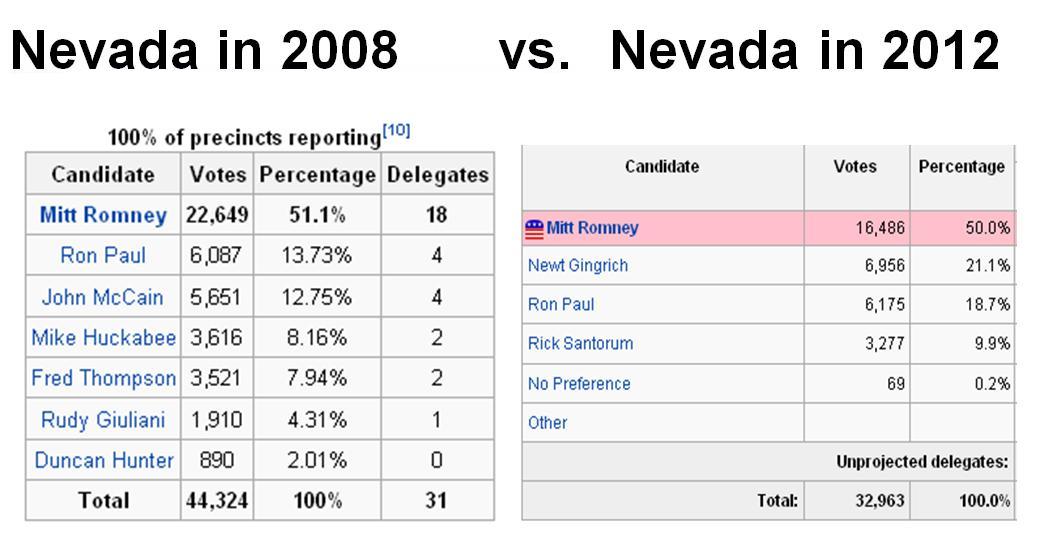
First the result, from AP via Google: Romney 50%, Gingrich 21%, Paul 19%, and Santorum 10%. Turnout little short of 33,000 voters.

What does that mean? According to Michael O’Brian writing on MSNBC/NBC, “Saturday’s caucus reflect an instance in which Romney was able to rally conservatives to his candidacy.” Chris McGreal writes for the Guardian that “Republican voters of various shades [now] latch on to Romney as the best prospect of beating Barack Obama.”

Wait a minute. Romney is the clear favourite to secure the Republican nomination, but it is not at all clear that the Nevada result suggests that conservatives are now rallying around him.

Why? Well, we could compare the 2012 results with 2008, for example—Romney 51%, Ron Paul 14%, John McCain 13% and the rest sharing the remaining 22%. Turnout? More than 44,000 voters. (The difference is clear from my highly sophisticated combo of the Wikipedia pages on 2008 and 2012 below, an example of the power of what Larry Lessig calls “remix culture“…)

In other words, Romney, the candidate that Republicans are now supposedly “rallying” around, and who came into Nevada with considerable momentum, who has a clear organizational and financial advantage, and who faced very little serious resistance on the ground as his rivals had given up the state in advance, got more votes in 2008 than in 2012. And not just a little– he got about a third more votes back then if you look at the absolute numbers. (16,486 in 2012, versus 22,649 in 2008.)

There are no doubt many reasons for this result that I won’t comment on here. But one thing I would venture to say is that it suggests that the Republican base is yet to accept Romney as their man. His campaign continues to have to fight on two fronts at the same time–making a broad-based appeal to the American people with an eye to the November general election while convincing the (diverse) conservative core of the Republican Party that they should support him too.

My book, Ground Wars: Personalized Communication in Political Campaigns, deals with how American political campaigns mobilize, organize, and target their field operations, using large numbers of volunteers and paid part-timer workers to contact voters at home at the door or over the phone. It has just been published by Princeton University Press and is available on Amazon.

February 2012 book talks

Monday February 13, 5pm-6.30pm at the Rothermere American Institute in Oxford. This is the official launch of my book, a talk moderated by Nigel Bowles with Tom Wales serving as a respondent, to be followed by a wine reception. The RAI is an ideal venue for this, first of course because it is the hub of all things American in Oxford, but also because I finished my revisions on the manuscript in their wonderful library. The venue is here.

Tuesday February 21, 5.15pm-6.30pm at the New Political Communications Unit, Royal Holloway, University of London. This event is hosted by Andrew Chadwick whose work I’ve learned much from, so I’m looking forward to discussing the book with him, his colleagues, and the rest of the RHU community. The venue is here.

Wednesday February 22 (time and location TBA) at the Communication and Media Research Institute at the University of Westminster My host is Anastasia Kavada, with whom I’ve had many an animated conversation about digital politics and protest at various conferences. It’s my first visit to CAMRI, an internationally famous media and communications department, so I’m sure it will make for very interesting conversation.

More information upcoming on talks in March (in Denmark) and April (in the United States). Stay tuned…