Journatic—a problem of by-lines or billions?

Sarah Koenig’s piece in last week’s This American Life on Journatic, a content provider that combines US-based editors and freelancers with Filipino writers and researchers to produce copious amounts of very cheap mostly local content for a variety of clients including Tribune Company newspapers, has produced quite a ruckus, with commentary on Poynter, by David Carr, a blog post by Koenig’s main source, Ryan Smith on the Guardian and much much more.

Much of the controversy focuses on Journatic’s use of fake by-lines—apparently, contributors would select an appropriately American-sounding name from a drop-down menu of options rather than publish under their own name. It is a powerful symbol of the de-skilling and commoditization of journalistic work that many reporters feel keenly as colleagues are laid off right, left, and center and both their profession and the industry that has sustained and constrained it seems in tailspin.

But as Mathew Ingram of GigaOm points out, outsourcing and automation are bound to be part of the news business’ future. It’s too easy to simply criticize this as “pink slime journalism” and wish for a better world in which good reporting is done by countless upstanding professionals with decent salaries, job security, and generous benefits.

As revenues continue to decline and users still expect (a) a package of news and (b) regular updates of news, the old model based on in-house production by staff correspondents is hard to sustain. Part of the discussion thus has to be about what to outsource and what to automate rather than whether to outsource and automate.

I’m sure a reporter going in person to cover budget negotiations at city hall is better than having someone do it in front on a screen on the basis of online documents and maybe a single phone call to a convenient source. But that doesn’t mean it is economically sustainable to have that reporter go to that meeting.

An insistence on individually hand-crafted news stories will necessitate a wholesale move away from the kind of large-scale production we have grown accustomed to, and for all the dangers of churnalism, there is something to be said for having running coverage of many things, especially when combined with distinct, relevant, content. Cottage production works for the few, I don’t see how it will work for the many.

Koenig acknowledges this in her piece—Journatic CEO Brian Timpone gets the second to last words in the piece (full transcript here)

Brian Timpone: I would posit that it’s better to have somebody look at them than to have nobody look at them. You know what? Newspapers are firing people. Newspapers are struggling. They’re going bankrupt. We have a solution that helps solve the problem, right? Cutting staff is not the way to growth. But empowering a reporter with people in the Philippines– that’s a really smart thing to do. The criticism’s fine. But at the end of the day, what’s a better solution?  … I mean do you have one? Tell me if you have a better idea, I’m all ears.

Sarah Koenig: I don’t have a better idea.

And that’s the real problem. Commercial sustainability is not a sufficient, but may well be a necessary, condition for widespread quality news journalism. In that light, the billions of revenue lost as newspaper advertisement collapsed over the last decade in the US is a far bigger problem for journalism than fake by-lines. Managing that transition–which Journatic is but one symptom of–is the challenge at hand both for journalists and industry executives.

UK newspapers account for 65% of investment in news provision, attracts about 25% of advertising

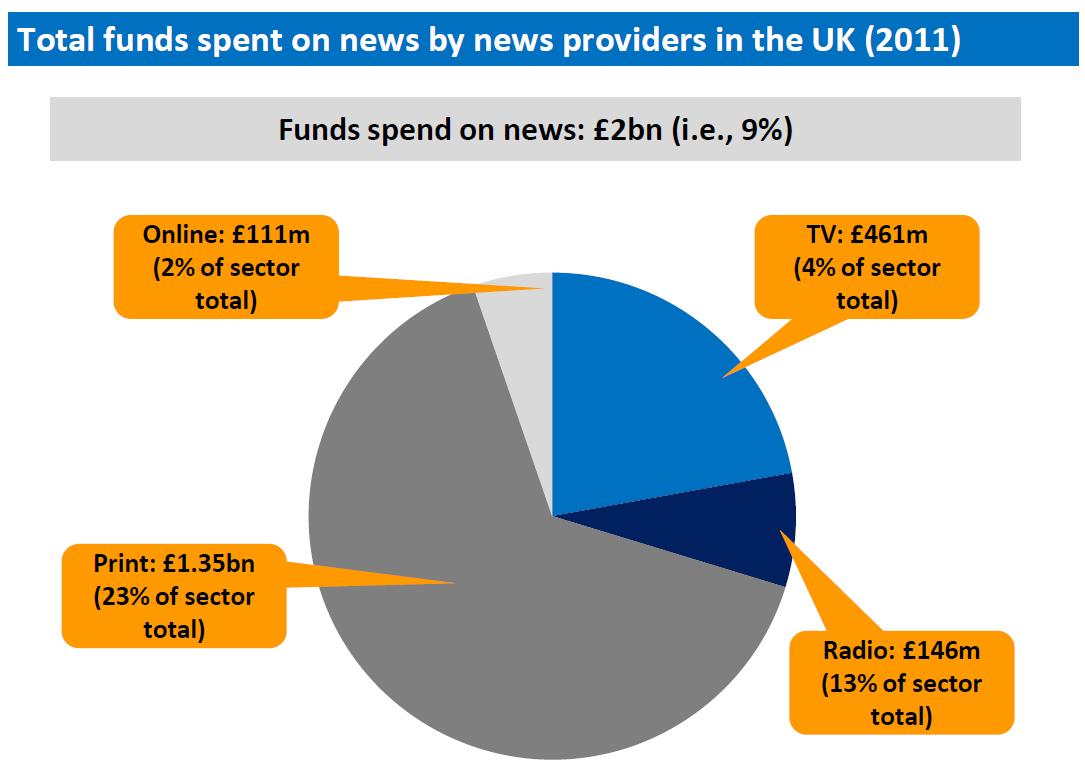
According to recent data from Ofcom and the Advertising Association, newspapers account for 65% of total investment in news provision in the UK, but draw only about 25% of total advertising spend. As audiences and advertisers continue to move from print to other platforms, this will drive a continued erosion of overall news provision in the UK.

The data on news provision comes from a report by Mediatique released by Ofcom June 19. The consulting company has been tasked with quantifying overall investment in news as part of a larger investigation into media plurality. One striking finding is that national and regional newspapers, even after years of declining revenues and often brutal cuts in newsrooms, continue to account for the majority of spending on news.

According to Mediatique’s estimate, the industry as a whole accounts for 65% of total news expenditure in the UK, £1,345 million–this is three times the combined news investment of the BBC, close to three times the combined news investment of all television broadcasters combined (counting BBC TV plus ITV, Channel 4, Channel 5, and Sky). The figure below is from the report and represents the distribution of total news investment in 2011.

Precise accounting is of course hard, and critics would be right to point out that the definition of news may be broader in the case of newspapers, where it includes all editorial content, from investigative reporting to the crosswords, than it is for TV where it focus on news and current affairs. But the overall impression, that newspapers provide the bulk of original news content, is broadly in line with what researchers have found in both the US and in Denmark in recent years.

The figure is striking–and chilling, in light of the newspaper industry’s continued commercial difficulties. Internet revenues are growing, as a mobile ones and a whole slew of side activities ranging from branded merchandise to guided tours, but the bulk of the industry’s income still comes from print sales and print advertising. And though overall advertising spend in the UK increased by 2.7% from 2010 to 2011, the latest data from the Advertising Association suggests that print newspapers drew less than a quarter of overall advertising expenditures in 2011, losing ground both in relative and absolute terms. Every year, this erosion of the commercial underpinnings of newspapers have consequences in the form of cutbacks and layoffs across the industry.

Will digital growth change this? The 25% figure above (still a significant £4 billion) does not include revenues from advertising on newspaper websites–but despite fifteen years of investment and pretty much non-stop growth in terms of traffic and time spent, few of them are making a profit, and none have made the kind of money being lost every year from the ongoing decline of print.

Take as an example the Daily Mail, arguably one of the most successful newspaper companies in the UK–from 2010 to 2011, the DMGT recorded 56% growth in internet advertising from its national newspaper websites (from about £12 million to £19 million). But its Associated Newspapers arm also recorded a five percent decline in print advertising, which fell by about £15 million to £286 million, more than twice what was gained online. A 14 percent growth in the print advertising of the free daily Metro alone accounted for an extra £10 million, more additional revenue than was delivered by the growth of the most popular newspaper website in the world…

As the print parts of the business continue to decline and digital only make up for parts of what’s lost, newspapers will have to continue to cut costs, including investments made in newsrooms. This means fewer journalists, less original news, and as always, we won’t know what we don’t know when things go uncovered.

Ongoing limited popular interest in phone hacking

The third round of oral evidence before the Leveson Inquiry into the culture, practice and ethics of the British press came to a conclusion last week with the current Prime Minister, David Cameron, in the witness stand.

Now Lord Leveson will have to consider the wealth of evidence and the many contracting recommendations made on the future of press regulation in the UK. The Guardian, which, in addition to breaking the Milly Dowler story last summer that started the avalanche, has covered the inquiry itself in great detail, has a nice write-up on the current situation by Dan Sabbagh. (As the joke went after Leveson said the inquiry was about “one single question: who guards the guardians.”–the answer is also simple: “the Guardian guards the guardians.”)

Much of the inquiry has been televised on various narrow news channels and the process has been talk of the town amongst media-interested parts of the chattering classes. And rightly so, in a way, since the matter of media regulation is one of considerable importance and where there is, in my view, room for improvement in the UK. (As I’ve made clear elsewhere.)

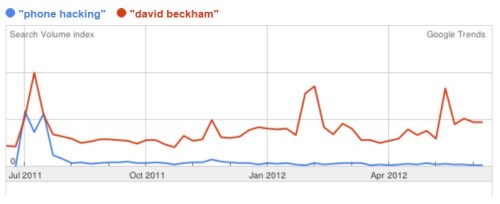
But does anyone neither directly involved nor professionally interested in the media actively care? Over the last year, I’ve used Google trends to track searches in the UK for “phone hacking” versus my random choice of celebrity baseline, “David Beckham”, to get a loose sense of this (in July 2011 and November 2011).

This metric, looking back on the spring of 2012 (see below), suggest that, despite the succession of high-profile witnesses who have taken the stand in June, including the three last Prime Ministers John Major, Tony Blair, and Gordon Brown in addition to the current one, there is (still) little popular interest in phone hacking.

This is worth keeping in mind whether one is for or against media policy reform. As it is, there is no popular outrage against what some would regard as politicians’ and judges’ allegedly attempts to meddle with the free press, nor for that matter much active support for reforming media regulation. Most people just don’t care that much.

In a best case-scenario, this relative absence of popular interest will allow lower the political stakes enough for a broad-based meaningful reform of media regulation in the UK to be possible. In a worst case scenario it will allow the issue to fade away and Lord Justice Leveson’s work to have been in vain.

Campaign Lessons from the Wisconsin Recall Election—it’s not about television, field operations, or the internet, but about all of them

So June 5, Wisconsin’s Republican Governor Scott Walker beat his Democratic challenger Tom Barrett 53-46 in a expensive, hard-fought, and divisive recall election that gives a taste of what the fall general election will have to offer in swing states around the United States.

Here are three observations about money and where it comes from, about television versus field, and about the role of the internet that will also apply as Obama and Romney face each other—

First, this was a very expensive election and both candidate campaigns were heavily reliant on various forms of outside allies. According to the Wisconsin Democracy Project and the Center for Public Integrity, the Walker campaign spent $29.3 million and outside pro-Republican groups a further $18 million. Barrett spent $2.9 million, a tenth of the incumbent, and outside groups supporting him, many of them labor unions spent a further $15.5 million. Total expenditures equaled $65.7 million, or $26.2 per vote cast, up more than 50% from $37.4 million or $17.3 per vote cast in the 2010 gubernatorial election between the same two men. Most of the money, especially for the Walker campaign and the outside groups, came from out-of-state donors.

Second, both campaigns worked intensely to use all means at their disposal, whether advertising, spin, or volunteers talking to voters. Some commentary has cast the recall election as “TV ad spending vs. boots on the ground”, which certainly reflects Walker and his allies’ almost 3-1 edge in the money race but also an effort by Barrett and his allies to spin their financial inferiority into a compelling narrative of people vs. power. Both campaigns spent millions on television, and both campaigns mobilized thousands of volunteers to make millions of phone calls and door knocks to sway the undecided, shore up support from their base, and turn out their voters. (The news coverage suggests Barrett with his labor allies had an edge on the ground, but Walker certainly also had his own field operation running and some numbers suggest they’ve contacted more than 60% of all registered voters in the state at least once in person.)

Third, on both sides, we’ve also seen signs of new digital tools being battle-tested in advance of the fall general election. TechPresident reports that the Obama campaign tested their new “Dashboard” system to let volunteers from around the country make calls into Wisconsin, the AFL-CIO has trialed software that matches voter lists with volunteers’ Facebook friends to let them call targets that they actually know rather than total strangers, and the Walker campaign combined VoIP with digital voter files to automate the connection between identification calls and data entry. More “mundane tools” like email, websites with information about when and where to vote, and of course Facebook pages set up by volunteer groups or lower-level candidates themselves were also integral to the campaigns everywhere. As is the case elsewhere, the internet was not only a separate platform for a digital advertising and marketing strategy directed at voters, but also an infrastructure used for a lot of other campaign operations like fundraising and mobilization.

So the Wisconsin recall election was expensive, it involved campaigns heavily dependent on outside allies and grassroots help as they mixed and matched old and new forms of political communication, and it saw various internet tools used both to promote each candidate’s message online, but also as integral to more back-end operations rarely visible from the outside.

All this will be the case in the fall too when the vastly bigger and more complicated Obama and Romney campaigns and their many allies square off for the Presidential Election, drawing on money and manpower from around the country but focusing their efforts on a dozen or so swing states.

My book, Ground Wars: Personalized Communication in Political Campaigns, deals with how American political campaigns mobilize, organize, and target their field operations, using large numbers of volunteers and paid part-timer workers to contact voters at home at the door or over the phone. It has been published by Princeton University Press and is available on Amazon.

(cross-posted to Politics in Spires)

(image from the Barret campaign’s Flickr stream)

Is the Obama campaign’s new tool “Dashboard” the “Holy Grail” of Digital Campaigning? Nobody knows

According to Ed Pilkington and Amanda Michel, writing in the Guardian, the Obama campaign is about to “unleash [the] ‘Holy Grail’ of digital campaigning.”

The grail in question is a new tools called “Dashboard”, meant to integrate voter contact, volunteer management, and activist social networking in one shared and accessible platform.

The campaign writes on their website, “for the first time ever, you’ll be able to join, connect with, and build your neighborhood team online.” (In other words, at this level of generality, it is kinda like MeetUp, DeanSpace, DFA-Link, MyBarackObama, National Field, etc, only different.)

It sounds great. Will it work? I have no clue. Neither do Pilkington and Michel, which they openly admit. As they write–

“[The campaign staffers] are keeping specific details about Dashboard heavily under wraps for fear that they might lose the substantial advantage they now enjoy over their rivals in the Romney campaign.”

So all we know about Dashboard at this point is that the Obama campaign has this new tool, that they have decided to promote its existence, that they say it will work (“substantial advantage”), but that they won’t tell us how, precisely.

In addition to the caveat quoted above, Pilkington and Michel’s article also includes all the usual buzzwords–Dashboard is “secret”, it is “sophisticated”, it is “powerful”, and it is being developed by brand-name “gurus” like Michael Slaby, Joe Rospars, and Jeremy Bird. (I’m trying to imagine a campaign that would let dimwits develop a feeble tool.) It’s already subject to speculation elsewhere, including on TechPresident.

Like other “Holy Grails” presented by “gurus” it is at this stage a question of faith whether you believe it will work (as a matter of fact, “Holy Grail” and “McCainSpace” was once mentioned in the same article).

I’m glad journalists like Pilkington and Michel are covering campaign technologies, because often-obscure back-end technologies like Dashboard increasingly matter for how digital politics works in practice, gives some campaigns a competitive edge, and structure how ordinary people can get involved and in what. But unless you are part of the team developing Dashboard or involved in testing it, at this point you won’t really have any evidence of its potential beyond whatever PR the campaign puts out.

I have every reason to believe that the people involved in developing Dashboard are smart, that they are very good at what they are doing, and that the tools they have developed will help them further rationalize, control, and perhaps even energize the Obama campaign’s voter contact program.

But I do get a little skeptical every time I encounter a heavily marketed new digital tool, whether it is being spun by a campaign wanting to assert it is ahead, or by a consultant peddling her wares. Is this another Demzilla, marketed aggressively by then-DNC chair Terry McAuliffe ( here in the Washington Post) but in practice a debacle–

“You could ask me about any city block in America, and I could tell you how many on that block are likely to be health care voters, or who’s most concerned about education or job creation […] And I could press a button and six seconds later you’d have a name, an address and a phone number for each of them. We can then begin a conversation with these people that is much more sophisticated and personal than we ever could before.”

Sounds good, Terry. Shame it didn’t work.

Is Dashboard another heavily hyped tool that won’t work in practice? Or is it the real thing? As said, I don’t know. Very few do, and they are not going to tell us very much at this stage. They have good reasons to hold their cards close to their chests.

Every cycle we are presented with new revolutionary tools. And some tools that actually really do change how politics is practiced. Sometimes, the tools we are presented with before, and the ones that in hindsight turned out to have made a real difference are not the same ones at all.

2008 was supposed to be the Facebook Election  or the YouTube election. But a good case can be made that more specialized back-end tools like the Voter Activation Network that I write about in my book or the MyBarackObama site that Daniel Kreiss writes about in his forthcoming book were actually in many ways more important. My point is simply that at this stage, we don’t know, and since the proof is in the pudding, in a way we can’t know–to find out, we’ll have to do more than simply listen to the PR hype, but go have a look at how these tools are used in practice, on the ground, battle-tested on the campaign trail.

My book, Ground Wars: Personalized Communication in Political Campaigns, deals with how American political campaigns mobilize, organize, and target their field operations, using large numbers of volunteers and paid part-timer workers to contact voters at home at the door or over the phone. It has just been published by Princeton University Press and is available on Amazon.

We are going to win this thing the (new) old-fashioned way

May 5th, President Obama gave (basically identical) speeches in the swing states of Ohio and Virginia, officially providing the “campaign kickoff” for his re-election effort. The opening statement is interesting for how it frames the campaign, as well as for the substantial ask–

I want to thank so many of our Neighborhood Team Leaders for being here today.  You guys will be the backbone of this campaign.  And I want the rest of you to join a team or become a leader yourself, because we are going to win this thing the old-fashioned way — door by door, block by block, neighborhood by neighborhood.

This campaign is about people (that’s part of the framing). He wants you to join the Obama army (that’s also a substantial ask, because the campaign needs help to get out the vote). And if you join, you will be asked to walk door to door to talk to voters, make calls, organize your neighborhood etc.

That may sound old-fashioned, as the President suggests, but there is a twist to it. Field operations and volunteer efforts these days are completely intertwined with a whole range of digital tools that are anything but old-fashioned.

So you’ll also be asked to enter data into VoteBuilder, the Democratic Party’s digital voter file, whether you have a smart phone to keep in touch with the campaign, to do distributed phone banking from home via an online integrated platform, and to lend data and profile updates from your social networking profiles (Facebook, Twitter, etc) to the campaign.

This is the (new) old-fashioned way honed to perfection in 2008 and refined ever since rather than the (old) old-fashioned way, blending traditional organizing with various new digital tools appropriated from corporate marketing or in some cases developed for the campaign. Romney’s campaign will be working along the same lines, as they too will be worried about turnout amongst traditional Republican base voters.

I’d love to be on the ground to follow these campaigns as they are operating “between door-to-door and databases” (an earlier working title for my book Ground Wars). Ten months with two congressional campaigns in 2008 was absolutely fascinating, and to spend just a few with a Presidential campaign working with the same tactics on a much larger scale would be a blast.

That’ll have to wait for some later election, however, as I’m bound in Europe working on other stuff… Till then, I’ll stalk the campaigns via coverage from the usual sources, I’ve grown particularly fond of the Financial Times‘ Richard McGregor, who reports a lot from the ground and pays attention to campaign mechanics like few other journalists, and of course continue to follow Sasha Issenberg’s great work at Slate.com and various stuff from TechPresident to keep up on the technology side of things.

My book, Ground Wars: Personalized Communication in Political Campaigns, deals with how American political campaigns mobilize, organize, and target their field operations, using large numbers of volunteers and paid part-timer workers to contact voters at home at the door or over the phone. It has just been published by Princeton University Press and is available on Amazon.

(cross-posted to Politics in Spires)

Door-to-door for Hollande

So François Hollande looks set to become the next French president the first Socialist on the post since Mitterand waved goodbye in 1988.

I haven’t followed the campaign closely, but I’m intrigued to learn that the French center-left have been building a ground war of unusual proportions, invoking, as the Social Democrats did in Denmark, the ’08 Obama campaign as their inspiration.

Kim Willsher provides an outline of the effort in the Guardian

On the ground, the Socialists are attempting to rebuff the [Front National] vote by redoubling efforts to mobilise their own supporters. Inspired by President Barack Obama’s election campaign in the US, they launched an ambitious programme in January to get five million French voters to open their doors.

An army of 120 professional “trainers” are overseeing 6,000 canvassers and 80,000 volunteers. Before last Sunday’s vote they had succeeded in opening 3.8m doors in districts around 10,000 voting stations seen as a priority because of their high rate of abstention or support for the Socialists in 2007.

“In all the voting stations where we carried out door-to-door canvassing before the first round there has been an increase of between 3% and 5% participation. As we are doing this in what are essentially our own areas, we are getting people out to vote for us,” said Hamon. “It’s been very successful in boosting our results.”

In November, I’m heading to Paris to talk about my book Ground Wars at Sciences Po after Florence Faucher King‘s kind invitation. I’m looking forward to discussing American, French, and other experiences in a comparative perspective.

New report on (the travails of) journalistic online start-ups in Western Europe

Given all that’s being written about the economic travails of the legacy media industry, it may be surprising—and somewhat depressing—to learn that news media start-ups are struggling too.

But that’s the main finding of a new RISJ Challenge, Survival is Success: Journalistic Online Start-Ups in Western Europe, written by the Italian journalist Nicola Bruno and myself.

Examining nine strategically chosen case studies of journalistic online start-ups from Germany, France, and Italy, we find that the economics of online news are as challenging for new entrants as they are for industry incumbents.

The competition for people’s attention is fierce, and though online advertising is growing rapidly, most of it goes to a small number of US-based giants like Google. This is a tough environment for start-ups, and the track record so far suggests that, as we indicate in the title of our report, survival is a form of success in itself.

Given the structural challenges that new journalistic ventures face, what can they do differently? In my view, one I’ve laid out in a bit more detail in a piece for Reuters Analysis & Opinion, they need to stop irrationally imitating the strategies of the (few) large US-based start-ups, like the Huffington Post, Gawker, and Politico, that many of the people interviewed for the report referred to as inspirations. Strategies that worked for earlier movers operating in a much larger US market are not necessarily going to work for start-ups entering smaller markets at a later point in time.

To survive—and to succeed—journalistic online start-ups in Western Europe need to find their own way, think beyond the dominant, and mostly failing, existing models of news production. I know this is a lot easier to say than it is to do, but it is worth saying anyhow. I wish all the new news entrepreneurs good luck. We need them.

2012 Midwest Political Science Association round-up

Earlier this month, I attended the 2012 Annual Meeting of the Midwest Political Science Association (one of my fixtures, having attended it more or less every year for five years or so).

A trio of highlights–one thing I did, a couple of things I attended, and one thing I did not attend but later caught up on.

First, doing–I had the pleasure of presenting some work in progress by Cristian Vaccari and myself, where we ask “What Drives Politicians’ Online Popularity?”  (the paper opens as a .doc here) on the basis of the same dataset underlying this previous paper. The panel, entitled “Campaigns, Elections & Technology” was one of those rare conference panels that had actual intellectual coherence to both the line-up of presenters and the discussion itself. Ben Epstein, Sounman Hong, and Christine B. Williams and Jeff Gulati all presented interesting papers. Betsy Sinclair did a great job as our respondent, and there was a good discussion with people in the audience afterwards, including Dave Karpf, Kevin Wallsten and others.

Second, attending–A couple of other panels I enjoyed were (1) “Mass Media and the Policy Process” were John Lovett and Frank Baumgartner presented a very strong paper asking when there is a single media agende, analyzing data over time, across issues, and between different outlets to show how media attention goes in and out of focus and (2) “Congressional Campaign Advertising” where a strong line-up examined various forms of strategic positioning vis-a-vis party brands, and the ways in which candidates and campaigns think about these choices and execute them.

Third, not doing, but catching up–I missed the presentation of a very interesting paper on “Career Concerns and the Behavior of Political Consultants in Congressional Elections” by Gregory J.Martin and Zachary Peskowitz from Stanford, but the paper can be downloaded here and it is a really neat piece of work that help advance our understanding of political consultants and the work they do.

Next steps for Romney?

It continues to look like Mitt Romney will be the Republican candidate for President in the fall. While he is still fighting a war of attrition with Rick Santorum, it will take a major game changer for him to lose the primary. So it is no surprise that he is increasingly orienting himself towards the general election.

What can the course of the campaign so far tell us about the challenges Romney will face and how he will try to tackle them?

The drawn-out primary has been a mixed blessing, forcing Romney to cater to a conservative base out of touch with many Americans, forcing him to spent time and money battling right-wing rivals when he would have preferred to train his guns on President Obama. It has also exposed some issues that Romney and his campaign will have to content with moving forward.

In short, Republicans aren’t really fired up about their likely Presidential candidate, and some may not be bothered to vote for him. This is a problem in what may very well be a very close race.

Moving to the general election, Romney has to make his pitch to independent voters, but also do his utmost to build a platform and an organization that can help him bring out the conservative base. If there is one thing Karl Rove taught us about American politics, it is that you cannot and should not take the base for granted, but actively cater to it and work to bring it out (his so-called “base-strategy”). The idea that simply not being Obama will do this for Romney is dangerous. The President is certainly not popular on the right, but Romney will need to fight for every vote, conservative or independent, to win in the fall.

Romney’s well-funded and professionally managed campaign organization has been highlighted as one of his advantages throughout the primary. As he begins to re-tool for the general election (while still dealing with Santorum et al at the same time), it will need to expand its presence on the ground and built a network of active supporters in all the potential battleground states. A proper field operation capable of getting out the vote is hard to put together on short notice. It takes time and effort to cultivate the relationships that animate a good ground game.

One of the advantages of the fiercely fought 2008 Democratic primary was that it left Obama with an organizational presence and strong supporter base across the country that also helped him fight and win the general election. In contrast, it is not clear that the Romney campaign has managed to maintain its presence even in states where it won the GOP primary. As Ed Pilkington and Amanda Michel from the Guardian writes

Romney until recently had three offices in Florida, all directed to his primary battle against Santorum, Newt Gingrich and Ron Paul. Yet despite the fact that no Republican has won the White House while losing Florida since Calvin Coolidge in 1924, Romney closed all three offices after the January 31 primary.

Calls to the main number of Romney’s Florida headquarters are sent to voicemail; the mailbox is full and will not accept further messages.

For all the talk about inevitability, it seems the Romney campaign is still mostly oriented towards winning the next primary states and has only just begun re-tooling for the general election. (I haven’t been able to find information on whether they remain active on the ground in Ohio and Virginia, it would be interesting to know.)

If they want to build an organization capable of fighting Obama for every inch in every contested state, they will need to maintain and continually expand a presence on the ground across the country. At the moment, they do not seem to be doing this. Come November, they may find there is a price to be paid for that.

My book, Ground Wars: Personalized Communication in Political Campaigns, deals with how American political campaigns mobilize, organize, and target their field operations, using large numbers of volunteers and paid part-timer workers to contact voters at home at the door or over the phone. It has just been published by Princeton University Press and is available on Amazon.

(cross-posted to Politics in Spires)

(image from the Mitt Romney campaign’s Flickr stream)