How can collaboration enable investigative journalism?

Today, we hosted a workshop at the Reuters Institute organized by Richard Sambrook and myself on how collaboration can enable more investigative journalism.

img_2917

As more traditional sources of funding are under pressure, different kinds of collaborative projects, whether anchored by legacy news media like the Guardian (with collaborations around the NSA/Snowden revelations and many others examples), digital-born players like BuzzFeed (working with, for example, the BBC), or non-profits like the International Consortium for Investigative Journalism (of Panama Papers fame, based on documents initially leaked to Süddeutsche Zeitung), have shown they can deliver important forms of accountability journalism in new ways.

The topics discussed included where collaboration can work, where not, what enables and what hinders collaboration (competition, habit, practical obstacles), as well as how collaborations can be funded.

The workshop included a diverse group of international participants with considerable experience across investigative journalism, editing, media law, technology, and included both people from private, public service, and non-profit media. It’s just a real privilege to get a chance to learn from all the interesting and important work people are doing.

Participants included Brigitte Alfter (Editor Europe, Journalismfund.eu), Ceri Thomas (Former editor BBC Panorama), Chuck Lewis (Founder, The Center for Public Integrity), Eliot Higgins (Founder, Bellingcat), Gerard Ryle (Director, International Consortium of Investigative Journalists), Jan Clements (Media lawyer and editorial consultant), Javier Moreno Barber (Director, El Pais), Mar Cabra (Head of Data & Research Unit, International Consortium of Investigative Journalists), Nicolas Kayser Brill (Co-founder and CEO, Journalism++), Rachel Oldroyd (Managing editor, Bureau of Investigative Journalism), Sylke Gruhnwald (Chairwoman of Journalismfund.eu and Reporter) and Tom Warren (Investigations correspondent, Buzzfeed).


New report for the Council of Europe

The Reuters Institute has just published a report that Alessio Cornia, Antonis Kalogeropoulos and I wrote for the Council of Europe’s Steering Committee on Media and Information Society reviewing challenges and opportunities for news media and journalism in today’s changing media environment.

I presented the report Dec 1 in Strasbourg at the CDMSI Workshop: ‘The Future of News: media and journalism in the age of digital convergence’.

img_20161201_143903r

It was a day of interesting discussions with participants from member state governments and the other speakers, including Nabil Wakim (Director of Editorial Innovation, Le Monde), Matt Rogerson (Head of Public Policy of Guardian News & Media), Pierre France, Founder of Rue 89 Strasbourg, Renate Schroeder (Director of the European Federation of Journalists), Wout van Wijk (Executive Director of News Media Europe), Benedicte Autret from Google’s Digital News Initiative, Alexandre Brachet (Founder of Upian), and Gabriele Bertolli (Team Leader – Future of the Media, Media Freedom and Media Pluralism, European Commission).

Key take-aways from the report (pp.6-7)–

The precise nature of change in the media environment varies in important ways from country to country, but there are some clear, high–level commonalities that represent both opportunities and challenges for journalism, media organisations, and public debate. The three most important developments driven by technological and market forces today are—


  1. The move to an increasingly digital, mobile, and social media environment with increasingly intense competition for attention where legacy media like broadcasters and especially newspapers, while remaining very important news producers are becoming relatively less important as distributors of news and are under growing pressure to develop new digital business models as their existing operations decline or stagnate.

  2. The growing importance of a limited number of large technology companies that enable billions of users across the world to navigate and use digital media in easy and attractive ways through services like search, social networking, video sharing, messaging, etc. and who as a consequence play a more and more important role in terms of (a) the distribution of news and (b) digital advertising.

  3. The development of a high–choice media environment where internet users have access to more and more information in convenient formats and often for free, across a range of increasingly sophisticated personal and mobile devices, and in ways that enable new forms of participation—an environment where those most interested in news embrace these new opportunities to get, share, and comment on news, but a larger number of people opt for more casual and passive forms of use.

Medientage München 2016 take-aways

I spoke at Medientage München 2016 (Munich Media Days 2016) in October as part of a day-long program organized by the Media Lab Bayern.

Here I am, looking characteristically serious. (I sometimes smile, photographic evidence to the contrary.)

tumblr_inline_oh70z1ilmh1t0vyq5_500

Foto: Medientage München 2016

It was really interesting, with lots of people from a new generation trying to do new things. There is a good summary (in German) of the day here, more on Twitter under #mtm16.

Three take-aways for me–

  1. Good to see more examples of people combining clear creative vision with data-informed decision-making: try, test, learn, repeat.
  2. As is often the case, professional/industry events tend to involve national speakers+speakers from US and UK. What about EU neighbors? Can’t we learn from each other across a continent with markets much smaller than Global, English-language market?(Looking forward to IJF in Perugia as always.)
  3. Discussion of relation between media companies, government, and large (US-based) technology companies are much more explicit and have a much harder tone in Germany than in the UK, let alone the US.

Is social media use associated with more or less diverse news use?

By Richard Fletcher and Rasmus Kleis Nielsen

In the wake of the US election result in November and earlier in the year the outcome of the UK referendum on the European Union, some have argued that the rise of social media and its increasing role as a source of news have led to a world where people get less and less diverse information.

The terminology varies—echo chambers, filter bubbles, etc.—but the underlying concern is the same: that the rise of social media means that people get less diverse news from a narrower range of sources.

But is that actually the case? At the moment, we know surprisingly little about how people get news via social media, and how social media platforms might shape news consumption. Much of the current discussion is driven more by worry than by evidence.

Data from the 2015 Reuters Institute Digital News Report might shed some light on what is going on. It suggests that social media users in fact use significantly more different sources of news than non-users, thus challenging the filter bubble hypothesis.

While both social media use and social media functionality have evolved since the survey was in the field in 2015, it provides an important pointer as to the implications of social media use, because it helps us distinguish between the news diet of (1) people who intentionally use social media to get news (News users), (2) people who use social media for other purposes and come across news in the process (the Incidentally exposed), and (3) people who never see any news on social media, or do not use it at all (Non-users).

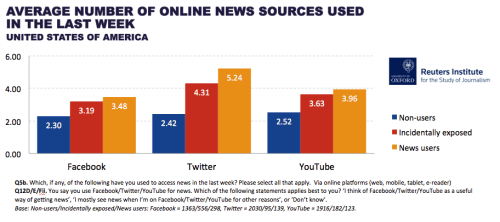
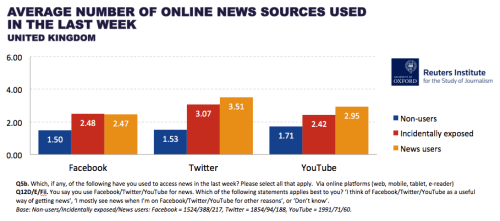
When we compare the number of online news sources (e.g. BBC News, the Mail Online, the New York Times app or website, etc.) each of these three groups said they had used in the last week, and compared them to those who do not use social media, we see that social media use is in fact associated with being exposed to significantly higher number of online news sources.

Importantly, both those social media users who use the platforms for news (News users) and those who use social media for other reasons and in the process come across news (the Incidentally exposed) get news from significantly more different online news sources than non-users.

The data presented in Figure 1 (for the UK) and Figure 2 (US) below clearly show how those who do not use social media (the blue bar of Non-users) on average come across news from significantly fewer different online sources than those who do use social media (the red bar of News users and the yellow bar of the Incidentally exposed). The figure for the incidentally exposed is particularly important because the data suggests that social media users typically receive a ‘boost’ in the number of news sources they use each week, even if they are not actually trying to consume more news.

us

UK.png

Furthermore, Figures 1 and 2 also show that the difference between those who intentionally use social media for news and those who are incidentally exposed is quite small; usually smaller than the gap between non-users and the incidentally exposed. In the case of Facebook in the UK, the gap is almost zero.

Put differently, the effect of incidental exposure is in some cases powerful enough to close gaps in news consumption between those who are motivated or interested enough to actively seek it out using social media, and those who use it for other purposes.

The data presented above are raw figures, but the patterns identified remain consistent even when we use regression analysis to control for demographic differences such as age, gender, income and education, as well as people’s level of trust and interest in the news. Social media use is thus associated with more diverse news use.

Of course, in some cases, using more different sources of online news will not in itself guarantee a more diverse news diet. It is possible that all the sources used by some respondents reflect the same basic political or ideological stance. A few respondents may use a high number of different but very similar, very partisan sources of news and thus still live in a filter bubble or echo chamber of sorts. Our data only captures the number of sources respondents say they have used in the past week, not the content they have actually consumed.

Nonetheless, in most cases, using significantly more different sources of online news is likely to result in a more diverse news diet, and social media users—both those who intentionally use social media for news and those who use the platforms for other purposes but come across news while on them—use more different sources of online news than people who do not use social media.

Take-aways from Google’s DNI Berlin

November 17, I attended a Google Digital News Initiative event in Berlin, where a new round of €24 million in grants was announced and developments in media discussed with various publishers from across Europe. (More on the winners here – lot’s of interesting initiatives.)

30 minutes took me from Tegel airport and its abundant offer of local printed newspapers to a conversation focused on the future of media and news.

20161117_102009

It was an interesting event with very good group of attendees, lively discussions during the sessions and even more so during the breaks.

My take-aways (check #dniberlin for more discussion)—

Journalism remains challenging and news a tough business, but both are important and I take 3 positive things from what I heard and conversation with various publishers.

  • First, it is great to see a gradual move beyond vague talk of “innovation” to how leaders can encourage it, how everyone in an organization needs to engage for it to succeed, and to how new and more diverse skills are needed. This is in line with what Lucy Kung’s research has found and others working on change and innovation too and it is good to see more publishers embrace these ideas—even as innovation and change in practice remains difficult and the environment continues to change faster than many publishers have been able to change themselves.
  • Second, more and more news media are embracing the idea that you need to try things, test them, evaluate, and repeat to constantly adapt and learn. This is a move away from the tendency to talk about and perhaps in practice focus on big-bang type initiatives that takes months to develop and require lots of resources and often in-fighting and resistance, to a greater focus on all the little things one can do to constantly try to improve and adapt, and how one can both empower decentral teams to try things while also having ways of deciding what to go ahead with and what not.
  • Third, there is obviously competition and even conflict between different actors in the wider ecosystem, but also a real interest in collaboration, in identifying synergies and win-win scenarios. No one can “go it alone”, so news media, technology companies, and other actors including foundations, non-profits, and universities need to find each other and find ways of working together.

News media are frequently criticized for being conservative and slow to change. Many of them are, and the pace of change and the pain of collapsing revenues in itself neither explains nor excuses this.

But it is also important to recognize that, as Alessio Cornia, Annika Sehl and I have found in our research on how private sector media and public service media across Europe are adapting to change that some of them have both (a) invested a lot in digital media and (b) build very significant audiences, produced great journalism, and in some cases found promising business opportunities.

Not everyone is equally conservative. And some of those who have tried more aggressively to change have done demonstrably better. A few media companies seem content to die with their current aging (print/broadcast) audience without fighting to build a digital future, but that is, thankfully, not the general outlook.

On the technology side, Google gave short presentations of various products, including the Accelerated Mobile Pages project, YouTube player for publishers, and various products around monetization.

The two most interesting things gauging from what people were buzzing about during the breaks were—

  • Rudy Galfi (Product Manager for the AMP Project)’s presentation on the development of “Progressive Web Apps” that aim to combine the discoverability (through links, search, social etc.) of the open web with the engagement and good user experience of native apps. As publishers think about scale versus niche, and about building reach and converting people to loyal (and potentially profitable) users, this is an important area.

20161117_123241

  • The demo by Behshad Behzadi (Director of Conversational Search) of Google Assistant, an attempt to “build the ultimate assistant” by developing a personal virtual AI assistant that can be controlled by voice and provide highly contextual, personalized, interactive information and services. It is being rolled out initially via the Google Pixel smartphone and the Google Home smart speaker, but will be available across smartphones, wearables and more in the future. As Laurence Kozera (Google Global Product Partnerships) put it, “as news publishers, you should be thinking ‘voice’ right now, and how you can integrate it into assistants”. And from December, developers can build “actions” for Google Assistant. As the content  will be delivered via the assistant, publishers will wonder about the usual issues around distributed content–recognizing the opportunity, but also wonder about editorial control over brand identity, access to data, and opportunities for monetization.

20161117_145750

Blavatnik School discussion of 2016 US election

blavatnik

November 16, I was part of a good discussion of the 2016 US elections and its potential implications at the Blavatnik School of Government with Bill Emmott (former editor of the Economist, Visiting Fellow of Practice at the Blavatnik School of Government), Sohrab Ahmari (columnist, Wall Street Journal), Sarah Churchwell (Professor at the University of London) and Pepper Culpepper (Professor of Politics and Public Policy, Blavatnik School of Government). It was a good debate with lot’s of great questions from the floor. Full video here.

Platforms and publishers – my 2016 ECREA keynote

I was honored to be one of the keynote speakers at the 2016 ECREA conference in Prague. I spoke on the basis of research I am doing with Sarah Ganter on the relationship between news media organizations and digital intermediaries like search engines and social media.

Extended abstract and my slides below.

Publishers and platforms

Rasmus Kleis Nielsen, keynote lecture at ECREA 2016 in Prague

What does the continued, global rise of platforms like Google and Facebook mean for public communication in a new digital media environment, and for how we research and understand public communication? That is one of the central questions facing the field of communication research today. In this lecture, I examine the relationship between publishers and platforms as one key part of how the rise of digital intermediaries is playing out, and show how news media—like many others—are becoming simultaneously increasingly empowered by and dependent upon a small number of centrally placed and powerful platforms beyond their control (and with whom they compete for attention and advertising). I develop the notion of “platform power” to begin to capture key aspects of the enabling, generative, and productive power of platforms that set them apart from other actors. As a range of different intermediaries including search engines, social media, and messaging apps become more and more important in terms of how people access and find information online, and in turn restructure the digital media environment itself, communication research is faced with a set of interlocking questions concerning both our intellectual work and our public role. The intellectual questions include the need to understand how people use these platforms to engage with public communication, but also institutional questions including how different platforms engage with other players (like publishers) and how these other players in turn adapt to the rise of platforms, as well as political questions concerning the implications of their rise. The question concerning our public role concerns how existing ways of doing and communicating communication research fits with our ability to understand—and help others understand—an opaque and rapidly-evolving set of processes profoundly reshaping our media environments.

“A desk is a dangerous place from which to view the world.” Social science and the 2016 elections

Dewey Defeats Truman NewspaperThe most important thing about November 8 is of course the result itself, but as a professional social scientist, I want to put out a few thoughts on what the 2016 elections might mean for social science.

For the last year, I have repeatedly told colleagues and friends I thought there was no chance Donald Trump would be elected president. Yesterday, I told a colleague I thought Hillary Clinton would win the popular vote by maybe 3 percent and it could be an early evening if she won Florida or North Carolina.

I was wrong.

My view was based on three things, all tied in with my core belief that while imperfect, social science is better than guessing— 

  1. Long-term trends: extensive political science research suggesting that economic and political fundamentals, and underlying demographic shifts, are more important than the campaign itself. Much of this research suggested any Democrat running in 2016 would start the race ahead of any Republican.
  2. Month-by-month measures of performance: immense amounts of public opinion polling and detailed analysis of it both by academic political scientists and by data journalists, which almost consistently showed Hillary Clinton ahead nationally and in key states.
  3. The campaign itself: the sense—impressionistic, but linked to my own qualitative research and the five years I lived in the US—that while Donald Trump clearly spoke to deeply held grievances amongst many (especially White) Americans, a billionaire member of 1% with a history of personal and professional scandals who did not have the support of his party was unlikely to make major gains during the campaign itself, especially as his organization itself seemed disorganized and inefficient.

Again, I was wrong. We were wrong. Very publicly, both in terms of academics who have had the courage and sense of citizenship to publish their predictions along the way and in terms of data journalists working in large part on the basis of social science data and methods, only doing so in real time with running commentary.

It is a humbling moment. The scientific response is to re-examine our assumptions, methods, and data, and see what we can do better.

One result, however important and high-profile, does not disprove everything we thought we knew as scientists about politics and everything we thought we knew about how to study politics scientifically.

Science is hard. We are in the dark, poking at the world with different sticks.

But we shouldn’t trivialize just how important this is, and I think addressing it will take more than tweaking and paradigm repair.

As powerful as I believe quantitative analysis and survey research can be, I can’t help but feel that part of the problem is that many of us as social scientists have lost track of what politics means for many people. For me, the 2016 UK Brexit result and the 2016 US election results both illustrate this wider problem.

It is easy to look back and identify prescient observations, but in terms of trying to make sense of November 8, I can’t help but feel the most insightful books might have been Katherine Cramer’s The Politics of Resentment and Arlie Hochschild’s Strangers in Their Own Land. Neither of them aimed to predict the election outcome. Neither of them focused on the kinds of large quantitative data sets, detailed polling, or scraped digital trace data that most social scientists work with.

Instead of looking at the numbers, Cramer and Hochschild went and talked to people to find the feelings, emotions, and meanings that are hard to get at with the most widely used social science methods.

I want to be clear this is not about qualitative methods being good and quantitative methods being bad. They are good at different things and should compliment each other. We need to capture both stories and numbers to understand the world (and in the social sciences, to understand how people understand the world, and act on their understanding).

But I think that, beyond re-examining what can be done incrementally with existing approaches to improve the models, the samples, the assumptions about who will vote, this (along with the Brexit result in the UK) is also a moment where we have to confront a more basic issues—

We as social scientists do not have a good, evidence-based understanding of how most people understand and relate to politics and the world around them. And if we don’t have that qualitative understanding, it is very hard to develop quantitative analysis and methods that will capture it. We know a lot about what people do, but very little about what it means for them.

And no, “big data” scraped from digital media or other sources will not solve this problem by itself. Facebook and Google, who have more of this data than probably anybody else, are very conscious that behavioural data does not in itself reveal what things mean, and as a consequence invest heavily in qualitative research. I think the social sciences should walk on two legs, quantitative and qualitative, too. (And have written about that, with colleagues, before.)

As Stephen Coleman has written in his study of How Voters Feel, “the sustainability of any social practice depends to a large measure on how it feels to participate in it.”

I think it is clear we don’t know how most people feel about politics and how it ties in with other aspects of their lives and identities. Yes, we may know that some of them are not very interested, don’t like it very much, or a quite partisan. But what does that actually mean? I don’t think we know.

Historically, I think it is fair to say social scientists have simply assumed we knew, and primarily asked qualitative questions about the lived experience and perspective of groups that were considered minorities.

In my view 2016 shows we need to start qualitatively researching the (diverse, fractious, fascinating) majority to, and see whether a better, evidence-based understanding of how people relate to politics and public life can help us get it right next time.

Doing this might mean more social scientists have to actually talk to and spend time with the people they study. As John le Carré has noted, “A desk is a dangerous place from which to view the world.”

Normative Theory in Communication Research ICA pre-conference

We are at it again — with Chris Anderson, Daniel Kreiss, Dave Karpf, and Matt Powers, I’m organizing an ICA pre-conference on the role of normative theory in communication research. Conference website here. Call for papers below.

Call for Papers

Normative Theory in Communication Research Pre-conference

2017 International Communication Association Annual Conference

May 25, 2017 – 8:00am-4:30pm

Department of Communication, University of California, San Diego

https://democratictheorycommresearch.wordpress.com/

Normative theories of democracy in communication research across its various subfields rarely receive explicit treatment. Often, researchers simply imply their normative standpoints through the research questions they ask about ‘participation,’ ‘civility,’ ‘two-sided information flows,’ ‘knowledgeable citizens,’ ‘rational debate and deliberation,’ ‘polarization and partisanship,’ ‘interactivity,’ and ‘quality information.’

The normative implications of many of these concepts rest on implicit assumptions about democracy, how it works, and more importantly, how it should work. When communication scholars explicitly discuss their normative models of democracy, they tend to be deliberative, following the guiding theorist of the field, Jurgen Habermas, and rich veins of deliberative research work by scholars such as James Fishkin. More common, however, is research that implicitly holds up rational debate among disinterested, non-partisan citizens premised on quality information as the normative ideal. Meanwhile, when scholars do not explicitly embrace deliberation, they tend to hold up an ill-defined, procedural idea of participation as the ultimate democratic value, often without any consideration of the ends towards which it is directed.

While deliberative theory and vague ideas of participation continue to hold significant appeal in communication research, are they the only models?  And, indeed, should they be? In the past two decades there has been a tremendous flowering of normative work in other fields that casts new light on democracy itself.  Social movement scholars have argued forcefully for the importance of contentious politics, emotion, identity, and culture to the practice and promise of democracy. Sociologists have argued that ‘civility’ often serves to cut-off critique and frankness should be valued as an alternative. Political theorists have embraced the normative importance of spectatorship in contrast to deliberation and participation, invoking communication research around media events. Others have worked to reclaim the value of partisanship in an era of extremist, single-issue civil society organizations. Meanwhile, some scholars have sought to re-establish the value of representation, while others have argued strongly for the value of agonism as the proper domain of the political.

With few exceptions, communication research has not explicitly engaged with its underlying normative models of democracy. In this pre-conference, we seek to bring communication scholars together to spark a conversation on the normative foundations of scholarship and move the field towards more sophisticated models of democracy. Through invited speakers, peer-reviewed papers, and critical discussants, we seek to make democracy and normative theories our object of analysis.

Confirmed participants include Cherian George (Hong Kong Baptist University), Claes de Vreese (University of Amsterdam), Michael Schudson (Columbia University), Jennifer Stromer-Galley (Syracuse University), Talia Stroud (UT Austin), Silvio Waisbord (George Washington University), and Barbie Zelizer (University of Pennsylvania).

Call for Extended Abstracts

We are looking for submissions that interrogate the democratic foundations of communication research across its various subfields. These can include articles on the history of normative models of democracy in the field, original theoretical papers that propose democratic frameworks or synthesize work in adjacent fields, or empirical papers that made a significant theoretical contribution to democratic theory in the field of communication.

Extended abstracts (up to 4,000 characters including spaces) should be submitted via the Normative Theory in Communication Research website by January 15, 2017.

The organizers – C.W. Anderson (CUNY), David Karpf (George Washington University), Daniel Kreiss (UNC-Chapel Hill), Rasmus Nielsen (Oxford University), and Matthew Powers (University of Washington) – will make decisions on accepted papers by February 15th. Full papers will be due in advance of the pre-conference on May 25, 2017.

There is no cost to attend this pre-conference and lunch and refreshments will be provided. Registration is required.

Sponsors

Department of Communication, University of Washington

Department of Media Culture, CUNY-CSI

Reuters Institute for the Study of Journalism, University of Oxford

School of Media and Journalism, University of North Carolina at Chapel Hill

School of Media and Public Affairs, George Washington University

ICA Communication and Technology Division

ICA Journalism Studies Division

ICA Political Communication Division

Draft Schedule

8:00 – 8:15am

Arrival and coffee

8:15 – 9:30am

PANEL 1: Reviewed Submissions, Paper Presentations

9:45 – 11:00am

PANEL 2: Reviewed submissions, Paper Presentations

11:15 – 12:30pm

PANEL 3: Reviewed Submissions, Paper Presentations

12:45-1:45pm

Lunchtime Journal Editors Panel on the Role of Normative Theory in Research

2:00 – 3:15pm

PANEL 4: Reviewed Submissions, Paper Presentations

3:30-4:30pm

Plenary Panel on Democratic Theory in Communication Research

New Report: Private Sector Media and Digital News

cornia-thumbnailSeptember 30, we published our latest RISJ Report, “Private Sector Media and Digital News”, focusing on how legacy news organisations in Europe are dealing with the business of digital news. The lead author is Alessio Cornia, who worked on the report together with Annika Sehl and myself. The full PDF is freely available here and the executive summary is below.

The report looks at how they are addressing recent developments such as the rise of social media, the move from desktop internet to an increasingly mobile web, and the growing importance of online video. It examines 25 different newspapers and commercial broadcasters in six European countries are adapting to an evolving media environment on the basis of interviews conducted with executives, senior managers and editors in Finland, France, Germany, Italy, Poland, and the UK.

It shows how legacy news organisations are investing in a wide variety of digital news initiatives to reach new audiences and build new business models, but most of their revenues still come from traditional print and television operations, even after almost 20 years of investment in digital news.

Executive Summary

In this report, we examine how private sector legacy news organisations like newspapers and broadcasters in six European countries (Finland, France, Germany, Italy, Poland, and the United Kingdom) are adapting to an evolving digital media environment.

The analysis is based on 54 interviews conducted between April and July 2016 primarily with executives, senior managers, and editors from a strategic sample of 25 newspapers and commercial broadcasters across Europe, as well as on survey data from the Reuters Institute Digital News Report and secondary sources.

We show that:

  • Newspapers and broadcasters, sometimes criticised for their conservatism, are investing in a wide variety of new digital initiatives to reach new audiences and generate new revenues. All the organisations covered see audiences moving from offline media to online media – quickly in the case of print to digital, and (thus far) more slowly in the case of television to digital. All aim to make a similar move to retain the audience connection upon which both their editorial impact and their business models depend.
  • In all the countries covered, private sector legacy news organisations reach more people with news than public service media, and more people get news online from newspapers and commercial broadcasters than get news via social media.
  • Despite their growing online reach, our interviews suggest 80 to 90% of revenues in most newspapers still come from print – even after years of decline in print advertising and circulation and almost 20 years of investment in digital media. Broadcasters generally have an even smaller share of digital revenues, primarily because their legacy operations have not yet been affected by the rise of online media to the same extent, but also because they have often been less focused on building a business around digital news.
  • As revenues from legacy operations are generally declining (print) or at best stable (broadcast) and digital revenues still limited, the resources for investments in digital initiatives generally continue to come from cross-subsidies and/or cost-cutting elsewhere in each organisation.
  • In terms of the business of digital news, interviewees highlight the following challenges when it comes to advertising:
    • the dominant role of large technology companies like Google and Facebook that attract a large share of online advertising;
    • the low average revenues per user, especially on the mobile web;
    • the growing number of people who use ad-blockers.
  • The challenges around advertising mean that more and more newspapers are moving to various forms of pay models, with the exception of a few high-profile titles with very large audiences. Only a minority of online news users have been willing to pay so far, but interviewees are cautiously optimistic that the number will grow.
  • Commercial broadcasters are generally seeking to replicate the television model of advertising-supported content free at the point of consumption in their approach to digital media. For many, news is a very small part of their overall business.
  • Beyond the turn to pay models, private sector legacy news organisations (especially newspapers) are exploring other alternative sources of revenue to supplement display advertising and subscription, including:
    • the launch of new verticals (content offerings beyond the organisations’ main brands), repackaged content products, and sections aimed at cultivating specific audiences more effectively;
    • investment in native advertising and branded content activities that are more effectively differentiated from generic display advertising;
    • diversification with a move into e-commerce, business-to-business services, and offline activities including events and merchandising.
  • Social media enable news organisations to reach a wider public, in particular younger people and other audiences who do not normally come direct to their sites or apps, but also imply a number of challenges related to editorial control, brand recognition, audience data, audience loyalty, and monetisation.
  • Many news organisations covered here are experimenting with distributed content formats (e.g. Facebook Instant Articles and Snapchat Discover), and see potential for synergy between publishers and platforms. Most selectively engage but want to evaluate the first results in term of reach and revenue before they decide how much to engage and with what. Other news organisations, in particular in France and Germany, have been more reluctant so far to distribute their content through third-party platforms and aim to be more self-reliant.
  • News organisations are addressing the growth of smartphone use by adapting their content to mobile devices, creating dedicated teams, adopting mobile-first approaches and focusing on the development of their news apps. However, the mobile advertising market is still much less developed than the desktop advertising market, and this represents a central challenge for the business of mobile news.
  • Online video advertising is growing fast and several news organisations are therefore investing in online video production and curation, strengthening their online video teams, experimenting with new formats and technologies (e.g. virtual reality, 360-degree, and social video), and seeking new ways to monetise online video news.
  • All our interviewees expect to see audiences and advertising continue to move from offline to online media, and expect to see the digital media environment itself continue to change, driven by evolving forms of use, new technologies, and initiatives from large technology companies. Individual organisations are adapting to this with varying degrees of success, but no clear generally applicable model(s) for sustainable digital news production have been developed so far. Every organisation examined is experimenting and forging its own path, seeking a balance between exploiting legacy operations, building digital operations, and exploring the opportunities ahead. Experimentation and exploration are an uncertain business, but encouraging in themselves – it is because of their decision to invest in the future that newspapers and commercial broadcasters continue to be central to an increasingly digital media environment.

This report is the first of a series of annual reports that will focus specifically on how European private sector legacy news organisations are adapting to the rise of digital media.