Category Archives: Comparative media research

3 key findings from new report on generative AI use

How do people think different sectors’ use of generative AI will change their experience of interacting with them?

That’s one of the question we fielded in a new survey, and one of the three key findings from my perspective – looking across the six countries covered, there are more optimists than pessimists for e.g. science and healthcare, and for search engines and social media, but more pessimists than optimists for news media, the national government, and – especially – politicians and political parties.

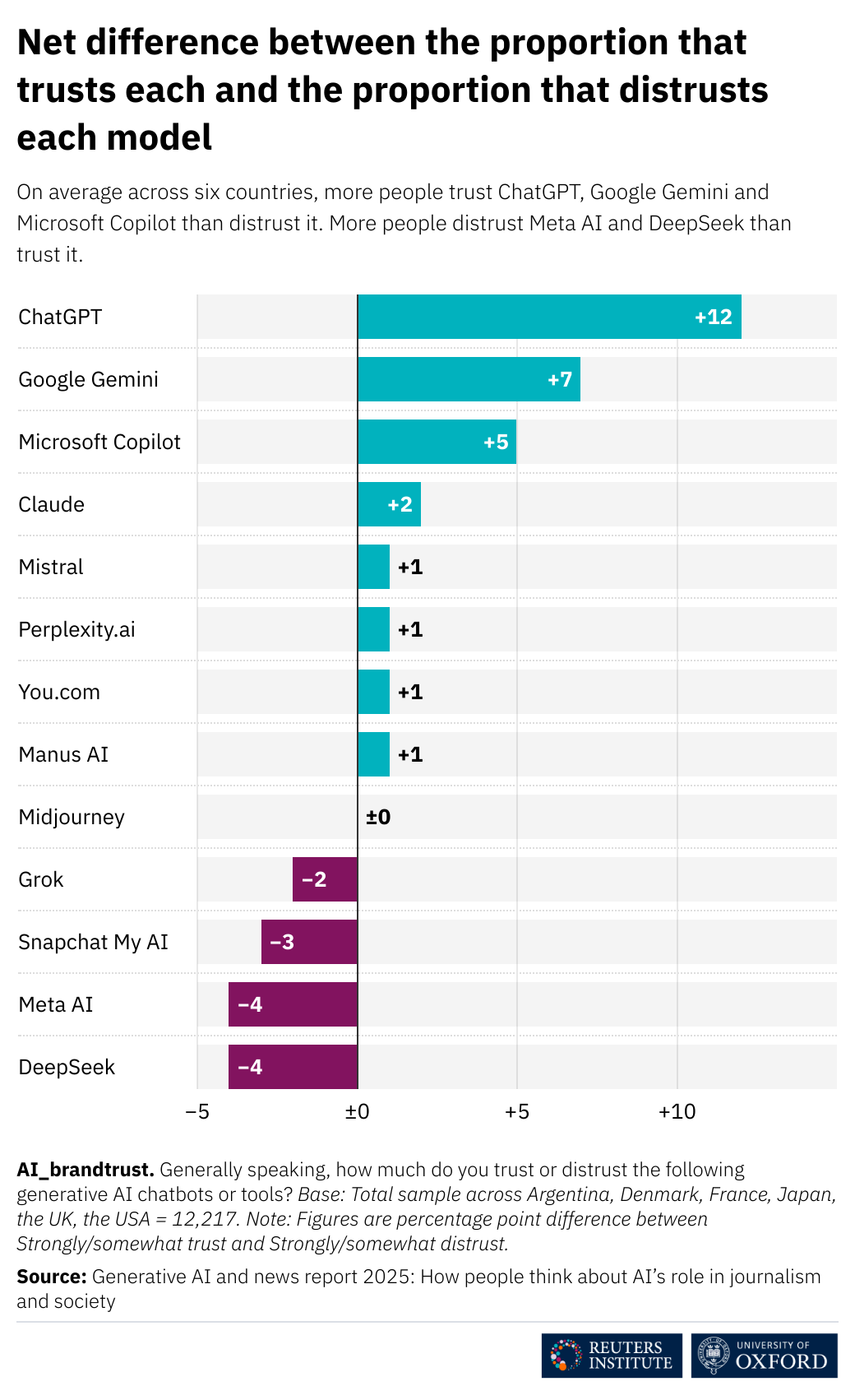
Elsewhere in the survey, we ask whether people trust different generative AI offers – the picture is very differentiated, with net positive trust scores for e.g. ChatGPT, Google Gemini, and Microsoft Copilot, but negatives for those that are seen as part of various social media companies.

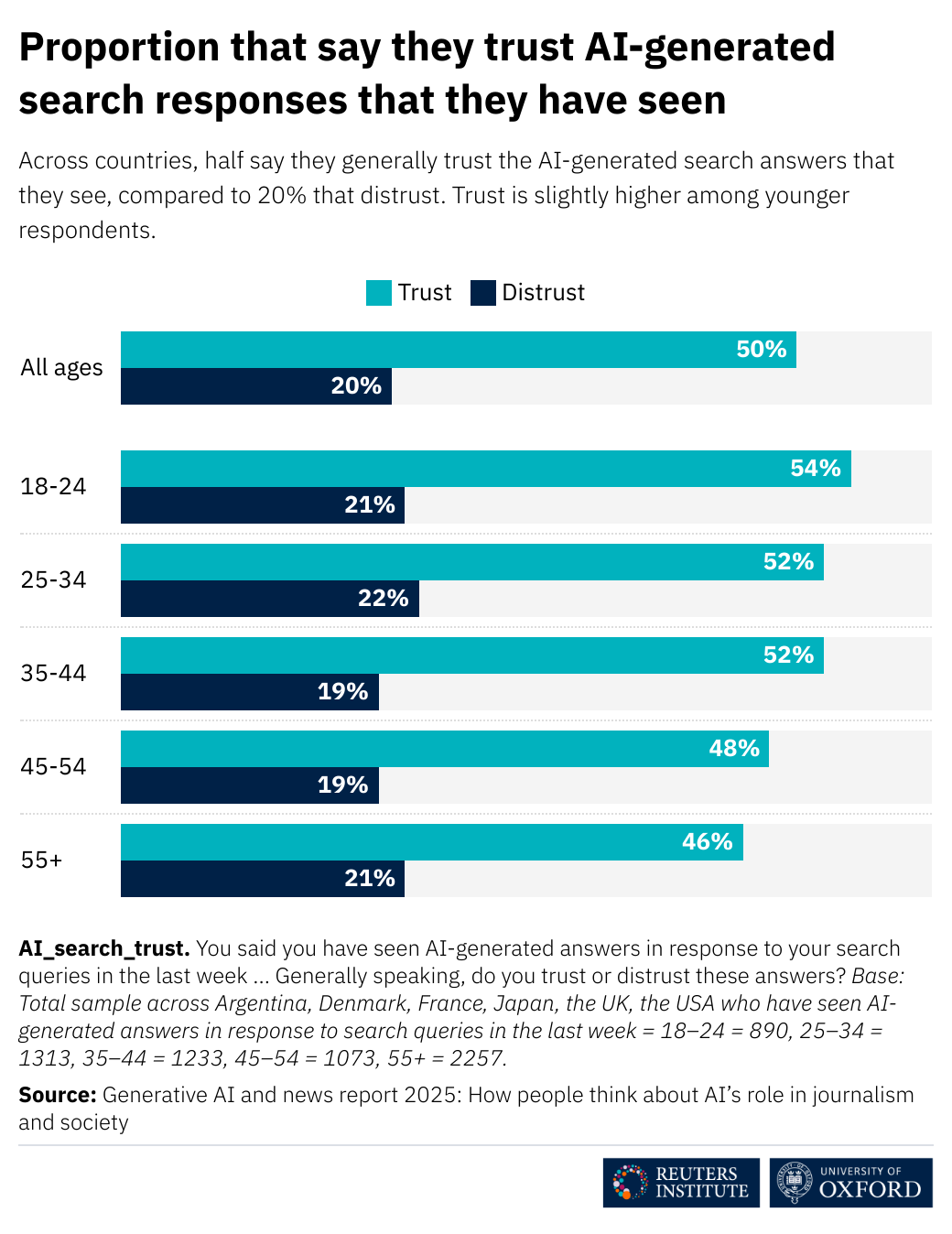
Finally, as search engines increasingly integrate AI generated answers, and more and more of us see these all the time, we asked about trust in these answers – the trust scores are high across the board, with higher net positives than any of the standalone tools. (With this and the question above, surveys do not measure whether the entities in question are trustworthy, and do not tell us anything about whether people should trust them, they provide data on whether they do trust them.)

Beyond that, the report, which I wrote with Felix Simon and Richard Fletcher, and which is published by the Reuters Institute for the Study of Journalism, is chock full of fresh data on generative AI use (basically doubled since last year), what people use these tools for (increasingly for information, presenting a very clear direct competition to search engines), and what they don’t (yet) use them for all that much (getting the latest news).

2025 Digital News Report out

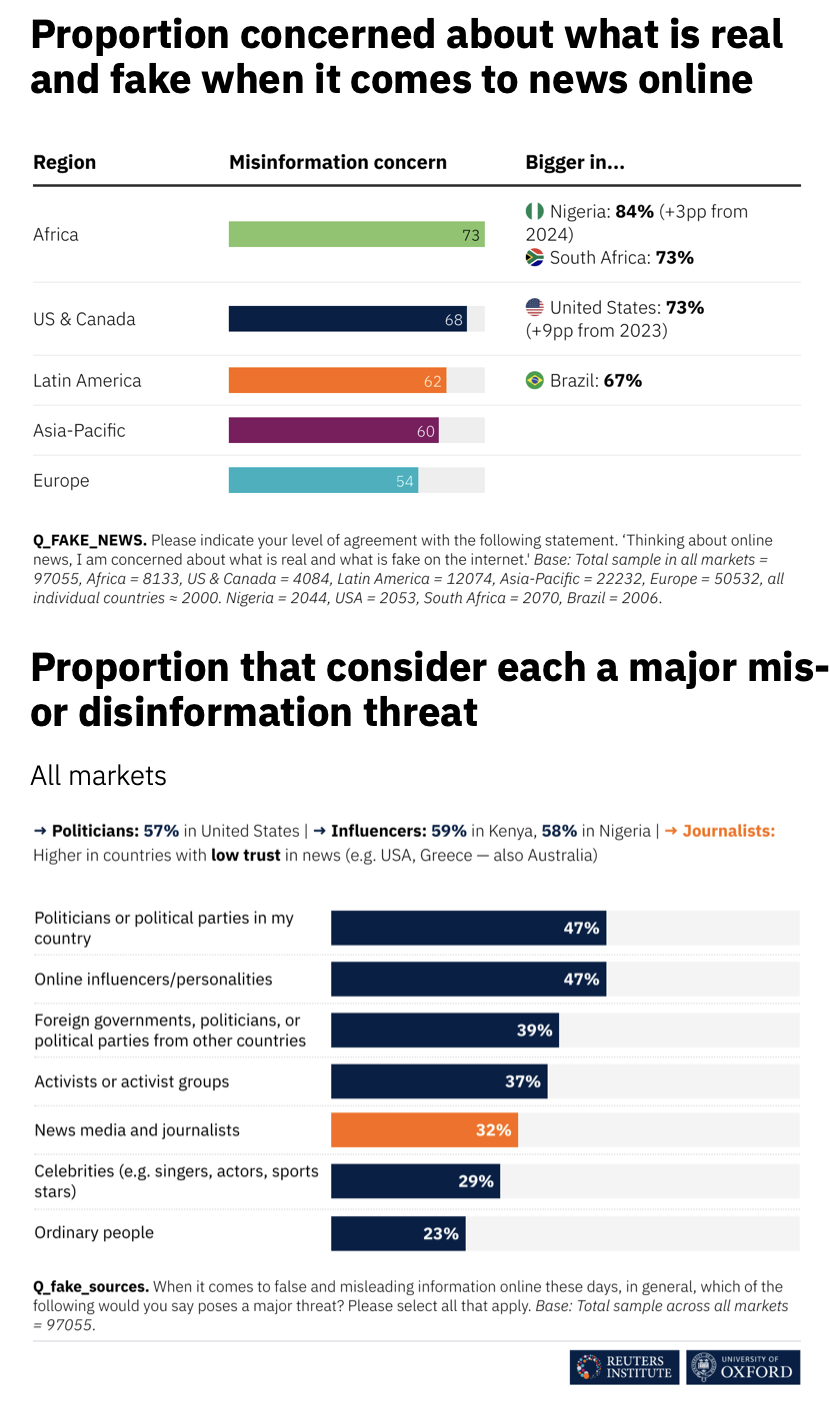
“Alternative media voices often have a wide reach and appeal to audiences that news publishers have been keen to engage with but the report also shows that, when it comes to underlying sources of false or misleading information, online influencers and personalities are seen as the biggest threat worldwide along with national politicians”, Mitali Mukherjee writes in her introduction to the 2025 Digital News Report.

There are countries where news media still have a strong connection with much of the public, and where publishers have adapted well to a challenging digital media environment (including my native Denmark), but overall the report is a sobering read for the news media. As lead author Nic Newman writes: “In most countries we find traditional news media struggling to connect with much of the public, with declining engagement, low trust, and stagnating digital subscriptions.”

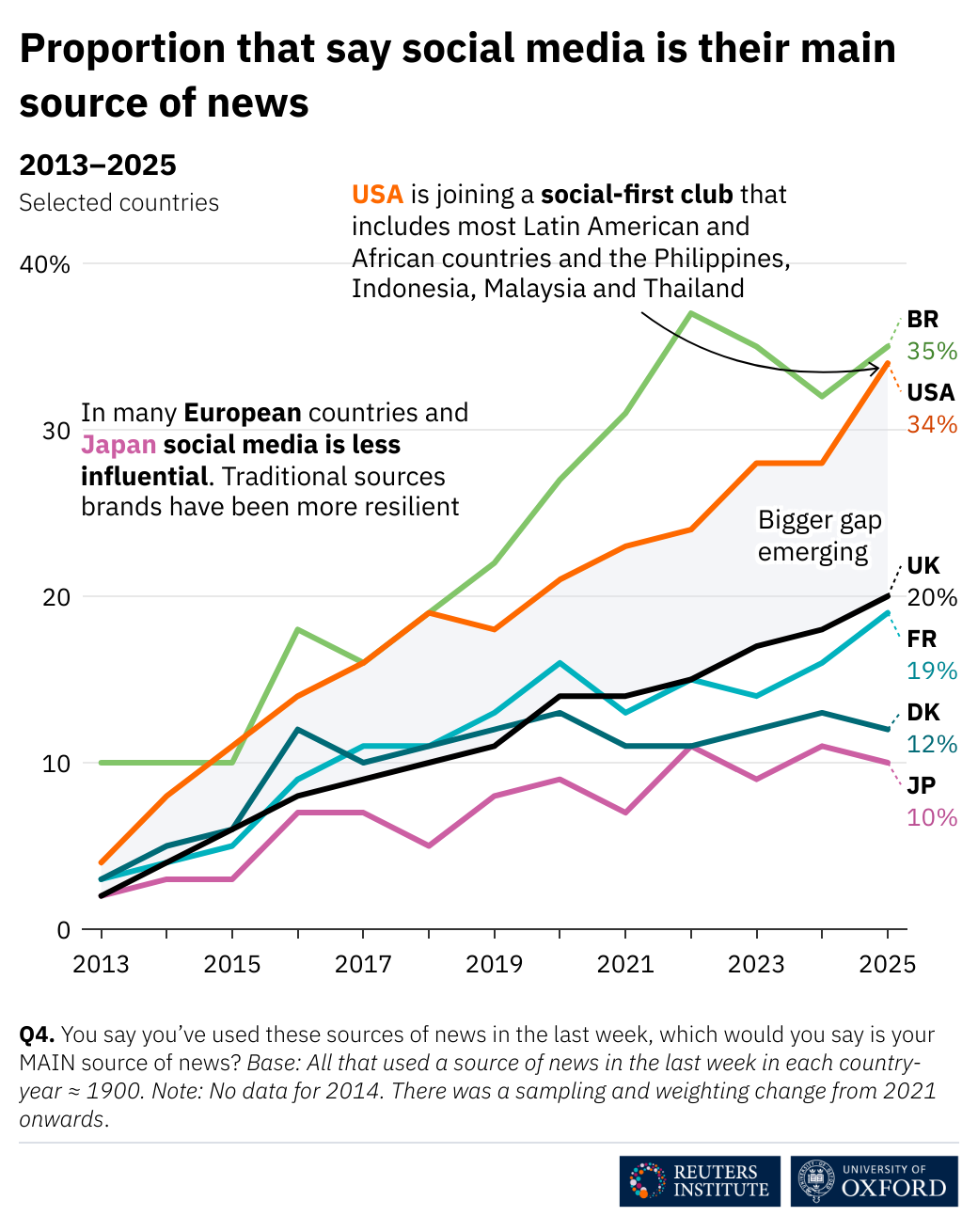
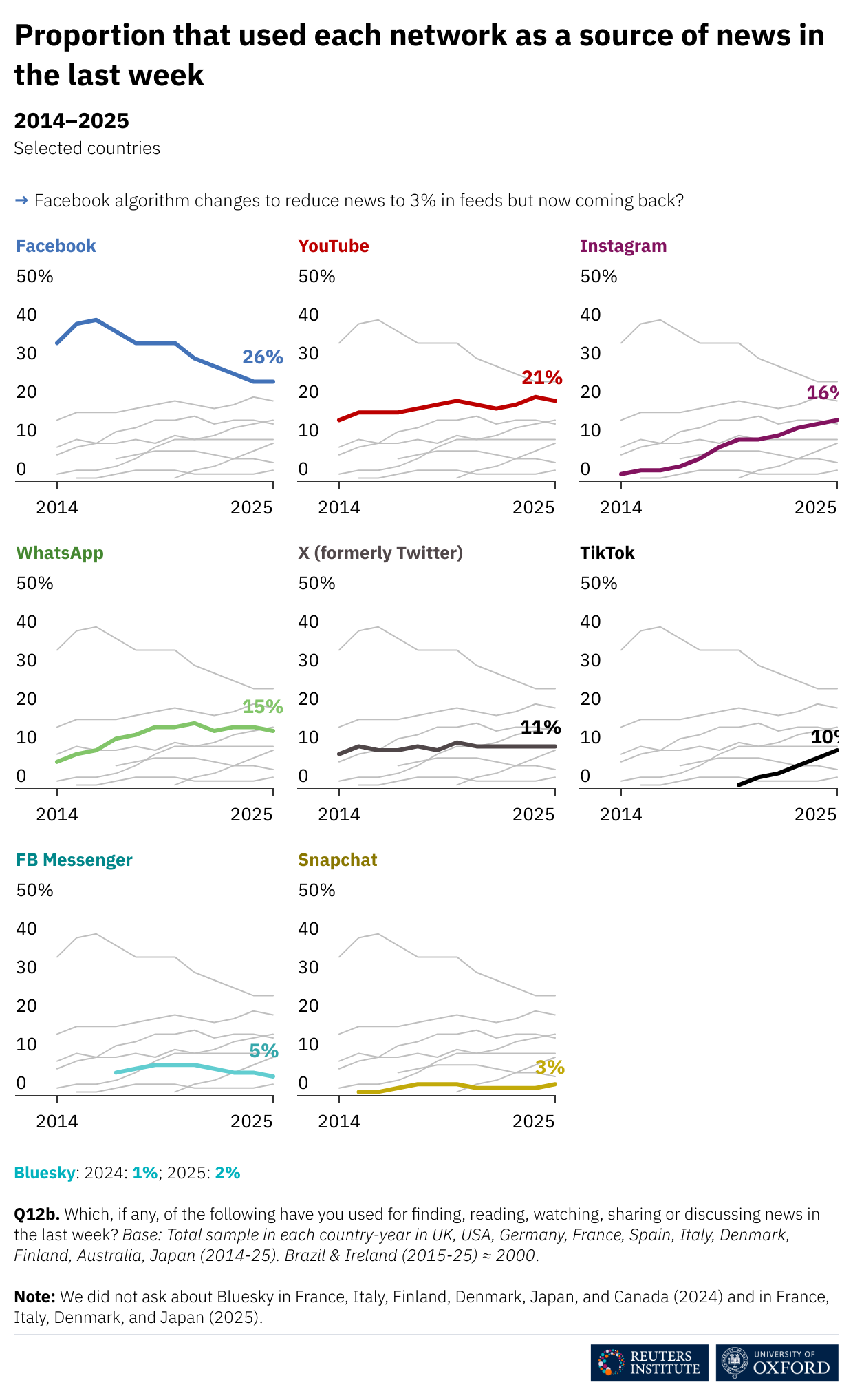
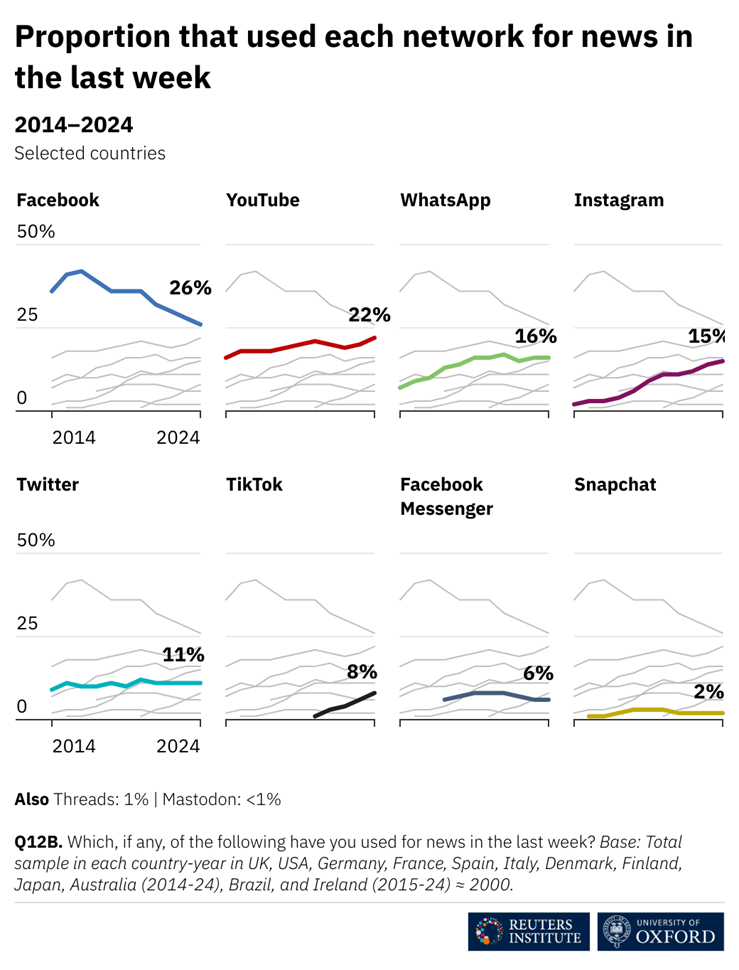
In the report, we document how platforms are increasingly central to how many find and access all sorts of content, including news, as well as a continued fragmentation of the platform space. There are now six networks with weekly news reach of 10% or more compared with just two a decade ago. Instagram, WhatApp, and TikTok in particular have grown in importance, whereas BlueSky still only has tiny reach amount our respondents.

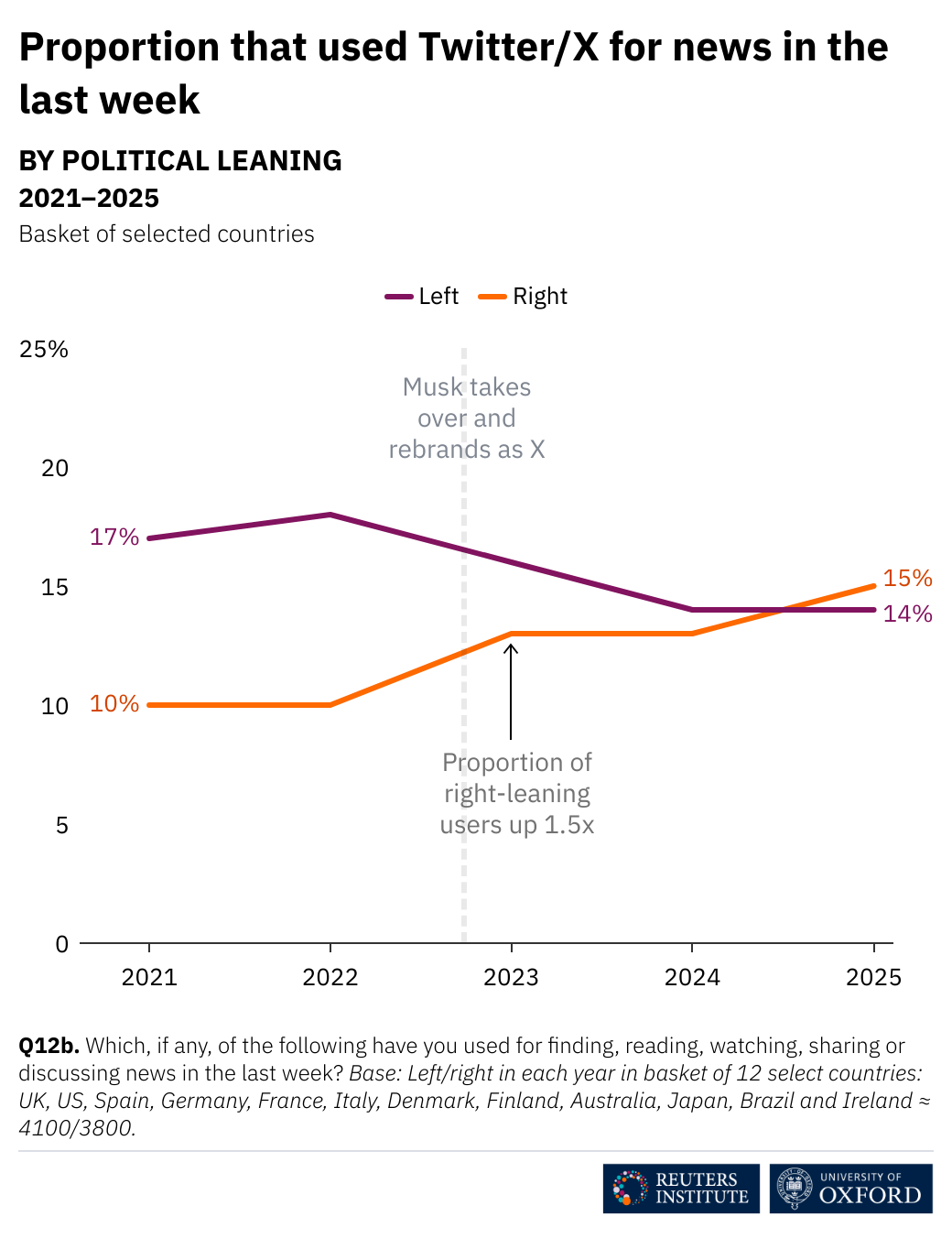
While industry data suggests X is much diminished in terms of how intensely it is used, survey data on weekly use – perhaps surprisingly – suggests stable reach overall. A liberal exodus seems to have been matched by a growing number of right-wing users, and after many years of having a predominantly left-wing user base, X now has slightly more right-wing users.

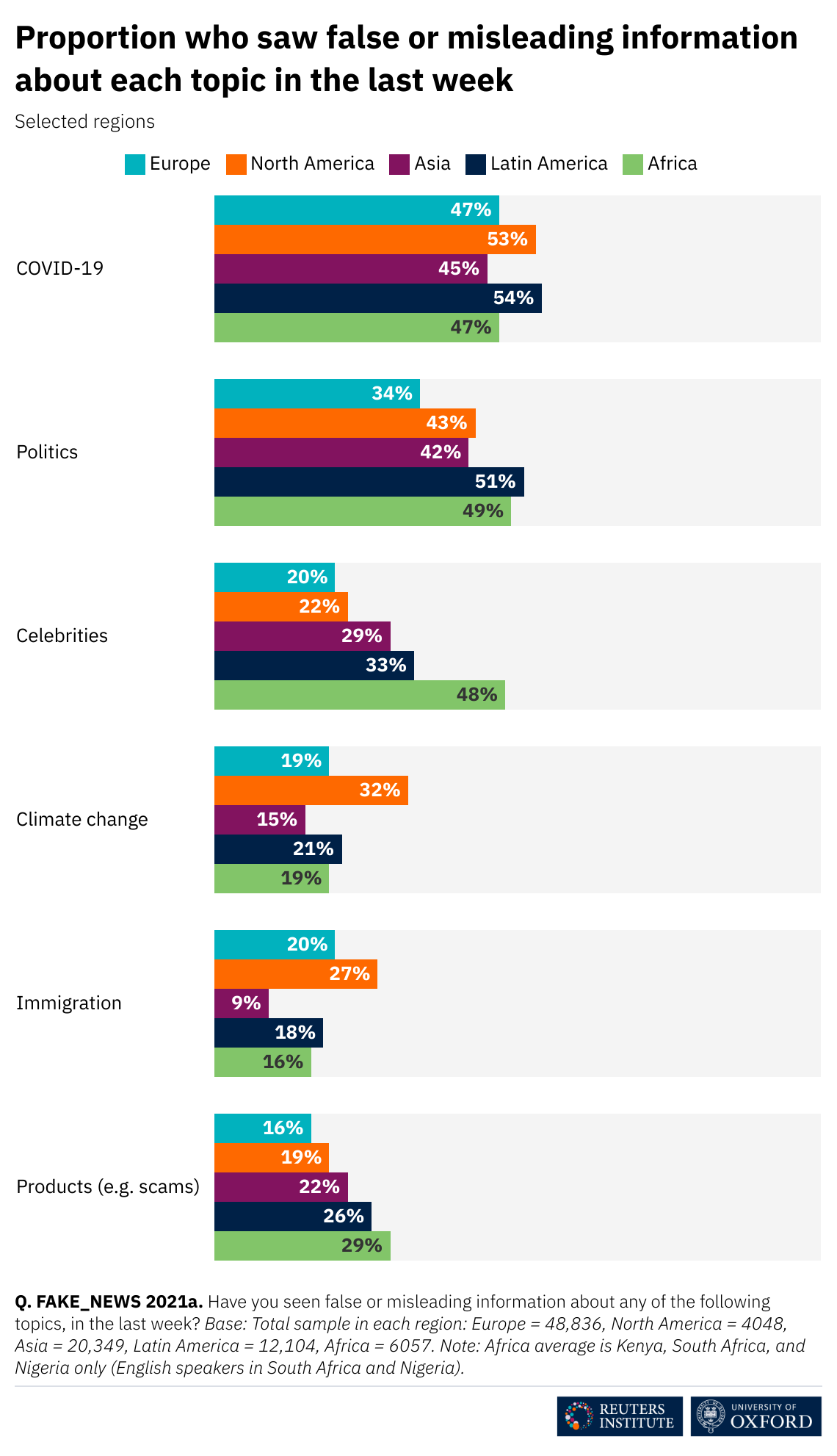
In this increasingly distributed and platform-dominated environment, large parts of the public continue to be concerned about what is real and what is fake when it comes to online news – when asked what they are most concerned about, domestic politicians and online influencers/personalities top the list, in terms of platforms, concern is focused on Facebook and TikTok.

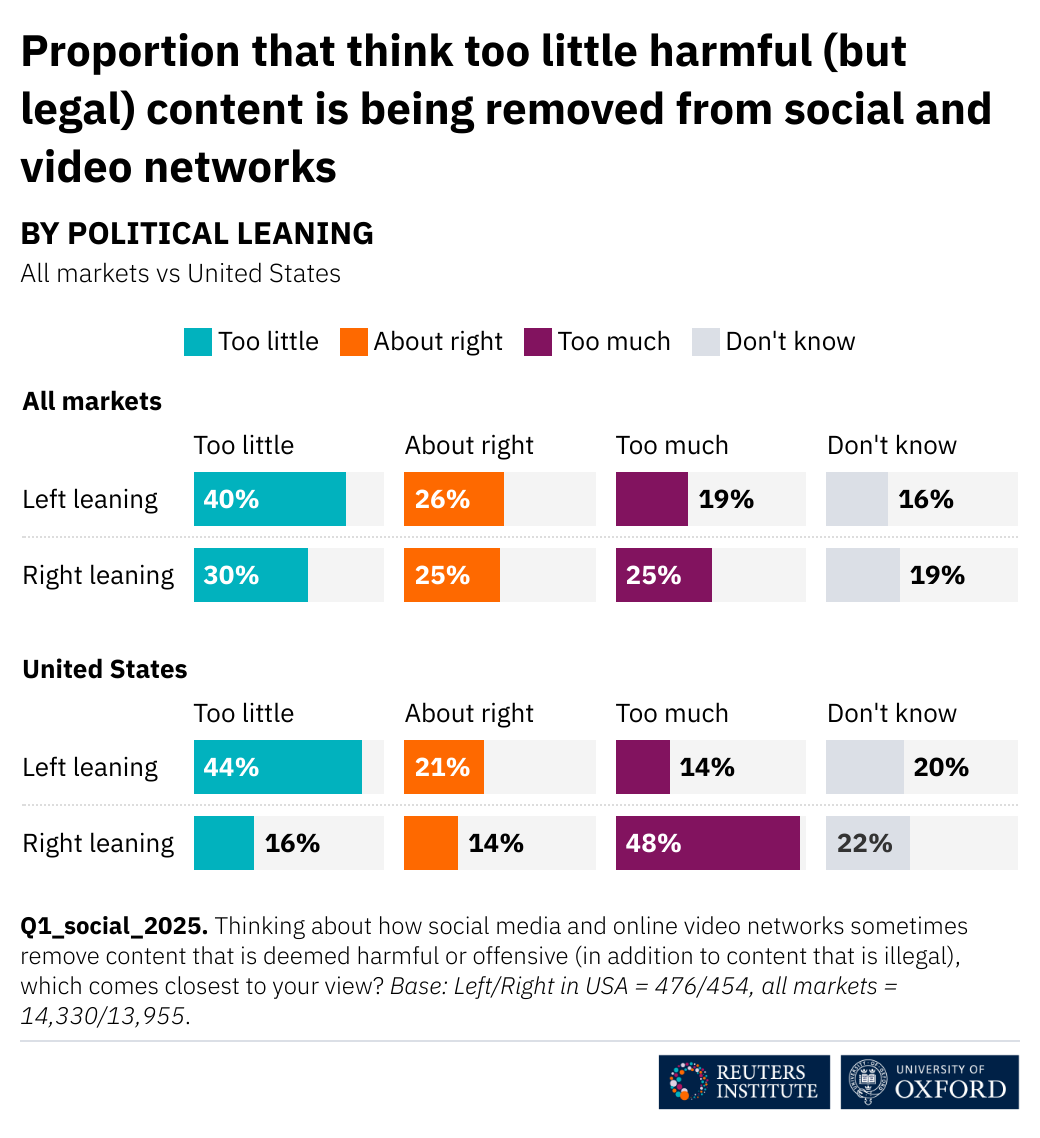
First Elon Musk and later Mark Zuckerberg has said they want to reduce how much content is subject to moderation on their platforms – while some political actors may applaud this, it is not clear the public does. A plurality in many countries say they want more harmful or offensive content removed from social media.

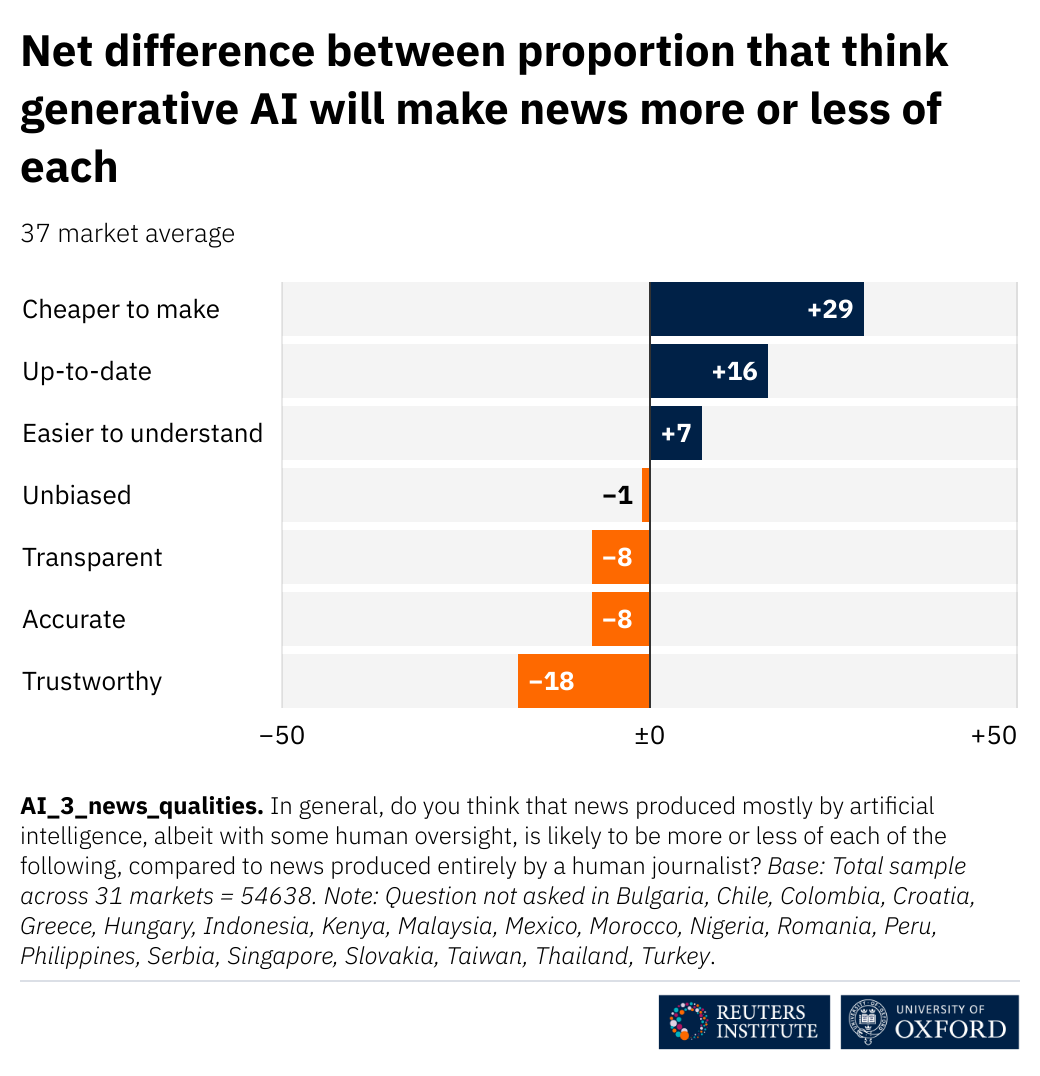
Finally, as generative AI is increasingly widely used, integrated into platforms, and adopted by many news publishers, we asked respondents what they think this will mean for news content – while there is some optimism AI-powered news will be more up to date and easier to understand, the topline is people expect it to be cheaper to make but less trustworthy.

All that and more in the 2025 Digital News Report, with topical chapters, country pages, interactive data, and more on the Reuters Institute website – an incredible team effort that I am proud to be part of.

2024 Digital News Report out

The 2024 Reuters Institute Digital News Report is out, documenting scale and scope of ‘platform resets’ and much more. It is a team effort by lead author Nic Newman, Richard Fletcher, Craig Robertson, Amy Ross, and myself, working with our country partners. The report covers 47 market accounting for more than half of the world’s population, and is made possible by our 19 funders. A real pleasure to chair the panel discussion at the global launch at Reuters News this morning, featuring Rozina Breen (editor-in-chief, The Bureau of Investigative Journalism), Anna Bateson (CEO of the Guardian Media Group), Rachel Corp (CEO of ITN), and Matthew Keen (Head of Operations and Strategy, Reuters).

A key theme this year is how a series of ‘platform resets’ are shaping how people access news and changing the environment publishers operate in – even as the percentage who say they get news via Facebook continues to decline, a range of other social, video, and messaging platforms are growing in importance for discovery, many focused on on-site video, visuals, and more private experiences.

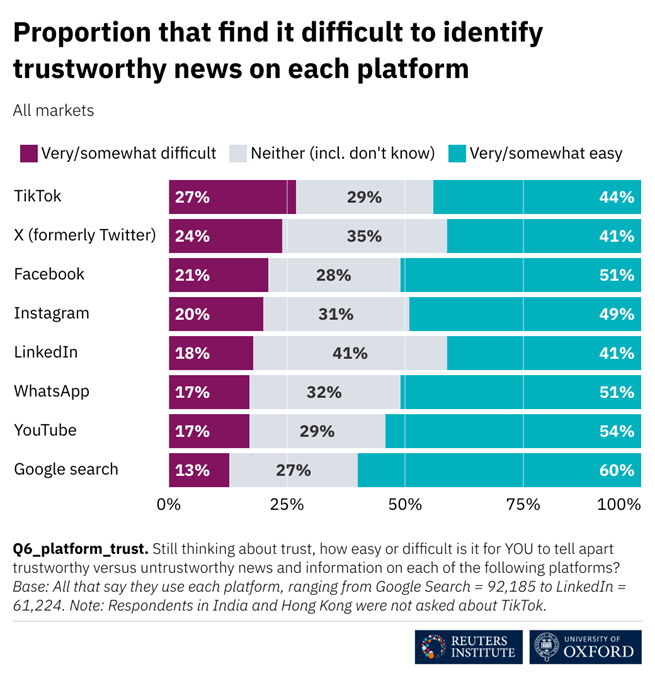
Generally, many of our respondents say they find it at least somewhat easy to tell trustworthy and untrustworthy news and information apart on various platforms, but there are real differences, with more people concerned about how to navigate information on e.g. TikTok, X, Facebook.

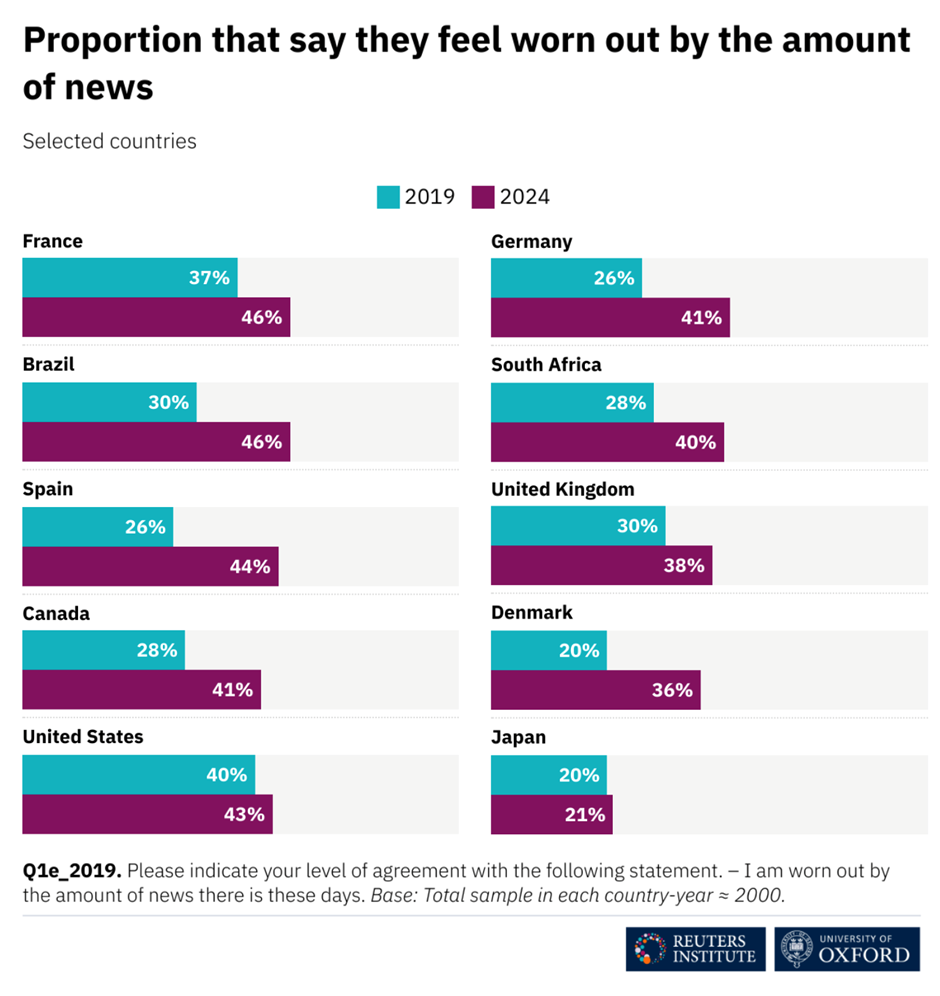
We also document the continually fraying connection between much of the public and much of the news media industry. In many markets, trust is limited, interest in news declining, and news avoidance growing. Many of our respondents say they are worn out by the amount of news, up sharply since we last asked this question in 2019.

We know many publishers care deeply about trust in news, and in a more challenging media environment where much of the public, in many cases especially less privileged people, do not trust the news, publishers able to earn and maintain trust may be able to stand out.

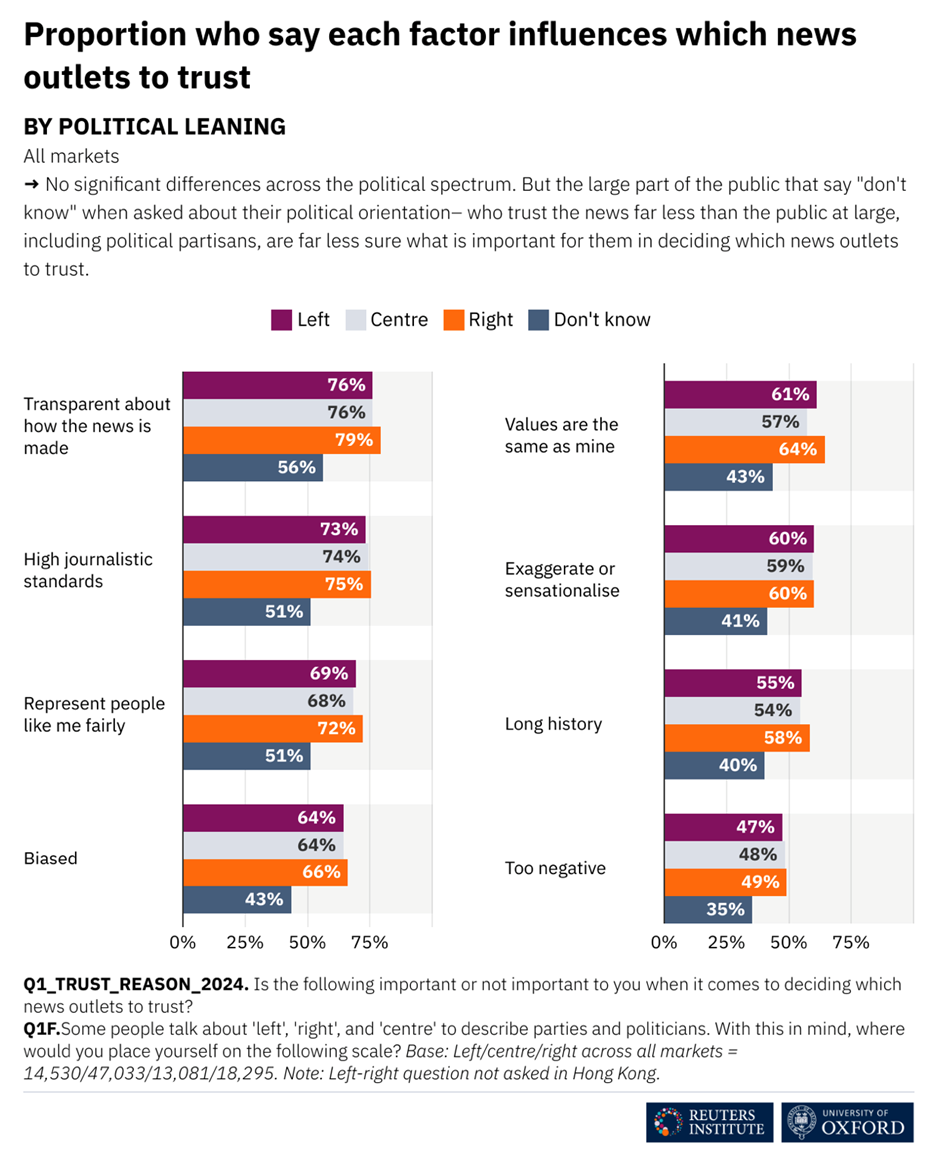
In terms of what factors are important when deciding which news outlets to trust, we show that while people come to different conclusions RE individual brands, across the political spectrum from left to right, most actually emphasize the same factors. The main difference here is not by political orientation but what political scientists call “the other divide” – the large group of people who are more distant from conventional politics (and often less privileged in terms of income and education) are less sure what, if anything, would lead them to trust a news outlet.

That and much more in the full report, which is freely available here.

2022 Digital News Report out

2022 Digital News Report out now. A huge effort by an amazing team that I’m proud to be part of.

We cover 46 markets on six continents, accounting for more than half of the world’s population.

The full report is available here in HTML and here as a PDF.

We are using the hashtag #DNR22 for discussions on Twitter.

As I write in my foreword, we live in an age of extremes, also when it comes to some aspects of news and media use.

While many of the most commercially successful news media are doing well by primarily serving audiences that are, crudely put, like me – affluent, highly educated, privileged, in many countries predominantly male, middle-aged, and white – questions continue to mount around the connection between journalism and much of the public.

The purpose of our research at the Reuters Institute is to ensure that reporters, editors, and news media executives and others who care about the future of journalism can understand these trends and many others on the basis of reliable, robust, relevant research that can help inform how they – on the basis of their different ideals and interests – chose to adapt to a changing environment.

The Digital News Report is a key part of this.

Seven highlights from this year’s report below.

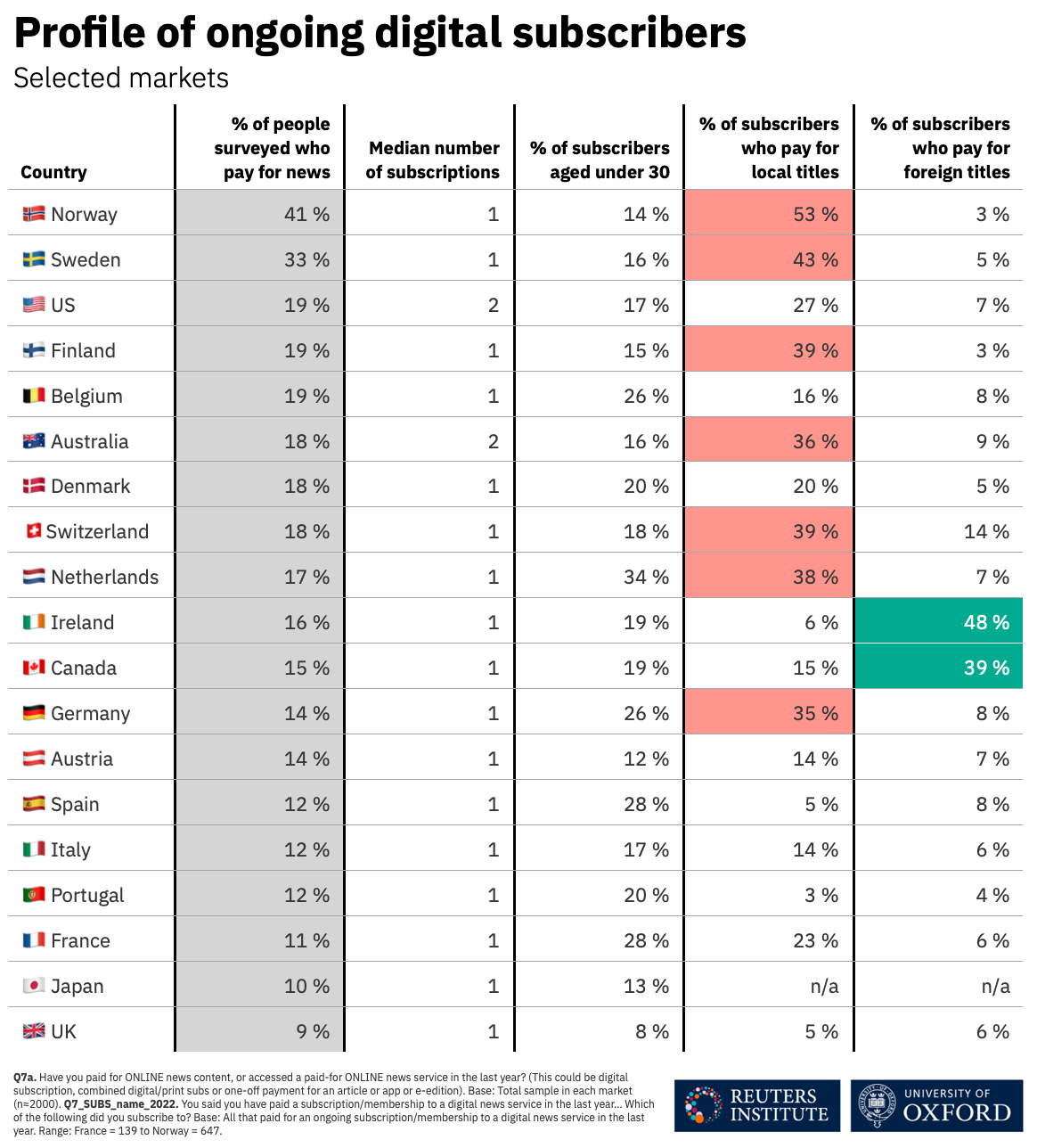
First, we find that a growing number of news media willing to embrace digital and able to offer distinct journalism in an incredibly competitive marketplace do well by doing good. But many struggle in an unforgiving winner-takes-most online environment, for example when it comes to subscriptions.

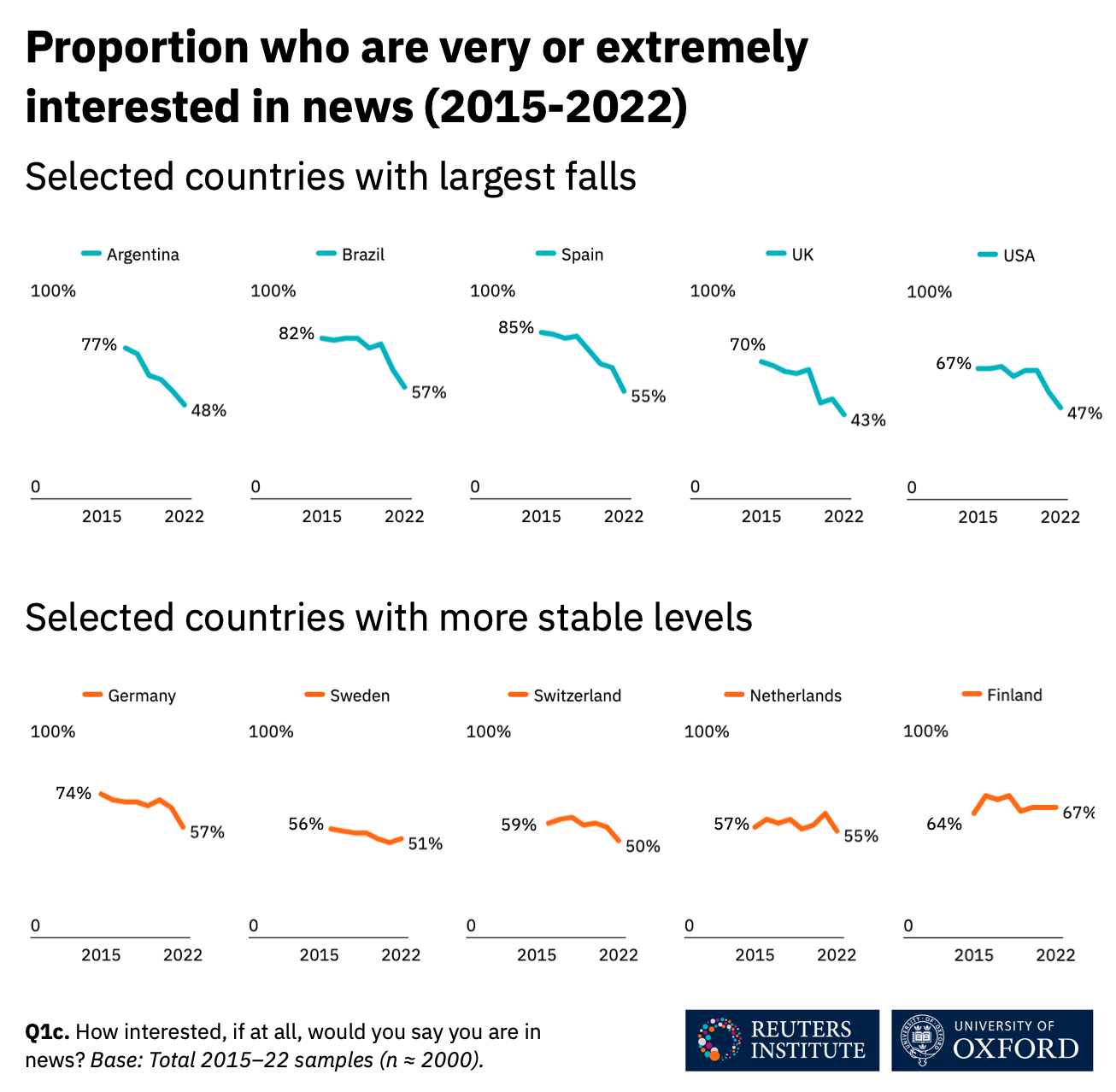
Second, while many commercially successful news media primarily serve audiences that are, crudely put, like me (affluent, highly educated, privileged etc) our findings document connection between journalism and much of the public is fraying. Interest and trust is down, news avoidance up.

Third, more broadly, in many countries much of the public question whether the news media are independent of undue political or government influence – even in very privileged countries, barely half say news media are independent of undue influence most of the time.

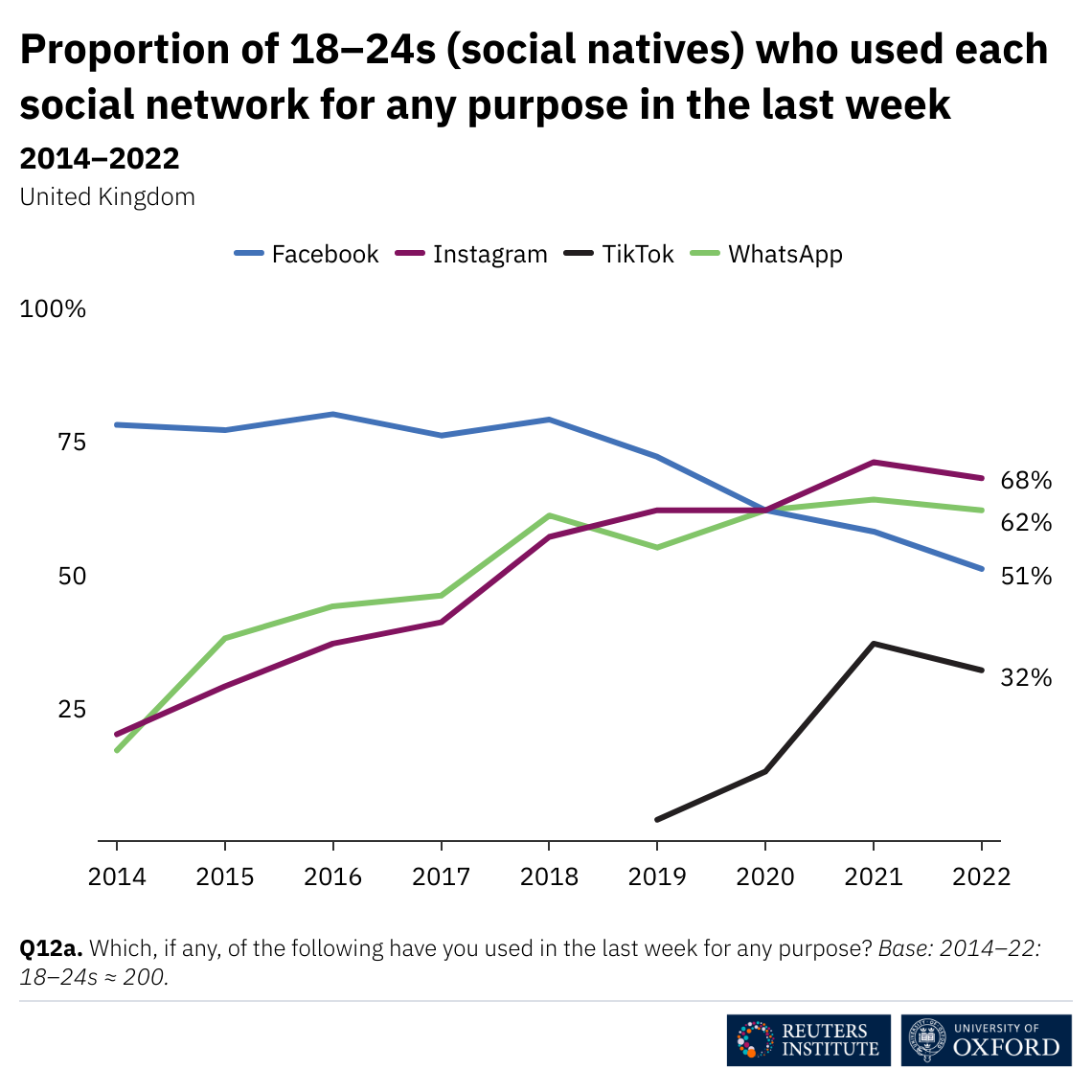
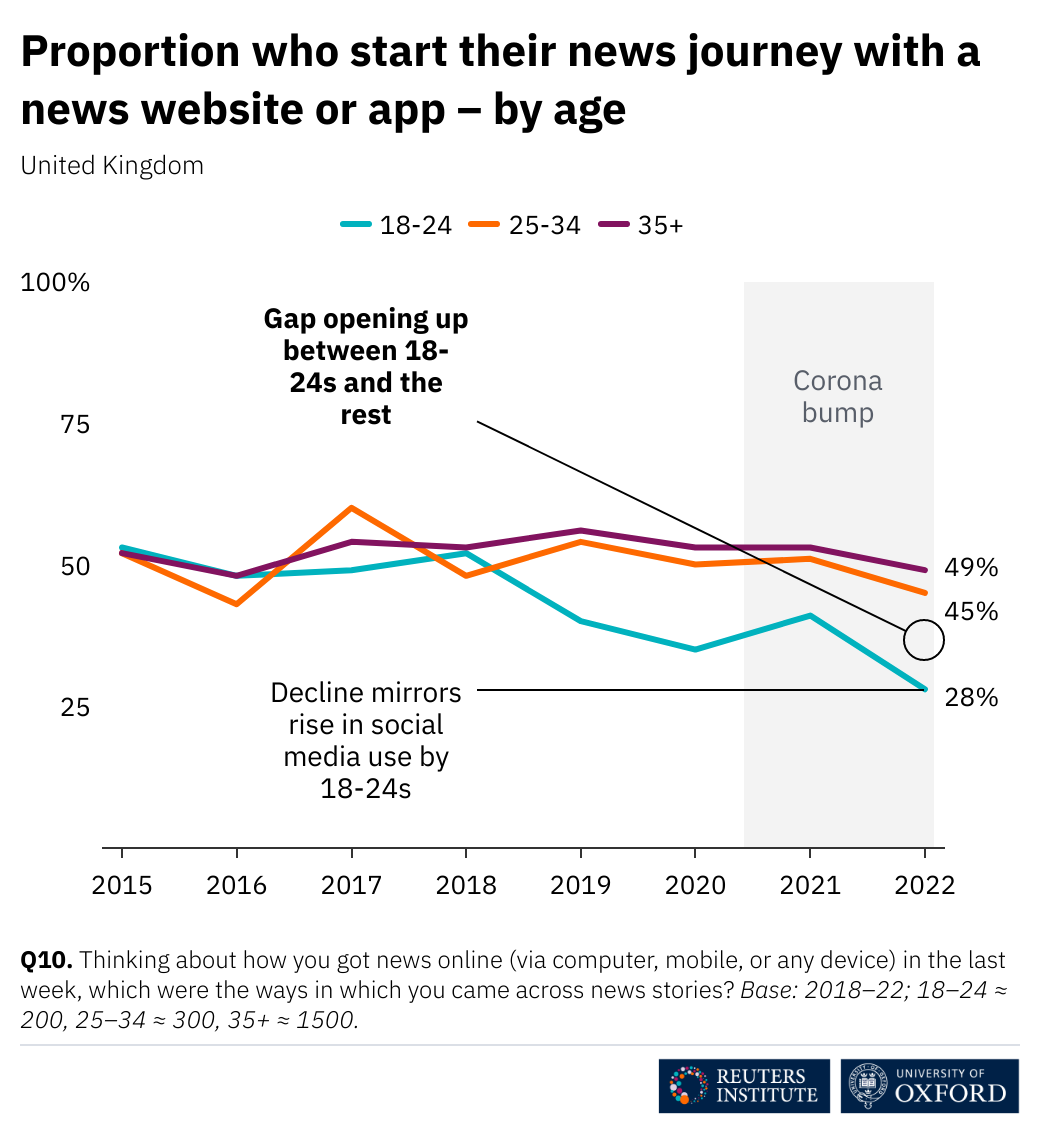
Fourth, these issues are compounded by differences in how new generations use media – looking specifically at those under 24 we find much less interest in connecting directly with news media, different views on what journalism ought to look like, much heavier reliance on newer forms of social media.

Fifth, across markets 54% say they worry about identifying the difference between what is real and fake on the internet when it comes to online news. More of those who say they mainly use social media as source of news (61%) are worried than among those who don’t use social at all (48%).

Sixth, despite these concerns, access to news continues to become more distributed. Across all markets, less than a quarter (23%) prefer to start their news journeys with a news site or app, down 9pp since 2018. Those aged 18–24 have an even weaker connection with news sites and apps.

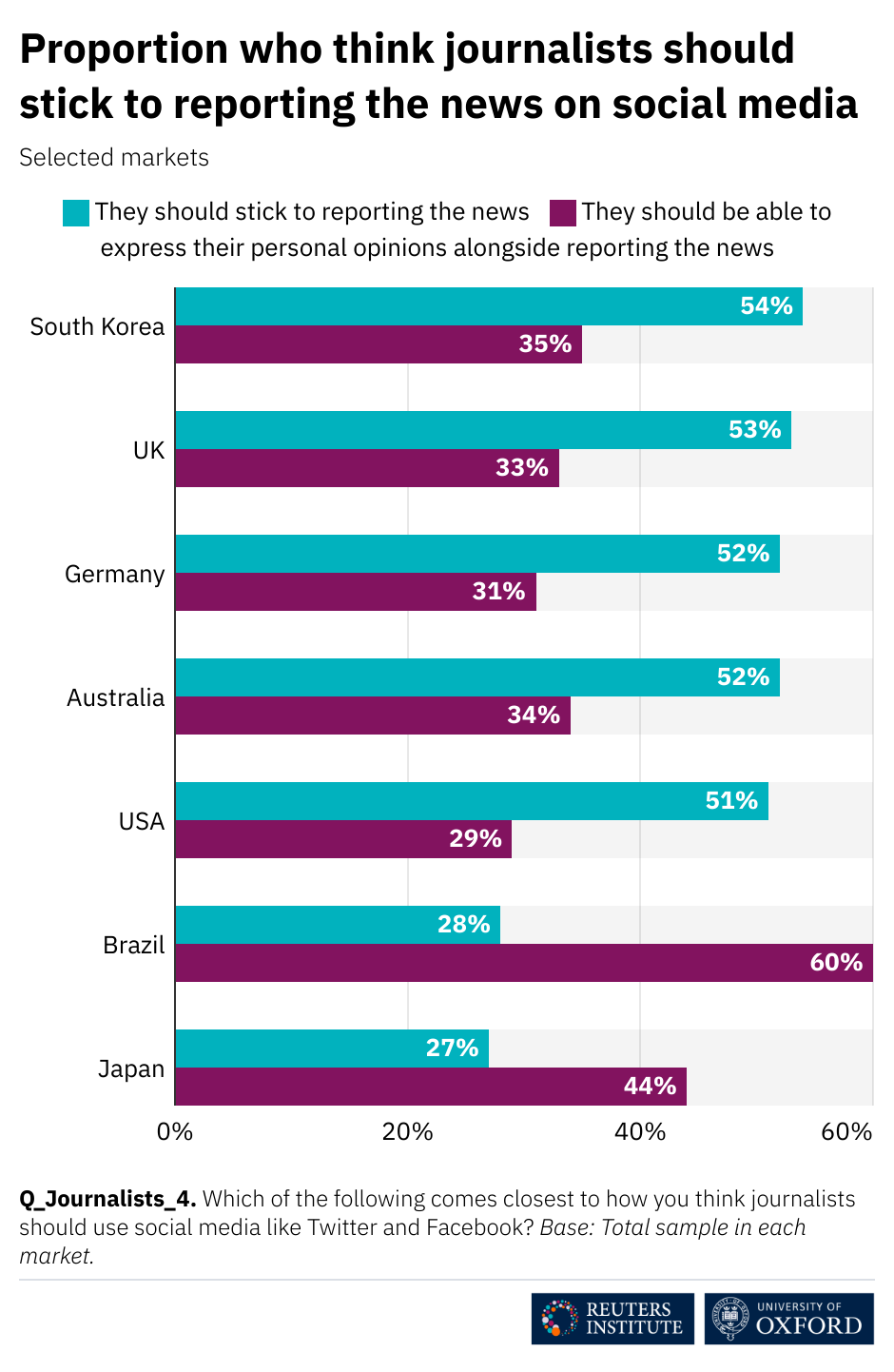
Seventh, as publishers, but also individual journalists, seek to reach people via social media, it is important to note that, in most countries, half or more of respondents feel that journalists on social should stick to reporting the news on social media (even as a sizable minority feel they should be allowed to express personal opinions).

Report lead author is Nic Newman, working with Richard Fletcher, Craig T. Robertson, Kirsten Eddy, and myself.

It is made possible by 18 sponsors, our amazing country partners, and the whole Reuters Institute team.

It takes a village and I’m so happy to be part of this particular one.

New book out: “The Power of Platforms”

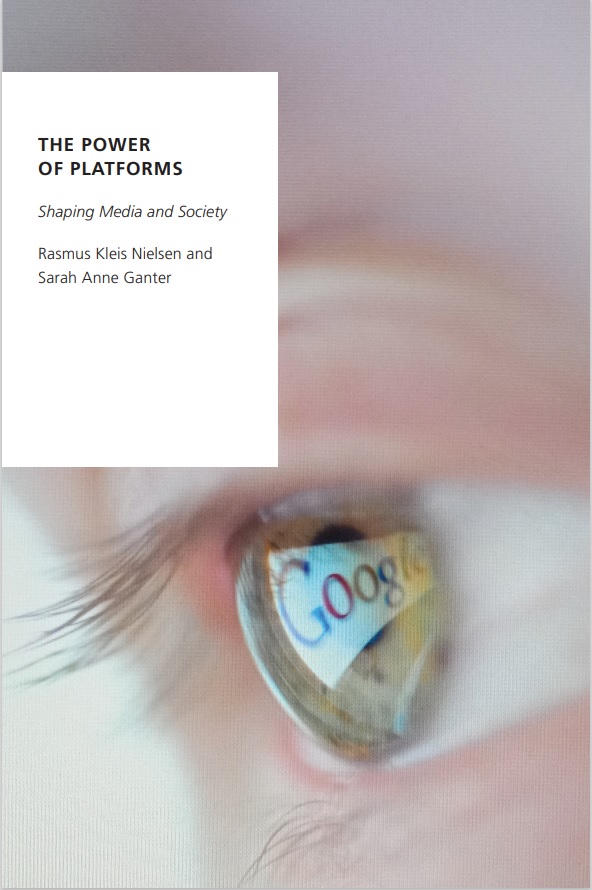
The Power of Platforms: Shaping Media and Society, my new book with Sarah Anne Ganter is out now with Oxford University Press.

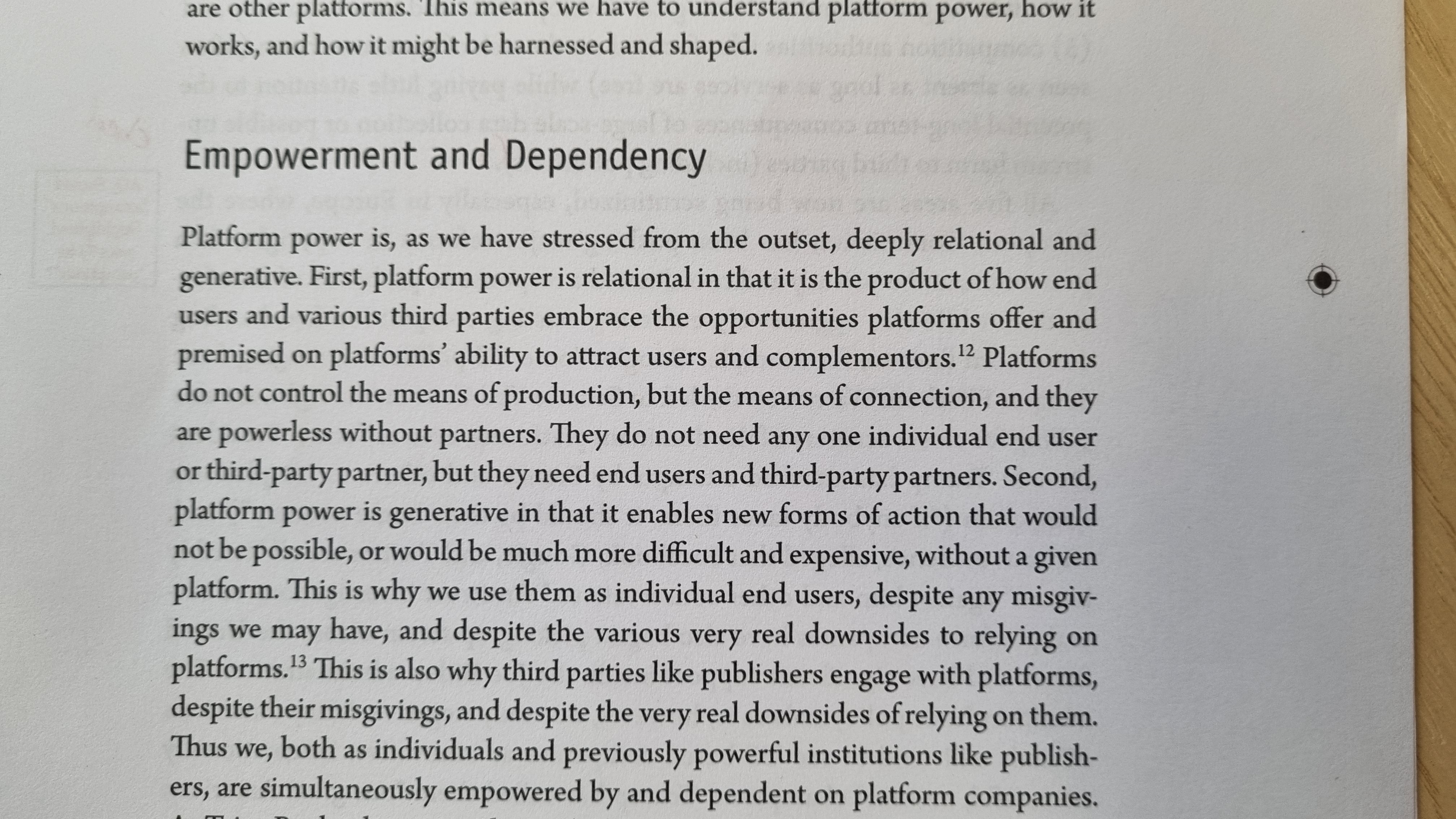
Our core argument is that the power of platforms is deeply relational and based on ability to attract end users and partners like publishers.

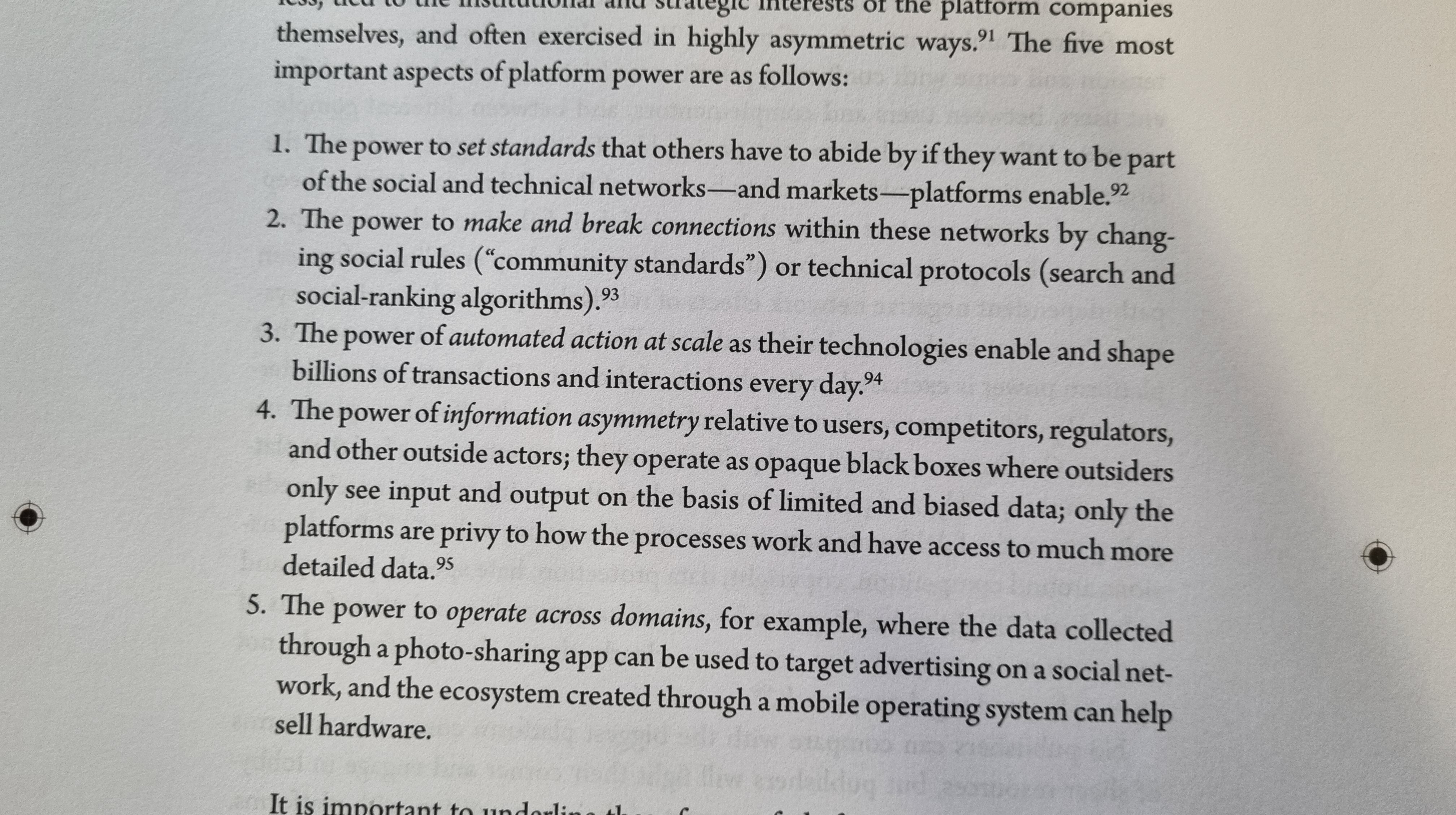
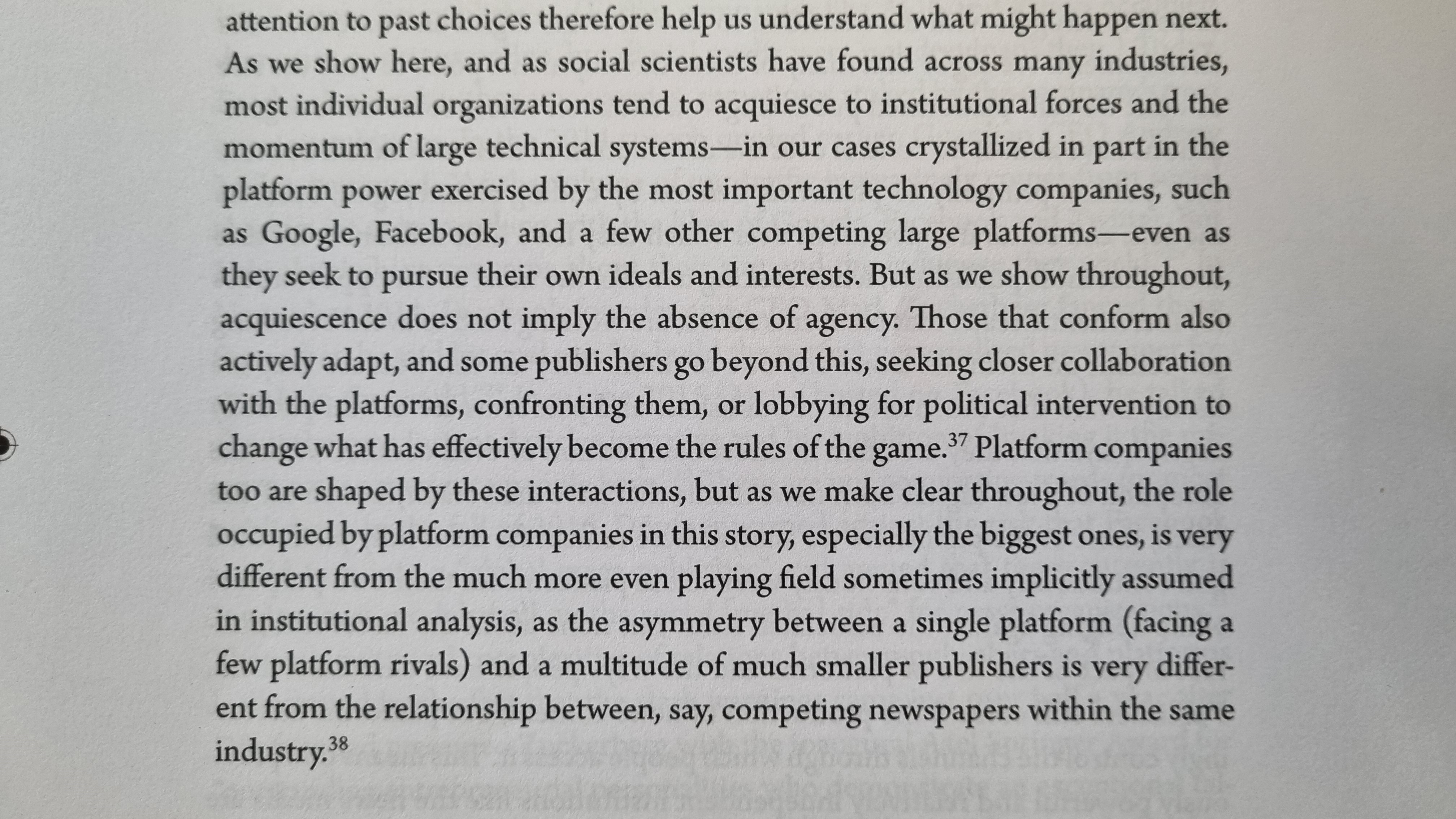
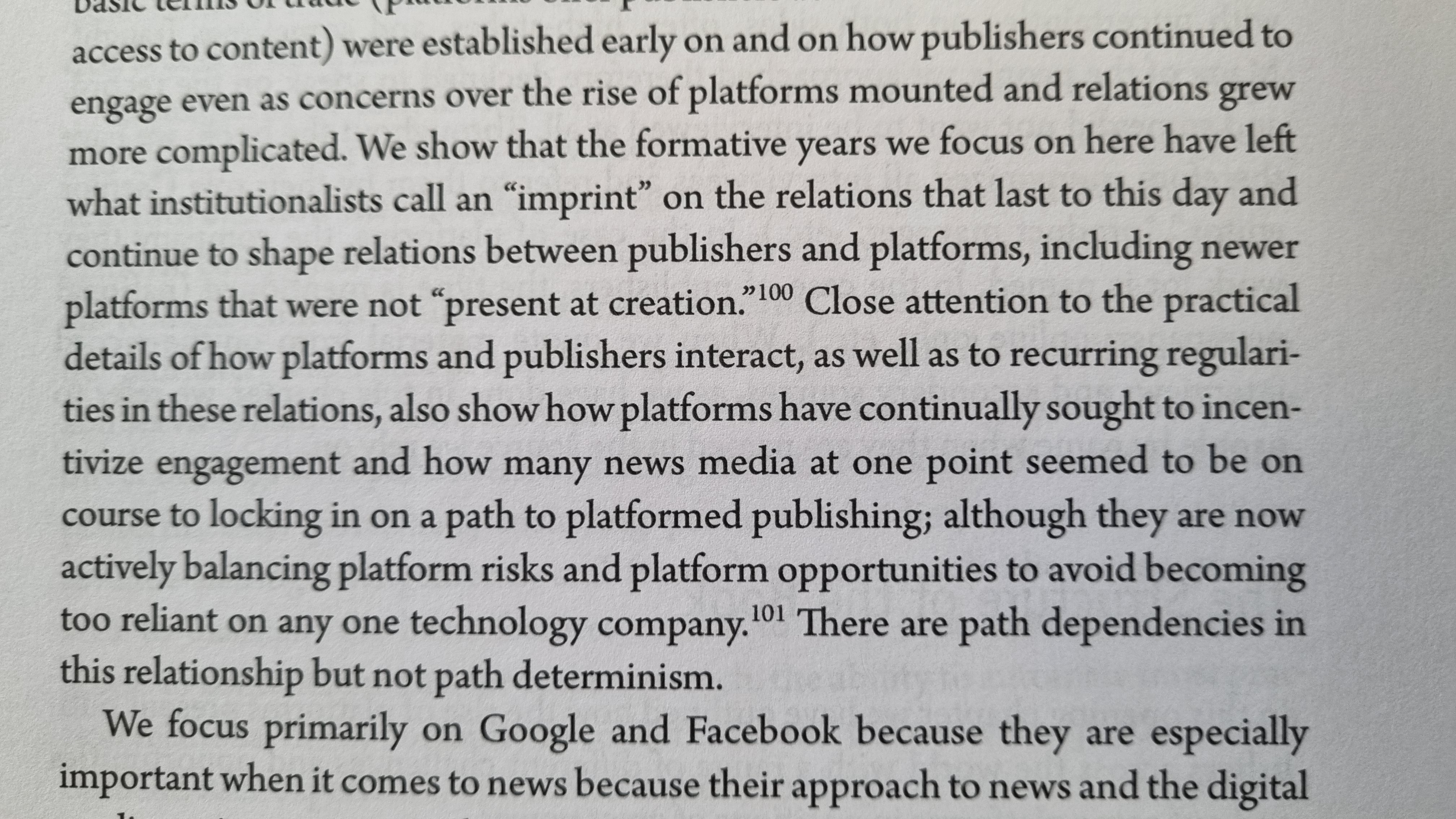
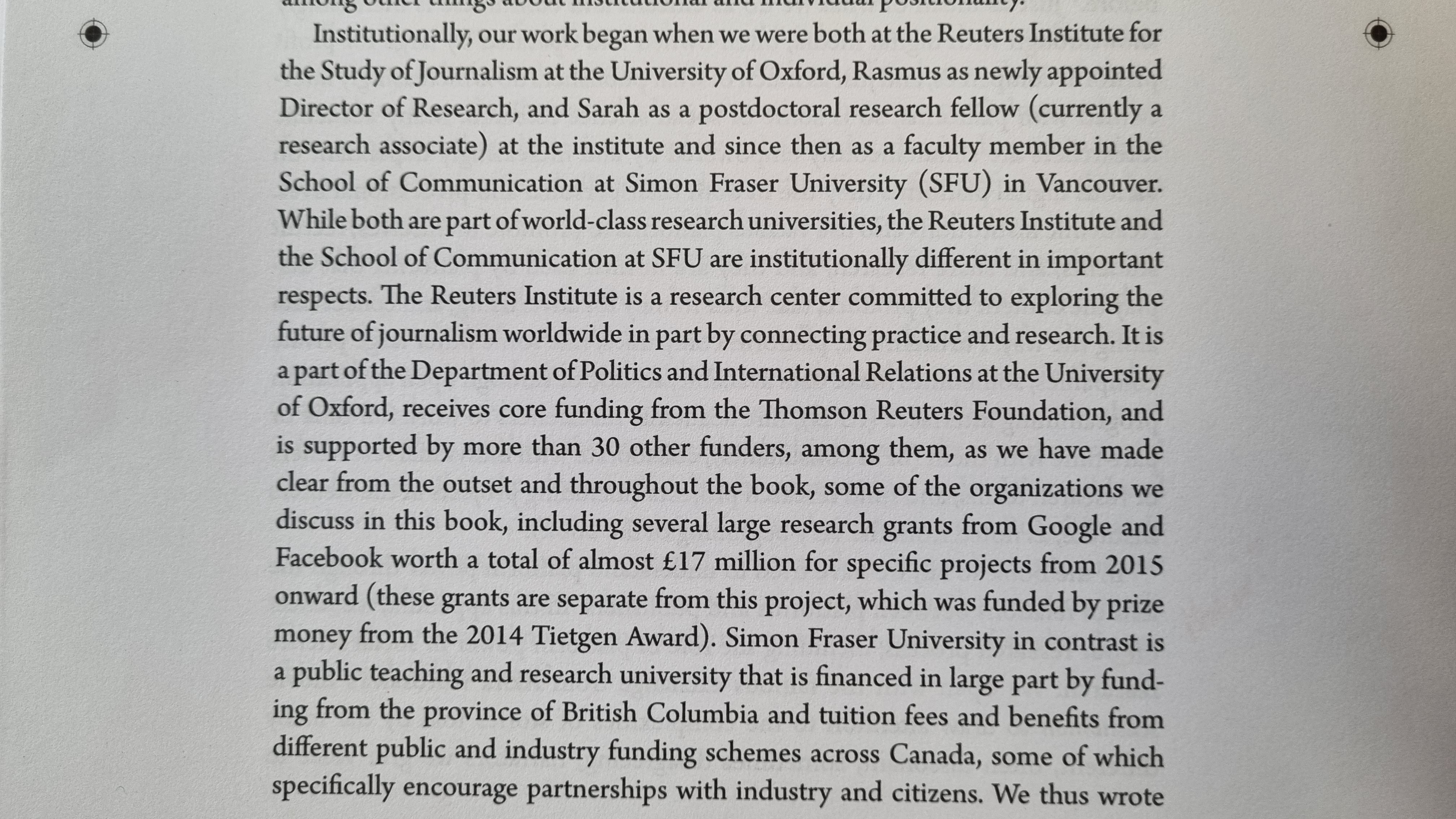
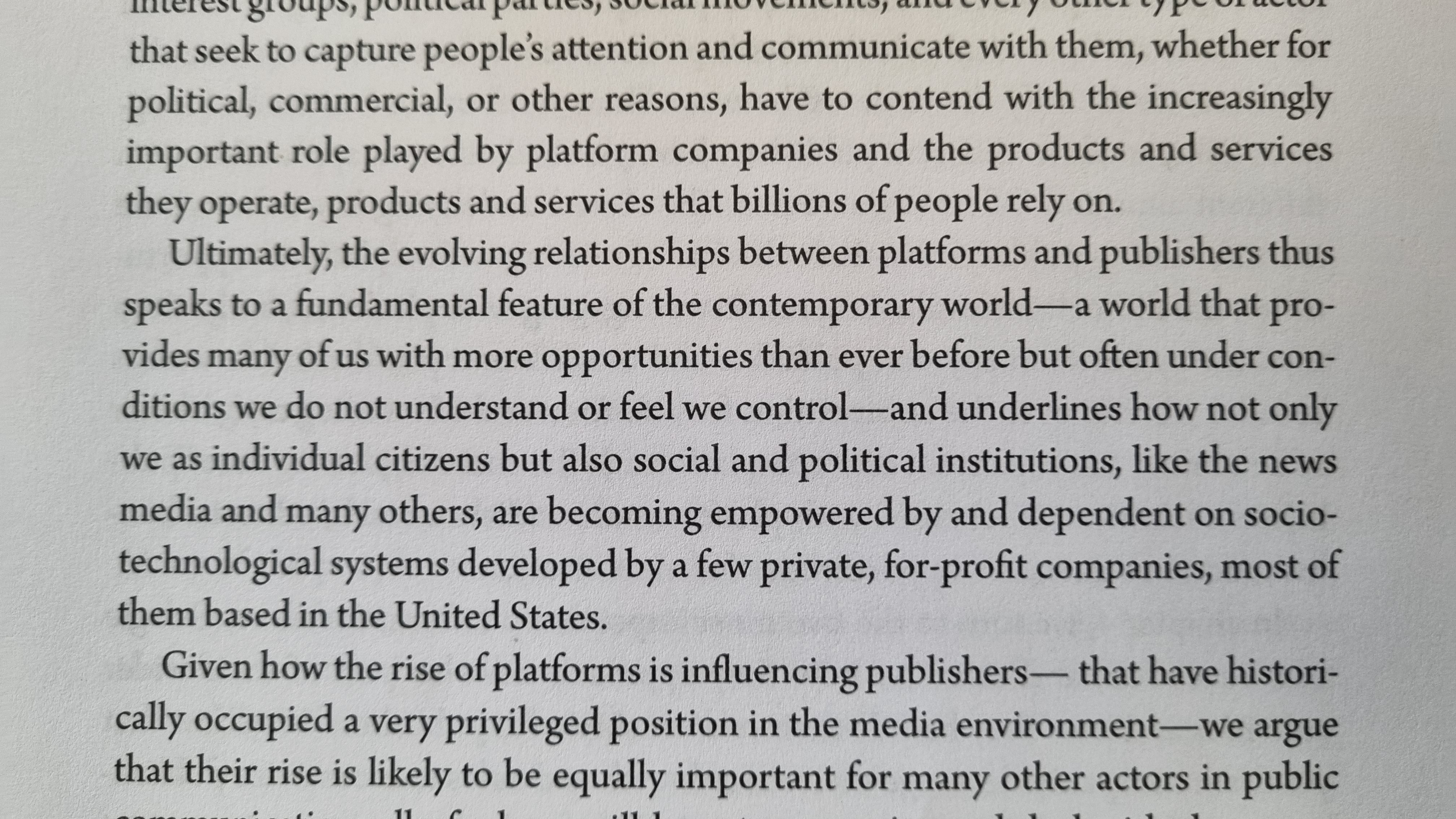
It’s always hard to summarize extensive empirical work briefly, but here a few key points from my short Twitter thread on the book, with a few pics of some central passages in the book.

Platforms do not control the means of production, but the means of connection, and they are powerless without partners. To understand their power we need to understand both reservations partners have and why they often embrace platforms nonetheless, continue to work with them.

Platform power is an enabling, transformative, and productive form of power—and power nonetheless, tied to institutional and strategic interests of platform companies, often exercised in highly asymmetric ways.

It goes beyond hard and soft power. We identify five main aspects.

In the short run, actors make choices, in the long run, these choices become structures. Both platforms and partners have agency here, but there is a huge asymmetry between the biggest platforms (facing a few big platform rivals) and a multitude of much smaller publishers.

We approach platform power through an institutionalist lens, and focus on how it is exercised in relational ways through socio-technical systems that develop path-dependency and momentum over time and retain an imprint of their founding logics that shape ongoing interactions.

Our analysis is based on interviews across several countries, observation, background conversations, as well as on-the-record sources and more. In the methods appendix we reflect on individual and institutional positionality, including differences between the Reuters Institute for the Study of Journalism where I work and much of the research was done, and Simon Fraser University where Sarah now works.

The evolving relationships between platforms and publishers speaks to fundamental feature of the contemporary world – that not only individual citizens, but also social and political institutions, are becoming empowered by and dependent on a few private, for-profit companies

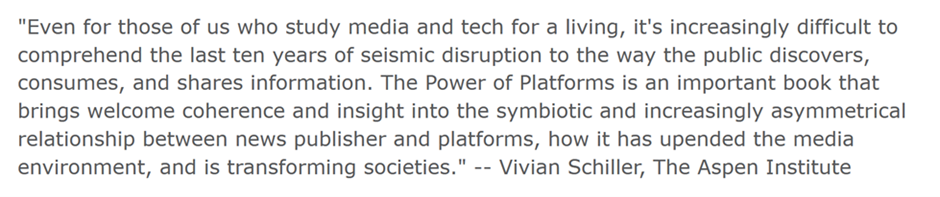
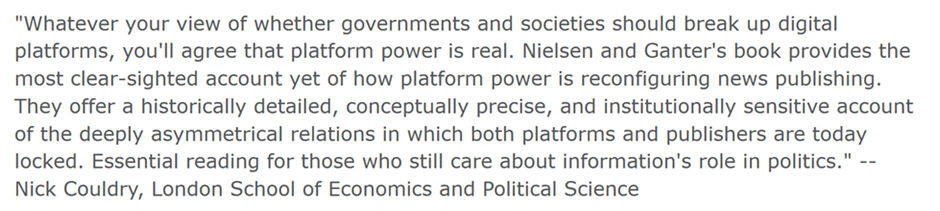
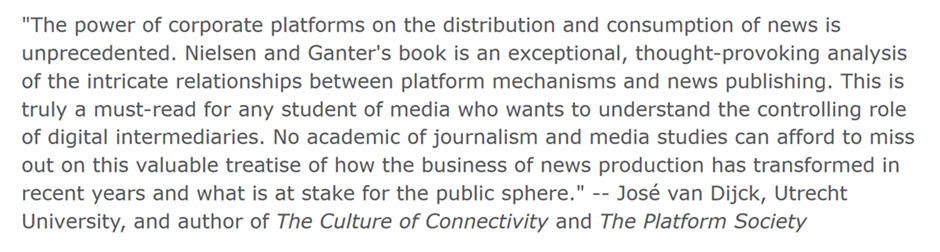
Very proud of the advance praise from colleagues with experiencing working in publishing companies, for platforms, as well as some leading academics researching digital media, including from Vivian Schiller, Nick Couldry, and José van Dijck. It means a lot to me personally to read what they kindly had to say about the book in advance of publication!

The research for this book was made possible by the prize money from the 2014 Tietgen Award, which funded Sarah’s position as a postdoctoral research fellow at the Reuters Institute for the Study of Journalism and the associated research costs.

We would like to thank first of all our interviewees and everybody else who has talked to us, joined off-the-record discussions we hosted, invited us to events, and let us sit in on meetings. The book would not have been possible without them sharing their perspectives, and whether they agree with our analysis or not, we hope they recognize the processes they are part of in what we write about here.

In addition, many different colleagues and friends have provided generous (and often challenging!) feedback as we worked on this, including David Levy, the former Director of the Reuters Institute for the Study of Journalism, and our many good colleagues there. Special thanks go to Chris Anderson, Gina Neff, Joy Jenkins, and Lucas Graves, who went through an entire draft manuscript with us and provided invaluable input. Daniel Kreiss and the anonymous reviewer helped further sharpen our thinking, and the series editor Andrew Chadwick went above and beyond in helping us develop our ideas. Fay Clarke, Felix Simon, and Gemma Walsh all did an outstanding job as research assistants at various stages of the project. Angela Chnapko at Oxford University Press masterfully guided us through the publication process.

What academic work on journalism/news/media would it be useful for journalists to read?

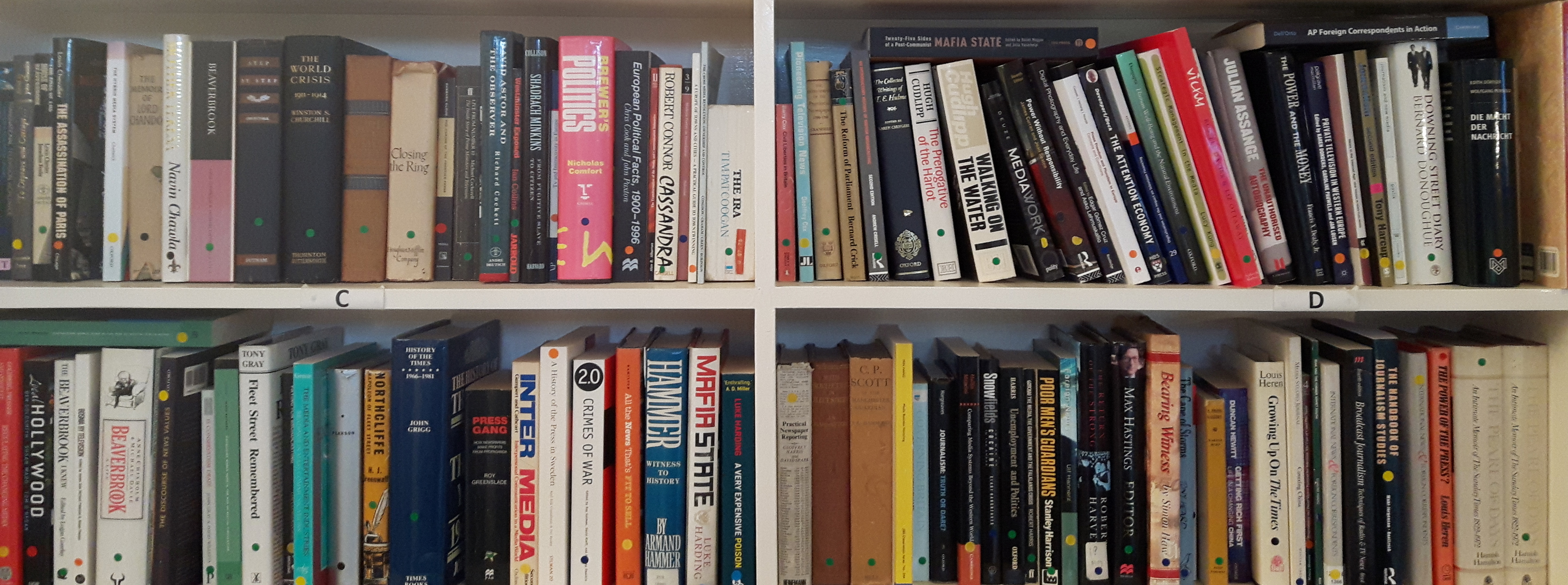
Back in August, Meera Selva, Joy Jenkins and I — all from the Reuters Institute — started asking people for suggestions of what academic work on journalism/news/media it would be useful for journalists to read.
Bookshelf

We wanted to create a list of reading suggestions for the incoming Reuters Institute  Journalist Fellows, mid-career journalists from all over the world who spend between 3 and 9 months with us in Oxford working on a project of their own choosing

A stable version is on the institute website here, and a Google Document open to editing is here.

We also hoped this would be useful for journalists elsewhere thinking about the present and future of their profession, the institutions that sustain and constrain it, its social and political implications, and how it is changing.

I’ve often felt (and written about) that academic research on journalism is too disconnected and far removed from urgent, present conversations about the future of news, so it was great to be reminded that there are many in the academic community who care  about how research can play a role in these discussions, and enthusiastically offered up suggestions.

We had hundreds of suggestions — and I’m sure we could have collected or come up with hundreds more — so what we have done to make it  a bit more managable and easy to access is to create 17 topics with a few suggested readings, including one marked as a good place to start on that topic, and then collected the other suggestions at the back of the document.

The 17 topics, and suggested first readings, are

1. Some classic big ideas on journalism, media, and ideas in public life

* Lippmann, Walter. 1997. Public Opinion. New Brunswick, N.J., U.S.A: Transaction Publishers.

2. What is journalism and news?

* Deuze, M. (2005). What is journalism? Professional identity and ideology of journalists reconsidered. Journalism, 6(4), 442-464. https://doi.org/10.1177/1464884905056815

3. Audience behaviour

* Newman, Nic, Richard Fletcher, Antonis Kalogeropoulos, David A. L Levy, and Rasmus Kleis Nielsen. 2018. “Reuters Institute Digital News Report 2018.” Oxford: Reuters Institute for the Study of Journalism. http://www.digitalnewsreport.org/.

4. Trust and the news media

* O’Neill, Onora. 2002. A Question of Trust. Reith Lectures ; 2002. Cambridge: Cambridge University Press. (Also available at https://www.bbc.co.uk/radio4/reith2002/lectures.shtml)

5. Inequality and polarisation in news use

* Prior, Markus. 2005. “News vs. Entertainment: How Increasing Media Choice Widens Gaps in Political Knowledge and Turnout.” American Journal of Political Science 49 (3): 577–92. https://doi.org/10.1111/j.1540-5907.2005.00143.x.

6. Framing and media effects

* CommGap. 2012. “Media Effects”. World Bank Communication for Governance Accountability Program. http://siteresources.worldbank.org/EXTGOVACC/Resources/MediaEffectsweb.pdf (short overview).

7. Relations between reporters and officials

* Bennett, W. Lance. 1990. “Toward a Theory of Press-State Relations in the United States.” The Journal of Communication 40 (2): 103–27. https://doi.org/10.1111/j.1460-2466.1990.tb02265.x.

8. News, race, and recognition

* Lamont, M. (2018). Addressing recognition gaps: Destigmatization and the reduction of inequality. American Sociological Review, 83(3), 419-444. https://doi.org/10.1177%2F0003122418773775

9. Women and journalism

* Franks, Suzanne. 2013. Women and Journalism. London: I.B.Tauris.

10. Business of news

* Nielsen, Rasmus Kleis. Forthcoming. “The Changing Economic Contexts of Journalism.” In Handbook of Journalism Studies, edited by Thomas Hanitzsch and Karin Wahl-Jorgensen. https://rasmuskleisnielsen.net/wp-content/uploads/2018/05/nielsen-the-changing-economic-contexts-of-journalism-v2.pdf.

11. Innovation in the media

* Küng, Lucy. 2015. Innovators in Digital News. RISJ Challenges. London: Tauris.

12. Platform companies and news media

* Bell, Emily J., Taylor Owen, Peter D. Brown, Codi Hauka, and Nushin Rashidian. 2017. “The Platform Press: How Silicon Valley Reengineered Journalism.” https://academiccommons.columbia.edu/catalog/ac:15dv41ns27.

13. Digital media and technology

* Dijck, José van. 2013. The Culture of Connectivity: A Critical History of Social Media. Oxford ; New York: Oxford University Press.

14. Disinformation

* Wardle, Claire, and Hossein Derakhshan. 2017. Information Disorder: Toward an Interdisciplinary Framework for Research and Policy Making. Report to the Council of Europe. https://shorensteincenter. org/information-disorder-framework-for-research-and-policymaking.

15. Democracy, journalism, and media

* Schudson, Michael. 2008. Why Democracies Need an Unlovable Press. Cambridge, UK: Polity. (Especially the chapter “Six or Seven Things that Journalism can do for Democracy”)

16. Censorship and propaganda

* Simon, Joel. 2014. The New Censorship : Inside the Global Battle for Media Freedom. Columbia Journalism Review Books. New York: Columbia University Press.

17. International/comparative research

* Hallin, Daniel C., and Paolo Mancini. 2005. “Comparing Media Systems.” In Mass Media and Society, edited by James Curran and Michael Gurevitch, 4th ed., 215–33. London: Hodder Arnold.

There are topics not yet on the list (local journalism, for example), and the list reflects the biases of published English language research and of our personal/professional  networks in tending towards studies of and from Western countries, often specifically from the US. (It also reflects the fact that I (a) have learned a lot from my time at Columbia University and (b) am proud of the work we have done at the Reuters Institute.) The list is thus, like any list, limited, but we hope it  is potentially useful and interesting, at least as a starting point, and hope journalists all over the world will find it useful.

Let us know what you think, we plan to update it going forward.

President Trump does not trust news from platform companies – nor do right-wing voters

President Trump not only considers wide swaths of the US news media “enemies of the people”.

He is now also asserting without evidence that social media companies like Facebook and Twitter “silence conservative voices” and has alleged that Google search results are “rigged” and are “suppressing” Republicans and conservatives.

Trump’s attacks included some demonstrable false claims, as for example BuzzFeed News has demonstrated, including the idea that Google promoted president Obama’s State of the Union on its homepage but stopped promoting these speeches when Trump took office.

As Jason Kint, CEO of Digital Content Next, a trade association that represents online news publishers and a frequent critic of platform companies wrote after Trump’s attacks on Google, “He’s 100% wrong. He’s spreading complete BS. If he was even remotely correct, I would be the first to call it out. I have a lot of issues with Google, this isn’t one of them.”

But will his attacks resonate with conservative voters? Our Reuters Institute Digital News Report survey data suggests it might.

Not only are partisan voters likely to take cues from politicians they support. In this case, the President’s attacks also plays into widespread distrust not only of news media, but also news found via social media and search engines. (Our survey was in the field in January/February so well before Trump started publicly attacking the platform companies.)

People on the political right in the US not only have far less trust in the news media than the rest of the population.

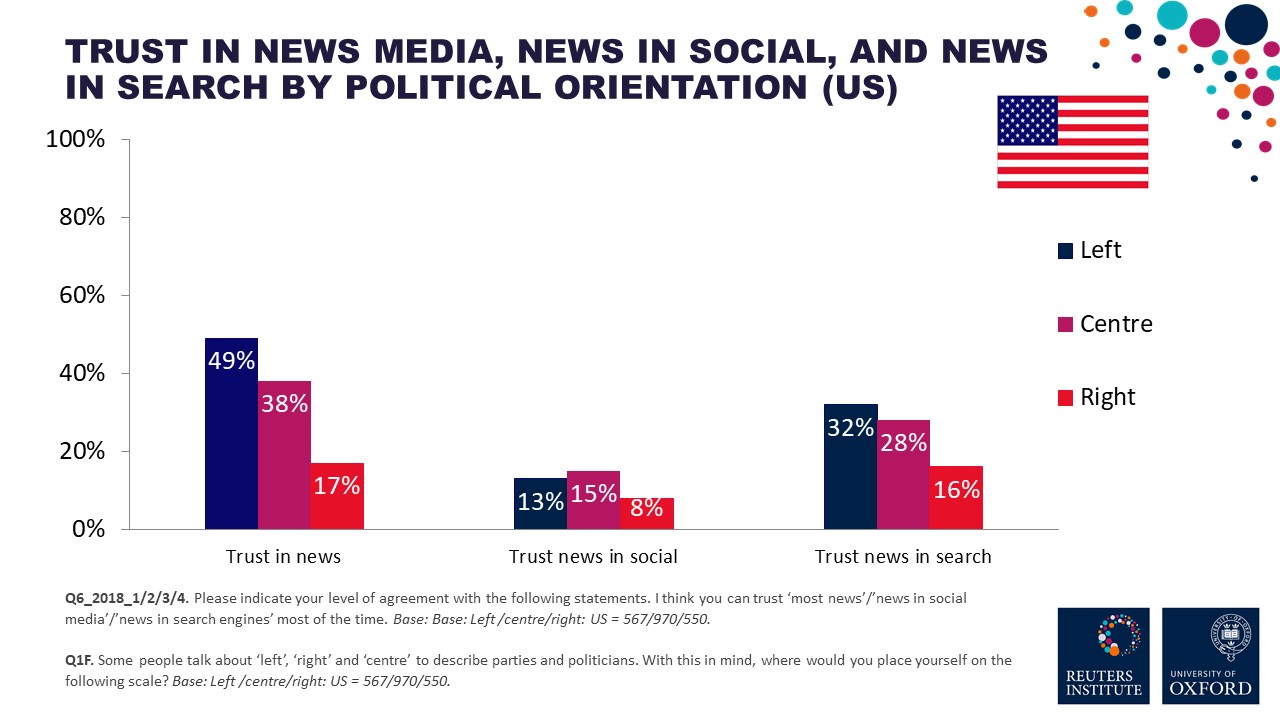
They also trust news in social and search far less than people in the center or on the political left, as shown in the chart below.

17 percent of those on the political right say they trust most news, compared to 16 percent who say they trust news in search engines and just 8 percent who say they trust news in social media. (The latter perhaps complicating the narrative that Conservatives favor social media.)

Trump trust US

Google has denied using political viewpoints to shape its search results, and said “Search is not used to set a political agenda and we don’t bias our results toward any political ideology.” (Facebook and Twitter have not responded directly.)

But Trump’s core supporters may not believe it, or any of the other platform companies the President is now attacking. As news media have long known, it is one issue how you can try to avoid political bias. It is another whether some people think you are politically biased.
Thanks to Antonis Kalogeropoulos who helped with the chart.
 

Trust in UK media

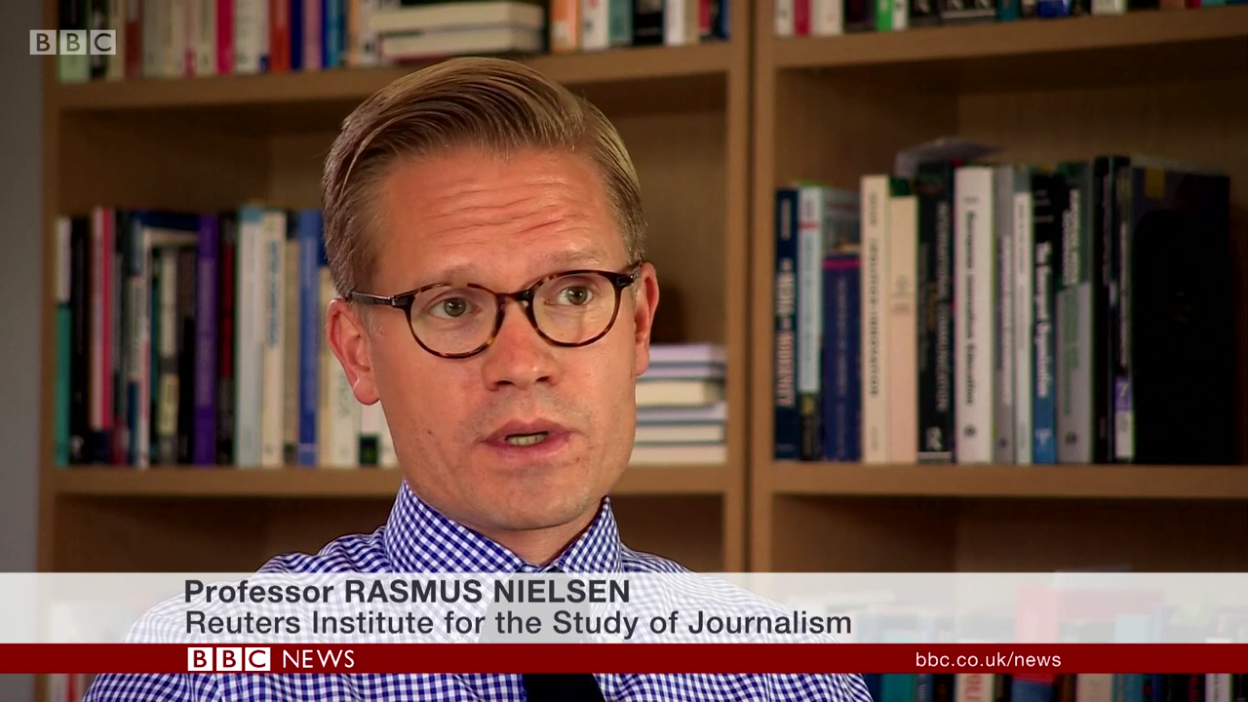
“The British people simply don’t trust the media”, Jeremy Corbyn said in his Alternative MacTaggart Lecture at the Edinburgh TV Festival. I spoke to BBC News for the News at Ten about trust in UK media, and below is a bit of Reuters Institute data for those interested.

RKN103ps

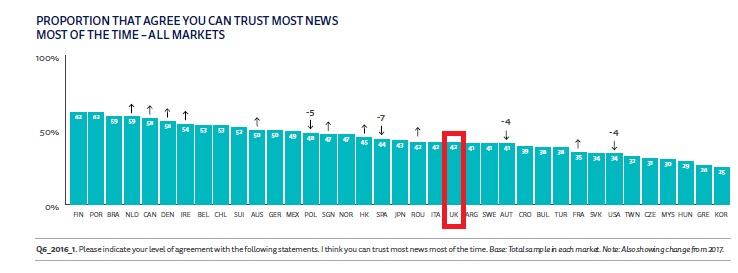
1) Trust in news is lower in the UK than many other countries,42 percent say they think they can trust “most news most of the time”, placing the UK 20th of the 37 countries we surveyed in 2018.

Trust

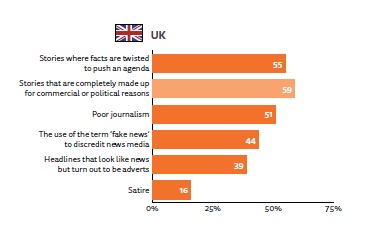
2) Corbyn also said that “most of our citizens think our newspapers churn out fake news day in, day out”, and indeed out survey data suggest that many online news users in the UK are also very or extremely concerned over what they see as “stories where facts are twisted to push an agenda” (55%) and “poor journalism” (51%). (Just as 44% are concerned over “the use of the term ‘fake news’ to discredit news media” by politicians and others).

concerns

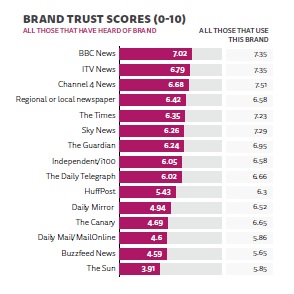
3) But, while overall trust is low, and many are concerned that much of what they see is biased and shoddy, 54 percent say they trust the news they use, and at the brand level, most people find the BBC and other broadcasters, regional/local papers, and upmarket papers like the Times trustworthy — irrespective of whether they use them or not, whereas some digital-born sites and mid-market/popular newspapers have limited trust even from the people who use them.

brands

All this data and more from our 2018 Digital News Report by Nic Newman et al, available at for free download, interactive graphics etc.

Newsroom Integration As An Organizational Challenge: Approaches of European public service media from a comparative perspective

Newsroom integration has been a priority and a industry buzzword for more than a decade, but how far have European public service media actually integrated their newsrooms? In most cases, not very far.

In an article published in August by Journalism Studies, based on ongoing comparative, qualitative research that Annika Sehl, Alessio Cornia, and I are doing on how European news media are adapting to digital, we (with our colleague Lucas Graves), use interviews at a range of different European public service media to show only a small minority have in fact integrated their newsrooms, and that organizational legacies shape how they are dealing with digital, with especially those with a history of separation between media (as in France), between different channels (as in Italy), or a regional structure (as in Germany) have so far not really integrated.

Abstract below and article here.

In this paper, we examine to what extent public service media (PSM) in six European countries have integrated or are integrating their newsrooms in order to adapt to an increasingly digital media environment. Based on 67 interviews over two years with senior editors and managers, this study constitutes the largest comparative analysis of newsroom change among PSM organizations conducted to date. Despite much talk of “convergence”, our empirical analysis shows that full newsroom integration remains the exception in this sector. Although all of the PSM studied experience pressure to reorganize across platforms, only two have achieved high levels of newsroom integration. Our findings suggest that centralizing online news under a single operational roof — only recently undertaken and still incomplete at several PSM — is a necessary first step to more thorough editorial reorganization across platforms. Our data also shed light on the complex ways that internal and external variables combine to shape organizational change: in addition to organizational challenges, we highlight broader historical, political, and economic factors affecting how PSM have responded to rapid technological shifts in the media environment.

‘We no longer live in a time of separation’: A comparative analysis of how editorial and commercial integration became a norm

Back in June, Journalism: Theory, Practice, Critique published an article based on the ongoing, comparative qualitative research Alessio Cornia, Annika Sehl, and I have been doing on how European news media are adapting to digital.

Based on interviews as 12 different private sector legacy news media, we show how many are rethinking the traditional separation of editorial and commercial operations, and that the increasing integration between editorial and commercial (not assimilation of editorial into commercial, not hierarchical relegation of editorial to commercial) is motivated by the same aspiration as the traditional separation: to ensure professional autonomy, only today that is pursued by working with other parts of the organization to jointly ensure commercial sustainability, rather than by trying to remain completely separate from commercial issues..

The abstract below and the article here.

The separation between editorial and business activities of news organisations has long been a fundamental norm of journalism. Journalists have traditionally considered this separation as both an ethical principle and an organisational solution to preserve their professional autonomy and isolate their newsrooms from profit-driven pressures exerted by advertising, sales and marketing departments. However, many news organisations are increasingly integrating their editorial and commercial operations. Based on 41 interviews conducted at 12 newspapers and commercial broadcasters in six European countries, we analyse how editors and business managers describe the changing relationship between their departments. Drawing on previous research on journalistic norms and change, we focus on how interviewees use rhetorical discourses and normative statements to de-construct traditional norms, build new professionally accepted norms and legitimise new working practices. We find, first, that the traditional norm of separation no longer plays the central role that it used to. Both editors and managers are working to foster a cultural change that is seen as a prerequisite for organisational adaptation to an increasingly challenging environment. Second, we find that a new norm of integration, based on the values of collaboration, adaptation and business thinking, has emerged. Third, we show how the interplay between declining and emerging norms involves a difficult negotiation. Whereas those committed to the traditional norm see commercial considerations as a threat to professional autonomy, our interviewees see the emerging norm as a new way of ensuring professional autonomy by working with other parts of the organisation to jointly ensure commercial sustainability.