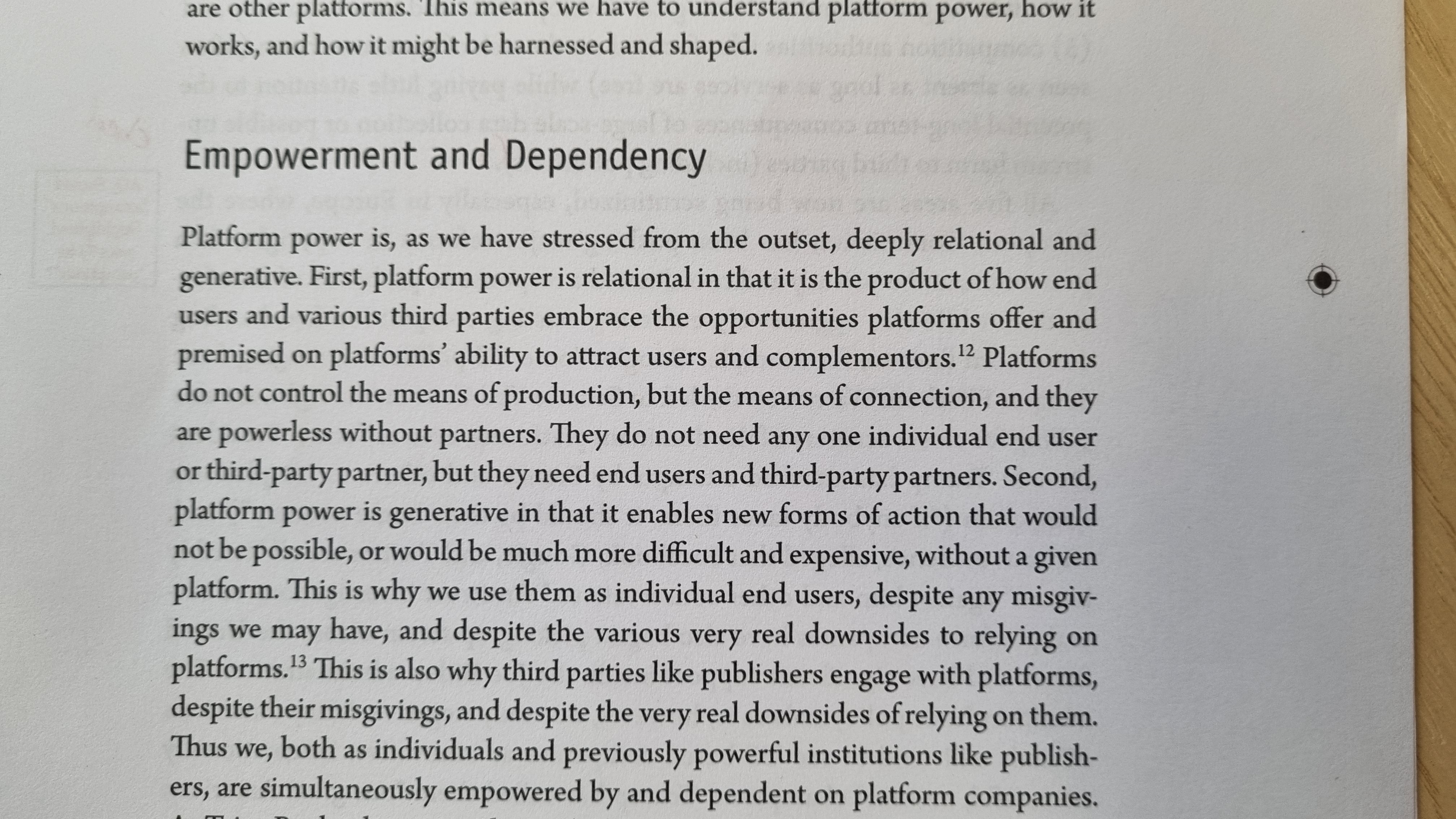
Our core argument is that the power of platforms is deeply relational and based on ability to attract end users and partners like publishers.
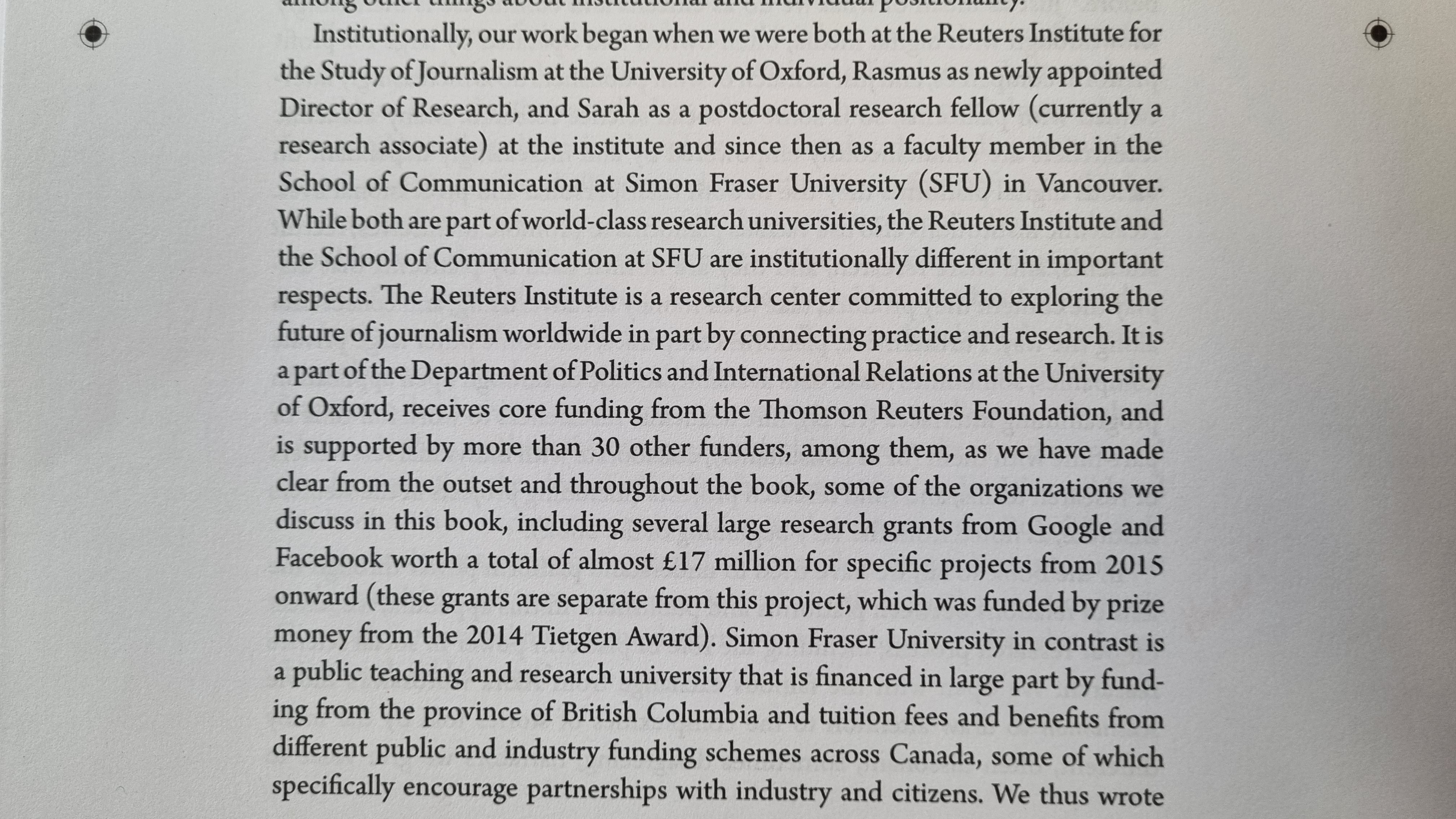
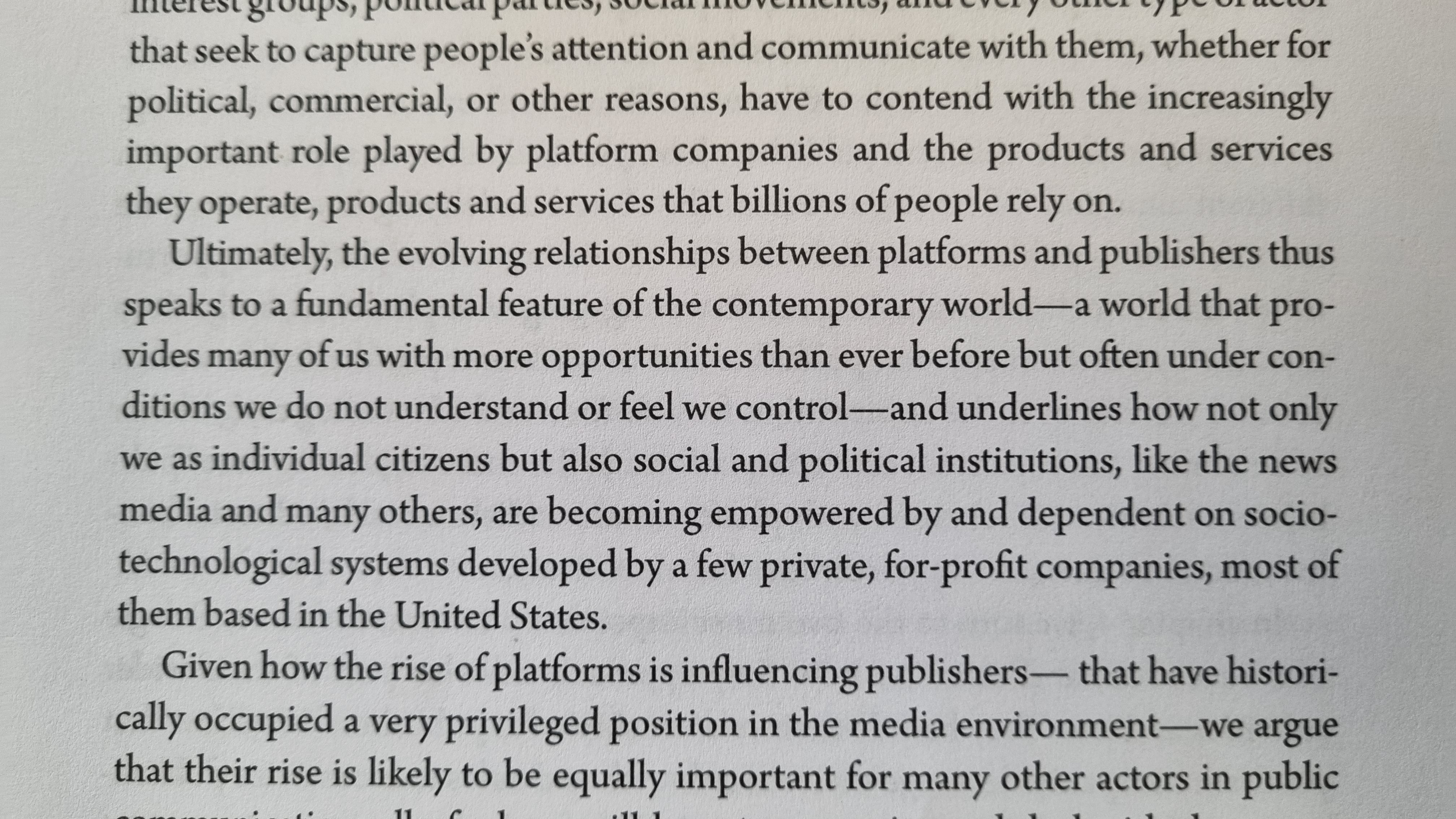
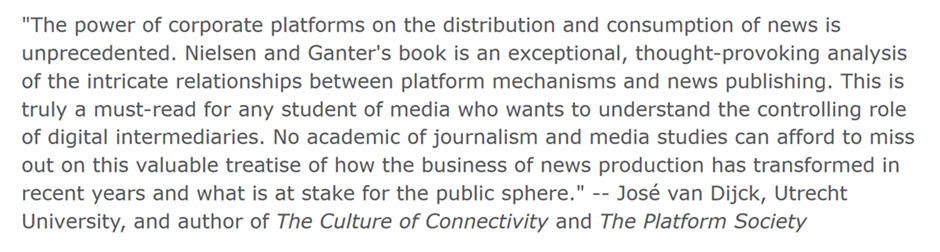
It’s always hard to summarize extensive empirical work briefly, but here a few key points from my short Twitter thread on the book, with a few pics of some central passages in the book.
Platforms do not control the means of production, but the means of connection, and they are powerless without partners. To understand their power we need to understand both reservations partners have and why they often embrace platforms nonetheless, continue to work with them.
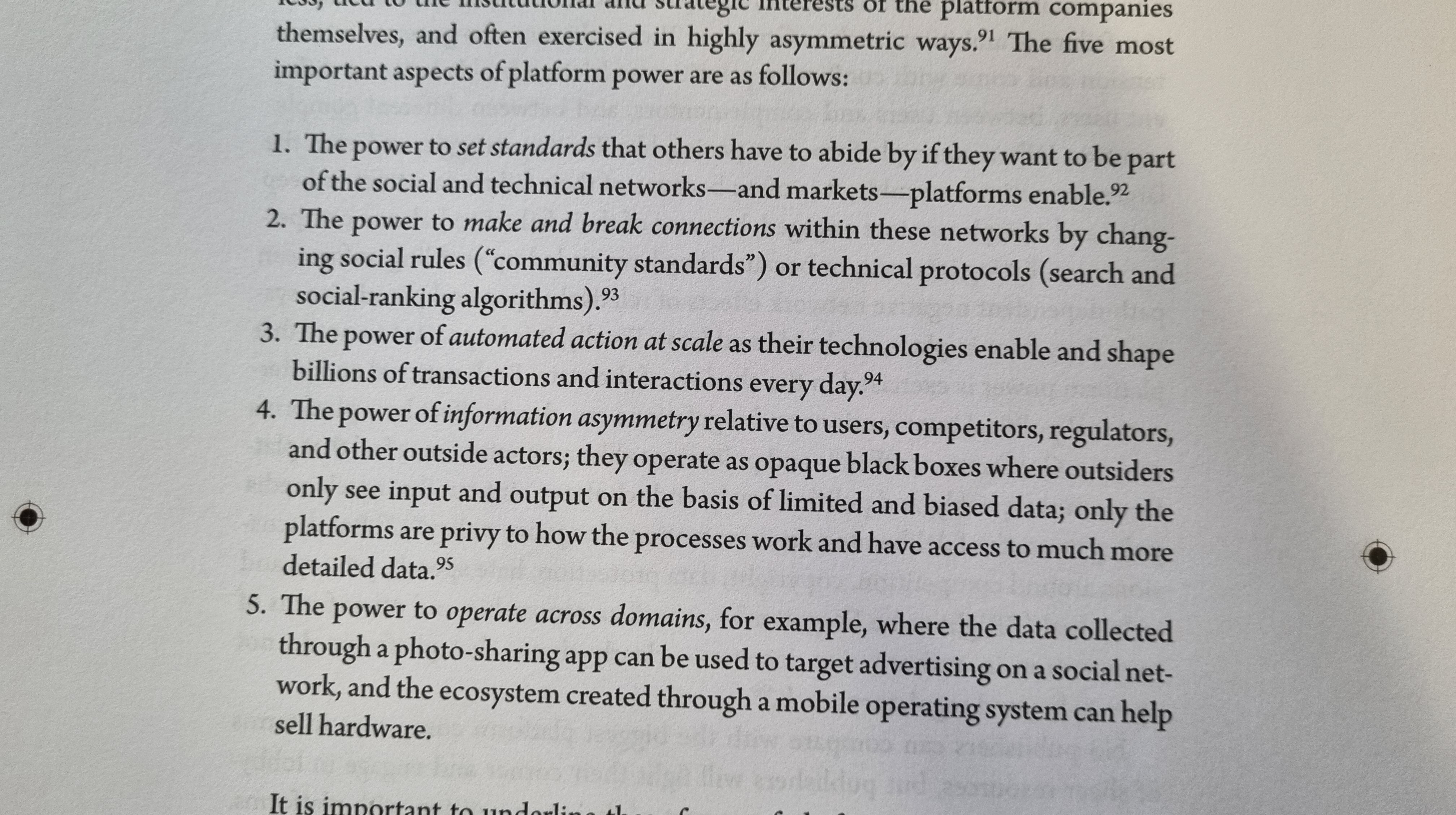
Platform power is an enabling, transformative, and productive form of power—and power nonetheless, tied to institutional and strategic interests of platform companies, often exercised in highly asymmetric ways.
It goes beyond hard and soft power. We identify five main aspects.
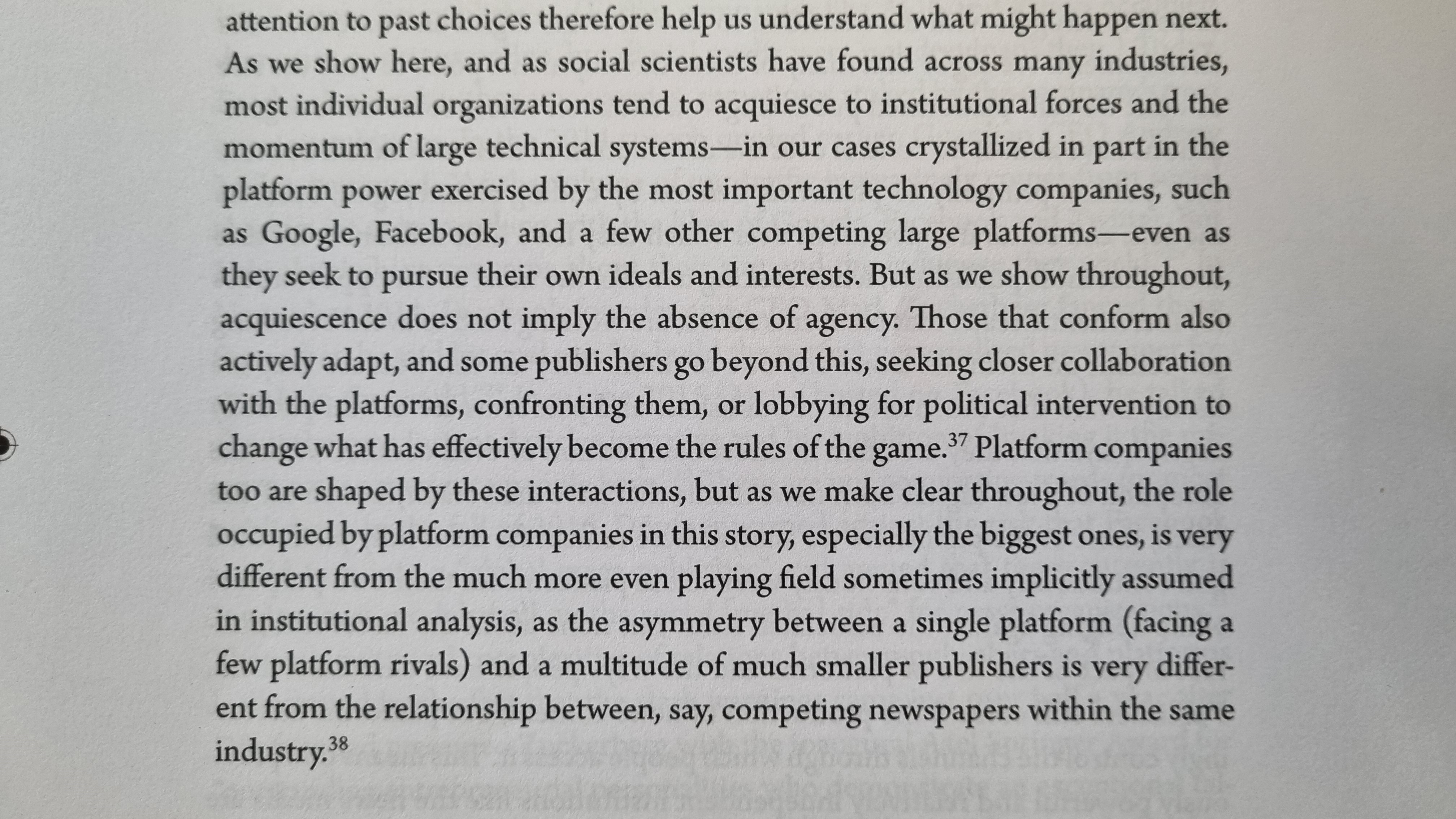
In the short run, actors make choices, in the long run, these choices become structures. Both platforms and partners have agency here, but there is a huge asymmetry between the biggest platforms (facing a few big platform rivals) and a multitude of much smaller publishers.
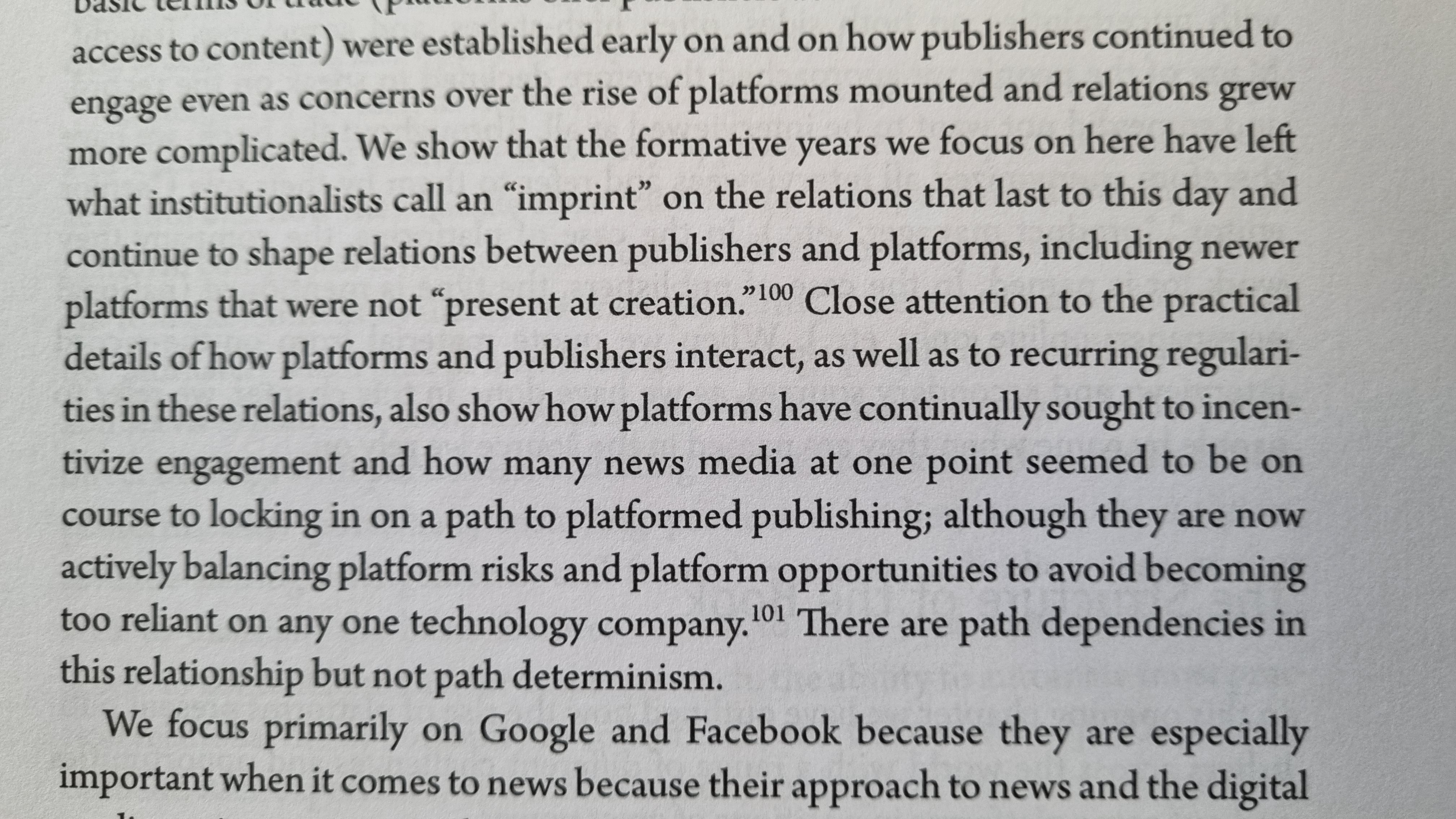
We approach platform power through an institutionalist lens, and focus on how it is exercised in relational ways through socio-technical systems that develop path-dependency and momentum over time and retain an imprint of their founding logics that shape ongoing interactions.
Our analysis is based on interviews across several countries, observation, background conversations, as well as on-the-record sources and more. In the methods appendix we reflect on individual and institutional positionality, including differences between the Reuters Institute for the Study of Journalism where I work and much of the research was done, and Simon Fraser University where Sarah now works.
The evolving relationships between platforms and publishers speaks to fundamental feature of the contemporary world – that not only individual citizens, but also social and political institutions, are becoming empowered by and dependent on a few private, for-profit companies
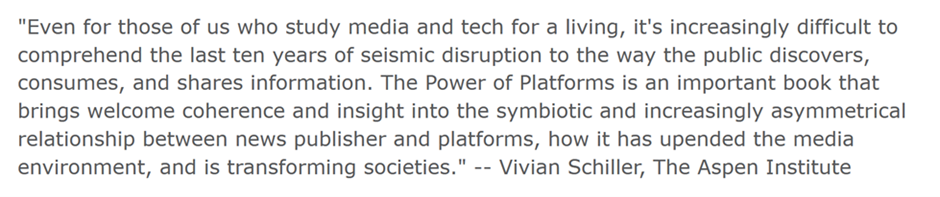
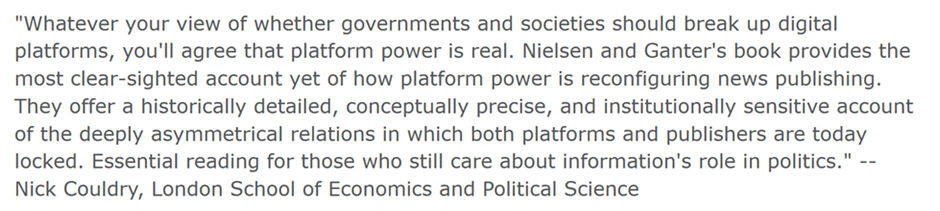
Very proud of the advance praise from colleagues with experiencing working in publishing companies, for platforms, as well as some leading academics researching digital media, including from Vivian Schiller, Nick Couldry, and José van Dijck. It means a lot to me personally to read what they kindly had to say about the book in advance of publication!
The research for this book was made possible by the prize money from the 2014 Tietgen Award, which funded Sarah’s position as a postdoctoral research fellow at the Reuters Institute for the Study of Journalism and the associated research costs.
We would like to thank first of all our interviewees and everybody else who has talked to us, joined off-the-record discussions we hosted, invited us to events, and let us sit in on meetings. The book would not have been possible without them sharing their perspectives, and whether they agree with our analysis or not, we hope they recognize the processes they are part of in what we write about here.
In addition, many different colleagues and friends have provided generous (and often challenging!) feedback as we worked on this, including David Levy, the former Director of the Reuters Institute for the Study of Journalism, and our many good colleagues there. Special thanks go to Chris Anderson, Gina Neff, Joy Jenkins, and Lucas Graves, who went through an entire draft manuscript with us and provided invaluable input. Daniel Kreiss and the anonymous reviewer helped further sharpen our thinking, and the series editor Andrew Chadwick went above and beyond in helping us develop our ideas. Fay Clarke, Felix Simon, and Gemma Walsh all did an outstanding job as research assistants at various stages of the project. Angela Chnapko at Oxford University Press masterfully guided us through the publication process.
We sometimes compare the multitude of intersecting challenges journalism faces to the global climate crisis. In the process of thinking about the climate crisis, I have come across the notion of fact-based hope, something I think applies to journalism too.
It’s about how we can be – and have evidence to be – resolutely hopeful even in the face of severe challenges.
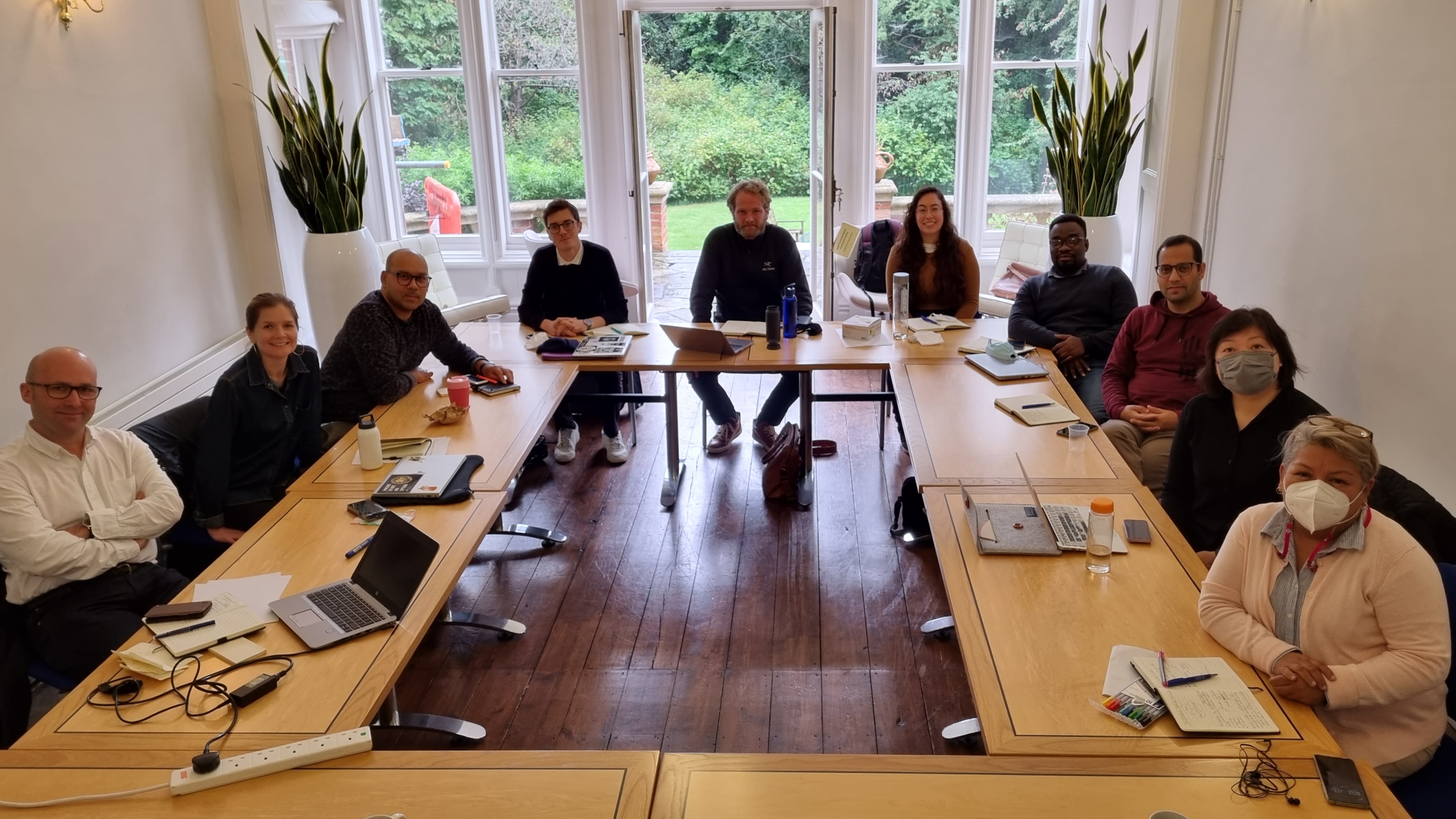
This post is about fact-based hope for journalism, and inspired by the amazing Reuters Institute journalist fellows we host, including the most recent cohort (pictured after a day full of evidence-based optimism!).
As with the climate crisis, anyone who hasn’t recognized the so-called “burning platform” in journalism is in denial.
Ignoring or actively distracting from the conflagration – created by the combination of analogue business models disrupted by audiences’ move to digital media and the rise of platforms, much more intense competition for attention and advertising in an high-choice online media environment, and the often fraying “public connection” between much of journalism and much of the public, in many countries compounded by powerful people who wage little less than a war on independent news media and those who seek truth and report it – is doing the profession, the industry, and the public a disservice. On closer inspection, there never really was a ‘golden age’, but in any case, there is no going back. Business as usual is suicidal.
* * *
But as with the climate crisis, we cannot and should not let the scale, scope, and complexity of the challenges ahead lead to paralysis, let alone resignation.
Fact-based hope is about how we might move beyond the crises we face.
So let’s be clear: there are both systemic, policy-level and more individual, organizational-level things we can do to create the different kinds of journalisms we want in the future.
The systemic things are largely political choices, up to citizens and the elected officials who represent them. We have many options based on evidence or at least with proof of concept, and while not cheap, uncontroversial, or without downsides, it is important to clearly state we can choose, as societies, to create a more enabling environment for the freedom, funding, and future that journalism needs. (I’ve written about that extensively here, here, here and elsewhere.)
But the more individual, organizational-level things are worth highlighting in parallel. Just as the climate crisis calls for both systemic and more granular responses, so too with the many challenges facing journalism. The need for systemic change does not mean we shouldn’t think about more individual and organizational-level change too.
That is especially important because large-scale systemic change for the better seems unlikely when it comes to journalism. There is no question policy can make a difference for the better (just as it very visible makes a difference for the worse in many countries when used for e.g. media capture). But will it? These are at best long-term responses, and in most countries face uncertain political prospects. As I’ve said before, I think we need to keep in mind that, realistically, most politicians around the world regard independent journalism at best with benign indifference, more often with rank hypocrisy, and very often with open hostility. Media policy, like all other forms of policy, is made by the politicians we have and will be used by those we get, it is not the exclusive province of the particular politicians each of us may personally prefer. We may hope that politicians will rally en masse to make a meaningful commitment to support journalism (despite the fact that there currently does not seem to be much public support for it). But I don’t think we have fact-based hope that they will.
So I am all for looking at evidence-based options for systemic change.
But, in parallel, I think we need to identify individual, organizational-level examples that can inspire fact-based hope.
* * *
And all around me, I see not just crises, but also evidence for fact-based hope.
The business of journalism second – it’s brutal out there, and few winners, many losers, but increasingly it seems the winners are not only some upmarket legacy titles but also some membership and subscription based digital born news media. After years of pretty unrelenting bad news, we are seeing some new investments in local news too, and some ad-supported popular titles at least in Europe have built huge online reach serving a far more diverse audience than often upper-crust-oriented subscription and membership-based titles. In addition to editorial collaborations, we are also seeing some publishers collaborate on the business side. And while limited and uneven, there is also a growing number of non-profit media and new ideas of how to support them. Finally, it’s also important to see that digitally-oriented titles often invest a far greater share of their revenues in journalism than legacy titles ever did – we can get more journalistic bang even if there may well be fewer bucks.
The public connection between journalism and the people it serves third – the coronavirus crisis has provided a reminder of the importance of trustworthy news. We have seen trust in news overall increase in many countries, we have seen some evidence more trusted brands seem to have grown their online reach more than others, research documents that news has helped people understand the crisis (just as it helps them understand politics). The way some journalists think about this connection is also evolving – with more emphasis on community engagement, a willingness to consider impact a measure of success, and a greater openness to using data to understand the audience. We are also seeing a greater recognition that unrelenting focus only on things that go wrong in the world (“negativity bias”) can turn people off the news, and an openness to think of constructive and solutions-oriented elements to journalism.
More than anything, across all four areas, I draw hope from how I see many journalists find one another in these discussions, whether in informal networks, professional associations, or unions, and face them with courage (insisting on the importance of change), curiosity (even if we don’t always know, in advance, exactly what we want), and community (we need to work together to get to where we need to be).
If we look at all these cases for fact-based hope and ask “will they work for all news media everywhere?”, the answer is clearly no. There is no single capital-S solution and no single capital-P problem.
But if we look at them and ask “will they work for some?” the answer is clearly, demonstrably, evidently “yes!” That provides the basis for hoping they can work for some others in some other places.
If we look at these examples and ask “will all journalists and all news media everywhere want to learn from these examples?” the answer is also clearly no.
Sometimes its because they may be a poor fit. That’s as it should be. Not everyone will want to walk the same paths.
Sometimes it is because, let’s be clear, some parts of journalism and some parts of the news media industry aren’t all that interested in changing. That’s in a way understandable, as long as we are clear-eyed that this is a choice, and that it too has consequences. In journalism as with the climate crisis, action and change can be difficult, but inaction has its own cost.
Sometimes some journalists and some in parts of the news industry want change, but some of their colleagues, perhaps their bosses, don’t want change, or disagree about the direction of change – as I’ve written before, we need to face up to the fact that this is sometimes about power and self-interest as much as about different ideals or hopes for the future.
But we clearly can change, even in the face of the many, serious challenges journalism faces – there are inspiring real-world examples all around us, and I’m so inspired by how the fellows we host in Oxford engage with them, from Adele’s work on collaboration and climate coverage, to Peter’s work on business models to protect editorial independence, to Zoe’s work on diversity, to Ramisha’s work on how journalists can learn from one another and many more.
I think fact-based hope points to many different paths ahead, and I think it provides an antidote to resignation, a position between the equally misleading extremes of facile pessimism and facile optimism. Fact-based hope is not about denying the multiple crises journalism faces. It is about responding to them.
Let me end with a quote from Varshini Prakash, co-founder and executive director of the Sunrise Movement organizing to fight the climate crisis in the United States.
“The biggest mistake we all make”, she says, “is in trying to jam hope down each other’s throats without giving the space and time for us to feel the full embodied response of what is happening.”
“Hope honestly comes from the action that I both see myself and those around me taking on a daily basis.”
“Hope”, she says, “lies in action.”
Prakash is not oblivious to the (climate) challenges we face. But she knows that hope is a necessary part of facing them.
I think that goes for journalism too. And I think we have evidence to support fact-based hope.
Journalists try to seek truth and report it, and many would like to do it on behalf of the public, ideally the whole public.
Something like that sentiment, I think, is behind the inscription on the old Daily News building in New York, a beautiful bas relief with the paper’s title on top and at the bottom the inscription “he made so many of them”, invoking a quote attributed to Abraham Lincoln: “God must love the common people; he made so many of them.”
Journalists who have never lived in New York often associate the city with the New York Times and may not know that the Times, for all its qualities, was long primarily an upmarket Manhattan newspaper and well behind the more popular Daily News in terms of audience reach and circulation. When I moved to New York in 2005, the News, whilemuch diminished, was still the most widely read print newspaper in the city, a title that, far more than august elite organs like the Times and the Wall Street Journal, tried to reach the whole, diverse, and often poor local public, and made doing that the basis of both its journalism and its business.
Of course, even the popular Daily News never reached everyone, just as journalism as a profession has always fallen short of the aspiration to serve the whole public.
Political pressures, economic realities, practical constraints and more have always limited journalism’s ability to really, fully, deliver on that ambition. As have professional routines, like the privileging of elite sources, and perhaps sometimes also cultural values that leave some journalists far moved from many people’s lived experience and worldview.
Many of these obstacles remain as relevant as ever. The “war on journalism” waged by authoritarian governments and powerful people across the globe, the severe disruption of the business of news driven in large part by the move to digital media and the rise of platform companies, necessarily limited resources in even the biggest newsrooms, compounded by structural inequalities internationally, between rich and poor countries, and nationally, between rich and poor communities. The obstacles to serving the whole public are many.
But the aspiration remains, and it is important in itself.
And yet, despite the aspiration, even in cases where these constraints are least present, in countries where media are largely free and the business of news still relatively robust, where there are still significant numbers of professional journalists and most of the public have unprecedentedly easy and cheap access to news, journalism falls short, often far short, of the aspiration to serve the whole public.
This is clear when we look at almost every kind of structural inequality, whether around class, gender, ethnicity, (some) religions, sexuality, and more, and of course especially where they intersect. Such structural inequalities influence both news coverage and news use. This is not a new observation, but it is an important observation.
These often long-standing forms of inequality are central to what Candis Callison and Mary Lynn Young in an important recent book call “the reckoning”, a reckoning that, as they write, “starts with the audience – journalism’s multiple, diverse publics”. It is not about who journalism serves, and often serves quite well, but about who actually-existing journalism isn’t serving. Callison and Young highlight how many people are actively resisting what they call “prior journalisms” by “using social media and other forms of digital media to reflect, resist, talk back, counter, and refuse to participate in legacy media or journalism conversations.” It’s important to note that it is not that people can’t engage with the news on offer. It is that they often don’t, and sometimes actively turn their back on news that they find disappointing, irrelevant, or even harmful to them and people they care about.
I want to use some of our Reuters Institute audience research to illustrate a few aspects of how central the challenge Callison and Young highlight is, even in very privileged countries, because I think it imperils the “public connection” between journalism and various audiences that both the public purpose of journalism as a profession and the practical sustainability of news as an institution is based on.
I also want to offer a few thoughts about how we, at the Reuters Institute, are reckoning with structural inequalities and trying to make sure we serve a diverse and varied community of journalists across the world.
Structural inequalities threatens journalism’s public connection
The public connection first, and how structural inequalities threaten it. I’ll focus on the UK here because it is a diverse and unequal society and thus while very privileged in a global perspective less of an extreme fairy tale outlier than, say, my native Denmark. The UK also has a diverse and comparatively well-resourced set of very different news media across local and national media, popular papers and upmarket papers, public service media, and various digital-born new entrants, so a varied and substantial supply of news.
Who aren’t been served, then?
First, overall, among UK adults with internet access, 80% say they access news once a day or more (which we in our survey describe to respondents as “national, international, regional/local news and other topical events accessed via any platform (radio, TV, newspaper or online)”).
But the figure is significantly lower among young people, among women, among those with limited formal education and lower social grade, and among those who are alienated from the conventional politics of left and right.
In fact, these social inequalities in news use are more pronounced, often far more pronounced, than differences between the political left and those on the political right. Pundits frequently worry about political polarization in news use, but rarely about social inequalities in news use that are often bigger than political differences.
Second, in a diverse country, with a competitive media market, and different publishers aiming to serve different audiences, no publisher can be expected to reach everybody, or everybody equally. But consider a few observations about individual brands.
Take the BBC, tasked with acting in the public interest and “serving all audiences through the provision of impartial, high-quality and distinctive output and services which inform, educate and entertain”, and provided with £3.6bn in licence fee funding to deliver on this mission in 2018-19. The BBC is by far the most widely used source of online news in the UK, and remains both highly and widely trusted. But online, its weekly reach for news according to our survey data is 45%. This is far short of “all audiences”, and furthermore, the BBC’s online reach is significantly lower among women , young people, those with low levels of formal education and lower social grade, and those who answer “don’t know” when asked to indicate their political leaning.
Or take the Guardian, which unlike some other prominent UK newspapers remains free online, and is the second most widely used source of online news in the UK, with 18% weekly reach. Unlike the BBC, the Guardian is under no obligation to serve all audiences, and it doesn’t get billions in public funding every year to do so. But it is freely accessible, privileged with the Scott Trust as its owner, and has for years aggressively invested in digital to grow its audience far beyond its limited print circulation. Yet, like the BBC, it has lower online reach among women, among those with low levels of formal education, of lower social grade, and among those who say “don’t know” about their political leaning – lower among the latter than among those on the political right. (In contrast to the BBC, though, the Guardian has significantly higher online reach among young people than in the population at large.)
All our survey respondents are internet users. They all have access to the BBC and the Guardian, news media that many journalists admire, for free. But most of them don’t access them, and use is significantly lower among many less privileged groups.
And it is not just the BBC and the Guardian (and I don’t want to pick on them, I focus on them here because they are important and because I, like many others, admire both of them in different ways). Across the more than thirty news brands we have survey data on in the UK, only one (1), the Sun, has significantly higher online reach among people with lower social grade than among more privileged parts of the population.
Nor is it only news media. Aggregators and search engines too are more widely used to access online news by those of higher social grade. Social media in fact represents the only type of platform with a different profile, equally widely used as a way of accessing news online across social grades. And unlike for example BBC News online, social media are more frequently used to access news by women and young people than the public at large. (This way, especially incidental exposure to news may at least partially counter some inequalities common across how people access news more directly online, though as Kjerstin Thorson argues, the question of who attracts the news on platforms, and what kind of news they attract, remains complex.)
And these inequalities have been pronounced during the coronavirus crisis too. Not only has the news coverage sometimes seemed more interested in how the pandemic was playing out on college campuses and cruise ships than meatpacking plants and prisons, despite the distribution of cases. (Though I of course only know this because of reporting on it.) We also see pronounced information inequalities by age, gender, household income, as well as education, as news media have been more successful in reaching older, more affluent men with higher education than any other groups throughout the crisis.
I want to be clear: a mass audience is not necessarily in itself always the same as delivering massive public value, or a necessary precondition for delivering public value – the audience reach of BuzzFeed News and the Economist, HuffPost and the Financial Times in the UK is limited, but they often do important journalism.
But it matters greatly whether journalism and news overall reach a wide public. And I think it matters greatly if there are systematic, structural inequalities in who are served by the news, with almost all brands skewed towards more privileged audiences. And if many people, and perhaps an increasing number of people, in particular people who face various forms of structural inequality, see the news as at best disappointing and irrelevant, and at worst harmful or hostile, they are arguably right to turn to other alternatives—like the forms of digital media witnessing that Allissa V. Richardson identifies among Black US Americans, embraced in part, as Meredith Clark has pointed out, because many are tired of seeing mainstream journalists get it wrong. In such cases, journalism is diminished and weakened as an institution in part because it has fallen short of its own purpose and aspirations.
Facing such often long-standing structural inequalities and the reckoning that Callison and Young call for while also dealing with political attacks, disrupted business models, and the power of platforms is a big additional challenge for journalists and news media who have a lot on. But I think it is urgent for the public purpose of journalism as a profession and for the news media as an institution. And while not made easier by other challenges, I don’t think these challenges are the same. Would existing news media really serve underprivileged communities better if newspapers made more money and didn’t have to worry about Facebook? Writing in 1979, a time that those with selective memories, little real interest in history, and a tendency to romanticize the past may look back at as part of some mythical “golden age” of American journalism, Herbert J. Gans noted that “news reflects the white male social order” and is often suffused with paraideological assumptions that valorize moderatism, order, and responsible capitalism. I think it still largely does. This challenge, of examining such assumptions and of overcoming structural inequalities in who journalism serves and ensuring it is more diverse and inclusive in terms of who it represents and what it covers, is distinct from other challenges, and I think it has to be faced on its own terms.
The reckoning in journalism – and at the Reuters Institute
How do we face this challenge? I don’t know. And even if I was arrogant enough to think I did, I’d have no right to tell journalists, editors, media executives (or anybody else really) how to do their jobs. Instead, what I try to do is to work with my colleagues to offer journalists and news leaders opportunities for discussing their challenges with peers, connect them with other interesting people, and provide independent, evidence-based relevant research, so that they can develop the responses they think are right for each of them, on the basis of their aspirations, their context, and their values.
There won’t be one way ahead. As with many of the other challenges and opportunities that journalism and journalists face, I think we need to recognize the fundamental reality of conflict inside journalism itself as we discuss how to face this challenge. Journalists will disagree over this too, they will have different priorities, different interests, different values, and we will never simply agree on one consensual one-size-fits-all solution. There will be fights. There will be winners and losers. Addressing diversity and inclusion in some areas won’t always go hand-in-hand with addressing them in others (popular papers have often been great at reaching less privileged white men, some of them have also been rather racist and sexist). People are getting hurt by the status quo, and other people will feel they get hurt if we change the status quo.
But I want to say a few things about how I think about structural inequalities in my own work as I enter my third year as Director of the Reuters Institute for the Study of Journalism, and about our way ahead.
I am a privileged, affluent, highly educated white man leading a privileged institution at a privileged university in a privileged part of the world. We carry the Reuters name, which we are extremely proud of, even as we are also conscious of its history of imperial entanglements. We are part of the University of Oxford, which has its own multitude of issues to face. We have the privilege of working with loads and loads of other privileged people, organizations, and institutions across news media, governments, and the technology sector. We need to reckon with who we at the institute do and do not serve, just as the profession and industry we engage with needs to face its own reckoning. If “the public”, in James Carey’s parlance, is journalism’s god-term, I suppose “journalism” is our god-term. And just as any mention of how journalism serves the public should prompt the question “what public?”, our invocation of journalism prompts the question “which journalists?”
I want to be very clear, I am very proud of the work we do, and of the legacy we build on. But I also know there is always room for improvement, and that improvement requires self-examination and new priorities. So here are some notes on how I think about how our work can serve multiple, diverse journalisms.
We do three things at the institute, we run programs for mid-career journalists, we offer leadership programs for editors and news media executives, and we run research programs. Beyond this we work hard to communicate our work and deliver on the debate and engagement parts of our mission.
To better understand how we are doing in terms of serving multiple, diverse journalisms, we are introducing a set of internal diversity trackers at the institute across these starting this term, inspired in our own small way by the important 50:50 project founded by Ros Atkins at the BBC and now adopted by many different news media. We have adapted their three core principles – collect data to effect change, measure what you control, and never compromise on quality – to create our own simple and flexible self-monitoring system across our activities. The tracking is partial and limited because it has to be practical, and what we track vary by area, but broadly, we are tracking gender (like the 50:50 project) as well as geography (because our mission is global), and for speakers we feature in our seminars, a basic white/non-white coding. We are missing out on many important things (class, religion, sexuality, etc.) but I hope this will be useful nonetheless.
Because we are conscious that our existing programmes are limited in various ways, and will remain so even as we monitor how we run them and aim to ensure they are diverse and inclusive, we are also pursuing a range of new priorities.
In terms of our journalist programs (led by Meera Selva), we aim to develop additional short courses that can be more accessible for journalists who for personal or professional reasons are not able to join a three- or six-month fully funded fellowship. While we remain very committed to the distinct value of in-person, on-site, private programs (journalists face hard challenges and need to be able to discuss them in confidence among their peers), we are also looking at ways in which we can replicate the particular qualities of private, off-the-record conversations in small groups in a safe space can be delivered online. We hope these initiatives will, over time, help us serve more, and more diverse, range of journalists from across the world.
In terms of our leadership programs (led by Federica Cherubini), we also remain strongly committed to the distinct value of in-person, on-site private programs, but again, recognize that cost and geography limit who we can serve with that model. We are therefore looking at developing off-site offers specifically targeted on poor parts of the world where travelling to Oxford impose an additional barrier, and also examining the potential for developing private online programs for individual independent news media in the Global South so that we can work with them, learn from them, and perhaps be of use to them.
In terms of our communications (led by Eduardo Suarez), to ensure our work is accessible to multiple, diverse journalists, we are focused on developing out networks with journalist covering the media across the world, doing some of our communications in Spanish (and on occasion a few other languages), increasingly translating at least parts of our research into Spanish, and investing in expanded capacity to write about journalism in the Global South – the latter in part because it is intrinsically important and doesn’t get the same attention at least in English as journalism in more privileged parts of the world, in part because we believe journalists everywhere can all learn from the experience of peers who have long operated in the face of political attacks, precarious business models, deep inequality, and profound polarization. (This may be new to some, but it is arguably the global norm.)
All of these priorities are at least in part at the expense of other things we could have done, and often done more easily. Our resources are limited, as are the hours in the day. We are proud to be part of the conversation that journalists and news media have about themselves in privileged high income democracies, a conversation often dominated by voices from the UK and the US, and we want to continue to be part of it because it is important and we learn a lot from it. We could double down on that. It’s often easier to fund than global work. But we won’t. We take the “worldwide” part of our mission – exploring the future of journalism worldwide through debate, engagement, and research – very, very seriously, and prioritizing it while also systematically monitoring how diverse our work is across other dimensions I think it’s key that we at the Reuters Institute make sure that we serve multiple, diverse journalisms.
The journalisms we had and the journalisms we want
We try to do this while remaining both respectful of the history and track record of actually existing journalism, what Candis and Young call “prior journalisms”, without being beholden to it or blind to its many limitations. As I wrote when I took over as Director of the Reuters Institute in 2018, we are not here to help people go back to the journalisms of yesterday, but to work with journalists from around the world as they build towards better journalisms for tomorrow, whether that is Adesola Akindele-Afolabi thinking about how financial journalism in Nigeria can serve poor people better, Camilla Marie Nielsen from Ekstra Bladet, a popular title akin to the Daily News of old, develop ways of reporting on sexual abuse to fatigued audiences, Tejas Harad analysing the barriers Bahujan journalists face in Indian newsrooms, or any of the many other journalists, editors, and news media leaders we work with.
We may be in Oxford, but we are not bound by the dead hand of tradition and we won’t let a romanticized picture of the past hold us captive. Much of journalism has, frankly, been classist, homophobic, racist, sexist, and xenophobic for far too long. Some of it still is, and journalism is demonstrably failing to reach many people who face various structural inequalities. Failing business models and new technologies may not make facing and addressing this any easier. But I think we have to. And I personally think we should.
As we do, I will think of the Daily News building and the “he made so many of them” inscription. It is important to seek truth and report all the news that’s fit to publish. It is also important to try to serve the whole public. And people, like journalists, are all different, and often want and need different things. We’ll try to keep that in mind at the Reuters Institute, and I hope journalists and news media will keep it in mind too. That is the only way we can confront the structural inequalities and issues arounds diversity and inclusion that are a distinct, and severe, threat to the purpose of journalism and the sustainability of news media.
I’m in the process of writing up a report that presents the main findings from the research project on the changing business of journalism and its implications for democracy that I’ve been involved in over the last two years.
In the project, we try to identify the key “big trends” in the media in a range of different democracies (Brazil, Finland, France, Germany, India, Italy, the United Kingdom, and the United States) over the first decade of the twenty-first century.
Given such a spread of countries, widely different in too many ways to mention, there is obviously not one thing, or even a few things, that have happened to media and democracy in all of them.
Nonetheless, I’m trying to summarize the main points—below is a condensed passage from the concluding part of the draft report. Any and all comments on its most welcome, here or by email.
Most fundamentally, the last decade has involved a continued expansion of the number of options available to audiences and advertisers. This expansion originates in political, economic, and technological developments that gathered pace in the 1980s and 1990s with deregulation of the media sector in many countries, the growth of multi-channel television, the launch of an increasing number of free newspapers in many countries, and the spread of first-generation internet access via dial-up modems. It has been vastly accelerated by the spread of digital television and broadband internet in the 2000s.
The expansion of options has lead to an erosion of the everyday audience of most individual media outlets across most platforms, pressuring sales and advertising revenues for commercial providers, especially in mature markets with limited growth—in some cases to an extent that has jeopardized sustainability or forced severe cost-cutting. Few significant newspapers or broadcasters have actually closed, but most are under pressure. One the one hand, media companies have responded by adding more and more outlets to their expanding portfolios—at the very least adding a website and mobile services to whatever print title or broadcast channel they have historically been based around. On the other hand, this move towards more and more integrated and convergent media companies has been accompanied by layoffs, demands for increased productivity, and internal restructurings. (The booming Indian media market, where industry revenues are growing at double-digit rates annually, has seen much more of the former than the latter, though a recession will almost certainly result in retrenchment and consolidation.)
While a handful of infrastructural intermediaries in the telecommunications, pay television, search engine, and social media sectors have built positions that allow them to exercise market power and generate considerable profits, most content-based media companies face increased competition. In their attempts to remain distinct and relevant to audiences they are under external pressure from a growing number of alternatives appealing to the same users and under internal pressure in cases where cost-cutting threatens investments in quality content.
National newspapers that in the 1990s primarily competed with each other today face competition from both freesheets, broadcasters, and online services. The terrestrial television channels that ruled the airwaves twenty years ago are now up against a growing number of digitally transmitted free-to-air channels as well as premium pay channels and audiovisual services streamed over the internet. Legacy media websites and internet portals that dominated online news provision ten years ago are under increasing pressure from a growing number of aggregators and other new alternatives. As when radio disrupted the media sector in the 1920s and 1930s and television did the same in the 1950s and 1960s, the introduction and spread of a new media platform and the emergence of a multitude of new entrants all catering to the same finite number of audiences and advertisers have had knock-on consequences for legacy media, forcing incumbents to adjust their existing operations and take a stance on how to position themselves vis-à-vis the new medium.
This fundamental strategic challenge is the same across the world, but differences in conditions on the ground means that the tactics and outcomes vary in significant ways.
…
Amongst affluent democracies, the development is most dramatic in the United States, where all major news providers, with the partial exception of local television stations and a few cable channels, have lost revenues, seen their profit margin shrink or disappear, and have cut their investment in journalism. In much of Europe, public service providers face strategic challenges associated with the expansion of choice and the intensified competition for audiences, but their revenue models remain fundamentally solid. In Northern Europe, including Finland and Germany, commercial legacy media companies coming out of both print and broadcasting have so far managed to hold their own despite the spread of multi-channel digital television and high levels of broadband penetration. In Southern Europe, broadcasters have also held their own while many newspaper companies are struggling as challenges associated with the rise of the internet threaten their already weak commercial foundations, forcing some to rely on cross-subsidies from non-media businesses or financial support from their owners. In Brazil and India, large parts of the media sector are booming, but the revenues are not necessarily invested in quality content.
In the absence of dramatic change in media use, media markets, or media policy, and assuming no new game-changing technologies are waiting in the wings, media systems in affluent democracies are likely to see (a) a continued erosion of most media audiences and an increasing number of only partially overlapping niche audiences, (b) the continued decline of a newspaper industry that has in some cases enjoyed a few decades of monopoly-powered profitability but has been on the retreat overall in many countries for longer (as newspapers, for all their trouble, has been the main underwriters of professionally produced news journalism this has direct consequences for the number of reporters employed), (c) a continually growing gulf, driven in part by people’s preferences, in part by niche-oriented marketing logics, and in part by competition between outlets keen to differentiate their products from the competition, between the few who will in all likelihood be more informed than ever before, and the many who will receive, seek out, and find less and less news produced for them, especially if they belong to groups not considered attractive by advertisers. We are still at the beginning of the shake-out that will follow.
The full report will be published in October–stay peeled.
The overall result of the Nevada caucus—a clear Mitt Romney victory—was so predictable that I haven’t really been following the campaign there and hadn’t planned to write about it. But then some of the media coverage of the result is interesting and amnesic enough to merit a few words.
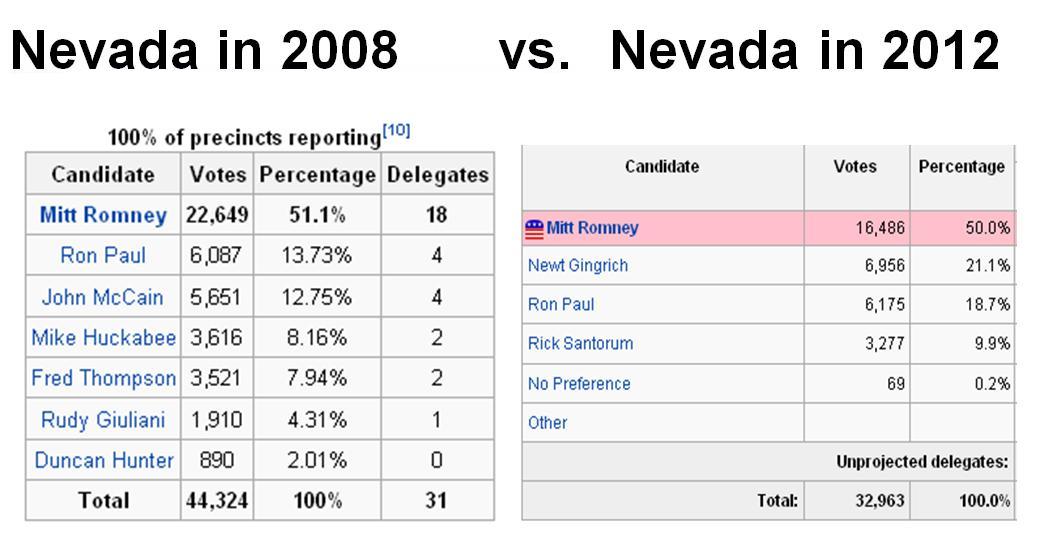
First the result, from AP via Google: Romney 50%, Gingrich 21%, Paul 19%, and Santorum 10%. Turnout little short of 33,000 voters.
What does that mean? According to Michael O’Brian writing on MSNBC/NBC, “Saturday’s caucus reflect an instance in which Romney was able to rally conservatives to his candidacy.” Chris McGreal writes for the Guardian that “Republican voters of various shades [now] latch on to Romney as the best prospect of beating Barack Obama.”
Wait a minute. Romney is the clear favourite to secure the Republican nomination, but it is not at all clear that the Nevada result suggests that conservatives are now rallying around him.
Why? Well, we could compare the 2012 results with 2008, for example—Romney 51%, Ron Paul 14%, John McCain 13% and the rest sharing the remaining 22%. Turnout? More than 44,000 voters. (The difference is clear from my highly sophisticated combo of the Wikipedia pages on 2008 and 2012 below, an example of the power of what Larry Lessig calls “remix culture“…)
In other words, Romney, the candidate that Republicans are now supposedly “rallying” around, and who came into Nevada with considerable momentum, who has a clear organizational and financial advantage, and who faced very little serious resistance on the ground as his rivals had given up the state in advance, got more votes in 2008 than in 2012. And not just a little– he got about a third more votes back then if you look at the absolute numbers. (16,486 in 2012, versus 22,649 in 2008.)
There are no doubt many reasons for this result that I won’t comment on here. But one thing I would venture to say is that it suggests that the Republican base is yet to accept Romney as their man. His campaign continues to have to fight on two fronts at the same time–making a broad-based appeal to the American people with an eye to the November general election while convincing the (diverse) conservative core of the Republican Party that they should support him too.
I’m no expert on Indian newspaper journalism, but for the last two weeks, I’ve been an avid reader of the country’s English language press and have thoroughly enjoyed my fleeting encounters with the Times of India, the Hindu, the Deccan Chronicle, the New Indian Express and several other titles.
There are plenty of things to worry about when it comes to the status of newspaper journalism in India, even as the industry in contrast to its peers in many Western countries is enjoying rapid growth in circulation and revenues—problems include the proliferation of paid coverage not only of commercial ventures and in reviews, but also in politics (“no money, no news”), various fights between the editorial and the commercial side, plus the frequent harassment of journalists by local authorities, political activists, criminals, and sometimes the military or the police.
All this is so interesting partially because the substance matter is so serious, so clearly worth ones’ time. (On my return I found by contrast that the London Times had seen fit to write an editorial about Prime Minister Cameron’s decision to, while on holiday, wear black shoes without socks. The Times editorial writer thought one should always wear socks when wearing shoes, though conceded that one could be forgiven for wearing flips flops or even loafers without socks. Riveting stuff, really.) The 2G scam, for example, is estimated is estimated by some to have cost the Indian state almost $40 billion in lost revenue.
This kind of stuff matters, and even without independent investigative work, simply reporting the work of judicial investigators, non-profits and others looking into this, and how elected officials talk about it is important and commands attention. Even as a complete outsider, on many days, I’d find as much of interest in the daily edition of a 24-page newspaper sold for 3 or 4 Rupees (about 5 pence) as I usually do in the UK in daily newspapers often approaching a hundred pages all included and sold for a pound.
The journalists and editors who write all this surely face many challenges as their industry and profession develops alongside so many other changes in India—let me just say I enjoyed my brief brush with their work and wish them and all their colleagues working in broadcasting, online, as well as in Hindi and numerous other vernacular languages well.