Changing Business of Journalism and its Implications for Democracy – new co-edited book out

Today we release The Changing Business of Journalism and its Implications for Democracy, a new book David Levy and I have edited. It’s been rushed to publication to address the timely issue of how the commercial media organizations who have for much of the twentieth century dominated news-provision in much of the world are changing, and what it means for our democracies.

There’s already been a bit of advance publicity on the Guardian (which didn’t get it quite right, I have to say, but of course, we are happy with the publicity) and on Journalism.co.uk and the Press Gazette, both of whom did good summaries.

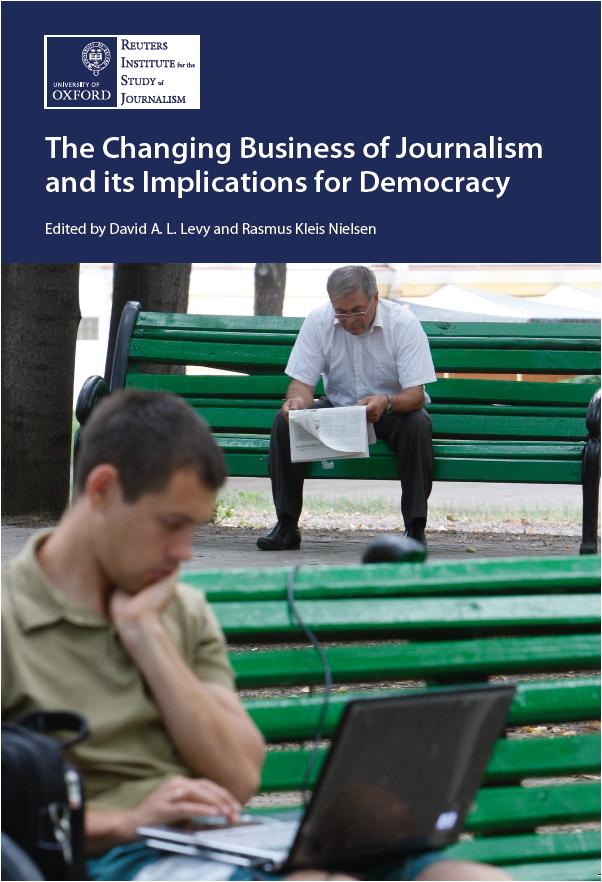
Here is the pretty cover…

Tonight, David, myself, and Robert Picard (one of the contributors to the volume), will speak at a launch event at Ofcom in London, and discuss the book and the main findings with George Brock (City University), Steve Hewlett (BBC/the Guardian), and Natalie Fenton (Goldsmiths, University of London) and moderator Tim Gardam (St Anne’s College, Oxford).

The Executive Summary is available here, and the book can be bought for £19.95, shipping included, here.

In addition to the chapters written by David, Robert, and myself, the book contains interesting contributions by Alice Antheaume (Sciences Po, Paris), Michael Brüggemann (University of Zürich), Frank Esser (University of Zürich), John Lloyd (University of Oxford), Hannu Nieminen (University of Helsinki),  Mauro Porto (Tulane University), Michael Schudson (Columbia University), Daya Kishan Thussu (University of Westminster), and Sacha Wunsch-Vincent (World Intellectual Property Organisation and formerly OECD).

Nicholas Lemann and Paolo Mancini have provided the advance praise, which almost makes me blush…

The Changing Business of Journalism and its Implications for Democracy, as the only rigorous global survey of a situation usually discussed on the basis of anecdote and unproved assertion, is an indispensable and necessary work. It ought to open the way for real progress in reinventing journalism.

Nicholas Lemann, Dean and Henry R. Luce Professor at the Columbia University Graduate School of Journalism

This is a very detailed and rich analysis of the structural changes in today’s business of journalism: the media in many countries face a deep crisis caused both by new technologies and more general economic circumstances while in others they are experiencing rapid growth. In both cases the entire structure of the field is undergoing a dramatic change in terms of professional practice and in how media are organized and run. This book represents an indispensable tool for all those who want to understand where journalism and democracy are going today.

Paolo Mancini, Professor at Università di Perugia and co-author of Comparing Media Systems (Cambridge, 2004).

The full table of content looks as follows:

Contents

Executive summary

1. The Changing Business of Journalism and its
Implications for Democracy
Rasmus Kleis Nielsen and David A. L. Levy

2. A Business Perspective on Challenges Facing Journalism
Robert G. Picard

3. Online News: Recent Developments, New Business
Models and Future Prospects
Sacha Wunsch-Vincent

4. The Strategic Crisis of German Newspapers
Frank Esser and Michael Brüggemann

5. The Unravelling Finnish Media Policy Consensus?
Hannu Nieminen

6. The French Press and its Enduring Institutional Crisis
Alice Antheaume

7. The Press We Destroy
John Lloyd

8. News in Crisis in the United States: Panic – And Beyond
Michael Schudson

9. The Changing Landscape of Brazil’s News Media
Mauro P. Porto

10. The Business of ‘Bollywoodized’ Journalism
Daya Kishan Thussu

11. Which Way for the Business of Journalism?
Rasmus Kleis Nielsen and David A. L. Levy

Twitter in the Midterms

Whereas virtually all candidates involved in competitive races for the House of Representatives in this year’s midterm elections were on Facebook (see previous post), Twitter use was lower, as one would expect from a newer and less widely-used platform. On November 2, 110 out of 112 Republicans running in competitive districts were on Twitter, 92 out of 112 Democrats.

Many candidates on Twitter are met with deafening indifference. The median number of followers of Republican candidates is 494, of Democrats, just 255. On Election Day, 19 out of the 92 Democrats and 2 out of 110 Republicans using this tool belonged to the estimated 97% of Twitter users who have less than a 100 followers. Ten-term incumbent Rep. Earl Pomeroy (D-ND) had 6 followers on the night he lost his seat to State Rep. Rick Berg. By comparison, President Barack Obama had almost 6 million Twitter followers in early November 2001, and former Alaska Governor Sarah Palin about 300,000. If we want to understand the use of Twitter in politics, we have to focus on the median candidates and the Earl Pomeroys of this world, and not only on successful outliers like Obama and Palin.

The figure below shows the distribution of Twitter followers, from data Cristian Vaccari and I have collected (see note below on the sample of districts).

As with Facebook supporters, the curve is steep—on Election Day, Jesse Kelly (R-AZ) had 13,726 followers, 11% of all the Republican followers, and Alan Grayson (D-FL) had 11,573 followers, 21% of all the Democratic followers in the dataset. (Both lost, incidentally). Grayson is no shock here, but in the light of her extraordinary Facebook support (139,203 on November 2) I was surprised to see Michele Bachmann a distant third amongst the Republicans, with 8988 followers.

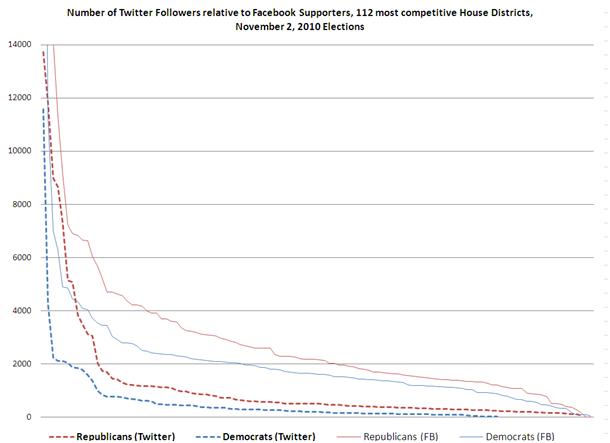
The next figure compares the Twitter following (dotted lines) with Facebook supporters (thin solid lines) for the two parties. (It’s cropped to leave out numbers over 14,000, which means that three Republicans’ and one Democrat’s Facebook support does not appear here.)

Unsurprisingly, the numbers for Twitter are generally lower than those for Facebook (though some individual candidates, like the above-mentioned Jesse Kelly, have more Twitter followers than Facebook supporters). The Republican average is 1186, the median, as said, 494. For the Democrats, the average is 600, the median 255. The Facebook numbers are, by comparison, 4223 (Republican average), 2156 (Republican median), 2149 (Democratic average), 1609 (Democratic median).

I think these figures document the limited reach of most politicians’ use of Twitter, which is an important point to keep in mind in discussions of social media’s role in politics—this should not, however, be taken to mean that this microblogging platform is politically irrelevant as such. First, as noted from the outset, there are a few politicians who have build very considerable Twitter followings. Secondly, much politics does not directly involve politicians, but simply citizens talking and acting together, and tools like Twitter and Facebook have a role in that too, though it is a role not considered here in this post.

Note: The data comes from major party candidates running in any of the 112 districts rated as lean Republican, tossup, or lean Democrat by either the New York Times, the Congressional Quarterly, Cook, or Real Clear Politics in August, 2010.

Do people “like” candidates on Facebook? Not really.

Virtually all candidates involved in competitive races in the 2010 midterm elections in the US used Facebook. Together with my colleague Cristian Vaccari from the University of Bologna, I have collected data on the number of supporters of each Democratic and Republican candidate for the House of Representatives in the 112 most competitive districts (see end for sample).

The numbers are quite interesting, even at a first glance. The figure below shows the distribution of the number of Facebook supporters on November 2 of all the candidates we coded (222 out of 224 had profiles).

The first striking thing is how skewed the distribution of Facebook supporters is in both parties. Michele Bachmann (R-MN) and Alan Grayson (D-FL) are clear outliers, with 139,203 and 30,807 Facebook supporters on Election Day, respectively. Compare this with the average number of supporters for each party, 4223 for Republicans, and 2149 for Democrats. Bachmann, one out of a hundred and ten Republican candidates on Facebook, had a massive 29% of all the Republican Facebook supporters in the sample. Grayson, one out of a hundred and twelve Democrats, had 13% of all the supporters.

The second striking thing is how relatively few supporters most candidates have, in absolute numbers. The median number of Facebook supporters for a Republican running in 2010 in one of these 112 competitive districts was 2156, 1609 for a Democrat. This should be seen in light of the on average about 700,000 people who live in each congressional district.

Politicians like Bachmann and Grayson can leverage their very considerable online following both in terms of votes, attention, and money (Bachmann won re-election, Grayson did not—both raised significant sums online). But the vast majority of candidates—even looking only at the most competitive districts—had a much more limited reach on social networks this election cycle.

The data we have gathered thus runs counter to the frequently discussed notion that Facebook and the like is widely used for “direct communication” between candidates and voters (see for instance this recent report).  In a sense, this is not surprising. Social media are based on people opting in, and most Americans do not care very much about electoral politics (and do not care much for most electoral politicians).

This needs to be taken into consideration both by those of us trying to understand the implications new information and communications technologies have for politics, and by those trying to use them.

Note: We included in the sample all congressional districts rated as lean Republican, tossup, or lean Democrat by the New York Times, the Congressional Quarterly, Cook, or Real Clear Politics in August, 2010. This comes to 112 districts.

Good reads 10 31 10

The Investigative Reporting Workshop published some of their work on the “new journalism ecology” emerging in the United States this weekend.

Check out:

(1) Charles Lewis’ lead article,

(2) their continually updated database, and

(3) his still relevant piece from 2007 in Columbia Journalism Review.

They are full of useful information on the”flowering of nonprofit news organizations” across the U.S. as new start-ups try to build sustainable forms of public interest journalism online and offline, beyond the legacy media businesses of the past–contributions to a new media environment that remain firmly rooted in some of the best of what the journalistic tradition has to offer, while trying to move beyond the mass-media/bureaucratic organizational forms that are in crisis in many  countries, and face challenges in all.

The journalists involved are few, compared to the net loss of about 20,000 newsroom jobs over the last fifteen years, but these initiatives are encouraging, important, and interesting nonetheless.

The Problem with the notion of “Digital Activism”

Malcolm Gladwell’s recent, pithy, and much-discussed provocative piece “Small Change” in the New Yorker adds another voice to the growing choir of people basically arguing that new information and communication technologies like social media hold little promise for activism.

The main problem with Gladwell’s argument, as I see it, is that he in his haste to dismiss all notions of radical change ends up accepting the sharp and simplistic dichotomy between (supposedly proper, serious, and dignified) offline activism and (one is to understand, ineffective, frivolous, and slightly silly) digital activism.

This is a simple inversion of the very rhetoric he seems interested in countering, and as technologically determinist as the most deluded cyber-evangelist. Instead of offering a distinction between effective technologically-empowered digital activism and ineffective old-fashioned analogue activism, Gladwell is simply arguing that the optimists got it wrong, digital activism is what is ineffective, analogue activism what works.

But what if the central intellectual problem here is not whether digital or analogue activism is more effective, but the very terms of this debate? I’d suggest that we need to move beyond this distinction between old school analogue activism and “digital activism,” stop labelling things on the basis of the presence or absence of a single set of tools. (Would anyone in their right mind try to reduce the French revolution to an instance of “coffee house” or “print activism”? Both cafes and gazettes were integral to the revolution, but hardly its master traits.)

We need to understand that media and communications technologies and tools are important parts of activism, without sliding into thinking they are the only, or even the most important, parts of activism. This is what I have, perhaps too glibly, called “digital politics as usual” (see my contribution to this book and my forthcoming article on the role of mundane internet tools in political campaigns)–a situation where activism is still first and foremost activism, and needs to be understood as such, but where digital tools begin to supplement and sometimes supplant other tools used for collective action.

I’d suggest simply that we should think of activism as a practice—and then evaluate to what extend individual acts of activism are more or less assisted by a range of different tools and technologies, some digital, some not, and assess what the implications are, not only in terms of effect, but also in terms of democracy, equality, sustainability, etc, and then try to determine what kinds of opportunities specific communications environments afford activists.

Sasha Constanza-Chock put it best in one of the many email exchanges sparked by Gladwell’s article, and I’m sure he won’t mind that I quote his recommendation: “Start from the social movement, then ask ‘how is this movement using ICTs, from old to new, to achieve its goals?’” Amen.

Good reads 09 30 10

I’m about ready to do the second round of coding of Democratic and Republican web campaigning with my colleague Cristian Vaccari, so I’ve enjoyed a couple of pieces recently on the perennial question: who’s ahead online?

1. Tea Party vs. Netroots

Micah Sifry at TechPresident has a nuanced analysis of both the active and the latent base of the left and the right in the U.S.

2. The ever-changing Christine O’Donnell

Right-wing Republican Delaware Senate candidate Christine O’Donnell has been interesting to watch online, partially because she has had a lot of success with very simple tools (a pet point of mine), partially because her web presence is constantly changing.

3. You got it wrong.

David Karpf has provided good ongoing critical commentary of the press coverage in the area.

Paywalls and online news provision

Earlier today, I was, with Leif Beck Fallesen (from Borsen) and Jens Nicolaisen (from Jyllands Posten), part of a discussion of paywalls and online news provision on the Danish radio program Mennesker og Medier, one of my favourite forums for media commentary and conversation.

I’m not going to try to summarize the points made by Fallesen and Nicolaisen, but just recommend the program to those who understand Danish. I was particularly struck by Fallesen, who compared contemporary experiments with various forms of online payments to soldiers rushing out of their trenches during the first world war—a few will emerge as heroes, but most will perish. I have these images in my mind now of salt-and-pepper haired, slightly overweight media executives in suits and ties being gunned down in the mud of Flanders—it is not a pretty sight, I assure you.

I focused on two basic points during our conversation.

1) Do experiments with paywalls suggest the end of free content? No.

Contrary to the scenario suggested by Chris Anderson from Wired, I don’t believe that the largely free flow of news on the web as we know it is dead and about to be replaced wholesale by services paid for by subscription or fees. Free and paid content will continue to coexist. I offered three reasons that pertains to news specifically:

First, as long as just some of the many, many players competing for people’s time and attention remain wedded to the idea of offering content free of charge online (as radio and television channels have long done offline, and freesheets more recently have done in print), it will require high degrees of editorial differentiation to convince people to pay for precisely your product and not simply go for the free alternative. This is doable for unique and high-value content such as the business coverage provided by newspapers like Borsen (a local Danish parallel to the Wall Street Journal or the Financial Times) and for a quality cable entertainment channel like HBO, but hard for general interest news organizations like Jyllands Posten.

Second, even if the problem of competition was momentarily bracketed out and an entire industry did start charging at the same time, the incentive for any one player to break the covenant and go free to maximize traffic and live of the advertising revenue will be immense—pace what social scientists call collective action problems. (And that is without even factoring in anti-trust regulation). Alan Rusbridger’s strategy of mutualisation at the Guardian no doubt has much to do with a genuine, normative commitment to open and collaborative forms of news production, but he clearly also sees the business potential in remaining free when others start charging.

Third, in most of Europe, commercial news organizations considering paywalls aren’t only competing with each other, with user-generated content (think of those adorable puppies on YouTube, and all those interesting blogs), and with all the other temptations that lurk online and offline for your time and attention. They are also competing with public service media organizations that are likely to continue to offer comparable content for free through a number of online services. So even in countries where the competition amongst commercial operators is perhaps less fierce than in, say, the UK, the presence of public service players complicates moves towards pay models.

In short: Free was here before the internet and the web, free is here now, and free will be here tomorrow. Free is not for everyone and everything, but free is here to stay. I’m tempted to say simply “deal with it,” but I don’t want to suggest I’m entirely insensitive to the business challenges and human costs of the current convulsions, so I won’t put it quite like that.

2) What will replace old business models? Ask Clay Shirky

Much of the conversation circles around how news organizations can generate “enough” revenue to maintain their current level of operations, how they can “replace” what is being lost. Clay Shirky would say that “nothing” will replace what we have known in the past. I don’t know quite what “enough” means here (commercial media in different countries have existed for decades with wildly different levels of income, advertising revenues per capita in Southern Europe, for examples are much lower than those in Northern Europe—and yet they have media there too.). I don’t think replacement is what we should be looking for, as much as innovation, progress, experimentation.

Nicolaisen used the metaphor of a “mosaic” to explain his approach to building online business for Jyllands Posten, and I think this image of a radically diversified media organization is very fitting. Fallesen is in a different position, as the editor and CEO of a niche product he can continue to focus on serving his (relatively limited and clearly defined) targeted audience. Both of their companies, a mass market newspaper moving towards a future role as a multimedia organization servicing different needs for a range of different audiences, and a niche newspaper moving towards servicing their niche audience across a wide range of platforms are in a different position from where a large broadcaster would be, in particular a public service media organization.

But the general trajectory suggests a further reason to give up many of our inherited notions and the tendency to discuss what will be in terms of what has been: in much of the post-industrialized world, we’ve grown up with media systems where many different people got news in fairly comparable and standardized ways, read similar newspapers, listened to the same radio programmes, and saw (some) of the same stuff on television. Not quite the undifferentiated mass society of early twentieth-century sociology, but with elements of it. We sometimes forget that that is a historical anomaly—the farmer and the merchant did not get their news the same way in 1850, and even if they did in 1950, they probably won’t in 2050. As many scholars have argued, the mass audience may be coming to an end as we move towards a more segmented media landscape, with potentially profound consequences for our democracies.

Good reads – 09 08 10

A few pieces on the internet and where it is heading, from August and the distant past of 2008.

1. The Web is Dead. Sorta.

Chris Anderson and Michael Wolff from Wired says “The Web is Dead, Long Live the Internet“, only the argument is more nuanced than the cheeky title, and about how corporate strategies and consumer preferences may change the web, or at least reduce it to a smaller part of a larger internet-enabled online environment with more emphasis on walled gardens, applications, and members-only material.

2. No, it is not, it just got company.

Rob Beschizza from Boing Boing calls Anderson and Wolff on some dodgy visual rhetoric in their data illustration of how the web is “dying” when in fact it is more accurate to say its share of a vastly expanded internet is shrinking in relative terms. Alexis Madrigal from The Atlantic protests that technologies rarely replace each other quite like that (though in fairness that thought is more pronounced in Anderson and Wolff’s title than in the actual argument).

3. Back to Berkman.

Lurking behind it all is Jonathan Zittrain’s insightful book about The Future of the Internet – And How to Stop It, well worth reading even for people with little interest in technology per se.

Local newspapers, community news sites, and how they are doing

Local newspapers have long played a particular role in our communications environment as one of the few sources of routine coverage of local public affairs. In many countries, they seem hard-pressed by the combination of advertisement revenue migrating online and the general impact of the recession. This has led some, like Paul Starr, to worry about the future of local coverage and the consequences for our democracies, as alternatives are few and far between, in particular in countries where public service media organizations either are weak or don’t focus much on local news. What sort of behavior can we expect from city councils, regional developers, and the like if they come to think no one is paying any attention to what they are doing?

A few things have happened recently to complicate but perhaps also brighten the picture.

First, a number of critics have pointed out that local newspapers aren’t always all that great when it comes to providing timely information about local affairs and keeping an eye on people in positions of power (take for example Roy Greenslade and George Monbiot, both writing at the British Guardian). More lapdogs than watchdogs, in short. This is important to keep in mind as governments consider whether the best way to revive local media is to allow for greater degrees of market concentration etc (as the British Conservative Party has suggested)—perhaps an acceptable price to pay if they make a valuable contribution to local democracy, but a fairly unattractive scenario if they do little but offer paid advertising and free editorial “advertising for authority.”

Second, the idea that their occasional lapse from the high standards some would like to hold them to is down to business problems seems less than convincing in many cases. Take for example Trinity Mirror plc, the biggest newspaper publisher in the UK (with more than two hundred local and regional titles to its name, and subject to this withering critique from Andrew Williams at Cardiff). In their 2009 Preliminary Announcement from March 2010, Trinity Mirror plc reported an operating profit of £105.4m in the annus horribilis of 2009 (from a revenue of £763.3m), and their 2010 Interim Results from July suggests they are on track to deliver something like 25% more than that in 2010 on the back of “workforce adjustments” and a resurgent demand for print advertising. Clearly a company like this is in a position to make serious investments in local newsrooms, if they see fit to do so. But right now, the priority seems to be to make do with fewer journalists.

Third, a recent study of local news in the US suggests that new alternatives to the local press should be taken very seriously indeed. While community news sites are still too few and far between to be reliably assessed in statistical terms, a team of media researchers at Michigan State University have published a report with the somewhat surprising finding that those included in their sample actually sourced their stories more than either daily or weekly local newspapers. Sites like these are not reducible to either solitary bloggers, the lionized “citizen journalists” of early discussions of online media, or simple extensions of earlier forms of professional journalism onto the internet, but represent a new form of content generation operating across distinctions between individual and group work, professionals and amateurs, and have much to offer our communications environment in general, and coverage of local affairs in particular.

All this is important for three reasons: First, if local newspapers rarely are all they are made up to be, community news sites can offer a welcome alternative, supplement, and standard-setting competitor. Secondly, it is very likely that the lay-offs at local print operations will continue for some time in many countries, as part of a greater market readjustment to leaner commercial news media organizations, and thus those local media who have little record of standing up to local power elites are unlikely to build the capacity to do so. Thirdly, community news sites may have many advantages over local newspapers when it comes to enhancing our communications environment—they operate on platforms that afford more participation and collaboration, easier sharing and commentary, are smaller and cheaper operations to run, even when they include some paid staff and professional writers/moderators, and are generally less dependent on large local advertisers (even if often at least partially funded by charities who may not be in for the long run, and perhaps, pace their very lean operation, also more vulnerable to outside pressure in the form of lawsuits etc. There are also questions of what the critical mass of community interest is for sustaining something like this, and whether there is something in particular that drives these enterprises in the US vs. other countries).

Here, then, is to the entrepreneurs out there working hard to build vibrant community news sites covering public affairs. They may well be our best hope to good local news.

Good reads – 08 13 10

1. Net neutrality

Google and Verizon’s publication of a joint policy proposal on internet regulation has sparked quite a debate. A few picks from a big discussion: Siva Vaidhyanathan on MSNCB reminding us that Google is a self-interested company, it doesn’t work for us, WSJ reporting about Facebook’s criticism of the idea that cellular networks should not be subject to rules requiring equal treatment of all traffic, FreePress calling it a “corporate takeover of the internet,” Susan Crawford and Lawrence Lessig reminding President Obama that candidate Obama promised to support net neutrality.

2. (more) PR-journos matching

In less momentous news: as if there weren’t enough connections and plenty of PR already, the NYT reports that a new startup wants to match up businesses and organizations with journalists working on topical articles.

3. AdAge on the relatively slow marketing uptake of the iPad

According to this article, big brand advertisers are being slow (and measured) in their embrace of the iPad, wanting higher penetration and demonstrable impact before they commit. Perhaps news organizations should take notice of this before they convince themselves this is the gadget to save them.