Category Archives: Uncategorized

Maybe the internet didn’t kill the newspaper

A rather poor summary of a presentation called “Beyond Determinism” that I gave at Westminster earlier this month on behalf of myself and David Levy have led to some misunderstandings.

Here is a better summary, from the Reuters Institute website:

Is the internet killing newspapers? On June 8, RISJ Postdoctoral Research Fellow Rasmus Kleis Nielsen presented preliminary research conducted with David Levy that suggests otherwise at a conference at the University of Westminster in London.

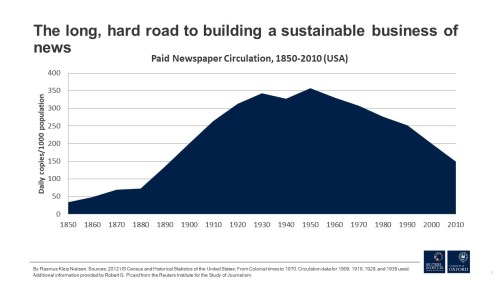
Comparing developments in the newspaper industry in the US, France, and Finland from 1998 to 2007, the two authors suggest that while the newspaper industry is clearly in decline in many developed countries today, the decline often started well before the advent of the internet, plays out very differently in different national contexts, and is—with the partial exception problems directly related to the recession—slow and gradual enough to offer most legacy news media organizations time and resources for a managed transition to a smaller but still central role in a new communications environment.

Clearly the newspaper industry face a structural adjustment today. Equally clearly, it still retains a large and loyal core readership and generates enormous revenue (though relatively speaking smaller than in the 1970s-1990s in many countries), and it is hard to imagine that commercial media organizations will simply leave the money on the table and walk away from news provision partially based on a print platform.

Good reads – 06 28 10

1. Jay Rosen (and more) on what the Rolling Stone McChrystal story says about journalists and sources

Rosen (taking a lead from Andrew Sullivan at the Atlantic) rightly pounced on this passage from a Politico story: “as a freelance reporter, Hastings [who did the interview and article that lead to the General's ousting] would be considered a bigger risk to be given unfettered access, compared with a beat reporter, who would not risk burning bridges by publishing many of McChrystal’s remarks.”

Politico in turn removed the paragraph from the online story, resulting in further debate and this summary on their own site.

The combination of the malleability of digital publishing and the ease of copying and commentating is one interest dimension of this whole episode, the other is how it confirms every textbook media research finding about the relations between (regular) reporters and officials.

2. Frédéric Filloux on the pending sale of Le Monde

Nice overview here for those of us who haven’t followed it closely, dealing both with the business situation itself and the larger question of what Le Monde’s project is/should be today.

3. Alan Mutter on newspaper economics

Mutter is sobering and interesting as always, pointing out that newspapers in the U.S. have had a hard time capitalizing on the economic recovery so far, with further declines in print advertisement and newspapers’ online advertisements growing more slowly than the sector as a whole.

Good reads – 06 22 10

1. BBC on broadband regulation in the US

BBC News had a short piece on the policy battles surrounding broadband regulation in the US, with many of the key players in place, the Federal Communications Commission and the courts, of course, but also telecom providers like ATT&T and Verizon versus internet companies like Goolge and Amazon, all arguing their side of the net neutality issue. Precious few citizen groups quoted in this debate, I have to say.

“It’s a tough road ahead and the telcos are going to fight this to the death,” [Public Knowledge] communications director Art Brodsky told BBC News. “AT&T in the first quarter of this year spent $6m on lobbying. That is one company. One quarter. Compare that to Google which spent $4m in the whole of last year.”"

In this article, the carriers/teleco’s got more for their lobbying/PR money–at least, the last third of the  story is spent on a report that argues “that a 10% reduction in investment by broadband providers would cost more than 500,000 jobs before 2015″ (funny they should scare lawmakers with jobs of all things, during a recession)–without wondering if perhaps a move away from net neutrality and common carrier provisions might also cost jobs by undermining what Jonathan Zittrain calls the “generative internet”.

2. Financial Times notes that Google could undermine Demand Media’s model

Lots of people are writing about the potential conflicts between the business model of legacy content creators (news organizations) and search companies like Google, now it looks the internet giant is also in potential tension with new content creators (Demand Media, Associated Content-type players).

The FT has this, for example: “a recently granted patent to Google that appears to replicate one part of what has made Demand’s approach to content so successful could spoil the party. Google’s patent on “identifying inadequate content”, co-authored by some of the search group’s leading thinkers, including Hal Varian its chief economist, details a similar system that analyses search engine queries to spot topics of high interest which are not readily available from publishers.”

A week in the news about the news

Little more than a week ago, I emailed two Danish journalists I know about this report from the OECD, on “The Evolution of News and the Internet.” I had seen it in draft form, knew it was about to be declassified, and thought it represented an interesting empirical challenge to the doom-and-gloom rhetoric that dominates many discussions of the news industry today.

Read the report, it is interesting, I promise.

One of the journalists did, and on Wednesday morning, with the OECD report published, this article appeared in the Danish morning broadsheet Politiken.

The people who produce this newscast on DR2 (public service television) clearly still read newspapers, and contacted me for a segment on the report for their show the same evening, so I stayed till late in the office and appeared via Skype.

The morning after, this digest was published on the business portal of another newspaper, Jyllandsposten (provided by a news service called MediaWatch). It is a fine little summary of two previous summaries that manages to transform the male author of the OECD report, Sacha Wunsch-Vincent, into a woman and conjure a “quote” from me–without ever actually speaking to me–by combining parts of what Lea Korsgaard, the journalist at Politiken, had written the day before, with parts of what she had quoted from our conversation.

Good reads – 06 14 10

1. Alan Mutter

Alan Mutter has a post noting how Yahoo may be moving from partnering with local content providers (like newspapers) to competing directly with them. Mutter suggests that if they go ahead and acquire Associated Content, they do it because they want to combine local content (from Associated Content) and behavioral targeting (on the basis of Yahoo’s databases of personal information) to sell premium advertising space, in direct competition with news organizations aiming at the same market.

2. Recaps of PdF’10

I missed out on Personal Democracy Forum ’10, so I have enjoyed Scola and Napolitano‘s digests.

3. Nicholas Lemann at Columbia Journalism School Graduation

This (opens as a .pdf) is cheating a little bit, since I actually heard it when it was delivered in mid-May, but Nicholas Lemann’s graduation address from the graduation ceremony of the Columbia Journalism school is worth looking at–in particular, his call for more journalists taking a part in the policy and business discussions that swirl around the industry right now is notable.

What can we learn about social media and politics from AR and PA?

How much is Organizing for America’s support worth when thrown behind a conservative candidate that many of the progressives who volunteered on President Obama’s campaign find politically and ideologically distasteful? And what does this say about the role of social media in politics?

In Arkansas yesterday, a coalition labor unions, progressive activists, and ideological liberals failed to topple Senator Blanche Lincoln in the Democratic Primary. Earlier this summer, a similar coalition won the Democratic Senate nomination in Pennsylvania for Joe Sestak, at Arlen Specter’s expense. In both cases, the White House, Organizing for America—the rebranded skeletal operation that remains of President Obama’s campaign organization as an appendix to the Democratic National Committee—and the rest of the party apparatus supported, both publicly and operationally, the more conservative incumbent over a more progressive challenger, for fairly transparent tactical reasons (Don’t make no waves, don’t back no losers. Or at least not two losers, in this case).

My friend and colleague Dave Karpf and many others have offered their take on the strategic implications. I will write here about the practical, on-the-ground implications. A presidential endorsement is about money and PR, support from the party machinery is about money, expertise, and strong-arming local interest groups not to back your rivals—but OFA’s support is supposed to be about small-dollar donations and volunteer labor, leveraged via various web platforms.

The question is whether Organizing for America can actually deliver that if the minority on the 13-million strong email list it inherited from Obama for America who might want to volunteer when less is at stake politically than taking back the White House find the candidate they are asked to support unappealing.

I have not seen any numbers on how many calls and knocks were channeled into Arkansas and Pennsylvania through Organizing for America, but I would be surprised if it can compete with what activist groups and interest groups who asked their members to support candidates who might actually fight for their ideals and interests produced—the NYTimes reports that the unions that backed Bill Halter against Lincoln in Arkansas knocked on 170,000 doors and made 700,000 calls. I would like to see numbers from Organizing for America, since it excelled at generating such personal contacts in 2008, and will be tasked with doing so again during the 2010 mid-terms and in 2012.

If state-level progressive blogs are anything to go by, it wouldn’t be much. The Arkansas Project did not warm to the endorsement—witness the title “‘Organizing for America’ continues to be ridiculous.” The analysis from the Pennsylvania Progressive is analogous—“The Obama Movement effectively backed Sestak or stayed home for the most part. Obama cannot take the Obama Movement down paths outside their core values.”

So if my intuition is right, and Organizing for America could not offer much in terms of on-the-ground support for Lincoln and Specter, that is not because the kind of social media-augmented form of organizing its predecessor, Obama for America, represented has lost its potency—it is just that it is hard to control. This is because social media are social first, and tools next. They help people pursue their interest in getting engaged in something, whether that is gossip or politics, but they will disengage when they no longer care—and the people who were willing to get engaged in supporting Obama, and found ways to do so because his campaign engaged them through old-school organizing and clever use of social media, probably weren’t all that interested in supporting Lincoln and Specter, so they stayed home, or backed the other candidate. To make social media work in politics, in short, people have to care.

(cross-posted on TechPresident)

Good reads – 06 07 10

1. PricewaterhouseCoopers’ Newspaper Outlook 2009, “Moving into multiple business models”

An interesting overview of business outlooks based on surveys, interviews, and secondary sources from Canada, France, Germany, the Netherlands, Switzerland, the UK, and the USA. Fairly bullish about the future of the industry–”Newspapers have a long-term future and will coexist with other media.”–and explicitly points out that the troubles in the US newspaper industry may have as much to do with mergers and acquisitions as with the internet–”The credit crisis has greatly imperiled many US publishers who took on large amounts of debt to make recent acquisitions.” A lot of the suggestions they make will restructure much of the daily work in news organizations, and will, in some countries, require renegotiations of contracts and cooperation with various unions.

2. Raffi Khatchadourian’s piece on WikiLeaks in the New Yorker

I knew only little about Wikileaks before reading this (and now know only marginally more…), but I thought it was a pretty interesting piece, introducing not only the site itself, some of the issues it has been involved in, and some of the main activists driving it, but also more broadly gives a sense of its operations, plugged in as it is with left-leaning and libertarian politicians, businessmen, and technologists, international differences in privacy and transparency legislation, and a combination of off-the-shelf tools and hand-crafted technologies.

3. Peter Kafka’s notes on Richard Rosenblatt and Paul Steiger at D8, talking about Demand Media and ProPublica

Below two exchanges cribbed from the Q&A,

Question for Rosenblatt: Why won’t you call your people “journalists”? Steve Jobs was full of venom for “bloggers,” too. Why not call people who write for money “journalists”?

Rosenblatt: If our writers want to call themselves journalists, great. But they’re not doing reporting from Afghanistan. We’re content creators, making things that people want.

Question for Steiger: Do you share Steve Jobs’s distaste for bloggers?

Steiger: I sleep with a blogger!

Digital Activism book out

Mary Joyce from meta activism has done yeoman’s work putting together an exciting new edited volume on digital activism.

The contributors include activists, academics, policy people–you name it. Including yours truly.

The book is available here for download, and here in print form.

Upcoming presentation on mobilizing practices at CUNY

On Thursday the 25th, I’ll present some work-in-progress on mobilizing practices in American campaigns from my dissertation at the “Politics and Protest” workshop at CUNY. It’s 4.15 till 6.15 p.m. at the CUNY Graduate Center building on 5th Avenue, on the 6th floor.

Article on letters to the editor out

Does it seem hopelessly old-fashioned to care about letters to the editor? Maybe, but I’m not alone in doing so. The Democratic National Committee are asking people to write after Michael Steele’s comment that “a million dollars is not a lot of money.” Maybe not for you, Mr. Steele, maybe not for you…

Such initiatives rely on the existence of something I call the “letters institution”, a small aspect of the larger news institution though which newspapers make it possible for a few citizens to raise their voice and express themselves in public with a larger audience than most bloggers and tweeters have.

I think letters to the editor are interesting for much the same reason I find both new media technologies and old organizations like political campaigns interesting-they constitute a way in which people can take (a small) part in politics.

Anyway, I wrote an article about letters to the editor and the letters institution as it operates in Danish newspapers a while ago. It is now out in Journalism.

Abstract et al is below (thanks to Michael Schudson, Anker Brink Lund, and Lucas Graves for their helpful comments on earlier versions).

Continue reading