Category Archives: Uncategorized

Activism vs. Slacktivism recap

Back in March, I made a guest appearance via a recorded presentation at a debate on “Activism vs. Slacktivism” organized by Fairsay.

The videos from the debate are up now, including my own aesthetically-challenged home-recorded contribution.

I thought the discussion was quite encouraging, partially because the cyber-optimism vs. cyber-pessimism polemic that seems to generate so much heat but relatively little light was largely absent, and partially because this absence did not equate a dearth of self-criticism and meaningful disagreement amongst these practitioners and observers of internet-assisted activism.

There are dozens of valuable nuggets scattered throughout the videos, from Naomi McAuliffe from Amnesty talking about how the organization has used Shell’s own social media marketing strategy against them to raise some pertinent questions about their business practices, over Eric Lee from Labourstart.org discussing how a company had left one union he had worked with flat-footed when it actually responded to an email-writing campaign by sending back a rebuttal it took the union weeks to respond to, and to basically every one of the speakers underlining the basic point that digital tools are precisely that—tools.

Tools are integral to what we do, and shape what we can do and how easily, and encourage us to see the world and our place in it in certain ways. They are important, worthy of careful attention, and each should be considered in its own terms—not all uses of technology equals inconsequential “clicktivism”, nor does the use of this or that new app or gadget magically propel one towards the promised land, and all effective acts of technologically augmented activism have to start from the first principles of activism—what do you want to achieve, who do hope to mobilize, what can you—together—do to change the world?
Good reads – 03 31 11 (NYT/Times paywalls)

Catching up on a couple of necessary reads on paywalls

1. Ken Doctor on the economics of what he calls the “pay fence” at the New York Times, which has adopted a carefully claibrated “metered approach” where people will only pay after a certain period and can find content in many ways that circumvent the fence/wall.

2. Alan Mutter on the same issue, cautiously suggesting the NYT content may be strong enough to make the wall work, but also warning that that does not mean that media outlets with less unique and compelling content–specifically other newspapers–can succeed.

3. Frédéric Filloux is considerably less sanguine, arguing that “The New York Times paywall is like the French tax system: expensive, utterly complicated, disconnected from the reality and designed to be bypassed.”

In all this mixed with some travelling with little web access, I almost missed the release of new figures from News International on the number of paying subscribers to the London Times website and tablet versions–journalism.co.uk has the numbers, Roy Greenslade a dose of skepticism.

Mundane internet tools and political mobilization

For some time, I’ve been developing the argument that when we want to understand the role of internet technologies in politics—in particular when it comes to getting people involved in electoral campaigns, in various forms of activism, and in other forms of civic and political activity—we should focus less on the newest and most heavily hyped tool of the moment (Twitter election! Twitter revolution!) and pay more attention to the role of what I call “mundane internet tools” like email, search, and ordinary websites.

New Media & Society has published the article where I make the argument, based on ethnographic research I did during the 2008 U.S. elections, but based on intuitions and interests aroused by previous research in the 2007 U.S. presidential primaries (published by the Journal of Information Technology & Politics here).

The abstract runs as follows:

The internet’s potential for political mobilization has been highlighted for more than a decade, but we know little about what particular kinds of information and communication technologies are most important when it comes to getting people involved in politics and about what this means for the active exercise of engaged citizenship. On the basis of ethnographic research in two congressional campaigns in the USA, I will argue that specific mundane internet tools (like email) are much more deeply integrated into mobilizing practices today than emerging tools (like social networking sites) and specialized tools (like campaign websites). Campaigns’ reliance on mundane internet tools challenges the prevalent idea that sophisticated ‘hypermedia’ turn people into ‘managed citizens’. Instead, I suggest we theorize internet-assisted activism as a process for the coproduction of citizenship and recognize how dependent even well-funded political organizations are on the wider built communications environment and today’s relatively open internet.

The notion of “mundane internet tools” is part of an empirical and relational typology distinguishing between mundane, emerging, and specialized internet tools—these are not properties of the tools themselves, but of patterns of use and degrees of familiarity, which of course change over time, between places, and across social groups. Tools are not causes of social actions, but parts of socio-technical action, things that help us do some things, hinder others, and are integral to how we live, act, and see ourselves—this is also how I hope people will think of the role of social networking sites and other technologies in the popular uprisings in Tunisia and Egypt, not as causes, or as irrelevant, but as tools (for protesters, though sometimes also for security forces)—in North Africa, even with a less than open internet, some of those involved in recent events certainly seemed to produce their own role as active citizens partially through the use of everyday tools and technologies.

Stressing the importance of mundane internet tools in processes of political mobilization (really one should include mobile phones in this, something I hope to research more in the future) does not mean that these tools are the most important internet technologies for all political processes (fundraising, PR, etc) let alone all social processes (online banking, open software development), or in all contexts (think ‘digital divide’).

My argument is simply that even in countries like the United States, where I did my research, which has high levels of internet access and use, and plenty of money plus professional expertise in politics, the oft-discussed “mobilizing potential” of the internet is mostly realized in practice where campaign staffers and volunteers trying to get more people to participate “meet them where they are.” People get involved in politics in many ways, amongst them via the various online (and offline!) platforms that are already part and parcel of their everyday life—whereas newfangled emerging tools and specialized platforms owned and operated by campaigns themselves in general seem to play a more modest role. Some politicians—in the U.S. most notably President Obama and Sarah Palin—have managed to leverage their high profile and charisma to generate a large community around themselves and their own profiles.

But most politicians and political campaigns still labor in the shadows of popular indifference (for instance on Twitter and even Facebook), and should not assume that people come to them—if one want them to be involved, one needs to mobilize and organize them, one at a time, on their terms, using their tools. Every elected official trying to capture the so-called “Obama effect” by purchasing this or that technological solution used by his 2008 campaign should have a sign in their office reminding them “you are not Barack Obama.” And they should never think they can become something like what he was in 2008 simply by buying some gadget—hence the suggestion they and the people who work for them—if they are genuinely committed to getting folks involved and building a movement for change—start elsewhere, try to meet people where they are, and go from there.

(cross-posted to Politics in Spires)

Good reads – 02 14 11 (on “digital feudalism” and its potentially corrosive implications)

In the wake of AOL’s $315 million acquisition of the Huffington Post (which many people have already criticized from a business point of view), quite a few media commentators are shivering at the thought of the dynamics that lead thousands (and across the web hundreds of millions) of people to generate content for free that competes for attention and advertising expenditures with what’s produced by paid professionals:

1. Here’s David Carr of the NYTimes talking about media companies build “on a nation of serfs” (that’d be you and me).

2. Athony de Rosa of Reuters, whom Carr cites, calls it “digital feudalism”.

They are having a bit of an autonomist moment, concerned about exploitation of immaterial labor by insidious networks, what a friend of mine in a nice phrase has called “loser generated content.”

I take the point (both of Carr et al and the autonomists–though I think it is rather overblown to call your average Facebook user or even HuffPo blogger a “serf” and I find the phrase “digital feudalism” hyperbolic).

From here on the debate only gets more confusing, even without getting into the discussion of whether the satisfaction that comes from sharing and expressing oneself outweighs the direct and indirect costs of becoming dependent on various “social media”–

3. Nate Silver argues that the unpaid bloggers on HuffPo don’t actually drive that much traffic, whereas Frederic Filloux in a couple of posts here and here have offered a pretty vehement criticism not only of the price AOL paid for HuffPo, but also the potentially corrosive “model” it is supposed to represent.

Heroic social science – John Keane on media and democracy today

I heard John Keane speak this Friday on “Democracy in the Age of Google, Wikileaks, and Facebook.” His talk represents a genre that divides academics—heroic social science, the attempt to synthesize findings on a range of topics from a range of fields to understand some “big” question, like the one raised by Keane that afternoon—what do changes in our communications environment mean for how we conceive of and practice democracy? Now that’s a big question if there ever was one. Try to think through what you would say in response to it, and how you would support your views, and I think you’ll agree.

Keane basically argued (further truncating what he himself constantly reminded us was a “bowdlerized” version of a much more extensive analysis) that the incipient and growing forms of “monitory democracy”—the permanent public scrutiny of power that supplements formal electoral arrangements around the globe—that he discusses in his book on The Life and Death of Democracy today have to contend with five truly new features of our life

  1. The democratization of information (as it is made more widely and easily accessible on a number of platforms)
  2. The end of privacy (as the boundary between the public and the private shifts and everything is potentially recorded and stored)
  3. A new age of muckraking as a whole host of new actors try to expose elites
  4. The flourishing of unelected representatives on- and offline
  5. The growing importance of cross-border communications and increasingly global politics

I think one can challenge him on each of these five features—whether they represent the dominant trends, whether they are new, whether there are others, and so on, and Keane did not get an easy ride—I got the sense that a third of the room was overwhelmed by all he had thrown at them, a third of the room thought there was little new in what he said, and a third of the room thought he was all wrong about something or other. Both respondents and the audience continually questioned and challenged him.

And rightly so. Keane was making important claims, and claims that he in a sense knew—and said in advance—are virtually impossible to substantiate, especially at this level of generality. He said early on that what he, using a wonderful German term, called a “Gestamtdarstellung”, a comprehensive picture of the phenomenon at hand, is impossible due to the complexities and pace of change involved. And yet he tried—and I think he (again, as he is a serial offender when it comes to trying to pull things together like this) did well enough to be lauded not only for having the courage to try tackle big questions, but also for having inched the debate around them forward.

Good reads – 02 03 11 (internet-assisted activism)

Like everyone else who cares about anything but ones immediate surroundings, I’m following the protests in Egypt, and find myself deeply touched by the  images coming out, ranging from the beautiful sight of police officers and protesters praying together to the terror of violence, chaos, and human suffering.

While history is being written on the streets of Cairo, many people are also trying to write their first drafts of the role of new information and communication technologies in the popular uprisings in Tunisia and Egypt.

I’m glad that this debate has mostly moved beyond (a) the increasingly sterile polemic between cyber-optimists and cyber-pessimists and (b) the mis-phrased question of whether the internet and other tools and technological infrastructures “caused” these events.

Just a few pieces I’ve found insightful so far are these:

1. Mary Joyce’s sketch of a “digital activism and digital repression framework” to get beyond the largely separate discussion of how new tools help or hinder on the one hand activists, and on the other hand state apparatuses.

2. Mathew Ingam reiterating the basic truth to keep in mind, “It’s not Twitter or Facebook, it’s the power of the Network.” “Network” here should be understood as what sociologists and science-studies folks call a “socio-technical” network, i.e., one that involves both people and the tools they use to connect across space and time.

3. Nancy Scola on the complications, calculations, and possible miscalculations behind Egypt’s regime first basically shutting down the internet and later turning it back on. Even when a government is in a position to turn to repression (online as well as offline), there are always complicating factors.

Did the fax machine cause the Tunisian uprising?

Sounds unlikely.  Did Twitter? Nobody really seems to claim so, though Evgeny Morozov erroneously claims that Andrew Sullivan claims so, though Sullivan actually only raised the question and linked to Ethan Zuckerman, who … wait, back to the fax machine.

I met Marc Plattner yesterday, who edits the Journal of Democracy and is a veteran of both academic and policy discussions around issues of democracy and democratization. He told me about how some people used to claim the fax machine “caused” (or at least played a large part in) the collapse of the Soviet Union. You can imagine all the arguments that could be marshalled. (“Between them, television, the fax machine and word of mouth have banished fear,” writes John Russell in the New York Times in 1991, offering an admirably cross-media if somewhat optimistic analysis of the role of communications in political change.

It seems we could save a lot of time and energy if we moved beyond this “new technology X caused specific political (or social) event Y” discussion, whether of events in Moldova, Iran, or Tunisia–all cases where complex and predominantly local political events have been taken intellectually hostage by people out to prove a point about this or that amazing new internet site.

I’d suggest that new information and communication technologies, whether fax machines or Twitter, do not have social implications in such a clear fashion, just as they do not seem to have clear moral implications in quite the neat way some would hope (“I think that the more freely information flows, the stronger the society becomes, because then citizens of countries around the world can call their own government to account,” in the words of President Obama–but surely, that depends an awful lot on what information we are talking about?). It seems to me that these claims, reducible to “the internet (or this internet tool) is a singular and powerful causal force that will affect change, and that change will be for the better,” are often driven by the posturing of publicity-seeking pundits and people looking for grants or business opportunities (see the first part of this story on the U.S. State Department)–and the professional pessimists who live to challenge them.

But that new information and communications technologies aren’t all-powerful or irrelevant doesn’t mean that they do not matter–or that their sometimes exaggerated positive sides actually distract us from recognizing their more nefarious aspects, as people like Morozov sometimes come close to arguing, as pointed out by Zeynep Tufekci in her thoughtful review of his book.

Even though new technological infrastructures or individual tools rarely, if ever, change the world in one blow or cause particular events, they still have implications, biases, long-term implications, like the ones discussed by careful, deep thinkers of long-term change like Harold Innis and Elizabeth Eisenstein and more immediate ones for how we live our lives, as studied by social scientists willing to let the chips fall as they may. (This is, since I’m on the topic, is what I’ve tried to do in my own research on political activism in developed democracies…) (See 1, 2, and my chapter in 3).

Tools–new and old–are part of human life, for good and for bad, and permeate everything from everyday life to extraordinary moments like the uprising in Tunisia and elsewhere. And they should be studied and understood as such–parts, tools, elements of larger settings and sets of practices.

New (additional) job

From January 1, I’ve been in the privileged position of having not one, but two jobs–and good ones too.

While remaining a Research Fellow at the University of Oxford, I now also hold a position as Assistant Professor of Communications at Roskilde University (RUC) in Denmark

I will continue to live in England for the time being but will visit Denmark periodically to teach, and assume my position at Roskilde full time September 1, 2012.

Good reads – 12 09 10 (on foreign correspondents)

Richard Sambrook‘s new Challenge booklet Are Foreign Correspondents Redundant? was launched yesterday at an event at Thomson-Reuters in London.

We had a really excellent discussion with Lindsey Hilsum, John Owen, and Fran Unsworth and many members of the audience–most seemed to agree that, despite the wonders of new media technologies and user generated content, Richard is right to insist on the continuing importance of international news and the relevance of good foreign correspondents, journalists who can fact-check, verify, and bear witness  about things far away–a high standard, and of course one that is not always met as imitation and “churnalism” is rampant amongst foreign correspondents as elsewhere in the profession, and one that may be undermined by the economic erosion of many parts of the commercial news media and by old bad habits like everyone covering the same story the same way (3,000 journalists and 33 Chilean miners, anyone?)

Anyway, the book is available for download (after registration) here, and a number of smart people have written thoughtful responses already, like

1. Timothy Garton Ash

2. Roy Greenslade

3. and then an old and provocative post by Solana Larsen, recursively involving the very same Richard Sambrook.

Changing Business of Journalism and its Implications for Democracy – new co-edited book out

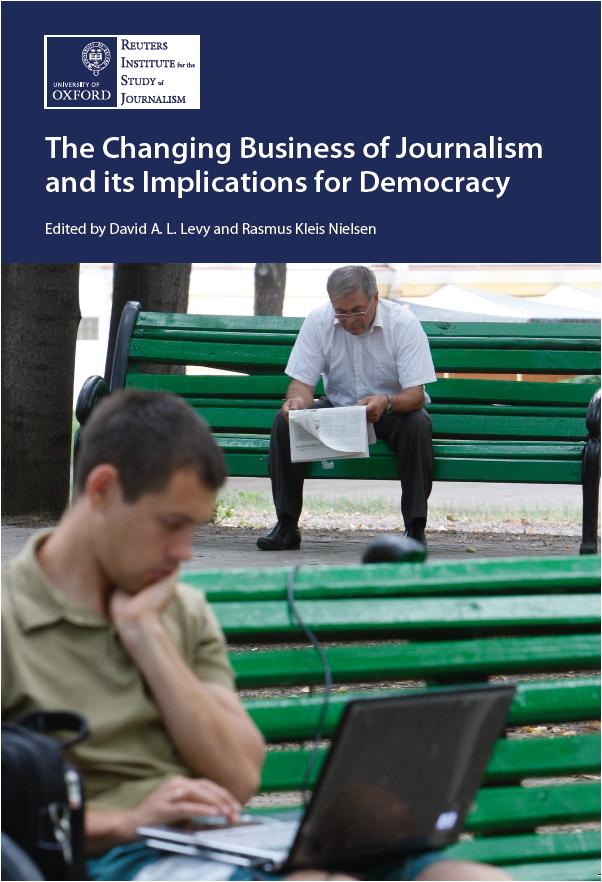
Today we release The Changing Business of Journalism and its Implications for Democracy, a new book David Levy and I have edited. It’s been rushed to publication to address the timely issue of how the commercial media organizations who have for much of the twentieth century dominated news-provision in much of the world are changing, and what it means for our democracies.

There’s already been a bit of advance publicity on the Guardian (which didn’t get it quite right, I have to say, but of course, we are happy with the publicity) and on Journalism.co.uk and the Press Gazette, both of whom did good summaries.

Here is the pretty cover…

Tonight, David, myself, and Robert Picard (one of the contributors to the volume), will speak at a launch event at Ofcom in London, and discuss the book and the main findings with George Brock (City University), Steve Hewlett (BBC/the Guardian), and Natalie Fenton (Goldsmiths, University of London) and moderator Tim Gardam (St Anne’s College, Oxford).

The Executive Summary is available here, and the book can be bought for £19.95, shipping included, here.

In addition to the chapters written by David, Robert, and myself, the book contains interesting contributions by Alice Antheaume (Sciences Po, Paris), Michael Brüggemann (University of Zürich), Frank Esser (University of Zürich), John Lloyd (University of Oxford), Hannu Nieminen (University of Helsinki),  Mauro Porto (Tulane University), Michael Schudson (Columbia University), Daya Kishan Thussu (University of Westminster), and Sacha Wunsch-Vincent (World Intellectual Property Organisation and formerly OECD).

Nicholas Lemann and Paolo Mancini have provided the advance praise, which almost makes me blush…

The Changing Business of Journalism and its Implications for Democracy, as the only rigorous global survey of a situation usually discussed on the basis of anecdote and unproved assertion, is an indispensable and necessary work. It ought to open the way for real progress in reinventing journalism.

Nicholas Lemann, Dean and Henry R. Luce Professor at the Columbia University Graduate School of Journalism

This is a very detailed and rich analysis of the structural changes in today’s business of journalism: the media in many countries face a deep crisis caused both by new technologies and more general economic circumstances while in others they are experiencing rapid growth. In both cases the entire structure of the field is undergoing a dramatic change in terms of professional practice and in how media are organized and run. This book represents an indispensable tool for all those who want to understand where journalism and democracy are going today.

Paolo Mancini, Professor at Università di Perugia and co-author of Comparing Media Systems (Cambridge, 2004).

The full table of content looks as follows:

Contents

Executive summary

1. The Changing Business of Journalism and its
Implications for Democracy
Rasmus Kleis Nielsen and David A. L. Levy

2. A Business Perspective on Challenges Facing Journalism
Robert G. Picard

3. Online News: Recent Developments, New Business
Models and Future Prospects
Sacha Wunsch-Vincent

4. The Strategic Crisis of German Newspapers
Frank Esser and Michael Brüggemann

5. The Unravelling Finnish Media Policy Consensus?
Hannu Nieminen

6. The French Press and its Enduring Institutional Crisis
Alice Antheaume

7. The Press We Destroy
John Lloyd

8. News in Crisis in the United States: Panic – And Beyond
Michael Schudson

9. The Changing Landscape of Brazil’s News Media
Mauro P. Porto

10. The Business of ‘Bollywoodized’ Journalism
Daya Kishan Thussu

11. Which Way for the Business of Journalism?
Rasmus Kleis Nielsen and David A. L. Levy